FDA Research Peptide Compounding Review: What It Is and What It Is Not
The FDA peptide compounding review scheduled for July 23-24, 2026 is a regulatory process about whether certain peptide-related bulk drug substances should be included on the 503A Bulks List. It is not FDA approval of BPC-157, KPV, TB-500, MOTS-c, emideltide/DSIP, Semax, or Epitalon. It is also not proof that those peptides are safe, effective, legal to buy, appropriate to use, or available for any particular person.
That distinction matters because a lot of peptide coverage turns regulatory procedure into access gossip. The Pharmacy Compounding Advisory Committee meeting is more specific and less dramatic than that. FDA is asking an advisory committee to discuss whether particular free-base and acetate forms of seven peptide-related substances should be placed on a list that can matter for certain traditional pharmacy compounding under section 503A.
The short version: FDA staff briefing documents propose not adding all of the reviewed peptide-related substances to the 503A Bulks List. That opposition does not end the process by itself, but it is a serious signal about how FDA reviewers are reading the evidence, product-characterization issues, historical-use record, and safety concerns.
Educational note: This article is for general information only. It is not medical advice, legal advice, dosing guidance, sourcing guidance, purchasing guidance, compounding guidance, or a recommendation to use any peptide.
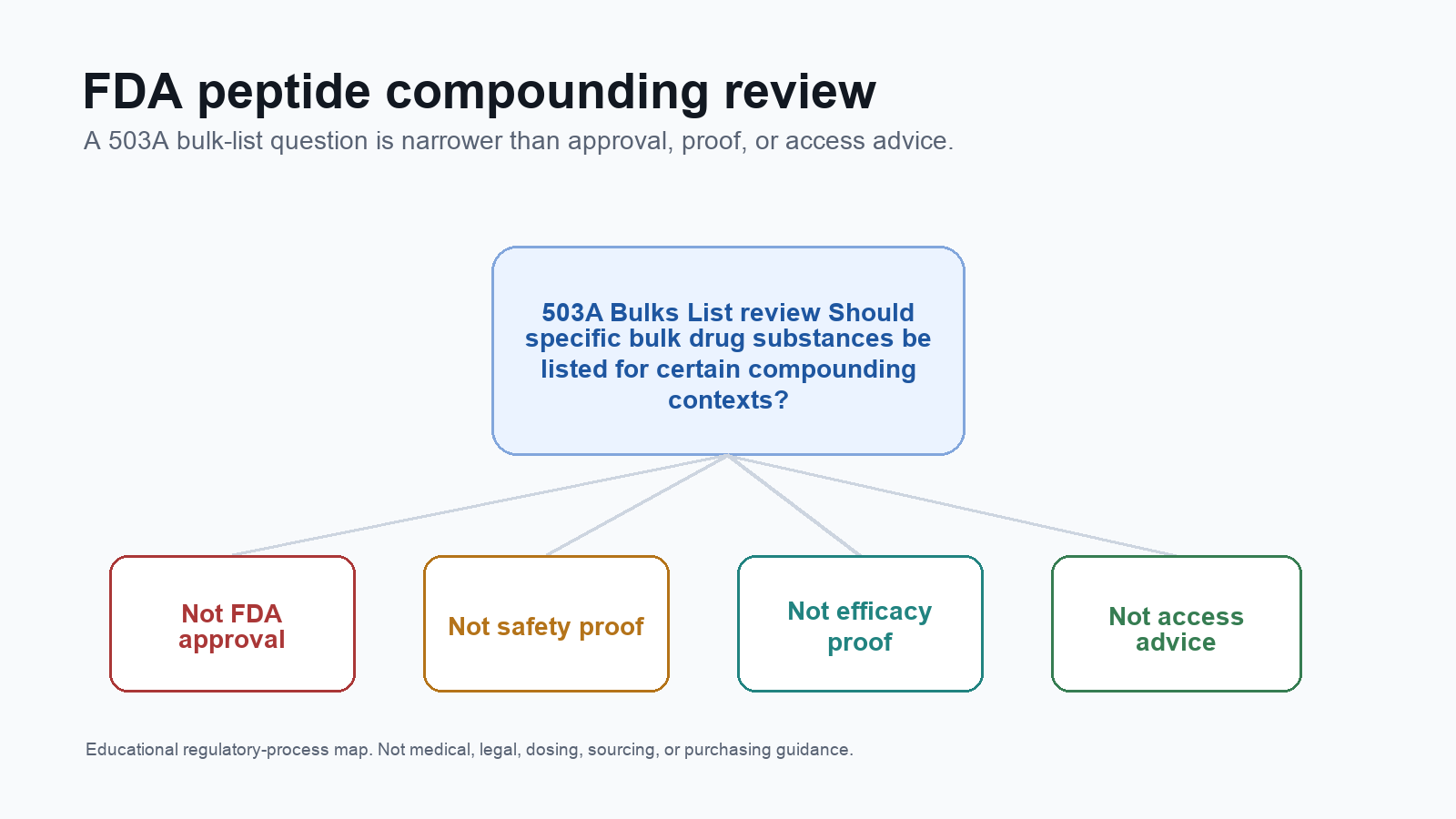 A 503A bulk-list review asks a narrow regulatory question. It does not turn a research peptide into an FDA-approved medicine.
Quick answer: what is the FDA peptide compounding review?
The FDA peptide compounding review is a Pharmacy Compounding Advisory Committee discussion about whether certain nominated bulk drug substances should be included on the 503A Bulks List. FDA's July 2026 meeting materials identify BPC-157-related, KPV-related, TB-500-related, MOTS-c-related, emideltide/DSIP-related, Semax-related, and Epitalon-related bulk drug substances.
For this meeting, FDA says the committee will discuss:
| Meeting date | Substances discussed | Uses FDA says it reviewed | |---|---|---| | July 23, 2026 | BPC-157 free base/acetate | Ulcerative colitis | | July 23, 2026 | KPV free base/acetate | Wound healing and inflammatory conditions | | July 23, 2026 | TB-500 free base/acetate | Wound healing | | July 23, 2026 | MOTS-c free base/acetate | Obesity and osteoporosis | | July 24, 2026 | Emideltide free base/acetate, also called DSIP | Opioid withdrawal, chronic insomnia, and narcolepsy | | July 24, 2026 | Semax free base/acetate | Cerebral ischemia, migraine, and trigeminal neuralgia | | July 24, 2026 | Epitalon free base/acetate | Insomnia |
This is a process article, not a use guide. The reviewed "uses" above are the uses FDA lists in its meeting notice and briefing materials. They should not be read as treatment advice, clinical endorsement, or instructions.
What the 503A Bulks List question actually means
The 503A Bulks List is about whether certain bulk drug substances can be used in some compounded human drug products under section 503A when other conditions are met. It is not the same thing as drug approval.
FDA's introductory briefing document explains that section 503A can exempt qualifying compounded drugs from three major requirements of the Federal Food, Drug, and Cosmetic Act: new drug approval, adequate directions for use labeling, and current good manufacturing practice requirements. One condition concerns what bulk drug substances may be used.
The bulk substance path includes three broad categories:
- a substance that complies with an applicable USP or National Formulary monograph, if one exists
- a substance that is a component of an FDA-approved drug, if no such monograph exists
- a substance that appears on the 503A Bulks List, if neither of those first two paths applies
For nominated substances, FDA says it evaluates criteria such as physical and chemical characterization, safety issues, evidence of effectiveness or lack of effectiveness, and historical use in compounded drug products. FDA describes this as a balancing test, not a popularity contest.
That is the boring part. Unfortunately, the boring part is the part that keeps the internet from turning every regulatory meeting into "the FDA approved my favorite vial." Bureaucracy: occasionally useful, against all odds.
What the review does not mean
A 503A bulk-list review does not mean the peptide is FDA-approved. Approval is a separate process that evaluates a finished drug product for a specific indication, with defined labeling, manufacturing controls, and evidence requirements.
The review also does not mean:
- the peptide is safe for human use
- the peptide is effective for a claimed outcome
- the peptide is appropriate for injection, nasal, topical, or oral use
- the peptide is legal to buy from any source
- the peptide can be compounded in every situation
- a clinic, seller, or influencer claim has been validated
- the reviewed use is a recommendation
It also does not settle the status of every product using a similar name. FDA's briefing documents repeatedly separate free-base and acetate forms, and they discuss concerns around naming conventions, salts, active moieties, impurities, and characterization. In plain English: similar labels do not always mean the same substance, same quality, same risk, or same evidence base.
For a broader explanation of the gap between research language and human-use claims, see Research Use Only Peptides: What That Label Does and Does Not Mean.
Why FDA reviewer opposition matters
FDA staff opposition matters because the briefing documents show the agency's current evidence and safety concerns before the advisory committee discussion. Advisory committee recommendations are non-binding, and FDA says it will not issue a final determination until after the advisory committee process and final reviews. But staff briefing documents still frame the scientific and regulatory record the committee is being asked to discuss.
In the July 2026 introductory briefing document, FDA lists "points to consider" proposing that each reviewed free-base and acetate form NOT be included on the 503A Bulks List. That includes BPC-157, KPV, TB-500, MOTS-c, emideltide, Epitalon, and Semax forms.
FDA's individual briefing documents repeatedly describe similar categories of concern:
- substances not being well-characterized physically or chemically
- unclear or limited historical use in compounding
- lack of evidence, insufficient evidence, or limited evidence for effectiveness
- safety uncertainties, including peptide impurities, aggregation, immunogenicity, route-related issues, and missing human data
- availability of FDA-approved or OTC monograph products for some reviewed conditions
Endpoints News also reported that FDA reviewers recommended against including the seven peptides on the bulk-substances list. The accessible portion of that report aligns with the FDA briefing documents: the staff position is opposition, not endorsement.
The evidence issue: "interesting" is not the same as "proven"
The recurring theme across the FDA documents is not that peptides are biologically impossible or scientifically uninteresting. It is that the available evidence and product-quality record do not satisfy FDA reviewers for this bulk-list question.
That distinction is important. Many of these peptides have mechanistic discussion, preclinical research, foreign-market history, online attention, or small studies attached to them. Those can be worth understanding. They do not automatically become proof of clinical benefit, safety, or product suitability.
For example:
- FDA's BPC-157 briefing document says the criteria weigh against adding BPC-157 free base and BPC-157 acetate, with concerns including characterization, evidence, and immunogenicity risk.
- FDA's KPV briefing document says there is a lack of evidence to evaluate effectiveness and that potential safety risks in humans are unknown.
- FDA's TB-500 briefing document says there is a lack of evidence to evaluate effectiveness and that safety risks in humans are unknown.
- FDA's MOTS-c briefing document says no published studies were found in which drug products containing MOTS-c free base or acetate were used in humans, and that there is a lack of evidence to evaluate effectiveness for the nominated uses.
- FDA's emideltide briefing document says there is insufficient evidence to make conclusions for several reviewed uses.
- FDA's Epitalon briefing document says there is a lack of evidence to support effectiveness for insomnia.
- FDA's Semax briefing document says there is insufficient evidence of effectiveness for the reviewed uses.
For readers, the lesson is simple: preclinical mechanisms, user stories, and confident marketing cannot do the job of relevant human evidence.
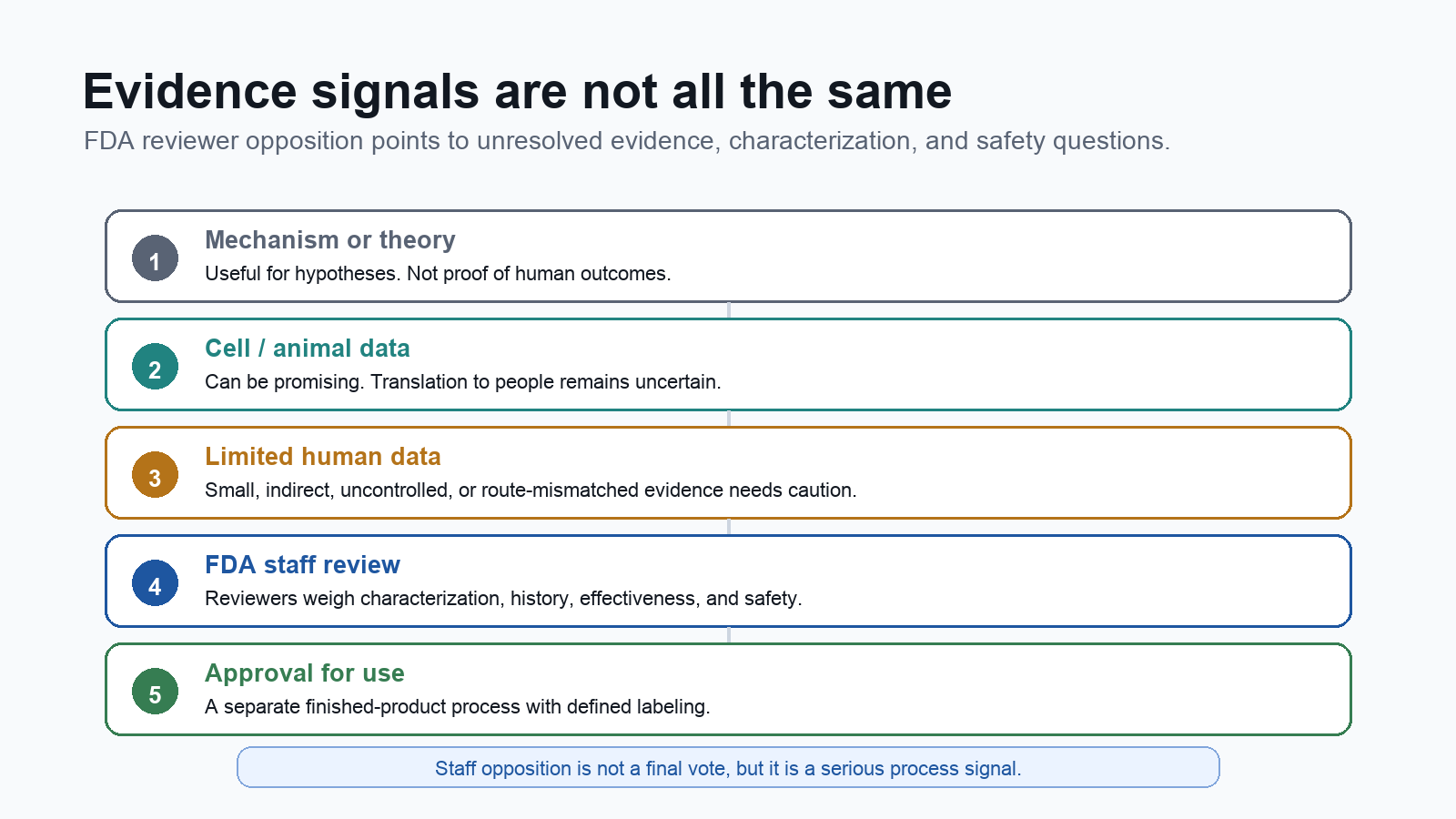 FDA reviewer opposition is mainly an evidence and risk signal. It is not a final advisory vote, but it is not background noise either.
How this affects BPC-157, TB-500, MOTS-c, Epitalon, KPV, Semax, and DSIP conversations
The review should make peptide conversations more precise, not louder. Each peptide has its own evidence profile, but the FDA documents highlight common problems that show up across research-peptide marketing.
For BPC-157, readers should separate the popular recovery narrative from the narrower FDA-reviewed use and the limited human evidence base. PeptideBase's overview of BPC-157 and comparison of BPC-157 and TB-500 together already frame that gap cautiously.
For TB-500, the meeting reinforces why "wound healing" and "repair" claims need careful evidence language. See What Is TB-500? for a fuller evidence-aware profile.
For MOTS-c, the key issue is translating mitochondrial and metabolic theory into human outcomes. See What Is MOTS-c?.
For Epitalon, the review connects directly to the sleep/longevity evidence gap. See What Is Epitalon?.
For KPV, Semax, and emideltide/DSIP, the same caution applies even where PeptideBase does not yet have a dedicated profile page: exact substance, route, formulation, evidence quality, and regulatory context matter more than the online nickname.
Why this is not an access guide
This article does not tell readers how to obtain, compound, prescribe, dose, or use any peptide. That is intentional.
A bulk-list meeting can affect how regulators think about certain compounding pathways, but turning that into personal access advice would be sloppy and unsafe. The legal and clinical facts depend on the product, jurisdiction, pharmacy, prescriber, intended use, route, formulation, and final FDA decisions. This article is not legal advice, and it is not clinical advice.
The more useful question for a reader is not "Can I get it?" It is "What exactly is being reviewed, what evidence is missing, and what conclusions should I avoid drawing?"
For that broader evidence-literacy framework, read How to Evaluate Peptide Claims Online, Peptide Therapy Explained, and What Preclinical Actually Means.
A practical way to read FDA peptide news
The safest way to read this FDA review is as a process signal, not a permission slip. When you see posts about the July 2026 meeting, ask five questions:
- Is the source talking about a bulk drug substance, a finished drug product, a supplement, or a research-only product?
- Is the claim about an advisory discussion, a staff recommendation, a final FDA determination, or FDA approval?
- Is the article separating free-base, acetate, salt, ester, and active-moiety issues?
- Is the evidence human clinical evidence for the exact reviewed use, or is it preclinical/mechanistic discussion?
- Is the source drifting into dosing, sourcing, treatment, or access advice?
If the answer to those questions is fuzzy, the coverage is probably moving faster than the evidence.
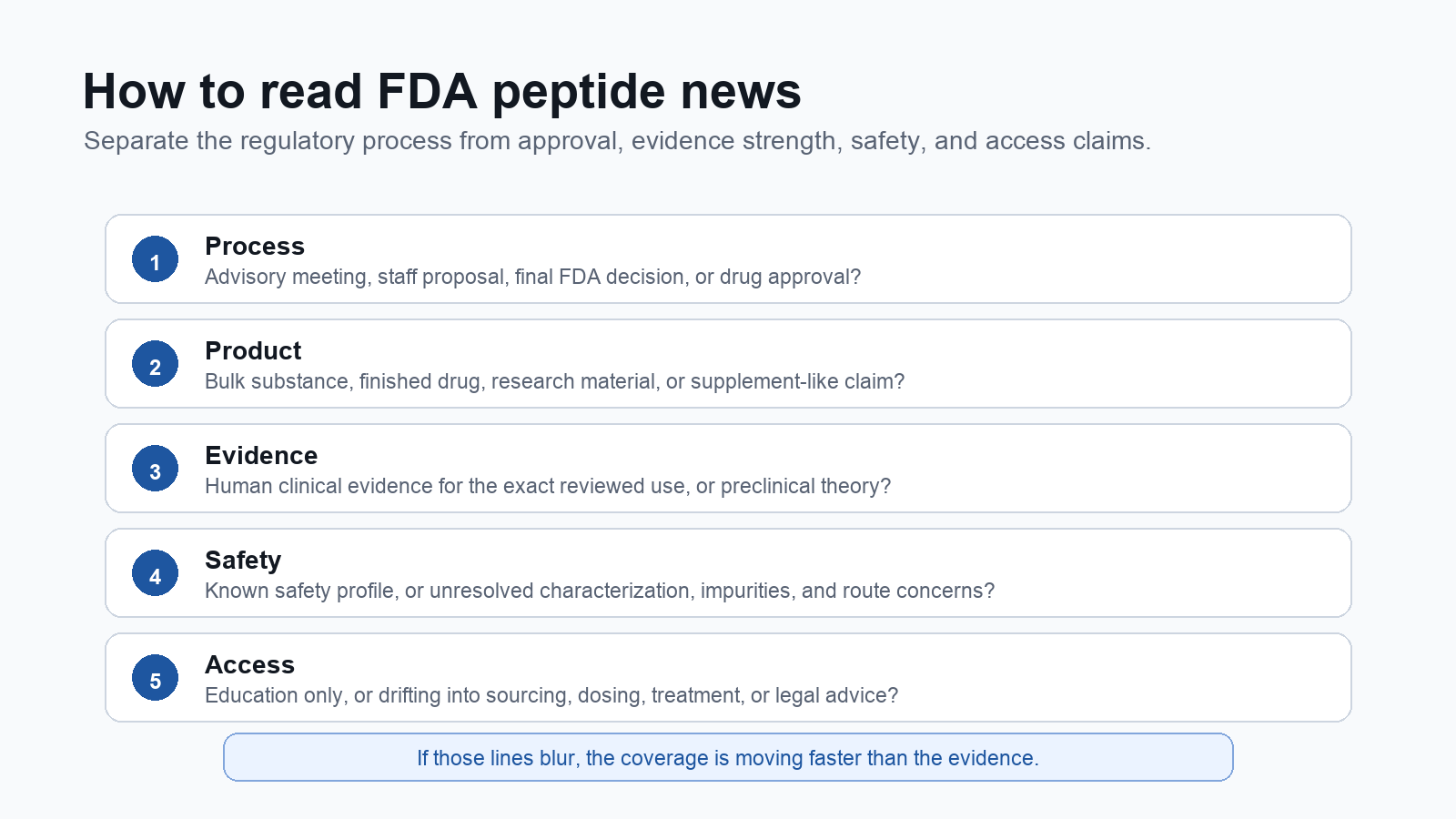 Read peptide regulatory news by separating process, product status, evidence strength, safety questions, and access claims.
Bottom line
The FDA peptide compounding review is important, but its meaning is narrow. It is a July 2026 advisory committee process about whether seven peptide-related bulk drug substances, in specific free-base and acetate forms, should be included on the 503A Bulks List.
FDA briefing materials propose not adding all of them. That staff opposition matters because it reflects reviewer concerns about characterization, historical compounding use, effectiveness evidence, and safety uncertainties. But it is not the same as a final FDA decision.
Most importantly, the review is not FDA approval. It is not proof of safety. It is not proof of efficacy. It is not a buying guide. It is not a treatment protocol.
The right takeaway is evidence literacy: understand the exact regulatory question, read the staff concerns directly, and do not let peptide marketing turn a procedural review into a medical claim.
FAQ
Does the FDA peptide compounding review mean these peptides are FDA-approved?
No. The review concerns whether certain bulk drug substances should be included on the 503A Bulks List. FDA approval of a finished drug product for a specific indication is a different process.
Which peptides are in the July 2026 review?
FDA's meeting page lists BPC-157-related, KPV-related, TB-500-related, MOTS-c-related, emideltide/DSIP-related, Semax-related, and Epitalon-related bulk drug substances, including free-base and acetate forms.
Did FDA reviewers support adding the peptides to the 503A Bulks List?
No. FDA's introductory briefing document lists staff proposals that each reviewed free-base and acetate form not be included on the 503A Bulks List.
Does staff opposition end the process?
No. Advisory committees provide non-binding advice, and FDA says it does not intend to issue a final determination until after the advisory committee process and final reviews. Staff opposition is still an important signal.
The post-meeting analysis of the advisory-panel vote explains why support for six peptide groups and rejection of emideltide/DSIP remained non-binding and did not approve any finished drug product.
Does this review prove the peptides are unsafe?
No. It does not prove a universal safety conclusion for every possible product or context. It does show that FDA reviewers identified unresolved safety and characterization concerns for the bulk-list question.
Is this article legal or medical advice?
No. This article is educational only. It does not provide legal advice, medical advice, dosing guidance, sourcing guidance, purchasing guidance, or treatment recommendations.