Research Use Only Peptides: What That Label Does and Does Not Mean
A cautious explainer on research use only peptides, what RUO labeling is meant to signal, and why it does not prove safety, legality, sterility, or suitability for human use.
Research Use Only Peptides: What That Label Does and Does Not Mean
Research use only peptides are products labeled for laboratory or research purposes, not for human consumption or treatment. The label can be a real boundary marker in legitimate research supply chains, but it is not a safety certificate, a legal shield, or proof that a product is appropriate for injection.
That distinction matters because the phrase appears in very different places. In a controlled lab context, "research use only" can signal that a material is not intended for clinical, diagnostic, or therapeutic use. Online, the same kind of wording can also appear beside products that are discussed with human-use clues, wellness claims, body-composition language, or injection-adjacent packaging.
This guide explains what the label is meant to communicate, why it does not settle safety or legality questions, and how regulators discuss unauthorized injectable peptides and products marketed with "not for human consumption" disclaimers.
Educational note: This article is for general information only. It is not medical advice, legal advice, sourcing guidance, dosing guidance, or a recommendation to buy or use peptides.
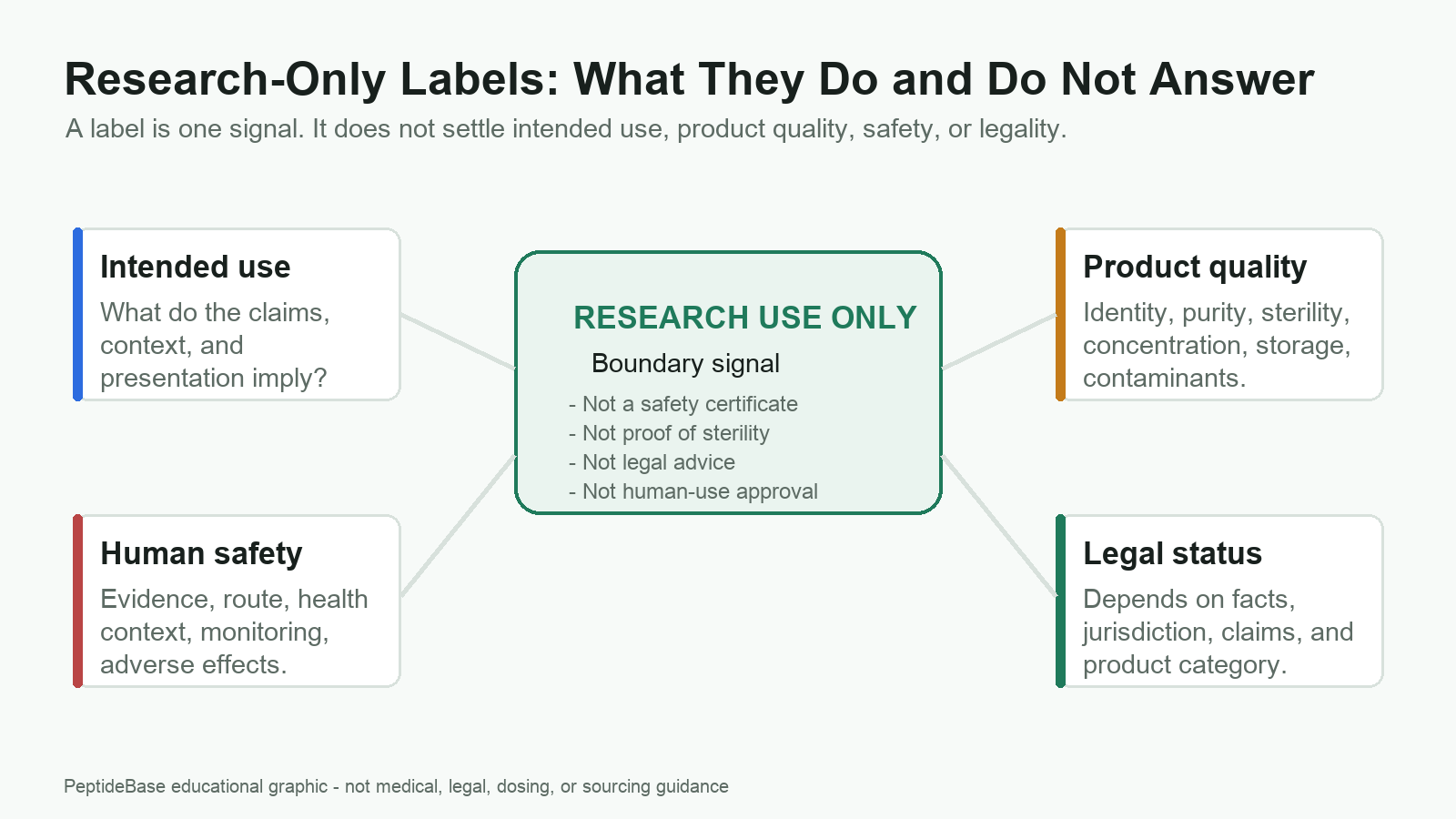 A research-only label is one signal. It does not answer the separate questions of intended use, product quality, safety, or legality.
Quick answer: what does research use only mean on peptides?
In plain English, a research use only label means the seller is representing the product as intended for research rather than human or veterinary use. For peptides, that usually means the product should not be treated as a medicine, supplement, injectable therapy, or self-experimentation tool.
The important part is what the label does not do:
- It does not prove the peptide is safe.
- It does not prove the peptide is sterile or suitable for injection.
- It does not prove the product contains what the label says it contains.
- It does not make human-use marketing disappear.
- It does not mean the product is lawful for a particular human use.
- It does not replace medical, regulatory, or quality review.
The label is a boundary. It is not a blessing.
Where RUO labeling comes from
Research-use labeling is most formally discussed in laboratory and diagnostic-product regulation. For example, FDA guidance for in vitro diagnostic products explains when products are properly labeled for research use only or investigational use only. The eCFR language for certain in vitro diagnostic products includes the statement "For Research Use Only. Not for use in diagnostic procedures."
That formal context is not the same thing as an online peptide product page. A vial of a peptide sold to the public under a "research use only" banner is not automatically covered by the same assumptions as a reagent distributed inside a controlled laboratory workflow.
Still, the underlying idea is useful: RUO labeling is supposed to limit intended use. It tells the reader the product is not being presented as a clinical diagnostic tool, approved medicine, or treatment product.
For peptides, that should push the reader toward caution. If the seller says the product is research-only, the product should not be interpreted as a consumer health product just because the surrounding internet conversation talks about recovery, fat loss, skin, hormones, or anti-aging.
Why the label does not prove safety
A research use only peptide label does not prove the product is safe for people. Safety depends on the exact compound, purity, identity, contaminants, route of exposure, dose, formulation, sterility, storage, health context, and evidence base.
RUO language does not answer those questions. It may actually mean the opposite of what some buyers assume: the product is not being supplied as something that has gone through the review, manufacturing controls, labeling, and monitoring expected for an approved human-use product.
This is especially important for injectable products. FDA has warned that injectable drug products can pose serious harm because they bypass some of the body's usual defenses against toxins and microorganisms. That point is not peptide-specific hype. It is a basic route-of-exposure issue.
The same molecule can carry different risk depending on whether it is an approved medicine, a properly compounded product under applicable rules, a research material, a mislabeled product, or an unknown powder from a casual online source. The label alone does not tell you which risk category you are really looking at.
For broader risk framing, read Peptide Side Effects: What's Known, What's Unknown, and What People Overstate.
Why the label does not prove legality for human use
RUO does not mean "legal to use in humans." It means the product is being labeled or represented for research use. Whether a product is lawful for a specific human use depends on the product, claims, intended use, jurisdiction, prescribing context, compounding rules, approval status, and many other facts.
This article is not legal advice, and it should not be used to decide whether a product, clinic, website, or personal plan is lawful. The safe educational point is narrower: a disclaimer does not automatically control the regulatory story.
FDA warning letters illustrate why. In recent enforcement letters involving peptide or GLP-1-related products, FDA has pointed to situations where websites used phrases like "research use only," "not for human consumption," or similar disclaimers, while the agency still described the products as unapproved or misbranded drugs based on the broader evidence of intended human use.
That is the core lesson: regulators do not have to read the front label in isolation. Claims, context, product presentation, website language, and use cues can matter.
Intended use matters more than a magic phrase
The phrase "research use only" is sometimes treated online like a magic spell. It is not. Intended use can be inferred from more than a disclaimer.
Human-use signals may include:
- claims about treating, mitigating, curing, preventing, or improving health conditions
- body-composition, recovery, libido, hormone, skin, or anti-aging promises
- customer-facing language that implies personal use
- injection-adjacent accessories, instructions, or bundled items
- before/after narratives or testimonial framing
- product names, categories, and site structure that point toward consumer use
- comparisons to prescription drugs or therapeutic outcomes
Not every mention of a biological effect is illegal or unsafe by itself. Context matters. But the practical reading lesson is simple: if a website says "research only" while the rest of the page nudges readers toward human outcomes, the disclaimer should not be treated as the final answer.
That is why PeptideBase separates claim evaluation from compound hype. See How to Evaluate Peptide Claims Online for a broader checklist.
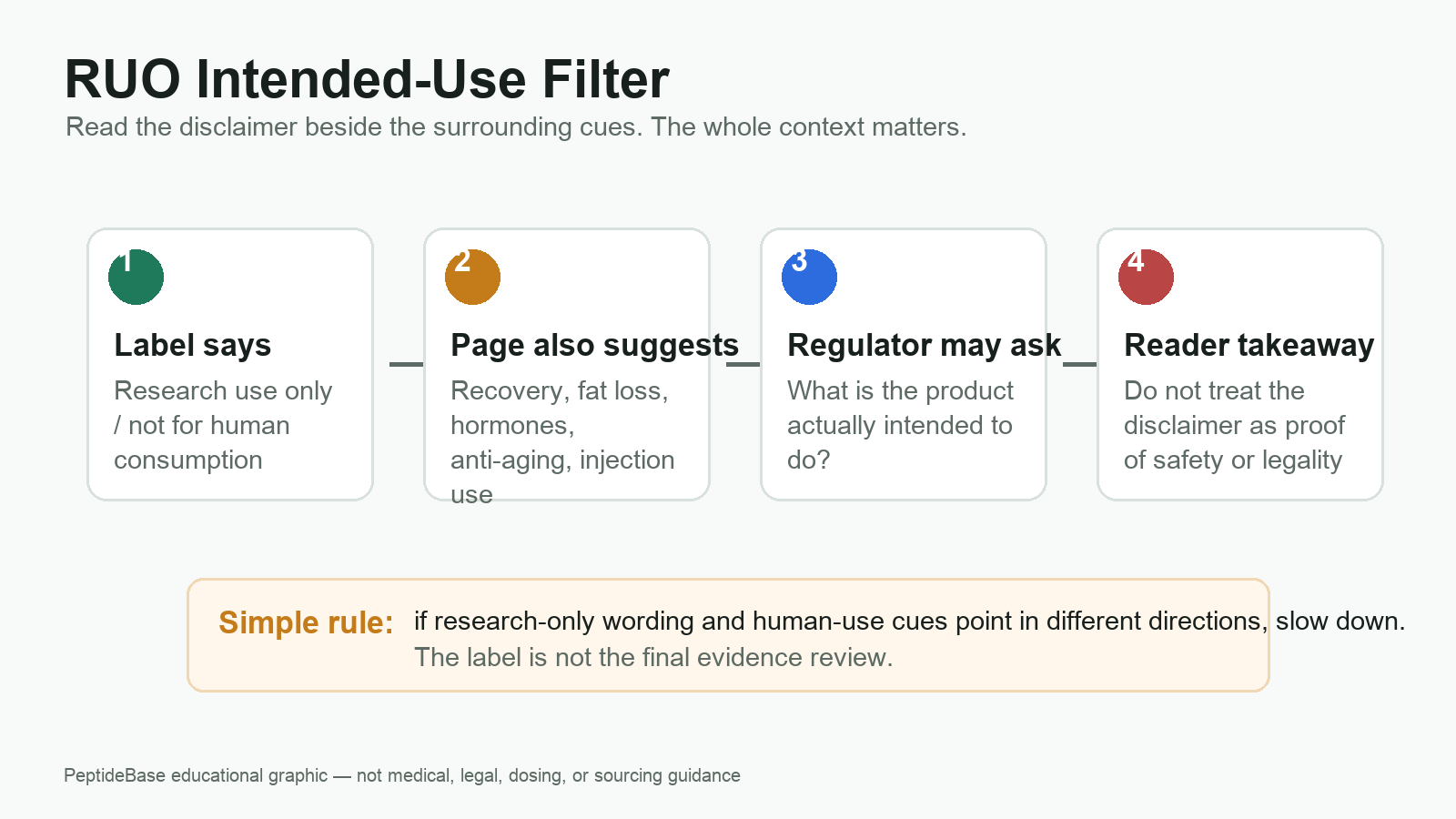 When the disclaimer and the surrounding use cues point in different directions, the label alone does not settle the question.
RUO peptides are not the same as approved peptide medicines
Peptides are a molecular category, not a regulatory status. Some peptide-based medicines are approved drugs for specific indications. Other peptides are research compounds, cosmetic ingredients, compounded products, or products marketed through gray areas.
That is why "peptide" and "research use only peptide" should not be blended together as if they mean the same thing.
An approved peptide-based medicine may have:
- defined indications
- regulated labeling
- manufacturing controls
- clinical trial evidence for specific uses
- known contraindications and adverse-event information
- professional prescribing and monitoring expectations
A research-use-only peptide product may have none of that for human use. It may be interesting to researchers without being established as safe or effective for a person trying to achieve a health outcome.
For a related distinction, read GLP-1 Peptides vs Research Peptides and Peptide Therapy Explained.
Why injectable research peptides raise extra concern
Injectable products raise a different risk profile than topical, oral, or purely analytical lab materials. Injection can introduce sterility, concentration, storage, contamination, dosing-error, and tissue-injury concerns.
For research use only peptides, the problem is not just "what does the peptide do?" It is also:
- Was the identity verified?
- Is the concentration accurate?
- Is the product sterile?
- Was it stored correctly?
- Are degradation products known?
- Are contaminants present?
- Is the route being discussed supported by human evidence?
- Are users interpreting animal or mechanistic findings as clinical proof?
Those are product-quality and evidence questions, not vibes. A neat label cannot answer them.
FDA's concerns about unapproved GLP-1 drug products make the same general quality point: unapproved versions do not go through FDA review for safety, effectiveness, and quality before marketing. GLP-1 drugs are not the same category as all research peptides, but the quality-control lesson travels well.
How to read "not for human consumption"
"Not for human consumption" is a warning, not a loophole for personal use. It should make a health-curious reader more cautious, not more confident.
The phrase usually tells you that the seller is not offering the product as food, a supplement, a medicine, or a treatment. It does not mean the product is secretly safe if you ignore the warning. It also does not erase human-use intent if the surrounding marketing says otherwise.
Treat these phrases as stop signs:
- "for research use only"
- "not for human consumption"
- "lab use only"
- "not intended to diagnose, treat, cure, or prevent disease"
- "not for medical or veterinary use"
Those statements may be legally meaningful in context, but for a reader they are simpler than that: the product is not being represented as a human-use health product. Do not upgrade it in your head because a forum, influencer, or product category makes it sound familiar.
A practical claim-evaluation checklist
You do not need to become a regulatory lawyer to read RUO peptide claims more carefully. You need to separate the label from the rest of the evidence.
Ask:
- What exact peptide is being discussed? Generic "research peptide" language is not enough.
- What does the label actually say? Research-only language should not be treated as human-use permission.
- What does the surrounding page imply? Claims, categories, accessories, and comparison language can matter.
- Is the product approved for the use being discussed? Approved status is specific, not vibes-based.
- Is human evidence available for the exact claim? Mechanism and animal data are not the same as clinical proof.
- Is injection being implied or described? Route changes the risk conversation.
- What quality controls are documented? Purity claims are not the same as regulated manufacturing.
- Does the page avoid dosing, sourcing, and treatment claims? If not, the RUO label may be doing suspiciously heavy lifting.
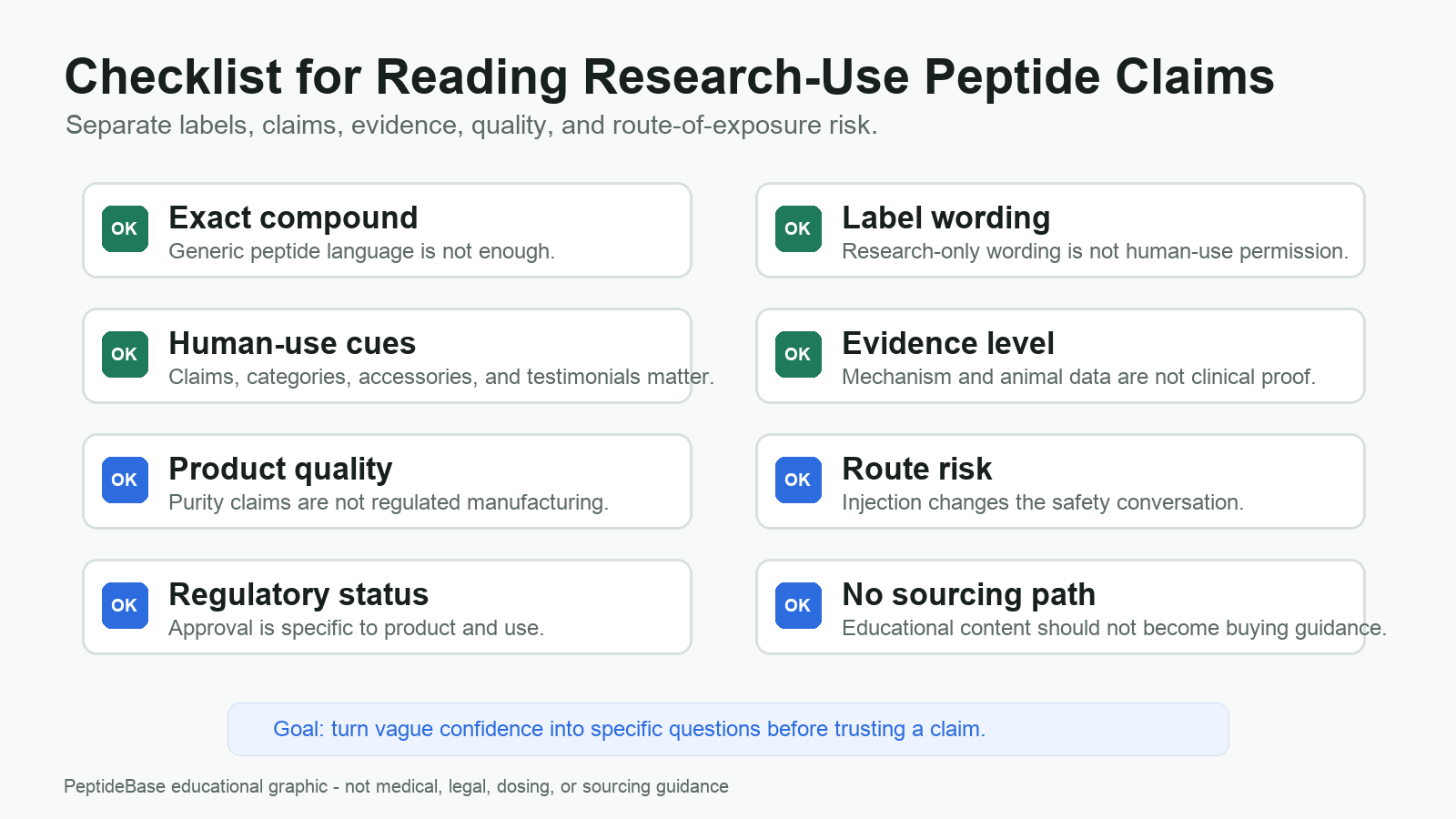 A cautious reader separates the label, intended use cues, human evidence, product quality, and route-of-exposure risk.
What PeptideBase does with RUO topics
PeptideBase treats RUO labeling as a trust-and-safety topic, not a buying topic. That means we do not provide sourcing routes, vendor comparisons, reconstitution steps, injection instructions, dosing schedules, or personal-use protocols.
Our editorial focus is narrower:
- explain what the label is meant to signal
- separate approved medicines from research products
- identify where marketing language outruns evidence
- explain why product quality and intended use matter
- connect readers to risk and claim-evaluation frameworks
Useful next reads:
- How to Evaluate Peptide Claims Online
- Peptide Therapy Explained
- Peptide Side Effects
- Peptide Research Status Explained
- What Preclinical Actually Means
Bottom line
Research use only peptides should be understood as research-labeled products, not consumer health products. The label may be meaningful, but it does not prove safety, sterility, identity, legality for human use, or clinical usefulness.
The safest way to read the label is conservatively. If a product says it is for research only, do not treat it as a shortcut to peptide therapy. If a website says research-only while implying human outcomes, do not let the disclaimer do all the trust work.
The question is not "does the page have the right phrase?" The question is whether the exact product, exact claim, intended use, evidence base, quality controls, route, and regulatory status all support the confidence being sold.
Usually, that is where the marketing gets a lot quieter.
FAQ
Are research use only peptides safe?
The label does not prove safety. Safety depends on the exact peptide, product quality, route, formulation, evidence base, health context, and regulatory status. A research-only label should not be treated as proof that a product is safe for people.
Does RUO mean a peptide is legal for human use?
No. RUO labeling means the product is being represented for research use, not that it is lawful for human use. Legality depends on specific facts and jurisdiction. This article is educational and not legal advice.
Why do peptide websites say not for human consumption?
The phrase usually signals that the product is not being sold as a food, supplement, medicine, or treatment. It should be read as a warning, not as a hidden permission slip for personal use.
Can a research-only disclaimer be ignored if people online discuss using the peptide?
No. Online anecdotes do not change the product's labeling, quality status, approval status, or evidence base. They may create more questions, but they do not turn a research product into an approved human-use product.
What does FDA say about unauthorized injectable peptides?
FDA warning letters have described concerns around unapproved peptide or GLP-1-related products, including situations where websites used research-only or not-for-human-consumption language while other evidence indicated intended human use. FDA has also emphasized that injectable products can pose serious risks because they bypass some normal body defenses.
Is this article telling me whether a specific peptide product is legal?
No. This is a general educational explainer. It does not evaluate specific products, sellers, clinics, purchases, prescriptions, or legal situations.