How to Evaluate Peptide Claims Online
Peptide claims online often sound more certain than the evidence behind them. A compound can be described as "healing," "fat-burning," "anti-aging," "neuroprotective," or "clinically proven" when the actual support is a cell study, an animal model, a small early human trial, a mechanistic theory, or a testimonial thread with the scientific rigor of a group chat during a power outage.
This guide gives you a practical way to evaluate peptide claims without needing to become a biochemist. The goal is not to make every reader cynical. It is to make readers harder to manipulate.
Educational note: This article is for general information only. It is not medical advice, treatment guidance, dosing guidance, purchasing guidance, or a recommendation to use any peptide.
Quick answer: how do you evaluate peptide claims online?
To evaluate peptide claims online, ask five questions:
- What kind of evidence supports the claim? Human trial, animal study, cell study, mechanism, anecdote, or marketing copy?
- What exactly was studied? The same compound, form, route, population, and outcome — or something adjacent?
- How strong is the human evidence? Large, controlled, replicated, and relevant — or small, indirect, and early?
- What does the claim leave out? Side effects, unknowns, product quality, regulatory status, failed studies, or uncertainty?
- Who benefits if you believe it? Education site, clinic, seller, affiliate, influencer, or someone trying to sound smarter than the data?
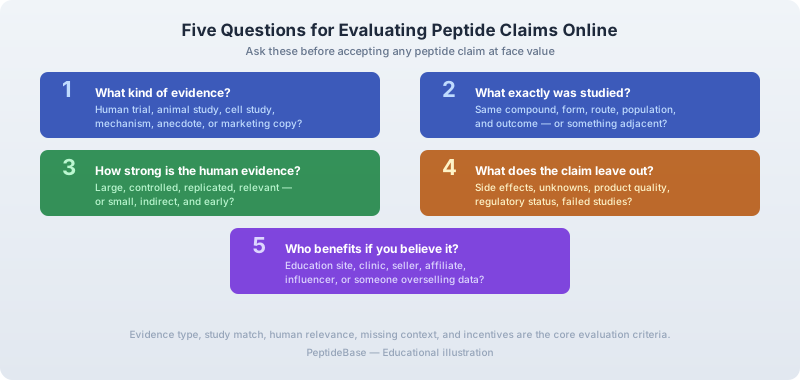 A peptide claim gets easier to judge when you separate evidence type, study match, human relevance, missing context, and incentives.
The most reliable peptide content separates preclinical signals, mechanistic theory, early human findings, better human evidence, and unknowns. The least reliable content blends those categories into one confident paragraph and hopes you do not notice the seams.
Why peptide claims are easy to exaggerate
Peptides sit in a perfect hype zone. Many of them are biologically interesting. Some have legitimate medical uses in specific forms or contexts. Others are mostly research compounds, preclinical ideas, or online wellness trends. That mix makes it easy for weak claims to dress up as science.
A peptide may interact with a pathway that sounds impressive: growth hormone signaling, tissue repair, inflammation, appetite regulation, mitochondrial function, pigmentation, or immune activity. But a pathway is not an outcome. "Influences X pathway" does not automatically mean "safely produces Y result in humans." Biology is rude that way. It keeps refusing to be a straight line.
The most common exaggeration is translation drift:
- a cell study becomes "supports healing"
- an animal study becomes "repairs injuries"
- a short trial becomes "clinically proven"
- a mechanism becomes "works by optimizing"
- a testimonial becomes "real-world evidence"
- lack of reported side effects becomes "safe"
Each step sounds small. Add them together and suddenly a cautious research signal has become a sales page wearing a lab coat.
Step 1: Identify the evidence level
The first move is to classify the evidence. Do not start by asking whether the claim sounds plausible. Start by asking what kind of support it has.
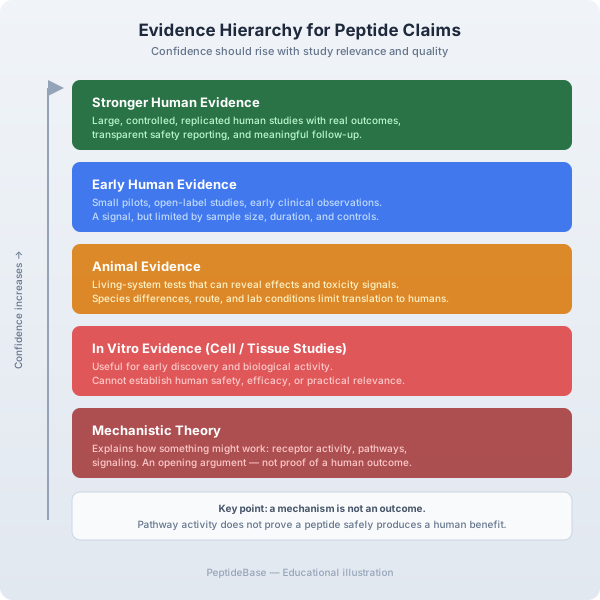 Mechanisms and preclinical signals can be useful, but they should not be read like mature human evidence.
Mechanistic theory
Mechanistic claims explain how something might work: receptor activity, signaling pathways, gene expression, inflammation markers, tissue remodeling, cell migration, hormone release, or metabolic effects. Mechanisms are useful because they suggest possible directions for research.
But mechanisms do not prove outcomes. A mechanism can be real and still fail to produce a meaningful benefit in humans. It can also produce different effects depending on dose, route, duration, tissue, disease state, and individual context. Mechanism is the opening argument, not the verdict.
In vitro evidence
In vitro research happens in cells, tissues, or lab systems outside a whole human body. It can show biological activity under controlled conditions. It is often useful for early discovery.
It cannot tell you whether a peptide is safe, effective, practical, or meaningful in people. Cells in a dish do not have kidneys, habits, medications, sleep debt, or a suspicious supplement stack from Reddit.
Animal evidence
Animal studies can be stronger than cell studies because they involve living systems. They can reveal biological effects, toxicity signals, and possible mechanisms that are worth exploring.
They still do not prove human outcomes. Species differences, study design, injury models, route, dose, duration, and controlled lab conditions all matter. A peptide helping a mouse model is not the same thing as a proven human intervention; what preclinical actually means is that such findings can justify further study without establishing clinical benefit or safety.
Early human evidence
Early human studies are important, but they can still be limited. A small pilot trial, open-label study, uncontrolled observation, or narrow clinical context may suggest a signal without proving broad safety or usefulness.
Look for control groups, randomization, blinding, sample size, duration, endpoints, adverse-event tracking, and whether the population matches the claim being made online.
Better human evidence
Stronger evidence usually means larger, controlled, replicated human studies with relevant outcomes, transparent methods, meaningful follow-up, and honest safety reporting. Even then, the conclusion should match the exact studied context.
A peptide can have evidence for one medical use, formulation, or population without that evidence applying to every wellness claim attached to its name.
Step 2: Check whether the studied thing matches the claim
A surprisingly large number of peptide claims rely on a bait-and-switch. The study may involve a related molecule, a different fragment, a different route, a topical preparation rather than systemic exposure, an animal model rather than humans, or a medical population unlike the people reading the claim.
Ask:
- Was the exact peptide studied?
- Was it the same form or analog?
- Was it studied in humans?
- Was the route comparable?
- Was the duration comparable?
- Was the outcome the same as the claim?
- Was the population relevant?
- Was the product quality controlled?
This matters for pages about compounds such as BPC-157 or TB-500, where online discussion often blends mechanistic, animal, human, and product-market claims into one pile. A pile is not an evidence hierarchy. It is just a pile.
Step 3: Look for outcome inflation
Outcome inflation happens when modest findings are described as bigger than they are. A study may show a marker changed, but the article claims a person will feel better. A model may show tissue signaling, but the post claims injury repair. A trial may measure appetite-related biomarkers, but the headline promises weight loss transformation.
Useful questions:
- Did the study measure the outcome people care about?
- Was the endpoint clinical, subjective, mechanistic, or surrogate?
- Was the effect large enough to matter?
- Was it compared against placebo or standard care?
- Did the study track adverse effects and dropouts?
- Was the conclusion cautious, while the article is aggressive?
Surrogate markers are especially easy to hype. A marker can move in the "right" direction without producing a meaningful real-world outcome. Markers are clues. They are not the whole detective novel.
Step 4: Notice what is missing
Weak peptide content often fails by omission. It may not say anything false in one sentence, but it leaves out enough context that the reader walks away with a distorted picture.
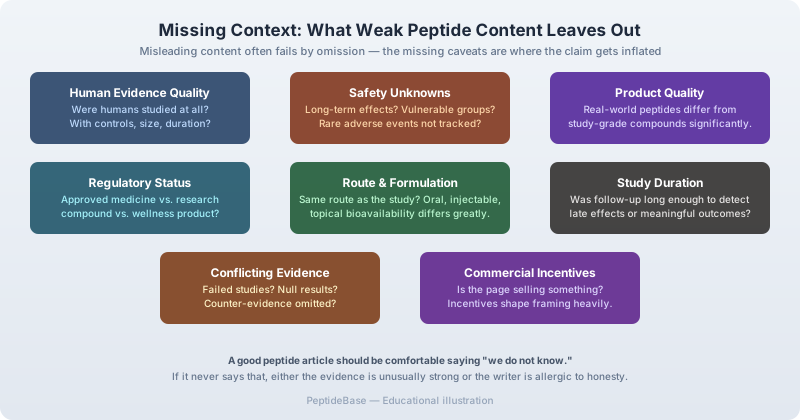 Weak content often misleads by omission: the missing caveats are where the claim gets inflated.
Watch for missing discussion of:
- human evidence quality
- side effects and unknowns
- long-term safety
- product quality and verification limits
- regulatory status
- study size and duration
- route and formulation
- conflicting or absent evidence
- whether claims come from animal or cell studies
- commercial incentives
A good peptide article should be comfortable saying "we do not know." If an article never says that, either the evidence is unusually strong or the writer is allergic to honesty. In peptide content, assume the second possibility until proven otherwise.
Step 5: Separate education from recommendation
Educational content explains evidence and uncertainty. Recommendation content tells readers what to do, what to use, what to combine, what to buy, or how to run a protocol. Those are different categories.
A trustworthy educational page should not need to push readers toward a product decision. It can explain why a peptide is discussed, what the evidence suggests, what remains uncertain, and what questions a reader should ask a qualified professional.
Be more cautious when an article:
- ranks "best peptides" without clear evidence standards
- gives dosing or protocol language in a supposedly educational piece
- links directly into buying funnels
- turns weak evidence into confident recommendations
- treats side effects as a small legal footnote
- uses "research-backed" without saying what kind of research
This does not mean commercial sites are always wrong or noncommercial pages are always good. Incentives are not automatic guilt. They are context. Context is where the bodies are buried.
Step 6: Read safety claims with extra skepticism
Safety claims deserve a higher bar than benefit claims because absence of evidence is often mistaken for evidence of absence. "No major side effects reported" may mean a compound is well tolerated in a narrow setting. It may also mean few people were studied, follow-up was short, adverse events were not carefully tracked, or real-world products differ from study materials.
For any peptide safety claim, ask:
- How many humans have been studied?
- For how long?
- In what population?
- With what route and formulation?
- Were adverse events actively monitored?
- Were rare or delayed effects even detectable?
- Does the article discuss vulnerable groups?
- Does it separate product-quality risk from molecule-level risk?
This is especially important for side-effect pages and recovery-peptide topics. A peptide can have a short list of reported issues because it is safe, because the evidence base is thin, or because no one is collecting the data properly. Those are very different stories.
Step 7: Use a simple claim-strength scale
You do not need a PhD to sort claims. A simple scale works:
Stronger claim
A claim is stronger when it is supported by relevant, controlled human evidence, measured real outcomes, enough participants, meaningful duration, transparent safety reporting, and replication or consistency across studies.
Moderate claim
A claim is moderate when there is some human evidence, but it is small, early, narrow, indirect, or not yet replicated. The wording should be cautious.
Weak claim
A claim is weak when it mostly relies on animal studies, cell studies, mechanism, testimonials, or extrapolation from related compounds.
Speculative claim
A claim is speculative when it sounds plausible but lacks direct evidence for the outcome, population, route, or use being discussed.
Most online peptide claims are weaker than they sound. That does not make them automatically false. It means the confidence should be turned down. Think dimmer switch, not light switch.
Red flags in peptide content
Here are common warning signs:
- "clinically proven" with no human trial details
- "no side effects" or "completely safe"
- "works for everyone" language
- animal evidence presented as human proof
- mechanisms presented as outcomes
- testimonials used as primary evidence
- no mention of dose, route, or formulation in the evidence discussion
- certainty around long-term safety without long-term data
- "doctor recommended" with no transparent reasoning
- aggressive affiliate or purchase links
- no discussion of uncertainty
- no distinction between approved medicines and research peptides
- stacked claims that cover healing, fat loss, sleep, cognition, recovery, skin, and longevity all at once
A peptide that supposedly improves everything usually deserves the same look you give a restaurant with 14 cuisines on the menu. Something weird is happening in the kitchen.
Green flags in peptide content
Better peptide content usually does the opposite:
- names the evidence level clearly
- separates human evidence from animal and in vitro evidence
- explains what was actually studied
- keeps claims proportional
- discusses unknowns and limitations
- avoids dosing, sourcing, or protocol advice in educational articles
- distinguishes approved uses from off-label, research, or wellness claims
- explains safety uncertainty without fearmongering
- links to related evidence-interpretation pages
- updates claims when better evidence appears
The best content often sounds less exciting because it refuses to sell certainty it does not have. That is not boring. That is the point.
A practical checklist before you trust a peptide claim
Before you accept a peptide claim, run this checklist:
- Claim: What exactly is being promised?
- Evidence: Is support human, animal, cell, mechanism, anecdote, or marketing?
- Match: Does the study match the peptide, route, population, and outcome?
- Size: Was the study large enough to mean much?
- Duration: Was follow-up long enough to detect useful effects or risks?
- Safety: Are adverse effects and unknowns discussed honestly?
- Context: Is regulatory status clear without being overplayed?
- Incentive: Is the page educational, commercial, affiliate-driven, or recommendation-like?
- Language: Does the certainty match the evidence?
- Missing pieces: What would you need to know before taking the claim seriously?
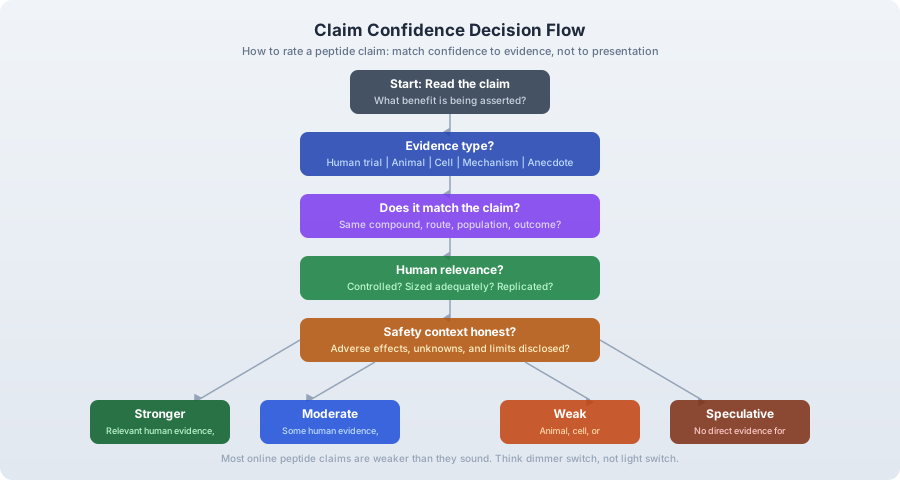 The goal is not to declare every claim false; it is to match confidence to the strength of the evidence.
If a claim fails several of these checks, do not treat it as settled. Treat it as a claim that needs better support.
How this applies to common peptide topics
For a compound profile, such as an overview of BPC-157 or TB-500, look for clear separation between what the peptide is, why it is discussed, what evidence exists, and what remains uncertain.
For a comparison page, such as BPC-157 vs TB-500, check whether the article compares evidence quality and uncertainty, not just theoretical benefits.
For a recovery-peptide guide, watch for recommendation language. A responsible page can explain why peptides are discussed for recovery without ranking compounds as if the evidence were settled.
For a safety page, look for humility. The best safety writing does not pretend unknowns are comforting. It explains why unknowns matter.
Bottom line
The easiest way to evaluate peptide claims online is to slow the claim down. Identify the evidence level, check whether the studied thing matches the claim, look for outcome inflation, notice what is missing, and read safety claims with extra skepticism.
A good peptide article should make you more informed, not more impulsive. If the content pushes certainty faster than the evidence can support it, step back. The science may still be interesting. The marketing just got there first.