Peptide Therapy Explained: What Clinics Mean, What’s Evidence-Based, and What’s Marketing
“Peptide therapy” sounds precise, but in clinics and online marketing it can mean several very different things. Sometimes people are talking about approved peptide-based medicines used for defined medical indications. Sometimes they mean compounded or off-label products. Sometimes they mean research compounds promoted with wellness language before strong human evidence exists.
That distinction matters. A peptide is a type of molecule, not a guarantee of safety, legality, quality, or clinical usefulness. The word can sit on everything from regulated medicines to products that have not been assessed for safety, efficacy, and quality in a given country. A good peptide therapy conversation starts by asking: which exact compound, for which claim, under what regulatory status, and supported by what level of evidence?
This guide is educational only. It does not recommend clinics, products, treatment, dosing, sourcing, or personal medical decisions. It is a framework for reading peptide therapy claims without getting steamrolled by confident marketing.
What “peptide therapy” usually means in clinics
In plain English, peptide therapy is a broad marketing and clinical umbrella for using peptide-based compounds in a health context. Peptides are short chains of amino acids. Some are naturally involved in signaling inside the body. Some peptide-based drugs are approved medicines. Other peptides are discussed mostly in research, compounding, performance, aesthetic, or wellness circles.
The problem is that the phrase compresses all of that into one tidy label. A clinic page may use “peptide therapy” to describe weight-loss medications, sexual-health medications, growth-hormone secretagogues, skin and hair claims, recovery claims, immune claims, or anti-aging packages. Those are not the same category of evidence just because the word peptide appears in each pitch.
Long COVID peptide claims show why condition-specific sorting matters: registered trials of tirzepatide or larazotide do not validate unrelated peptides marketed for the condition, and neither trial had posted efficacy results at the article’s review date.
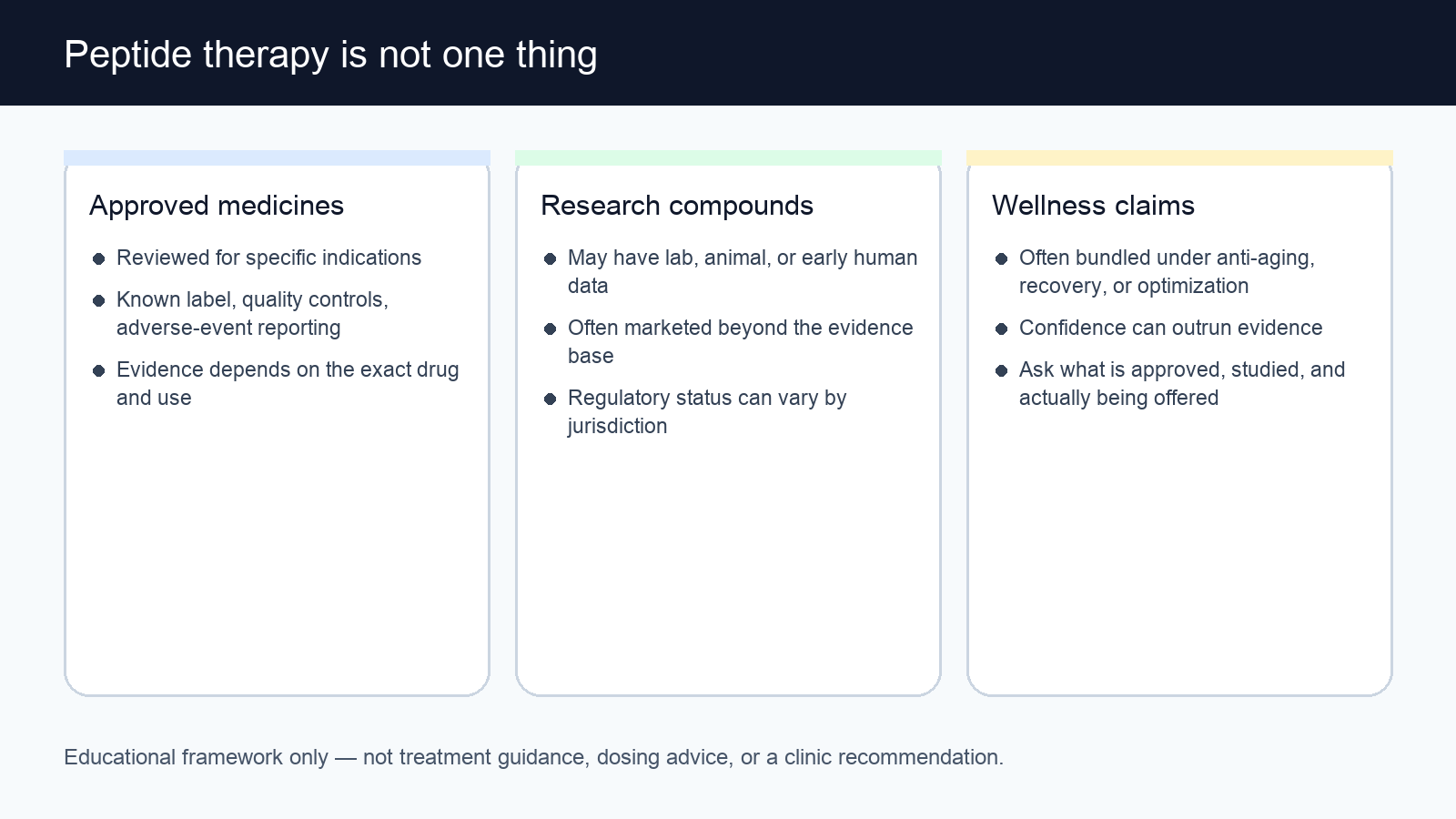
A more useful way to sort the topic is into three buckets:
- Approved peptide-based medicines used for specific indications under regulated product standards.
- Compounded or off-label uses where medical oversight may exist, but the exact product and use may not have the same evidence or approval status as a branded approved medicine.
- Research or wellness-marketed compounds where claims may be based on animal studies, mechanisms, anecdotes, or extrapolation rather than strong human evidence.
That does not mean every clinic is careless or every peptide discussion is nonsense. It means the label “peptide therapy” is too broad to trust by itself. You have to unpack it.
Approved medicines are different from research compounds
The most important distinction is whether the product being discussed is an approved medicine for the specific use being claimed.
The setmelanotide phase 3 trial in acquired hypothalamic obesity demonstrates the boundary: strong evidence and approval for a rare, biologically defined disorder do not make the drug a general obesity treatment. Approved medicines go through regulatory review for quality, safety, and efficacy for defined indications. They also have labeling, manufacturing standards, adverse-event reporting pathways, and known limitations.
Research compounds are different. A peptide may be interesting in cell studies, animal models, or early-stage research without being proven as a safe and effective therapy for people. A research-use-only peptide label does not establish human safety, sterility, legality, or suitability for treatment. That gap is where a lot of peptide marketing gets slippery. A page may describe a plausible mechanism, then slide into language that sounds like a practical health promise.
This matters for familiar names. BPC-157, TB-500, CJC-1295, ipamorelin, GHK-Cu, PT-141, sermorelin, and GLP-1 receptor agonists are often discussed in the same online universe, but they do not occupy the same evidence or regulatory lane. Some have approved-drug contexts. Some are better understood as research-stage or claim-heavy topics. Some are used in ways that depend heavily on jurisdiction, product status, and clinician judgment.
For readers, the rule is simple: do not ask “is it a peptide?” Ask “what is the exact regulatory and evidence status of this exact compound for this exact use?”
Evidence-based does not mean “a mechanism exists”
Peptide marketing often leans hard on mechanisms. You will see phrases about signaling, repair, inflammation, growth hormone, collagen, fat metabolism, mitochondria, or cellular regeneration. Mechanisms can be useful for understanding why researchers are interested in a compound. They are not the same as proof that a clinic claim is clinically established.
A cautious evidence ladder looks like this:
- Mechanistic theory: biologically plausible, but not enough by itself.
- Cell or animal data: useful for research direction, weak for personal health claims.
- Early human studies: more relevant, but often limited by size, duration, population, and endpoints.
- Better human evidence: replicated trials, clinically meaningful outcomes, and clear safety follow-up.
- Regulatory approval for a defined use: stronger than general wellness language, but still not a free pass for every off-label claim.
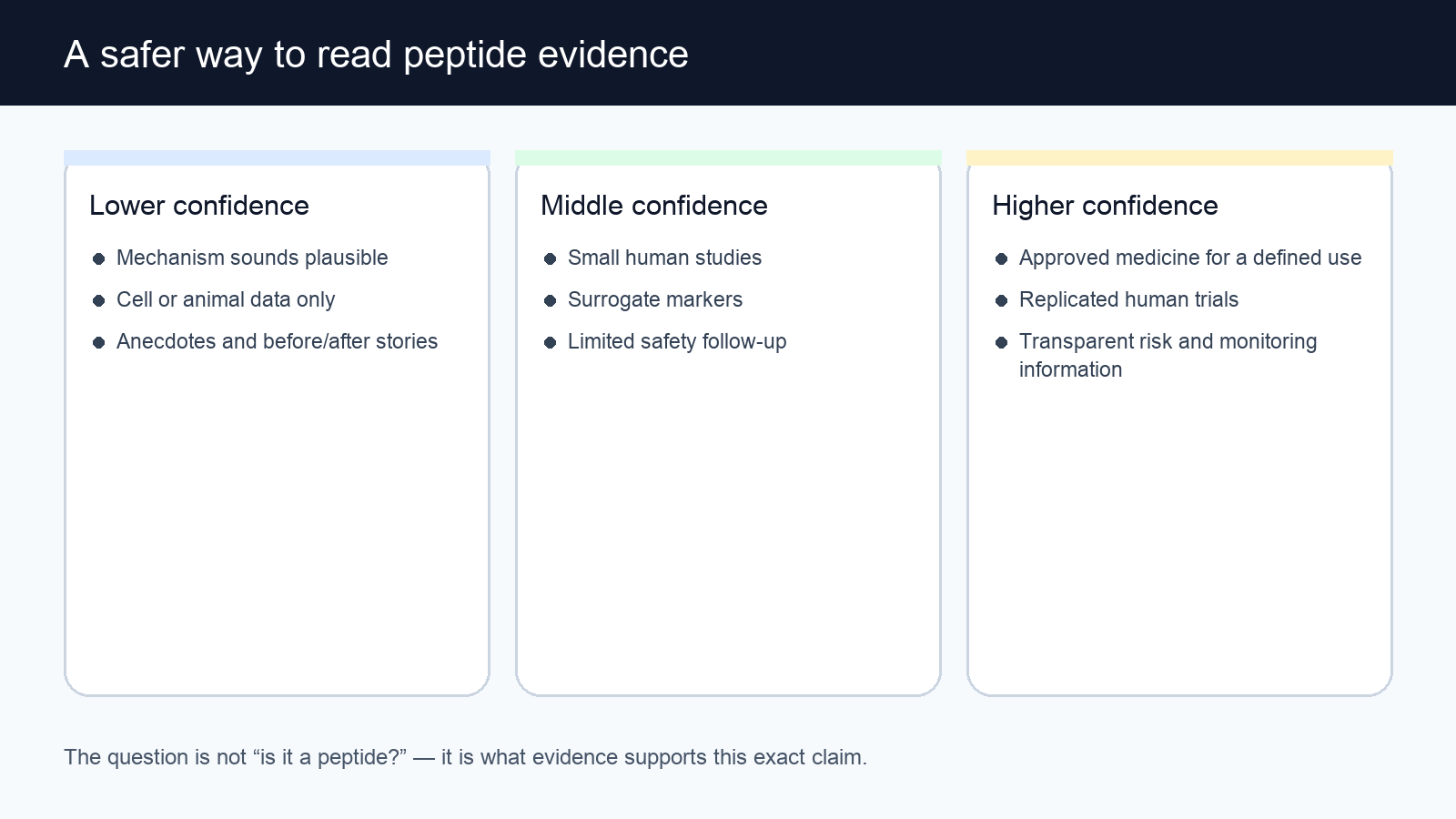
When a clinic page says a peptide “supports recovery,” “promotes healing,” “optimizes hormones,” or “helps with aging,” pause. Ask what kind of evidence supports that exact statement. Is it human evidence? Is it disease-specific? Is it a surrogate marker? Is it an animal model? Is the claim about a legally marketed product or a research compound?
The more dramatic the claim, the more boring and specific the evidence should be. If the evidence is vague while the promise is vivid, that is not a small gap. That is the whole game.
What is marketing language in peptide therapy?
Marketing language is not automatically false. It is language designed to sell interest. In peptide therapy, it often shows up as broad, attractive claims that avoid the hard parts: exact compound identity, approval status, evidence level, safety uncertainty, and product quality.
Common marketing patterns include:
- Using “therapy” to make a research compound sound clinically settled.
- Grouping approved medicines and unapproved wellness peptides under one friendly umbrella.
- Presenting animal data as if it predicts human outcomes.
- Turning “may influence a pathway” into “supports healing” or “promotes fat loss.”
- Using clinic testimonials or before/after stories as evidence substitutes.
- Skipping regulatory status, adverse effects, contraindications, and quality-control questions.
- Framing injections as routine wellness rather than medical interventions.
The red flag is not that a page is optimistic. The red flag is confidence without boundaries. A trustworthy article or clinic explanation should be able to say: this is known, this is plausible but uncertain, this is not established, and this should be discussed with a qualified professional.
Peptide therapy in Canada, Vancouver, and BC: what searchers should understand
People searching “peptide therapy Canada,” “peptide therapy Vancouver,” or “peptide therapy near me” are often looking for clinics. This article is not going to recommend one. The safer educational point is that jurisdiction matters.
In Canada, Health Canada has warned about unauthorized injectable peptide drugs and notes that most injectable peptides are regulated as prescription drugs. Products that have not been authorized have not been assessed by Health Canada for safety, efficacy, and quality. That does not mean every peptide-based medicine is unauthorized. It means readers should not treat clinic availability, online availability, or local marketing as proof of authorization.
For a Canadian or BC reader, useful questions include:
- Is this product authorized for sale in Canada?
- Does it have a Drug Identification Number or another appropriate authorization marker?
- Is the claim being made consistent with the product’s approved use?
- Is the clinic discussing an approved medicine, a compounded product, or a research compound?
- Who is responsible for monitoring adverse effects and interactions?
If those answers are unclear, the safe move is not to fill in the blanks with optimism. Blanks are information.
What about peptide injections cost?
Searches for “peptide injections cost” usually come from people trying to understand whether a clinic package is reasonable. Cost is hard to interpret without knowing the exact compound, product status, visit structure, monitoring, jurisdiction, and whether the clinic is bundling unrelated services.
A cheap offer can still be risky if the product quality, oversight, or claim basis is unclear. An expensive offer is not automatically more evidence-based. Price does not solve the core questions: what is it, what is it approved for, what evidence supports this use, what are the risks, and who is accountable if something goes wrong?
Be especially cautious when cost pages focus on monthly packages before explaining evidence, authorization, safety monitoring, and alternatives. A health claim should not be sold like a phone plan with better lighting.
Questions to ask before trusting a peptide therapy claim
The best defense against peptide therapy hype is a short repeatable checklist. You do not need to become a pharmacologist. You need to make vague claims become specific.
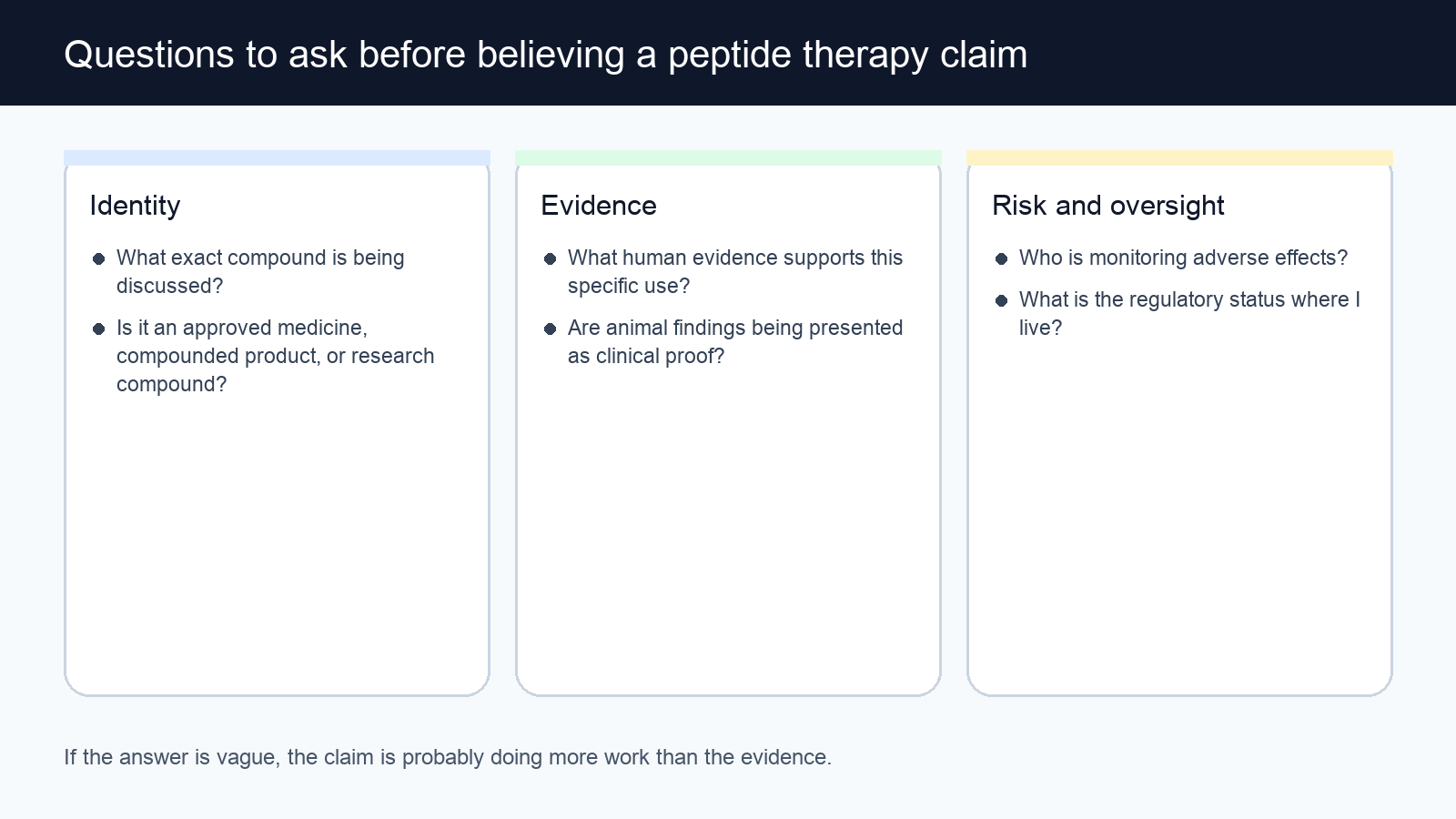
Ask:
- What exact compound is being discussed? “Peptide therapy” is not specific enough.
- Is it an approved medicine, compounded product, or research compound? Those are different evidence and regulatory lanes.
- What is the claimed use? Weight loss, injury recovery, sexual function, skin, sleep, immune effects, and anti-aging are not interchangeable.
- What human evidence supports that exact use? Mechanisms and animal data should not be presented as clinical proof.
- What are the known and unknown risks? A good explanation includes side effects, interactions, uncertainty, and who should not use it.
- What is the product quality and regulatory status? Availability is not the same as authorization.
- What happens if there is an adverse effect? Oversight is part of the intervention, not a bonus feature.
If a clinic, website, or influencer cannot answer those questions clearly, the problem is not that you are being difficult. The problem is that the claim is too foggy for the confidence being sold.
How PeptideBase classifies peptide therapy claims
PeptideBase articles separate peptide topics by evidence and intent. A compound profile, such as BPC-157 or TB-500, should not sound the same as a guide to side effects or a research-status explainer. A GLP-1 article should not be treated as interchangeable with a research peptide article just because GLP-1 drugs are peptide-based.
Useful internal reading paths include:
- Compound profiles: BPC-157, TB-500, GHK-Cu, CJC-1295, ipamorelin, sermorelin, and PT-141.
- Evidence framing: peptide research status explained and what preclinical actually means.
- Risk framing: peptide side effects and unknowns.
- Claim evaluation: how to evaluate peptide claims online.
- Adjacent clarification: GLP-1 content should be read as its own category when published, because approved medicines and wellness-marketed research compounds should not be blended together.
The goal is not to make every peptide sound scary. The goal is to prevent a broad marketing term from doing more work than the evidence.
What a careful peptide therapy page should not do
A careful page should not provide dosing protocols, injection instructions, sourcing recommendations, clinic rankings, or product-purchasing paths. It should not imply that a peptide diagnoses, treats, cures, or prevents disease unless it is discussing an approved medicine within its appropriate regulatory context and labeling.
It should not treat “natural,” “body-identical,” “research-backed,” or “physician-formulated” as magic words. It should not imply that clinical supervision erases evidence gaps. And it should not use a stack of citations as decoration while making claims the citations do not actually support.
A good page can still be useful. It can explain categories, name uncertainty, describe what evidence would be stronger, list questions to ask, and point readers toward professional medical advice without pretending to be that advice.
Bottom line
Peptide therapy is a real phrase, but it is too broad to trust without unpacking. Some peptide-based medicines are legitimate regulated drugs for specific uses. Some peptide discussions are research-stage. Some clinic and online claims are marketing-heavy and evidence-light.
The safest way to read any peptide therapy claim is to separate the molecule from the marketing. Identify the exact compound, the exact claim, the approval status, the evidence level, the product-quality question, and the risk-monitoring plan. If those pieces are not clear, the responsible conclusion is not “it works” or “it is fake.” The responsible conclusion is: the claim has not earned confidence yet.
That is less exciting than a miracle pitch. It is also how you avoid turning health decisions into a vibes-based chemistry experiment.
FAQ
Is peptide therapy evidence-based?
Sometimes, but not as a blanket category. Some peptide-based medicines have strong evidence for specific approved uses. Other peptide therapy claims are based on early research, mechanisms, animal studies, anecdotes, or marketing. The exact compound and exact claim matter.
Is peptide therapy legal in Canada?
Regulatory status depends on the product and use. Health Canada has warned about unauthorized injectable peptide drugs and notes that most injectable peptides are regulated as prescription drugs in Canada. Availability from a clinic or website is not the same as authorization.
Are peptide injections safe?
Safety depends on the compound, product quality, route, medical context, interactions, and monitoring. Unauthorized injectable products can carry risks such as infection, allergic reactions, contaminants, unsafe storage, or unassessed ingredients. This is a question for a qualified healthcare professional, not a marketing page.
Why do clinics use the phrase peptide therapy?
It is a broad umbrella that sounds clinical and modern. It can refer to approved medicines, compounded products, off-label uses, or research/wellness compounds. Readers should ask what exact product and claim sit underneath the phrase.
Does PeptideBase recommend peptide therapy clinics?
No. PeptideBase provides educational, evidence-aware content. It does not recommend clinics, sellers, products, dosing, sourcing, or treatment decisions.