If you read peptide articles long enough, you start seeing the word preclinical used like it means "basically proven, just not officially blessed yet." That is not what it means. Preclinical means the work happened before human clinical testing established real-world safety and effectiveness in people. It can include cell studies, animal studies, mechanistic lab work, and early biological observations. It can be interesting. It can be useful. It is not the same thing as solid human evidence.
This page exists because too much peptide content tries to smuggle certainty through vocabulary. A compound can have promising preclinical data and still fail to translate well in humans, fail on safety, fail on dosing, or simply never get meaningfully validated. If you understand what preclinical actually means, you can read later peptide articles with a much better bullshit filter.
Quick answer: what does preclinical mean?
Preclinical means research that happens before adequate human clinical evidence is established. It usually includes laboratory experiments, animal studies, mechanistic investigations, toxicity work, and other early-stage research used to explore whether a compound might be worth studying further.
Preclinical does not mean proven in humans. It does not mean safe for self-experimentation. It does not mean regulatory approval is close. It does not even mean the signal will hold up once researchers move from tightly controlled experimental conditions into actual people.
Why this page matters in peptide content
The word preclinical sits at the center of a lot of sloppy peptide writing. Some articles use it responsibly as a label for early evidence. Others use it like perfume sprayed on uncertainty.
If a later article says a peptide "showed promise in preclinical studies," you need to know what that sentence can and cannot carry. At most, it means there was some early-stage signal worth noticing. It does not mean the peptide has established benefits in humans, predictable risk, or a settled place in real-world medicine.
That distinction matters because peptide topics attract a weird mix of curiosity, hope, speculation, and marketing. Once those ingredients get shaken together, the phrase "preclinical evidence" can start doing dishonest emotional labor.
What counts as preclinical research?
Preclinical research is a broad bucket, not one thing. It usually includes several kinds of early evidence that differ a lot in how much weight they deserve.
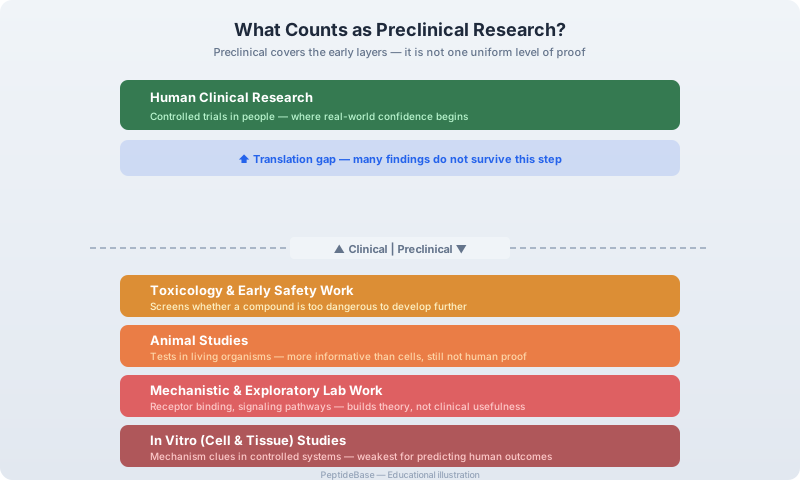 Preclinical is a bucket that includes several different kinds of early evidence, not one uniform level of proof.
In vitro studies
In vitro research usually means experiments done in cells, tissues, or controlled laboratory systems outside a living organism. These studies can help researchers understand whether a compound affects a biological pathway, receptor, or process they care about.
This kind of research is useful for mechanism clues. It is weak for predicting real human outcomes by itself. Cells in a dish do not have the same complexity as an entire human body with metabolism, compensation, variability, and side effects all crashing into each other at once.
Animal studies
Animal studies often carry more practical weight than cell studies because they test compounds in living systems. Researchers may look at healing, inflammation, tissue response, behavior, metabolism, or toxicity in mice, rats, or other models.
Animal data can be more informative than in vitro data, but it still does not equal human evidence. Different species process compounds differently. A result that looks impressive in rodents can weaken, disappear, or become less useful when translated to humans.
Mechanistic and exploratory lab work
Some preclinical research focuses on how a compound might work rather than whether it clearly improves meaningful outcomes. That can include receptor binding, signaling cascades, tissue effects, or biological pathway mapping.
This work helps build theory. Theory is not the same as clinical usefulness. Biology is full of mechanisms that look elegant on paper and disappoint the second they meet reality.
Toxicology and early safety work
Preclinical research can also include toxicity screening and early safety evaluation. This matters because even compounds with interesting effects may fail once safety becomes the central question.
A compound being in preclinical development does not mean its safety profile is well understood. Sometimes it means researchers are still trying to figure out whether it is dangerous in ways that make further development a bad idea.
What preclinical does not mean
This is where a lot of peptide content goes off the rails.
It does not mean clinically proven
Preclinical does not mean clinically proven. A peptide can look promising in animals or cellular models and still have no meaningful evidence of benefit in people.
It does not mean safe for human use
Preclinical does not mean safe for human use. Safety in people depends on dose, route, impurities, interactions, duration, population differences, and actual clinical observation. Early-stage research does not settle those questions.
It does not mean regulatory approval is near
Preclinical does not mean approval is around the corner. Plenty of compounds stay stuck in early development, fail to move forward, or disappear because translation, funding, safety, or strategic priorities fall apart.
It does not mean "basically works"
This is the internet's favorite scammy little leap. A compound having preclinical promise does not mean it "basically works" and is just waiting for paperwork. That is not science. That is wishful fan fiction in a lab coat.
Why preclinical findings often fail to translate to humans
Many preclinical findings fail to hold up in humans because human biology is messier, more variable, and less obedient than controlled models.
A few reasons translation breaks down:
- the effect size in animals was overstated or model-specific
- the mechanism mattered less in real human disease than expected
- dosing that worked in lab settings was not realistic or safe in humans
- side effects or off-target effects became more important later
- the measured outcome in animals was only a rough proxy for what people actually care about
- the early studies were exploratory, small, or not robust enough to support confident conclusions
This does not make preclinical research useless. It means it should be read as directional, not decisive.
How to read peptide claims that mention preclinical evidence
When a peptide article leans on preclinical data, the right move is not automatic dismissal. The right move is disciplined interpretation.
Ask these questions:
1. What kind of preclinical evidence is this?
A cell study and an animal study are not the same thing. A mechanistic theory and a replicated animal finding are not the same thing either. If an article just says "preclinical research suggests" without telling you the evidence type, that is already a trust problem.
2. What outcome was actually measured?
Did researchers measure a meaningful functional outcome, or just a biomarker shift? A biomarker signal can be interesting, but it is not automatically equal to practical benefit.
3. Was the evidence replicated or isolated?
One interesting paper is not the same as a stable evidence pattern. A lot of peptide content quietly builds castles on one or two early studies and hopes you will not notice the foundation is basically damp cardboard.
Paper status matters too: a retracted peptide cancer study should no longer be treated as usable evidence, although its retraction does not invalidate every related research question.
4. Are human data missing, limited, or mixed?
If human evidence is absent or thin, the article should say that clearly and early. That does not kill the topic. It just keeps the framing honest.
5. Is the wording stronger than the evidence?
This is one of the easiest ways to catch bad content. If the studies are preclinical but the article sounds like the outcomes are established, the writing is doing something the evidence did not earn.
Preclinical vs clinical: the difference that actually matters
The simplest useful distinction is this:
- Preclinical research asks whether something might be worth studying further.
- Clinical research asks what actually happens in humans under defined conditions.
That difference matters more than a thousand content-marketing synonyms. If a compound is still mainly supported by preclinical data, the real answer is usually some version of: interesting, biologically plausible in some contexts, not established in humans yet.
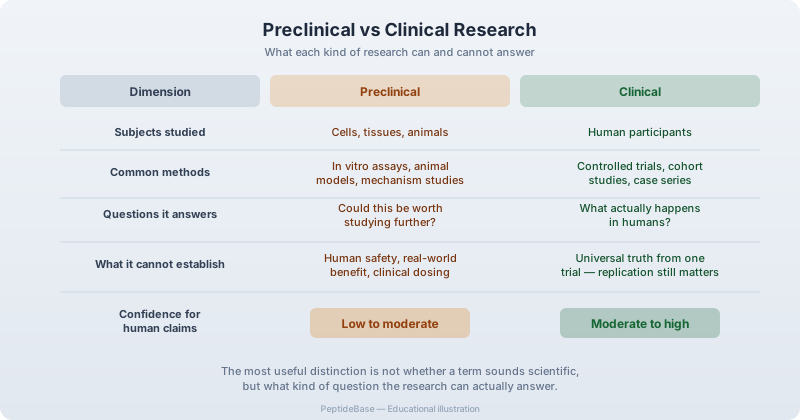 The most useful distinction is not whether a term sounds scientific, but what kind of question the research can actually answer.
Clinical evidence is not magically perfect either. But it is where the conversation starts becoming meaningfully real for human use, risk, and practical interpretation.
Why this matters for peptides specifically
Peptide topics create a perfect storm for confusion because they often involve complicated biology, limited public understanding, early-stage research, and commercial incentives to make uncertainty sound exciting.
That means the word preclinical does a lot of work in peptide writing. It can be used honestly to signal caution and stage of evidence. Or it can be used as camouflage to make weak evidence look halfway mature.
If you are reading about peptides for recovery, healing, muscle retention, fat loss, cognition, inflammation, or longevity, this distinction becomes one of the most useful mental tools you have. It helps you separate:
- early mechanistic interest
- animal-model promise
- weak human speculation
- stronger human evidence
- outright marketing theater
A simple hierarchy of evidence for peptide readers
If you want a practical framework, use this rough hierarchy:
- In vitro findings — useful for mechanism clues, weakest for real-world claims
- Animal studies — more informative than cell work, still not human proof
- Early or limited human data — more relevant, but often still uncertain or preliminary
- Better human clinical evidence — stronger basis for real interpretation
- Replicated human evidence with clearer safety framing — much more useful for serious confidence
Preclinical usually covers the first two layers and sometimes adjacent early exploratory work. That means it matters, but it should not be inflated into something it is not.
See the full peptide research-status evidence ladder for how preclinical findings relate to case reports, early human studies, controlled trials, and replicated evidence.
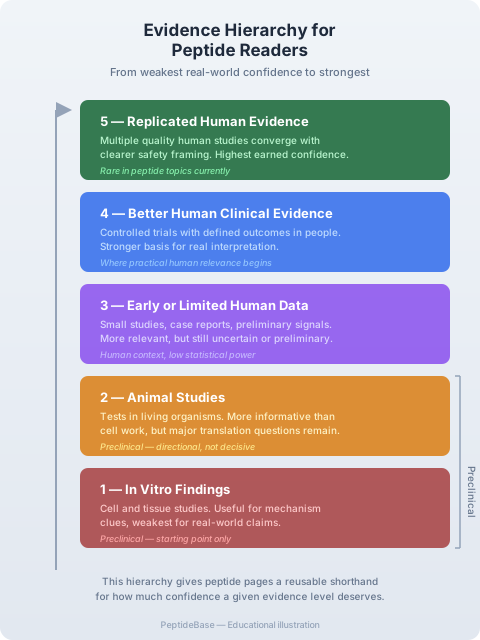 This hierarchy gives later peptide pages a reusable shorthand for how much confidence a given evidence level deserves.
How later peptide articles should use this page
This page should act like a sanity anchor for the rest of the site.
When later articles say:
- "evidence is mostly preclinical"
- "animal data are promising but human data are limited"
- "mechanistic interest exists, but translation is uncertain"
those phrases should link back here so readers understand the exact level of confidence being described.
That is useful for three reasons:
- it builds trust instead of pretending every article starts from the same evidence level
- it reduces repetitive explanation across compound pages
- it helps comparison articles stay cleaner and more consistent when evidence quality differs across peptides
Common bad interpretations to avoid
"Preclinical means it works, just unofficially"
No. It means the evidence is still before meaningful clinical validation in humans.
"Animal success means human success is likely"
Sometimes animal data are encouraging. They are not a guarantee of human usefulness.
"If it has a mechanism, it probably has a benefit"
Mechanisms help generate hypotheses. They do not automatically deliver practical outcomes.
"Preclinical means low risk because it is natural or targeted"
No. Risk depends on far more than whether the mechanism sounds elegant or the compound gets described in flattering language.
FAQ
What does preclinical mean in peptide research?
Preclinical means the evidence comes from research done before adequate human clinical evidence is established, usually including cell, animal, and mechanistic studies.
Does preclinical mean a peptide works in humans?
No. Preclinical evidence can be interesting without proving real benefit in humans.
Is preclinical evidence useless?
No. It helps researchers identify signals, mechanisms, and areas worth studying further. It is just not enough to support strong human claims on its own.
Why do so many peptide articles mention preclinical studies?
Because many peptide topics still rely heavily on early-stage evidence, and because the term can be used either honestly or manipulatively depending on how the article is written.
What should I look for when an article says "preclinical data suggests"?
Look for the evidence type, the measured outcome, whether human data exist, and whether the wording is stronger than the evidence actually supports.
Final take
Preclinical means early-stage evidence before meaningful human clinical validation, not "basically proven." That is the cleanest way to think about it.
If you keep that definition straight, you will read peptide content better, catch inflated claims faster, and understand why evidence-aware writing matters. In a space full of hopeful language and sketchy certainty, that alone is worth a lot.