TB-500 is usually described as a synthetic peptide associated with thymosin beta-4 (Tβ4), a naturally occurring peptide involved in cell migration, tissue repair signaling, and wound-healing biology. The useful short answer is that TB-500 is popular in recovery and injury-repair discussions because of the broader thymosin beta-4 research story, not because it is backed by simple, settled human proof for every claim made online.
That distinction matters. A lot of content treats TB-500 like a plug-and-play healing shortcut. A better explanation is that it sits inside a larger tissue-repair conversation involving angiogenesis, actin dynamics, inflammatory signaling, and wound remodeling. Some of that biology is genuinely interesting. Some of the online certainty is absolutely not.
If you want to understand what TB-500 is, the real questions are these: What is its relationship to thymosin beta-4? What has actually been studied? What kinds of recovery claims are more plausible than others? And where does the evidence remain thin?
Quick facts
- What it is: a synthetic peptide commonly discussed in relation to thymosin beta-4 biology
- Best known for: wound-healing, soft-tissue repair, and recovery discussions
- Most important nuance: TB-500 and thymosin beta-4 are related in conversation, but they should not be treated as perfectly interchangeable evidence buckets
- Evidence reality: much of the interest comes from mechanistic, preclinical, and broader thymosin beta-4 research rather than strong universal human outcome data for marketed TB-500 use
- Best comparison target: BPC-157 for recovery-oriented readers
What is TB-500 in plain English?
TB-500 is best understood as a recovery-associated synthetic peptide concept linked to thymosin beta-4, not as a single universally validated clinical solution for healing. In plain English, people talk about it because thymosin beta-4 has been studied for roles in wound healing, cell migration, angiogenesis, and tissue repair.
Quick answer block: Is TB-500 the same thing as thymosin beta-4?
Not exactly. TB-500 is commonly described as a synthetic fragment or derivative associated with thymosin beta-4, while thymosin beta-4 itself is the endogenous peptide with the deeper scientific literature. If an article blurs that distinction completely, it is usually taking a shortcut.
That does not mean the comparison is useless. It means readers should know where the backbone of the evidence actually comes from. A big share of the meaningful scientific discussion centers on thymosin beta-4, especially in wound-healing and repair contexts.
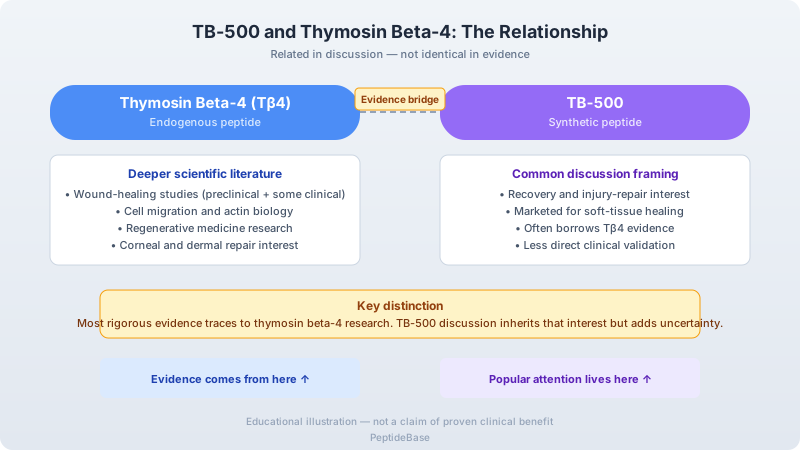 The important distinction is not whether the names sound similar. It is where the evidence actually comes from.
How is TB-500 supposed to work?
TB-500 is usually discussed through the mechanisms associated with thymosin beta-4: actin binding, cell migration, angiogenesis, inflammatory modulation, and tissue remodeling. Those pathways help explain why it keeps showing up in recovery conversations.
The simple version is that thymosin beta-4 biology appears relevant to how tissues reorganize and repair after injury. That makes it interesting for wounds, soft tissues, and possibly broader repair environments. But mechanism is not proof. A plausible repair pathway can justify research interest without proving the marketed product delivers the same clinical benefit across use cases.
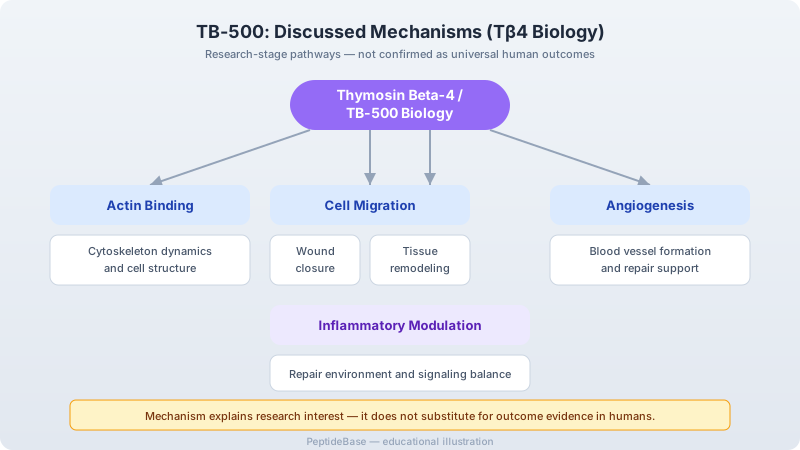 Mechanism can explain interest. It cannot substitute for outcome evidence.
What is TB-500 commonly used for?
TB-500 is commonly discussed for soft-tissue recovery, wound healing, muscle strain questions, and generalized injury-repair support. The key phrase there is "commonly discussed." That is not the same as "clinically established for all of those uses."
The most defensible way to frame common use cases is this:
- Wound-healing and tissue-repair biology: strongest conceptual fit
- Soft-tissue recovery: commonly discussed, but often extrapolated
- Muscle and tendon recovery: frequently mentioned, though readers should compare it carefully with BPC-157 rather than assume they do the same job
- Whole-body accelerated healing claims: the least trustworthy category
Quick answer block: What is TB-500 best known for?
TB-500 is best known for recovery and tissue-repair discussions that trace back to thymosin beta-4 research on wound healing, cell migration, and regenerative signaling. It is more credible when discussed in that context than when marketed like a universal healing cheat code.
What does the evidence actually show?
The evidence around TB-500 is best described as interesting, biologically plausible, and uneven. The broader thymosin beta-4 literature includes preclinical work and some clinical interest in tissue repair, wound healing, dermal repair, corneal healing, and regenerative medicine. That is the serious part of the story.
The messier part is that online TB-500 content often compresses several layers into one oversized claim:
- thymosin beta-4 has meaningful repair-related biology
- some preclinical and clinical work exists around tissue repair contexts
- therefore any marketed TB-500 use is proven for injury recovery
That third step is where the wheels usually come off.
Quick answer block: Is TB-500 proven for healing and recovery?
No, not in the broad internet-marketing sense. There is real scientific interest in thymosin beta-4-related repair biology, but that does not mean every TB-500 recovery claim is backed by strong, direct human outcome data.
A fair summary is that TB-500 belongs in the peptide recovery conversation because the underlying biology is not imaginary. But the certainty level should stay lower than the marketing usually suggests.
TB-500 vs BPC-157: how are they different?
TB-500 and BPC-157 overlap in recovery content, but they are not interchangeable. TB-500 is usually framed through thymosin beta-4 style tissue-repair and cell-migration biology, while BPC-157 is more often positioned as the broad preclinical anchor for tendon, ligament, and soft-tissue healing discussion.
That means the better comparison is not "which one is stronger?" It is "what kind of injury or tissue question is being asked?"
- TB-500: better editorial fit for wound-healing and repair-signaling discussion
- BPC-157: more common anchor for tendon and ligament comparison pages
- Both: often discussed in recovery stacks, though stacking popularity proves very little by itself
Quick answer block: Should TB-500 be compared with BPC-157?
Yes. If someone is searching for TB-500, a BPC-157 comparison page is usually one of the most useful next steps because the two compounds compete for the same recovery attention.
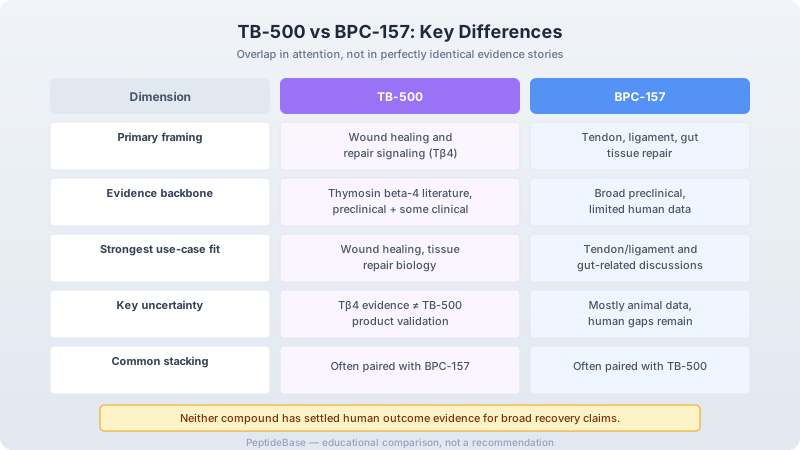 These peptides overlap in attention, not in perfectly identical evidence stories.
What are the main risks and limitations?
The biggest limitation is evidence quality. The biggest practical risk is false confidence.
TB-500 content should come with several cautions:
- human evidence is not as broad or settled as the marketing tone often implies
- product quality and sourcing may be a real concern in real-world use
- self-experimentation can distract from diagnosis, rehab, and appropriate medical care
- compound naming and evidence mapping can get sloppy fast when TB-500 is treated as identical to every thymosin beta-4 finding
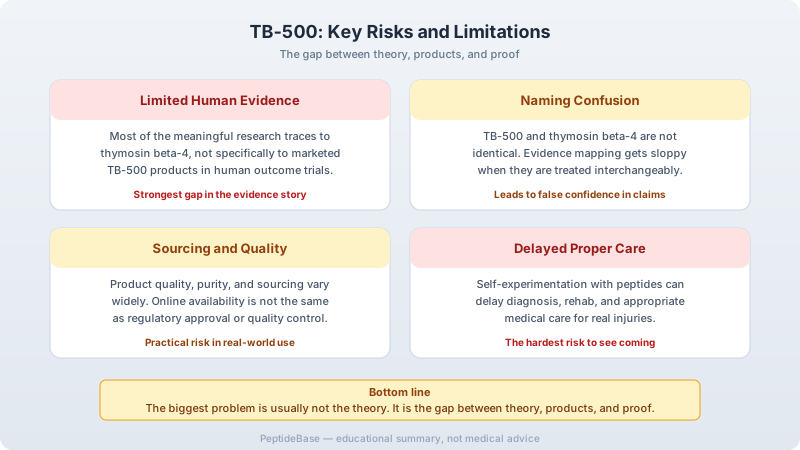 The biggest problem is usually not the theory. It is the gap between theory, products, and proof.
Quick answer block: Is TB-500 safe?
Safety questions around TB-500 are limited by sparse, uneven, and context-dependent evidence. The fuller review of TB-500 side effects and unknowns separates reported effects from plausible risks and unresolved long-term questions. Even where the underlying biology looks promising, that does not automatically answer purity, dosing, quality control, or long-term safety for products marketed under the TB-500 label.
Who is TB-500 not ideal for?
TB-500 is not ideal for readers who want a clean, proven, mainstream answer. It is also a poor fit for people who confuse promising repair biology with guaranteed outcomes.
More specifically, it is not ideal for:
- anyone expecting personalized medical guidance from a general educational article
- anyone trying to replace diagnosis or rehab with peptide self-experimentation
- anyone who has not clarified whether the real goal is wound healing, tendon repair, muscle recovery, or general "feel better faster" marketing language
How long does TB-500 take to work?
There is no single honest timeline for TB-500. Tissue type, severity, baseline care, rehab quality, and the exact claim being made all matter.
Quick answer block: How long does TB-500 take to work?
There is no universally reliable timeline. Fast anecdotal claims should be treated cautiously because recovery speed depends on the underlying injury and because the evidence is not strong enough to support one clean expectation curve.
Is TB-500 legal or approved?
TB-500 should not be described as broadly approved for recovery use just because it is easy to find online. Regulatory treatment can depend on the specific compound description, formulation, intended use, claims made by sellers, and jurisdiction.
That is the boring answer, which usually means it is the honest one.
FAQ
What is TB-500 used for?
TB-500 is commonly discussed for wound healing, soft-tissue recovery, and injury-repair support, usually through the lens of thymosin beta-4 biology. That discussion is more defensible than broad claims that it is proven for every type of recovery.
Is TB-500 better than BPC-157?
Not as a blanket statement. TB-500 and BPC-157 make more sense as comparison tools for different recovery questions than as winners in a generic popularity contest.
Is TB-500 the same as thymosin beta-4?
No. They are closely related in discussion, but they should not be treated as identical evidence buckets.
Does TB-500 help tendon healing?
It is discussed for recovery and tissue repair, but tendon-specific comparisons often work better when TB-500 is evaluated alongside BPC-157 rather than presented in isolation. Human certainty remains limited.
Bottom line
TB-500 is best understood as a synthetic peptide associated with the broader thymosin beta-4 repair story. That story includes real wound-healing and tissue-repair biology, meaningful scientific interest, and enough nuance to get mangled by lazy content.
If this page does its job, it should leave readers with a cleaner view: TB-500 is interesting, relevant to recovery discussions, and worth comparing carefully—but it should not be sold as settled proof in a vial.
Educational note: This article is for informational purposes only and is not medical advice. TB-500-related claims vary in evidence quality, safety certainty, product quality, and regulatory treatment.