The fastest way to get misled in peptide content is to read a compound page without first understanding what stage the research is actually in. "Promising" can mean anything from a petri dish signal to a useful human therapy, and the internet loves acting like those are basically neighbors. They are not.
Quick answer: A peptide's research status tells you how much confidence you should have in claims about safety, effectiveness, dosing, and real-world usefulness. Before trusting a compound page, readers should ask whether the evidence comes from cell studies, animal studies, early human studies, larger clinical trials, or mostly anecdote.
Quick evidence ladder
From weakest real-world confidence to strongest:
- Mechanistic theory only
- Cell or tissue studies
- Animal studies
- Case reports or informal human observation
- Small early human studies
- Larger controlled human trials
- Replicated evidence with clearer safety and outcome data
That ladder is not perfect, but it is good enough to stop readers from treating every peptide write-up like it belongs in the same confidence bucket.
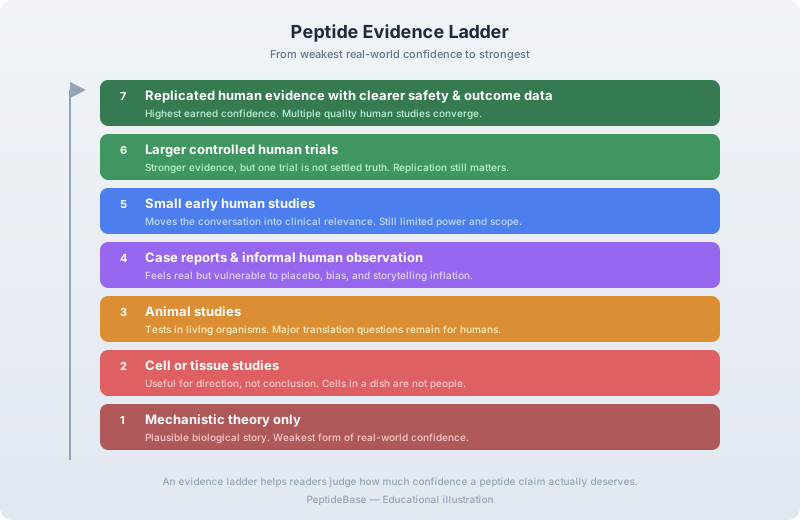 An evidence ladder helps readers judge how much confidence a peptide claim actually deserves.
Why research status matters so much in peptides
Research status matters because peptide discussions often jump straight from biological plausibility to lifestyle certainty. A peptide can have an interesting mechanism, strong animal data, and exciting anecdotes while still being nowhere near a well-validated human intervention.
That gap affects four things immediately:
- how much trust to place in benefit claims
- how cautious to be about side effects and unknowns
- how seriously to take dosage discussions
- whether a page is describing a research topic or something closer to a settled therapy
Quick answer: Why not just read the benefits section first?
Because the benefits section is where weak evidence gets dressed up for prom.
Stage 1: Mechanistic theory
Mechanistic theory means the peptide has a plausible biological story. Maybe it appears to influence inflammation, angiogenesis, repair signaling, receptor activity, mitochondrial function, or appetite regulation.
That is useful, but it is the weakest form of confidence in the real world. A clean mechanism story can explain why a peptide might work. It does not prove that it does work in humans in a meaningful, repeatable, safe way.
What readers should infer at this stage
- the peptide is conceptually interesting
- claims should stay cautious
- dosage confidence should be low
- real-world expectations should be restrained
Stage 2: Cell and tissue studies
Cell studies test how a peptide behaves in isolated systems such as cultured cells or tissue models. This is where a lot of exciting headlines are born.
The problem is obvious once you say it out loud: cells in a dish are not people. A peptide may look impressive in a controlled laboratory environment and still fail to produce meaningful, safe, or reproducible results in whole organisms.
Quick answer: Are cell studies enough to trust a peptide?
No. Cell studies are useful for direction, not conclusion.
Stage 3: Animal studies
Animal studies are a real step up because they test effects in living organisms. This is often where peptide enthusiasm gains serious momentum, especially in healing, metabolism, or neuroprotection discussions.
Animal work can make a peptide worth watching. It still leaves major unanswered questions about translation to humans, dosing, safety, metabolism, durability of effect, and whether the same outcomes actually matter clinically.
What animal evidence can and cannot tell you
Animal studies can suggest:
- the peptide may have meaningful biological activity
- certain use cases deserve more study
- some safety or efficacy signals exist
Animal studies cannot tell you with confidence:
- that the same benefit will happen in humans
- that dose-response will translate cleanly
- that side effects will look the same
- that gray-market products match research material quality
Stage 4: Case reports and anecdotal human use
This is the danger zone for reader judgment because anecdote feels more real than preclinical data. Someone says their tendon felt better. Someone else says their gut improved. A coach swears a stack changed recovery. Suddenly the compound starts sounding battle-tested.
Anecdotes can be useful for hypothesis generation. They are terrible as standalone proof.
Why? Because anecdote is vulnerable to expectation effects, placebo effects, regression to the mean, selection bias, misdiagnosis, concurrent interventions, and straight-up storytelling inflation. The internet is basically a steroid cycle for confidence.
Quick answer: Should anecdotal reports be ignored?
No. They can signal where interest exists. They just should not outrank controlled evidence.
Stage 5: Small early human studies
Early human studies matter because they start moving the conversation from theory into direct clinical relevance. They may give clues about tolerability, preliminary effectiveness, useful endpoints, or target populations.
But small human studies still have serious limitations. They may be underpowered, poorly controlled, too short, not replicated, or focused on outcomes that sound interesting but do not translate into meaningful real-world benefit.
What readers should ask when a peptide has early human data
- How many participants were included?
- Was there a control group?
- What outcome was actually measured?
- Was the effect clinically meaningful or just statistically interesting?
- Has anyone replicated it?
Stage 6: Larger controlled human trials
This is where confidence starts to become earned rather than imagined. Larger controlled trials can tell readers much more about whether a peptide works, for whom, under what conditions, and with what side effect profile.
Even here, one positive trial is not the same as settled truth. Readers still need to look at replication, study quality, endpoint relevance, follow-up time, and whether the published results match the claims being made online.
Quick answer: Does one human trial settle the issue?
No. One trial can move a peptide into serious consideration, but replication and context still matter. Our guide to what a peptide entering Phase 1 actually means explains why early safety and tolerability findings should not be mistaken for clinical efficacy.
Stage 7: Replicated evidence and clearer clinical confidence
A peptide deserves higher trust only when evidence has been reproduced across quality human studies and when safety, use-case boundaries, and outcome expectations become clearer.
This does not mean perfection. It means the compound has moved beyond "interesting" into something more decision-useful. Most peptide content online skips directly to this tone without actually having the receipts.
How to read a compound page once you know the stage
Once you understand research stage, a compound page becomes easier to judge.
If the evidence is mostly mechanistic, cell-based, or animal-based, then:
- benefits should be framed as possibilities or research interest
- safety language should emphasize uncertainty
- dosage language should stay cautious and educational
- comparison claims should stay modest
If the evidence includes meaningful human data, then stronger language may be justified — but only to the extent the actual studies support it.
Five questions to ask before trusting any peptide article
- What is the highest evidence stage being cited?
- Is the article separating animal data from human data clearly?
- Does the language sound more certain than the evidence deserves?
- Are risks and unknowns treated honestly?
- Is the article explaining what is known, or just selling confidence?
These five questions will save readers from a shocking amount of nonsense.
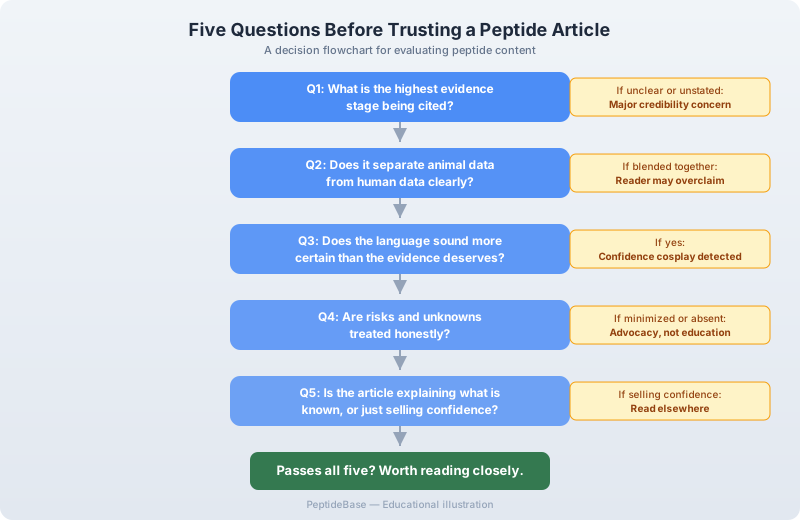 A simple decision flowchart can turn vague skepticism into a repeatable way to read peptide content better.
Common ways peptide articles mislead readers about evidence
Weak peptide articles tend to make the same mistakes over and over:
- blending mechanistic theory with proven human benefit
- using animal findings as if they automatically predict human outcomes
- quoting anecdotes as if they are data
- presenting dosage discussions with fake precision
- downplaying uncertainty because uncertainty does not convert as well
- treating popularity as proof
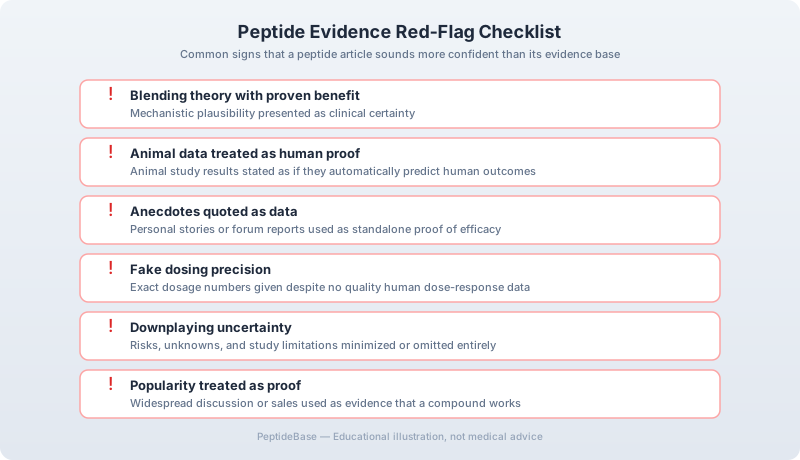 A red-flag checklist makes it easier to spot when a peptide article sounds more confident than its evidence base.
Quick answer: What is the biggest red flag?
When an article sounds clinically certain but never tells you what kind of evidence the claims actually come from.
How this should change the way you read compound pages
Readers should not ask only "What does this peptide do?" They should ask "How much of that answer comes from theory, animals, early human data, or stronger clinical evidence?"
That single shift makes peptide content far more useful. It also makes a lot of internet copy look like what it really is: confidence cosplay.
FAQ
What does "research peptide" really mean?
It usually means the compound is being discussed more as an experimental or investigational topic than as a well-established mainstream therapy with clear clinical consensus.
Is animal evidence enough to make a peptide promising?
Animal evidence can make a peptide promising enough to watch, but not reliable enough to treat as proven for humans.
Why do peptide websites sound more confident than the evidence?
Because certainty sells, and nuance does not get invited to many marketing meetings.
Should I ignore peptides with early-stage evidence?
No. Early-stage evidence can still be interesting. The key is matching your confidence to the actual stage rather than upgrading the story in your head.
What should a trustworthy peptide article do?
A trustworthy peptide article should tell you what kind of evidence exists, where the limits are, what remains uncertain, and how much confidence the claims actually deserve.
Bottom line
Peptide research status is not a technical footnote. It is the filter that determines how every benefit, risk, dosage, and comparison claim should be interpreted. Readers who understand the evidence ladder will read compound pages more intelligently, trust hype less, and make fewer category mistakes before they ever get attached to a peptide narrative.
This article is for educational purposes only and is not medical advice. Research stage does not determine personal suitability, safety, legality, or quality of real-world products, and readers should treat peptide content as evidence interpretation first, not treatment guidance.