GLP-1 Peptides vs “Research Peptides”: What People Mean and Why It Matters
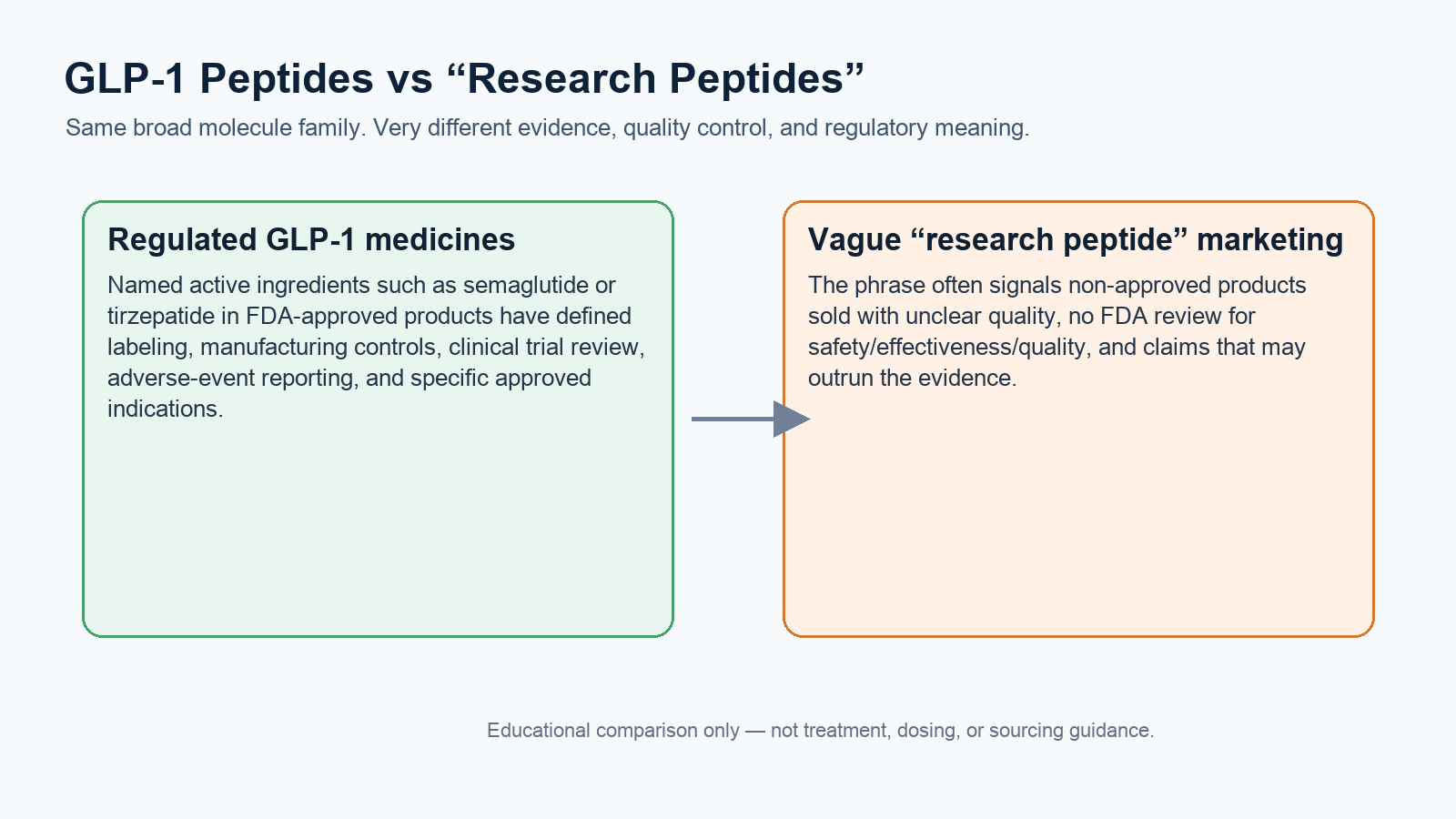
GLP-1 drugs are peptide-based medicines, but that does not make every product marketed as a “GLP-1 peptide” equivalent to Ozempic, Wegovy, Mounjaro, or Zepbound. The important distinction is not only chemical category. It is whether a specific product has defined identity, manufacturing controls, clinical evidence, labeling, adverse-event monitoring, and regulatory review.
That difference matters because “peptide” can mean several things at once. In biochemistry, a peptide is a short chain of amino acids. In medicine, some peptides or peptide-like molecules become regulated drugs. In online marketing, “research peptide” often means a compound sold with vague research-only language, unclear quality controls, or claims that are not backed by the same evidence and oversight as an approved medicine.
This article is educational only. It does not provide treatment advice, dosing instructions, purchasing guidance, or sourcing recommendations.
Quick Answer
GLP-1 peptides are a broad biological and drug-development category. Some GLP-1-related compounds, such as semaglutide and tirzepatide in FDA-approved products, are regulated medicines with specific labels and evidence packages. “Research peptides” is a looser marketing phrase and does not itself prove safety, legality, quality, or clinical evidence.
Table of Contents
- What Are GLP-1 Peptides?
- Where Ozempic, Wegovy, Mounjaro, and Zepbound Fit
- What People Usually Mean by Research Peptides
- Why Regulatory Status Changes the Meaning
- GLP-1 Peptides vs Research Peptides: The Practical Difference
- Why Evidence Status Matters More Than the Word Peptide
- Common Misunderstandings About GLP-1 Peptides
- How to Read GLP-1 Claims More Carefully
- Bottom Line
What Are GLP-1 Peptides?
GLP-1 stands for glucagon-like peptide-1, a peptide hormone involved in glucose-dependent insulin signaling, glucagon suppression, gastric emptying, and appetite-related pathways. The natural GLP-1 hormone is a peptide made from amino acids, and GLP-1 receptor agonist medicines are designed to act on the GLP-1 receptor pathway.
That is why people call drugs like semaglutide “GLP-1 peptides.” The phrase is broadly understandable, but it can blur useful distinctions. Natural GLP-1, semaglutide, liraglutide, tirzepatide, and unapproved compounds sold online are not automatically the same thing just because peptide language appears around them.
Orforglipron shows the opposite classification issue: it activates the GLP-1 receptor but is a non-peptide small molecule.
The most useful way to think about GLP-1 peptides is:
- Biological category: GLP-1 is an endogenous peptide hormone.
- Drug class: GLP-1 receptor agonists are medicines designed to activate GLP-1 receptors.
- Specific active ingredient: semaglutide, liraglutide, tirzepatide, and others each have their own structure, pharmacology, evidence, and labels.
- Product status: an FDA-approved branded product is not the same as an unapproved or research-only product using a similar name.
The word “peptide” explains part of the molecule story. It does not answer the evidence, quality, or regulatory-status questions.
Where Ozempic, Wegovy, Mounjaro, and Zepbound Fit
Ozempic and Wegovy are brand-name semaglutide products, while Mounjaro and Zepbound are brand-name tirzepatide products. They are often discussed together because they sit in the incretin-drug conversation, but they are not identical.
Semaglutide is a GLP-1 receptor agonist. FDA-approved semaglutide products have specific indications, labeling, warnings, dosage forms, and risk information. The approved product matters because the label describes the reviewed product, not every substance advertised as “semaglutide” somewhere online.
Tirzepatide is commonly grouped into the GLP-1 conversation, but it is more specifically a dual GIP and GLP-1 receptor agonist. That means it is not simply “the same as semaglutide but stronger.” It has a different pharmacologic profile and its own approved labels, warnings, and evidence base.
For readers, the clean distinction is this: Ozempic, Wegovy, Mounjaro, and Zepbound are regulated medicines tied to specific manufacturers, formulations, labeling, and reviewed evidence. A product marketed online as a “GLP-1 research peptide” may be using similar language, but that language does not establish equivalence.
What People Usually Mean by Research Peptides
“Research peptide” usually means a compound marketed for laboratory or research use rather than as an approved medicine for consumer treatment. Sometimes the phrase is used appropriately in research contexts. Online, it can also become a way to talk around medical-drug rules while still implying human benefits.
The problem is that the phrase can hide several different questions:
- Is the compound identity verified?
- Is the product manufactured under appropriate quality controls?
- Is it sterile when sold for injection-related contexts?
- Is it the same salt, base, or form as an approved drug ingredient?
- Has the final product been reviewed for safety, effectiveness, and quality?
- Are the claims based on human clinical evidence, animal data, mechanism theory, or marketing?
Those questions are not academic hair-splitting. FDA has warned that unapproved GLP-1 versions can be risky because they do not go through FDA review for safety, effectiveness, and quality before marketing. FDA has also flagged concerns around compounded semaglutide and tirzepatide products, including dosing errors, salt-form issues, adverse events, and products promoted outside approved labeling.
That does not mean every research-labeled molecule is fake. It means the label “research peptide” should lower your certainty, not raise it.
Why Regulatory Status Changes the Meaning
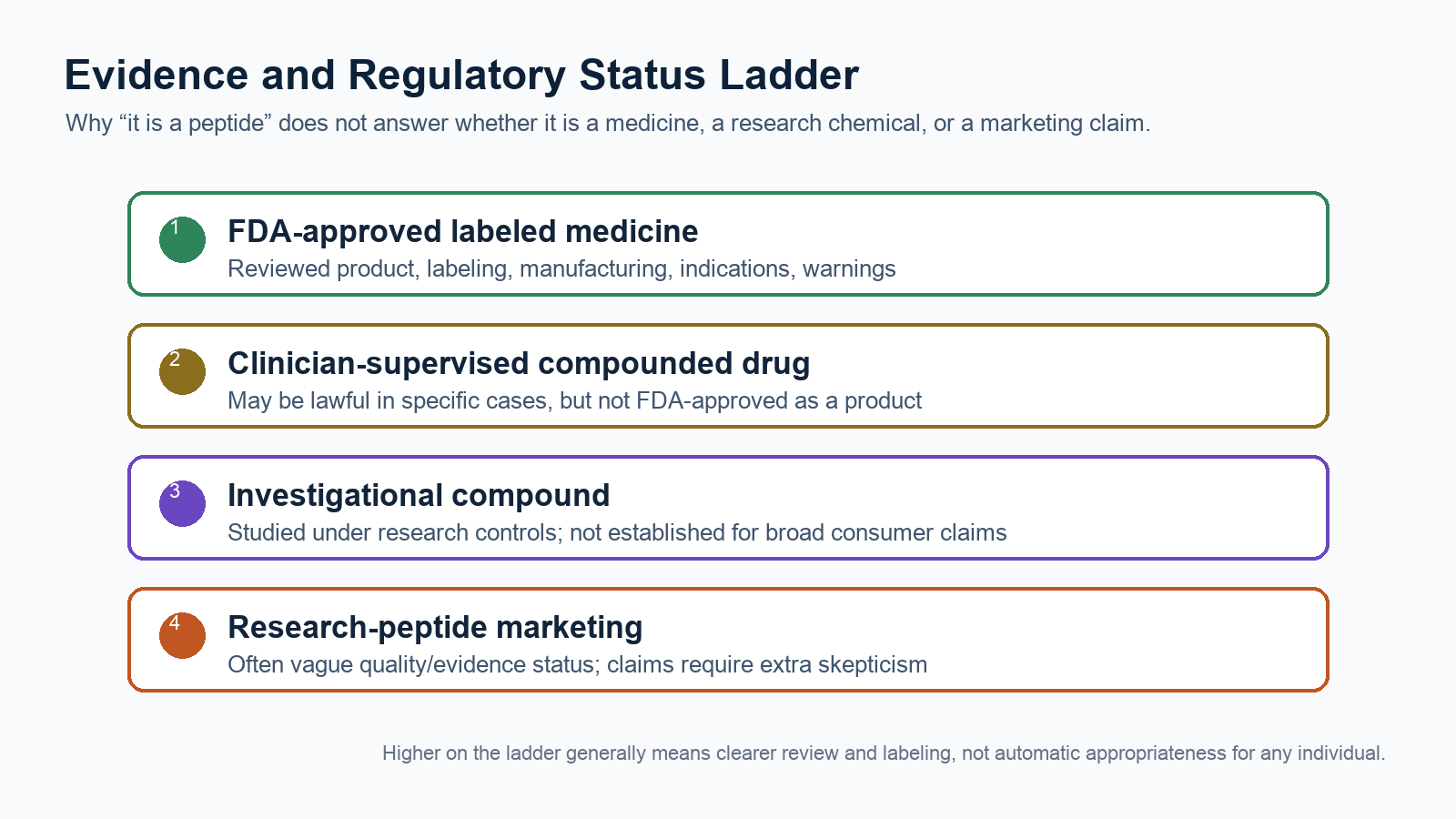
Regulatory status changes what can reasonably be inferred from a peptide claim. A reviewed drug label is not just paperwork. It defines the product, indications, warnings, studied populations, dosage forms, adverse reactions, contraindications, and manufacturing expectations.
An FDA-approved GLP-1 product has a different evidence and accountability profile from an unapproved vial, capsule, or compounded product marketed as “same active ingredient” or “for research only.” The molecule name may be familiar, but the product is not automatically interchangeable.
There are several status buckets that get blended online:
| Status | What it means | What it does not prove | |---|---|---| | FDA-approved medicine | A specific product has been reviewed for safety, effectiveness, quality, labeling, and intended use | It does not mean the drug is appropriate for every person | | Clinician-supervised compounded drug | A customized preparation may be used in specific patient circumstances when legal conditions are met | It is not FDA-approved as a finished product | | Investigational compound | A substance may be studied under research controls | It is not automatically established for consumer use | | Research-peptide marketing | A seller may be using research-only language around a compound | It does not prove identity, quality, safety, or clinical benefit |
This is the center of the GLP-1 confusion. People see familiar names, then assume the same evidence follows the name wherever it appears. It does not.
Our FDA research-peptide compounding review explains another commonly blurred boundary: regulatory review of whether an ingredient may be used in compounding is not approval of every finished product or claimed use.
GLP-1 Peptides vs Research Peptides: The Practical Difference
The practical difference is that approved GLP-1 medicines are specific drug products, while “research peptide” is a broad and often ambiguous marketplace phrase. The difference shows up in evidence, labeling, quality control, adverse-event expectations, and claim reliability.
Approved GLP-1 medicines generally have:
- defined active ingredient identity
- reviewed indications
- prescribing information
- known dosage forms and strengths
- controlled manufacturing expectations
- adverse-reaction data from trials and postmarketing monitoring
- warnings and contraindications
- a clear manufacturer and regulatory history
Research-peptide marketing may have:
- unclear final-product quality
- unclear sterility or formulation controls
- claims based on mechanism theory rather than human outcomes
- “not for human use” disclaimers sitting next to human-benefit implications
- no FDA review of the finished product
- limited accountability if the product is mislabeled, contaminated, or misused
That is why “GLP-1 peptides vs Ozempic” is usually the wrong comparison. Ozempic is not a category. It is a specific approved semaglutide product. A vague GLP-1 peptide listing is not automatically the same thing.
Why Evidence Status Matters More Than the Word Peptide
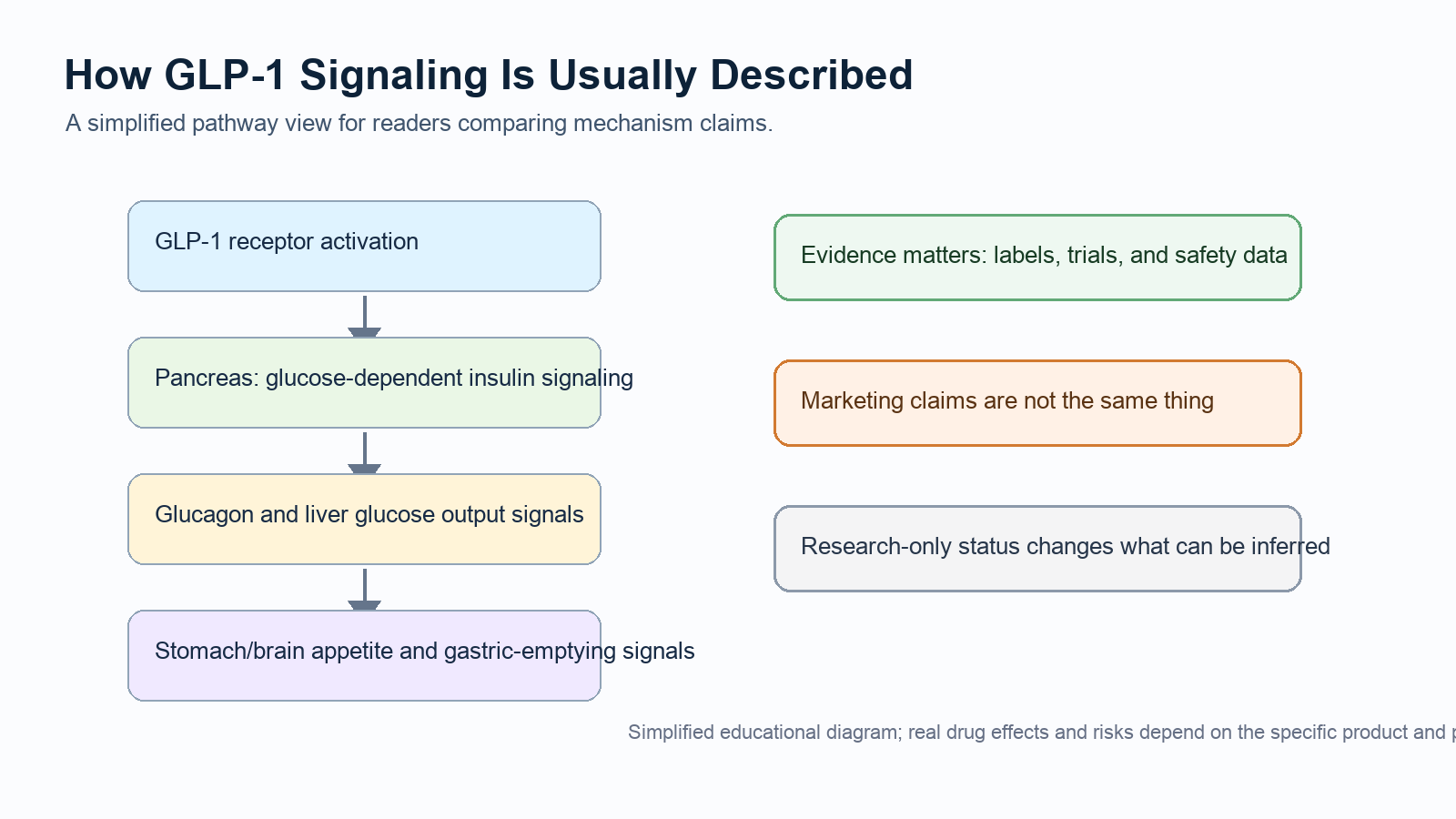
Evidence status matters because mechanism does not equal proven outcome. A compound can plausibly interact with a receptor, resemble a known peptide pathway, or show activity in early studies without having the same clinical evidence as an approved product.
For GLP-1-related drugs, there is real clinical evidence behind specific approved medicines. There is also a much weaker evidence environment around many online “research peptide” claims. The marketing language often compresses several different levels of proof into one overconfident story.
A more careful evidence ladder looks like this:
- Mechanism: The compound is designed to act on a receptor or pathway.
- Preclinical evidence: Cell or animal studies suggest a possible effect.
- Early human evidence: Small or early trials explore safety, signals, or dosing.
- Large clinical trial evidence: Larger controlled studies evaluate outcomes and adverse events.
- Regulatory review: A specific product, label, manufacturing package, and indication are reviewed.
- Postmarketing experience: Safety signals continue to be monitored after wider use.
The phrase “GLP-1 peptide” can appear at several points on that ladder. The ladder position matters more than the phrase.
Common Misunderstandings About GLP-1 Peptides
The first misunderstanding is that “peptide” means natural or automatically safer. It does not. Peptides can be endogenous hormones, prescription drugs, investigational compounds, or poorly controlled products. Safety depends on the specific compound, dose context, formulation, patient factors, and evidence base.
The second misunderstanding is that semaglutide and tirzepatide are interchangeable. They are related in the incretin-drug conversation, but semaglutide is a GLP-1 receptor agonist while tirzepatide acts at both GIP and GLP-1 receptors. They should not be flattened into one generic “GLP peptide” bucket.
The third misunderstanding is that compounded or research-labeled products are just cheaper versions of approved medicines. FDA-approved products and compounded or unapproved products are regulated differently. Compounded drugs can have legitimate roles in specific medical circumstances, but they are not FDA-approved finished products.
The fourth misunderstanding is that weight-loss demand changes evidence quality. Popularity is not a study design. Social media demand can make a compound famous faster than it makes the product reliable.
How to Read GLP-1 Claims More Carefully
The safest way to read GLP-1 peptide claims is to separate molecule identity, product identity, evidence level, and regulatory status.
Ask four basic questions:
- What exact active ingredient is being discussed? Semaglutide, tirzepatide, liraglutide, retatrutide, and generic “GLP-1 peptide” are not the same level of specificity.
For retatrutide, the TRIUMPH-2 estimand analysis shows why the 20.8% and 18.8% figures require their matching assumptions, placebo results, and the compound’s investigational status. 2. What exact product is being discussed? A branded FDA-approved pen, a compounded preparation, and a research-labeled vial are different product categories. 3. What evidence is being cited? Approved labeling, randomized trials, animal studies, mechanism theory, testimonials, and influencer claims are not interchangeable. 4. What claims are being made? Educational mechanism discussion is different from claims that a product treats, prevents, cures, or guarantees a body-composition outcome.
For PeptideBase readers, this is where related topics matter. A general peptide therapy explainer helps define the broader clinic/marketing landscape. A peptide side effects guide helps separate known risks from overstated or ignored ones. A research-status explainer and claim-evaluation guide are especially useful when a seller uses scientific language without showing product-specific evidence.
Bottom Line
GLP-1 drugs can accurately be discussed as peptide-based or peptide-related medicines, but “peptide” is not enough information. Ozempic, Wegovy, Mounjaro, and Zepbound are specific regulated products with specific active ingredients and labels. “Research peptides” is a broader phrase that may refer to investigational compounds, laboratory-use materials, or online products whose quality and evidence status are much less clear.
The useful distinction is not “peptides good” or “research peptides bad.” It is this: what exactly is the molecule, what exactly is the product, what evidence supports the claim, and what regulatory review applies?
If a GLP-1 claim cannot answer those questions cleanly, the uncertainty is the point.