Retatrutide’s TRIUMPH-2 Trial: Why 20.8% and 18.8% Weight-Loss Headlines Are Both Reported
Both figures come from the same retatrutide TRIUMPH-2 trial, but they answer different questions. The 20.8% figure is the week-80 efficacy estimand for the highest trial arm: an estimate of what weight change would look like if participants remained on assigned treatment and did not start prohibited weight-management treatment. The 18.8% figure is the treatment-regimen estimand: an estimate that incorporates treatment discontinuation and other intercurrent events according to the trial’s prespecified analysis strategy.
Neither number is automatically false. Neither should appear in a headline without its estimand, placebo result, and uncertainty.
The peer-reviewed Lancet report, published September 29, 2026, describes a randomized, double-blind, placebo-controlled phase 3 trial in 1,152 adults with type 2 diabetes and obesity or overweight. It reports outcomes after 80 weeks and makes clear that the two analyses were designed to estimate different treatment effects.

One randomized trial can support more than one valid estimate when each analysis asks a different, prespecified question. The estimand—not just the percentage—belongs in the headline.
Quick answer: why did TRIUMPH-2 report 20.8% and 18.8%?
The 20.8% and 18.8% figures differ because TRIUMPH-2 used two prespecified estimands, not because one source found a different trial result.
- 20.8% mean weight reduction: efficacy estimand, 12 mg randomized arm, standard error (SE) 0.6.
- 18.8% mean weight reduction: treatment-regimen estimand, 12 mg randomized arm, SE 0.7.
- Placebo also changed: 4.0% reduction under the efficacy estimand and 5.1% under the treatment-regimen estimand.
- Placebo-adjusted differences: 16.8 percentage points (95% CI 15.3 to 18.3) under the efficacy estimand and 13.8 points (95% CI 11.8 to 15.8) under the treatment-regimen estimand.
The minus signs in the paper indicate reductions. Expressed in plain English, the estimated reduction was 20.8% or 18.8%, depending on the question being estimated.
What was the retatrutide TRIUMPH-2 trial?
TRIUMPH-2 was an 80-week phase 3 efficacy and safety trial, not a product-availability study or a cardiovascular-outcomes trial. According to the paper and the NCT05929079 registry record, it enrolled adults with a body-mass index of at least 27 kg/m², type 2 diabetes, and a history of at least one unsuccessful dietary effort to reduce weight.
The 1,152 participants were randomly assigned to four groups:
- placebo: 289 participants;
- retatrutide 4 mg trial arm: 292 participants;
- retatrutide 9 mg trial arm: 284 participants;
- retatrutide 12 mg trial arm: 287 participants.
The mean age was 55.1 years, mean BMI was 38.2 kg/m², and mean HbA1c was 7.71%. Most participants—1,055 of 1,152, or 92%—were already using at least one oral glucose-lowering medication at baseline.
Efficacy analyses included every randomized participant. Safety analyses included the 1,149 participants who received at least one dose: 287 placebo, 292 in the 4 mg arm, 284 in the 9 mg arm, and 286 in the 12 mg arm. Safety was assessed during the 80-week treatment period and a four-week follow-up.
What is an estimand?
An estimand defines the treatment effect a trial is trying to estimate, including how events after randomization are handled. Those events—called intercurrent events—can include permanently stopping assigned treatment, switching to a prohibited treatment, or using rescue therapy.
An estimand is more than a statistical method. It connects five things: the population, treatment condition, outcome, way intercurrent events are handled, and summary measure. Change the handling of intercurrent events and the result can change even though the randomized participants and endpoint remain the same.
In TRIUMPH-2:
- The treatment-regimen estimand asked about the average effect regardless of permanent treatment discontinuation or initiation of prohibited weight-management treatment. The analysis used a treatment-policy approach and primary multiple imputation for missing efficacy data.
- The efficacy estimand asked about the average effect under the hypothetical condition that participants remained on assigned treatment as intended and did not experience the specified intercurrent events. Continuous outcomes were analyzed with a mixed model for repeated measures using data relevant to that hypothetical strategy.
Dose interruptions and modifications were part of the treatment condition in both definitions; permanent discontinuation was the key distinction for the efficacy estimand. For glycaemic outcomes, the definitions also addressed prohibited glucose-lowering medication and glycaemic rescue therapy.
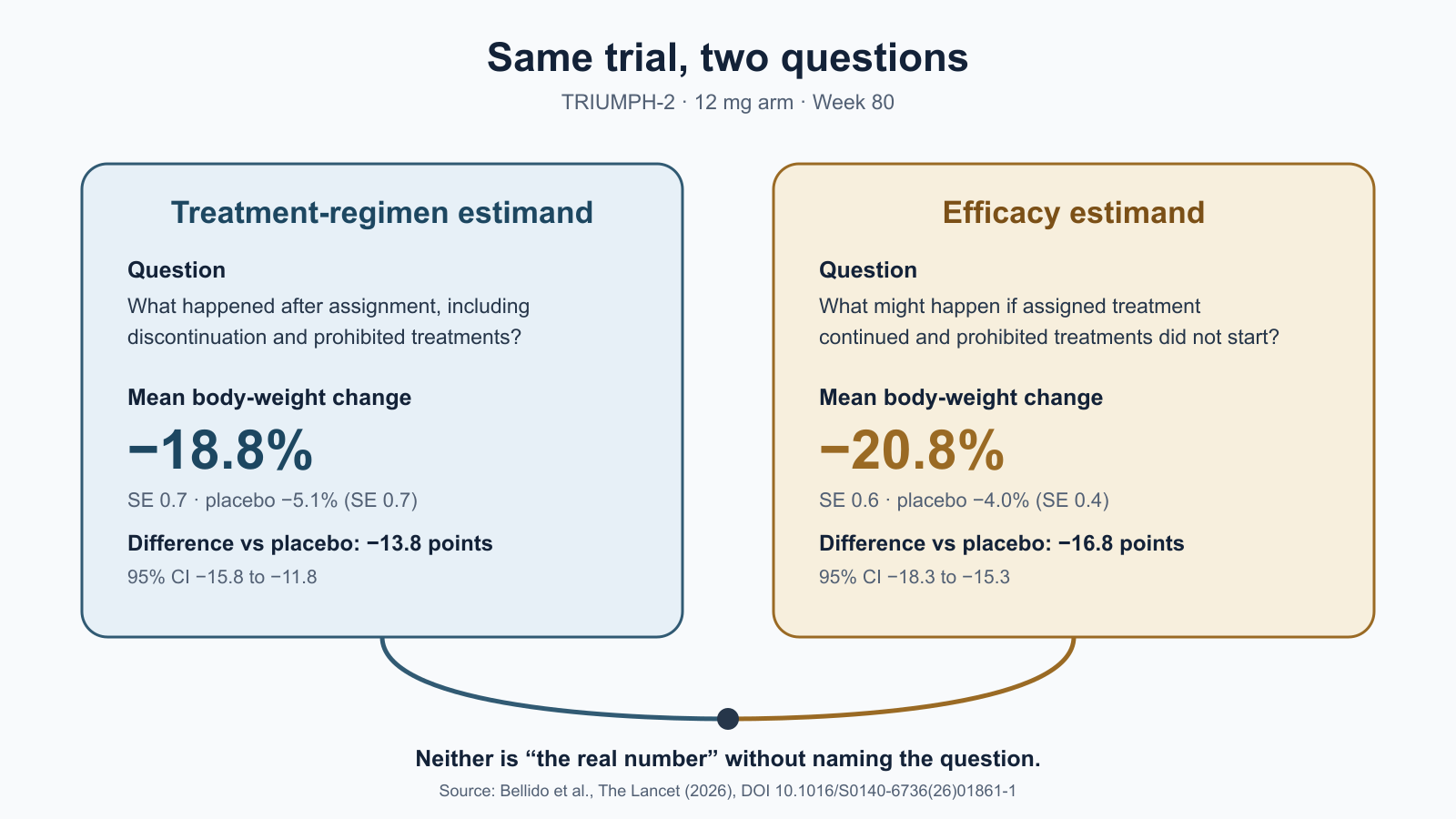
The 18.8% and 20.8% estimates are attached to different assumptions. The corresponding placebo changes and between-group differences change too.
Which estimate is more “real”?
Neither estimand is universally more real; each is more relevant to a different question. The treatment-regimen estimand is closer to “What happened after people were assigned, including discontinuation and prohibited treatment?” The efficacy estimand is closer to “What might happen if assigned treatment continued and those specified events did not occur?”
That does not make the treatment-regimen estimate a prediction of routine clinical practice. Trial participants were selected, followed, and supported under a protocol, and missing outcomes were estimated statistically. It also does not make the efficacy estimand an observed completers-only average. It is a model-based hypothetical estimate for all randomized participants under stated assumptions.
The useful question is not “Which number wins?” It is “Which treatment effect is this number estimating?” A percentage stripped of that sentence is an orphan statistic.
Why do placebo changes and between-group differences matter?
An isolated percentage does not separate the assigned treatment effect from changes that also occurred in the placebo group. Participants in every group received trial contact and lifestyle intervention, and body weight changed in placebo recipients too.
For the 12 mg arm at week 80:
- Under the treatment-regimen estimand, mean change was −18.8% (SE 0.7) with retatrutide and −5.1% (SE 0.7) with placebo. The estimated difference was −13.8 percentage points (95% CI −15.8 to −11.8; p<0.0001).
- Under the efficacy estimand, mean change was −20.8% (SE 0.6) with retatrutide and −4.0% (SE 0.4) with placebo. The estimated difference was −16.8 points (95% CI −18.3 to −15.3; p<0.0001).
The confidence intervals describe uncertainty around the placebo-adjusted estimates. The paper notes that these intervals were not adjusted for multiplicity and should not themselves be used for hypothesis testing. The prespecified testing procedure controlled error across the primary and key secondary endpoints.
What did TRIUMPH-2 find for body weight?
Weight reduction was greater in every randomized retatrutide arm than with placebo under both estimands. The full week-80 estimates were:
| Randomized group | Treatment-regimen estimand | Efficacy estimand |
|---|---|---|
| Placebo | −5.1% (SE 0.7) | −4.0% (SE 0.4) |
| Retatrutide 4 mg arm | −11.9% (SE 0.6) | −12.7% (SE 0.6) |
| Retatrutide 9 mg arm | −16.8% (SE 0.7) | −19.1% (SE 0.6) |
| Retatrutide 12 mg arm | −18.8% (SE 0.7) | −20.8% (SE 0.6) |
Under the treatment-regimen estimand, the 12 mg arm’s estimated difference from placebo was −13.8 points. The corresponding differences were −6.9 points (95% CI −8.7 to −5.1) for the 4 mg arm and −11.8 points (−13.7 to −9.8) for the 9 mg arm.
These are group averages, not promises for an individual. The distribution of responses was broad, and some participants stopped treatment before week 80.
What did the trial find for HbA1c and glycaemic control?
TRIUMPH-2 also found larger average HbA1c reductions with retatrutide than with placebo, but the same estimand label still matters. From a mean baseline HbA1c of 7.71%:
- Under the treatment-regimen estimand, mean HbA1c change was −1.38 percentage points in the 4 mg arm, −1.50 in the 9 mg arm, and −1.45 in the 12 mg arm, compared with −0.45 with placebo.
- For the 12 mg arm, the placebo-adjusted difference was −1.00 percentage point (95% CI −1.21 to −0.80).
- Under the efficacy estimand, the 12 mg arm changed by −1.54 percentage points versus −0.19 with placebo, a difference of −1.35 points (95% CI −1.57 to −1.13).
Under the treatment-regimen estimand, 207 of the model-estimated participants in the 12 mg arm (72%) reached HbA1c of 6.5% or lower, compared with 86 (29%) on placebo. Because these binary results used multiple imputation, the paper labels the counts as model-based averages across imputed datasets rather than simple observed-event counts.
The trial also reported changes in fasting glucose, waist circumference, blood pressure, lipids, and quality-of-life measures. Those intermediate endpoints do not establish fewer heart attacks, strokes, hospitalizations, or deaths.
What adverse events were reported?
Gastrointestinal events were the most frequent adverse events, while dysesthesia, hypotension-related events, and treatment discontinuation were more common in several retatrutide groups than with placebo. Safety results were descriptive and used the treated population, so their denominators differ slightly from the randomized efficacy population.
Among placebo (n=287), 4 mg (n=292), 9 mg (n=284), and 12 mg (n=286), respectively:
- Any treatment-emergent adverse event: 227 (79%), 231 (79%), 236 (83%), and 242 (85%).
- Diarrhoea: 38 (13%), 80 (27%), 95 (34%), and 96 (34%).
- Nausea: 23 (8%), 40 (14%), 59 (21%), and 80 (28%).
- Constipation: 27 (9%), 41 (14%), 46 (16%), and 48 (17%).
- Vomiting: 12 (4%), 16 (6%), 29 (10%), and 45 (16%).
- Dysesthesia: 2 (1%), 13 (4%), 16 (6%), and 21 (7%).
- Hypotension, orthostatic hypotension, or decreased blood pressure: 1 (<1%), 4 (1%), 14 (5%), and 18 (6%).
- Adverse events or death leading to permanent treatment discontinuation: 14 (5%), 11 (4%), 33 (12%), and 22 (8%).
Serious adverse events occurred in 22 placebo participants (8%), 24 in the 4 mg arm (8%), 25 in the 9 mg arm (9%), and 27 in the 12 mg arm (9%). Seven participants died across the four groups; investigators judged all deaths unrelated to study intervention. The safety table reports counts and percentages rather than confidence intervals for these descriptive event frequencies, so small between-group differences should not be overinterpreted as precise comparative risks.
For a broader explanation of what randomized trials, labels, and other source types can each establish, see GLP-1 Side Effects: What Trials, Labels, and Online Communities Can Each Tell Us.
Does TRIUMPH-2 establish cardiovascular benefit?
No. TRIUMPH-2 was not designed to determine whether retatrutide reduces major cardiovascular events or mortality. Fifteen adjudication-confirmed major adverse cardiovascular events were reported and distributed similarly across groups, but that small event count is not a cardiovascular-outcomes test.
The paper reported changes in blood pressure, lipids, weight, and glycaemic measures. Those risk factors can be clinically relevant, but improvements in intermediate markers are not substitutes for a trial powered around cardiovascular outcomes. The authors explicitly said further studies are required to determine whether the observed changes translate into improvement in obesity-related complications.
Can TRIUMPH-2 be compared directly with semaglutide or tirzepatide trials?
Only cautiously, because TRIUMPH-2 did not randomize participants against semaglutide or tirzepatide. Cross-trial comparisons can be distorted by differences in diabetes status, baseline HbA1c and BMI, background medication, follow-up duration, adherence, missing-data handling, estimand definition, and participant selection.
It is fair to describe the TRIUMPH-2 results in their own randomized placebo-controlled context. It is not fair to convert separate trials into a head-to-head league table as if they shared one protocol and population.
For background on why compound names and regulatory categories matter, see GLP-1 Peptides vs “Research Peptides”: What People Mean and Why It Matters.
Does publication mean retatrutide is approved or commercially available?
No. A peer-reviewed phase 3 publication is evidence about a trial; it is not FDA approval, a product label, or proof of lawful commercial availability. Retatrutide remains investigational. Its PeptideBase database page groups educational coverage; it is not a product listing.
Trial phase describes a stage of clinical development, not automatic regulatory success. PeptideBase’s explainer on what it means when a peptide enters phase 1 provides the earlier-stage comparison.
The FDA states that retatrutide is not a component of an FDA-approved drug and has not been found safe and effective for any condition. The agency also warns that products marketed online as retatrutide, compounded retatrutide, or “research use only” material do not become the studied trial product because they use the same name.
That distinction matters because grey-market material can differ in identity, purity, concentration, sterility, storage, and labeling. TRIUMPH-2 cannot validate those products. PeptideBase separately explains what a “research use only” peptide label does and does not mean and what the FDA’s 2026 peptide-seller warning letters actually said.
How should future TRIUMPH-2 headlines be written?
A responsible headline should name the estimand or state both estimates. At minimum, reporting should include:
- the randomized arm and week-80 endpoint;
- whether the estimate is treatment-regimen or efficacy;
- the matching placebo change;
- the placebo-adjusted difference and 95% confidence interval;
- the population—adults with type 2 diabetes and obesity or overweight;
- the fact that retatrutide remains investigational;
- the boundary that cardiovascular outcomes and head-to-head superiority were not established.
The same discipline applies beyond this trial: How to Evaluate Peptide Claims Online explains how to check the source, denominator, endpoint, comparator, and regulatory status behind a claim.
“20.8% weight loss” is incomplete. “20.8% under the efficacy estimand versus 4.0% with placebo” is interpretable. “18.8% under the treatment-regimen estimand versus 5.1% with placebo” answers a different but equally legitimate question.
Bottom line
TRIUMPH-2 did not produce one true percentage and one false percentage. It produced two prespecified estimates for two different questions. The efficacy estimand estimated a 20.8% mean reduction in the 12 mg arm under continued assigned treatment without specified prohibited treatment, while the treatment-regimen estimand estimated 18.8% while incorporating discontinuation and related intercurrent events under the paper’s strategy.
The most informative reading includes the estimand, placebo change, between-group difference, uncertainty, adverse-event denominators, and limits of the design. Anything less turns statistical context into headline confetti.
This article is for general education only. It does not provide medical advice, treatment recommendations, dose selection, administration instructions, sourcing, purchasing, compounding, or self-experimentation guidance.
Frequently asked questions
Is 20.8% the wrong TRIUMPH-2 number?
No. It is the efficacy-estimand result for the 12 mg randomized arm at week 80. It should be labeled as such and paired with the 4.0% placebo change and the 16.8-point estimated difference.
Is 18.8% the “real-world” result?
It is the treatment-regimen estimand, but calling it a real-world effectiveness estimate goes too far. It incorporated discontinuation and prohibited-treatment events under a prespecified trial analysis, yet participants still took part in a controlled randomized trial with protocol-defined follow-up.
Why did placebo weight change differ between estimands?
Because the estimands applied different assumptions and analysis strategies to all randomized groups, including placebo. That is why the matched placebo result must travel with each retatrutide percentage.
How many people were in TRIUMPH-2?
The efficacy population included 1,152 randomized participants. The safety population included 1,149 participants who received at least one dose.
Did TRIUMPH-2 prove retatrutide prevents heart attacks or strokes?
No. The trial was not designed or powered as a cardiovascular-outcomes trial.
Is retatrutide FDA-approved?
No. Publication of TRIUMPH-2 does not equal approval. FDA states that retatrutide is not a component of an approved drug and has not been found safe and effective for any condition.
Sources
- Bellido V, le Roux CW, Ekinci EI, et al. Retatrutide in adults with obesity and type 2 diabetes (TRIUMPH-2): a double-blind, parallel-group, randomised, placebo-controlled, phase 3 trial. The Lancet. Published online September 29, 2026.
- U.S. National Library of Medicine. PubMed record 42810372.
- ClinicalTrials.gov. NCT05929079: TRIUMPH-2.
- U.S. Food and Drug Administration. FDA’s Concerns with Unapproved GLP-1 Drugs Used for Weight Loss.