GLP-1 Side Effects: What Trials, Labels, and Online Communities Can Each Tell Us
GLP-1 side-effect claims mean different things depending on whether they come from clinical trials, FDA labels, adverse-event databases, or online communities. This evidence-method guide explains how to read each source without turning anecdotes into proof or labels into panic.
GLP-1 Side Effects: What Trials, Labels, and Online Communities Can Each Tell Us
GLP-1 side effects are easiest to understand when you separate the source of the claim from the claim itself. A randomized trial, an FDA label, a pharmacovigilance report, and a Reddit thread can all mention nausea, vomiting, constipation, gallbladder concerns, pancreatitis, fatigue, or unusual digestive symptoms. They do not all mean the same thing.
Clinical trials are good at comparing side-effect rates in defined groups. FDA labels summarize reviewed product-specific risk information. FDA adverse-event systems can surface possible post-market signals, but they cannot prove incidence or causation by themselves. Online communities can reveal what people notice, fear, misunderstand, or fail to get answered elsewhere, but they are heavily biased toward memorable stories.
This article uses semaglutide and tirzepatide as examples because they sit at the center of GLP-1 discussion. It is educational only. It is not medical advice, diagnosis, treatment guidance, dosing guidance, discontinuation guidance, purchasing guidance, or a recommendation to use any GLP-1 product.
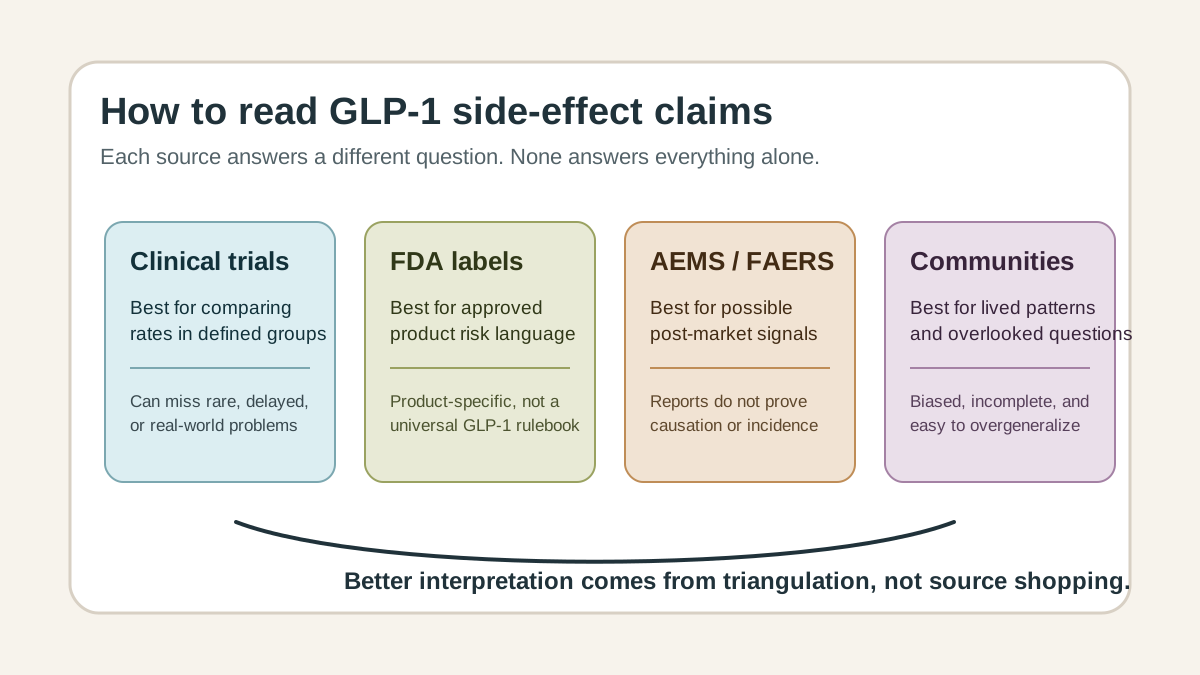 GLP-1 side-effect claims are more reliable when the source type, product, population, and uncertainty are kept separate.
Quick Answer: What Is the Best Source for GLP-1 Side Effects?
The best source depends on the question. Trials are strongest for structured comparisons, labels are strongest for approved-product warnings, pharmacovigilance is useful for possible safety signals, and communities are useful for lived-experience questions.
| Source | Best for | Biggest limitation | |---|---|---| | Clinical trials | Comparing adverse events between treatment and control groups | Trial populations are selected and follow-up is limited | | FDA labels | Product-specific warnings, contraindications, adverse reactions, and postmarketing language | Labels are not personalized guidance and may be misread as a generic GLP-1 rulebook | | FDA AEMS / former FAERS | Detecting possible post-market signals after broader exposure | Reports do not prove the drug caused the event or how often it occurs | | Online communities | Finding symptoms people discuss and questions formal sources may not answer plainly | Anecdotes are self-selected, incomplete, and vulnerable to panic or hype |
The most defensible reading usually combines sources: trial data for expected patterns, labels for reviewed risk language, pharmacovigilance for signal awareness, and communities for questions worth checking more carefully.
Why GLP-1 Side-Effect Claims Get Confusing
GLP-1 side-effect claims get confusing because people often collapse different products, populations, and evidence sources into one sentence. “GLP-1s cause X” may refer to semaglutide, tirzepatide, liraglutide, a compounded product, a research-labeled product, an off-label context, or a personal story about a symptom that happened nearby in time.
That flattening matters. Semaglutide is a GLP-1 receptor agonist. Tirzepatide is usually discussed in the GLP-1 category, but it is more specifically a dual GIP and GLP-1 receptor agonist. Ozempic, Wegovy, Mounjaro, and Zepbound are specific regulated products with their own labels. A vague online “GLP-1 peptide” or “research peptide” claim is not automatically equivalent to any of those products.
The side-effect conversation also mixes different levels of confidence:
- Common trial-reported reactions, especially gastrointestinal symptoms such as nausea, diarrhea, vomiting, constipation, abdominal pain, and dyspepsia.
- Label warnings and precautions, such as pancreatitis, gallbladder disease, kidney injury related to dehydration, hypersensitivity, hypoglycemia risk in certain diabetes-medication contexts, and product-specific contraindications.
- Postmarketing reports, which may include rare or serious events but require careful interpretation.
- Community anecdotes, which can be emotionally vivid but often lack medical confirmation, denominator data, and full context.
Answer block: why do GLP-1 side effects sound different depending on the source?
Because each source is built for a different purpose. Trials compare groups. Labels regulate product risk communication. Adverse-event databases collect reports. Communities collect stories. Treating those as interchangeable is where bad conclusions start.
What Clinical Trials Can Tell Us
Clinical trials can tell us which adverse events appeared more often in a studied group than in a comparison group under controlled conditions. That makes trials especially useful for common, expected, and treatment-emergent events.
In the STEP 1 trial of once-weekly semaglutide in adults with overweight or obesity, nausea and diarrhea were among the most common adverse events, and the publication described them as typically transient and mild to moderate in severity.[^step1] In the SURMOUNT-1 tirzepatide obesity trial, the most frequently reported adverse events were gastrointestinal, including nausea, diarrhea, and constipation, and they occurred more often during dose escalation.[^surmount1]
Trials also help compare related drugs in similar contexts. In SURPASS-2, a trial comparing tirzepatide with semaglutide in people with type 2 diabetes, common adverse events were gastrointestinal and generally mild to moderate, while serious adverse events were reported in a minority of participants across groups.[^surpass2]
That kind of evidence is much stronger than “people online say they felt sick.” It gives a structured denominator, a defined population, a time period, a protocol, and systematic adverse-event collection.
But trials do not answer every safety question.
They may exclude people with complex health histories. They may not be long enough to catch delayed outcomes. They may not detect rare adverse events. They may not reflect messy real-world product switching, overlapping medications, compounded products, inconsistent follow-up, or non-prescribed use. They also answer the question they were designed to ask, not every question the public later asks.
Answer block: do trials prove GLP-1 side effects are fully known?
No. Trials are one of the strongest tools for common adverse-event patterns, but they are not a complete map of rare, delayed, real-world, or product-quality risks.
What FDA Labels Can Tell Us
FDA labels can tell us what risk information regulators require for a specific approved product. For GLP-1-related drugs, labels are often the cleanest place to find official language on adverse reactions, contraindications, warnings, precautions, drug interactions, and postmarketing experience.
As of the current FDA labels reviewed for this article, semaglutide and tirzepatide products commonly list gastrointestinal adverse reactions among the most frequent side effects. Wegovy labeling includes adverse reactions such as nausea, diarrhea, vomiting, constipation, abdominal pain, headache, fatigue, dyspepsia, dizziness, abdominal distension, eructation, hypoglycemia in patients with type 2 diabetes, flatulence, gastroenteritis, gastroesophageal reflux disease, and nasopharyngitis.[^wegovy-label] Zepbound labeling lists common reactions including nausea, diarrhea, vomiting, constipation, abdominal pain, dyspepsia, injection-site reactions, fatigue, hypersensitivity reactions, eructation, hair loss, and gastroesophageal reflux disease.[^zepbound-label]
Labels also separate common adverse reactions from more serious warnings. Semaglutide and tirzepatide labels include warnings around thyroid C-cell tumor risk based on rodent findings, pancreatitis, gallbladder disease, severe gastrointestinal reactions or delayed gastric emptying concerns, kidney injury in dehydration-related contexts, hypersensitivity, and hypoglycemia risk when used with certain glucose-lowering medications, depending on the product and indication.[^ozempic-label][^mounjaro-label][^zepbound-label]
The important point is not “read a label and self-manage.” The important point is narrower: a label is product-specific evidence infrastructure. It tells you what risk language belongs to that reviewed product, not what every online GLP-1-related product automatically means.
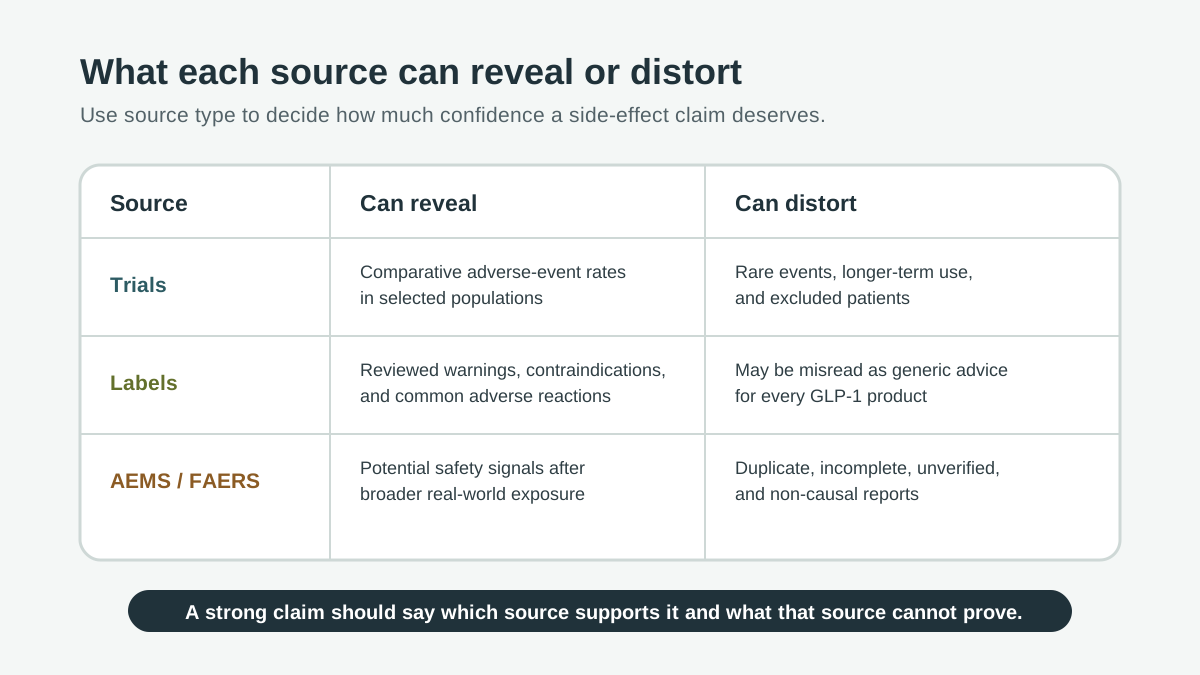 A strong side-effect claim should say which evidence source supports it and what that source cannot prove.
What Labels Can Distort When People Read Them Too Fast
FDA labels can be misread when people turn them into either reassurance or panic. A label is not a guarantee of safety. It is also not a list of events that will happen to every user.
Common mistakes include:
- treating an adverse-reaction list as a personal prediction
- treating a warning as proof that an event is common
- assuming one product label applies cleanly to every GLP-1-related product
- ignoring the difference between clinical-trial adverse reactions and postmarketing reports
- reading “reported” as “proven caused by”
- using label language to validate unapproved, compounded, or research-labeled products
For PeptideBase readers, the product distinction matters. An approved GLP-1 medicine has a reviewed label, manufacturing controls, and defined indication language. That is different from a research-peptide marketplace claim. The phrase “GLP-1 peptide” by itself does not carry the label with it.
Related reading: GLP-1 peptides vs research peptides explains why regulated product identity matters. Peptide side effects: what is known, unknown, and overstated gives the broader safety framework.
What Pharmacovigilance Can Tell Us
Pharmacovigilance can tell us what is being reported after a product reaches broader real-world use. FDA’s Adverse Event Monitoring System, formerly FAERS, is meant to expand visibility into adverse-event reports submitted by industry, healthcare professionals, and consumers.[^aems]
This can be valuable. Post-market reporting can surface unusual patterns, rare events, or concerns that were not obvious in pre-approval trials. It can also help regulators decide what needs closer review, label changes, communication, or further study.
But FDA is explicit about the limitations. A report in AEMS does not establish that the drug caused the event. Reports can be duplicate or incomplete. The information may not be medically verified. And the reports cannot be used to calculate incidence rates.[^aems]
That means pharmacovigilance is best understood as a signal tool, not a verdict machine. It can say, “This event has been reported and may deserve attention.” It usually cannot say, by itself, “This drug caused this event at this frequency.”
Answer block: do FDA adverse-event reports prove GLP-1 side effects?
No. They can identify possible signals and reporting patterns, but FDA states that the existence of a report does not establish causation, and the reports cannot be used to estimate how often an event occurs.
What Online Communities Can Tell Us
Online communities can tell us what formal sources often fail to explain in plain language: what symptoms people notice, what they worry about, what they misunderstand, and what questions keep repeating.
That makes communities useful for evidence literacy. If many people ask about nausea, constipation, food aversion, fatigue, reflux, hair shedding, mood changes, skin sensitivity, gallbladder concerns, or delayed gastric emptying, those questions are worth comparing against trial publications, labels, and pharmacovigilance signals.
Communities are also useful because they capture context that formal tables often flatten. A person may describe timing, severity, lifestyle disruption, uncertainty, embarrassment, fear, or frustration. That does not prove causation, but it helps explain why a technically “mild to moderate” adverse event can still matter to quality of life.
The trap is treating story volume as incidence. People with dramatic symptoms are more likely to post than people who had no symptoms or ordinary transient nausea. Viral discussion can amplify a concern after media coverage. People may omit other medications, underlying conditions, product source, dose changes, hydration status, diet shifts, illness, alcohol use, or unrelated causes. Some posts are secondhand. Some are marketing. Some are litigation-adjacent. Some are just internet weather.
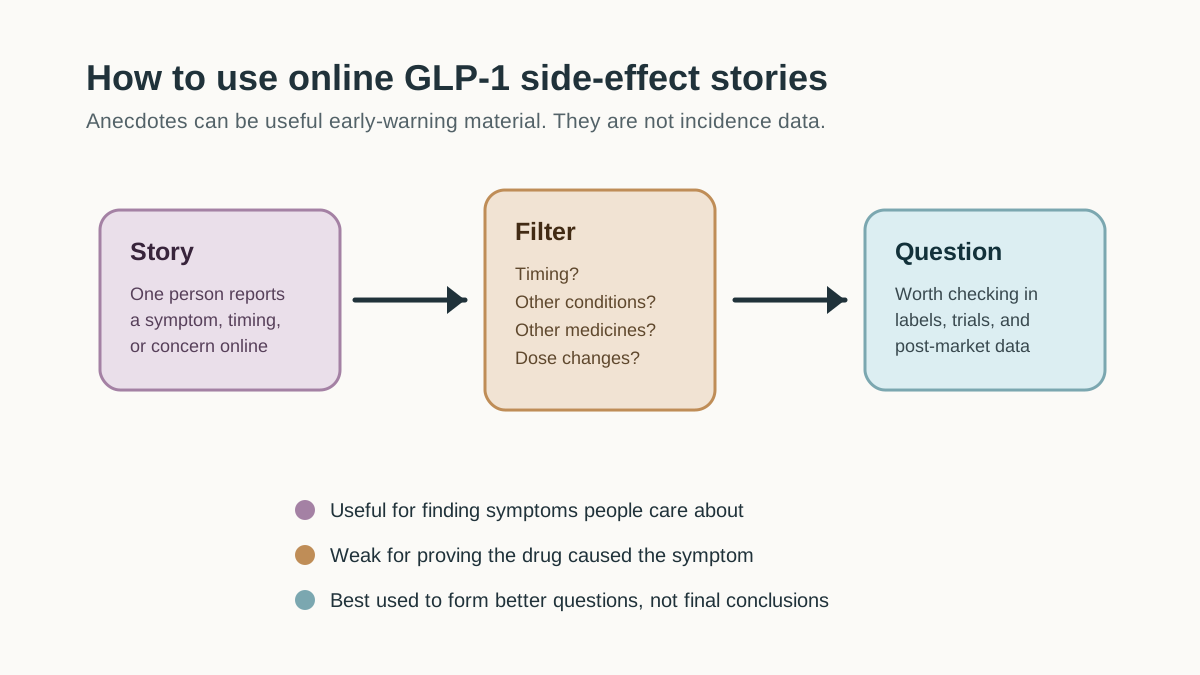 Online anecdotes are most useful when they become better questions, not instant conclusions.
How to Read a GLP-1 Side-Effect Story Online
The safest way to read a GLP-1 side-effect story is to turn it into a question before turning it into a belief.
Ask:
- Which product is being discussed? Semaglutide, tirzepatide, another GLP-1 drug, compounded product, research-labeled product, or unclear source?
- What is the event? A common gastrointestinal symptom, a serious diagnosis, a lab abnormality, a nonspecific feeling, or a confirmed medical event?
- What is the timing? Did it start after exposure, during escalation, after another medication change, or during an unrelated illness?
- What is missing? Age, underlying conditions, other medications, alcohol use, eating pattern, gallbladder history, diabetes status, pregnancy status, product source, or medical confirmation?
- What stronger source should this be checked against? Trial data, product label, FDA adverse-event systems, systematic reviews, or professional clinical guidance?
This is not about dismissing people. It is about not making the internet do a job it was never built to do. Communities are excellent at raising questions. They are bad at providing denominators.
Semaglutide and Tirzepatide: What the Sources Agree On
Across trials and labels, the clearest shared pattern for semaglutide and tirzepatide is gastrointestinal tolerability. Nausea, diarrhea, vomiting, constipation, abdominal discomfort, dyspepsia, reflux-related symptoms, and related digestive complaints appear repeatedly across major trials and prescribing information.[^step1][^surmount1][^wegovy-label][^zepbound-label]
The sources also agree that product-specific labels matter. Semaglutide and tirzepatide are related in the incretin-drug conversation, but they are not identical molecules. Wegovy is not Ozempic. Mounjaro is not Zepbound. A label is tied to a product, indication, formulation, and reviewed evidence package.
The sources further agree that rare or serious events require more careful language. Pancreatitis, gallbladder disease, kidney injury related to volume depletion, severe gastrointestinal reactions, hypersensitivity, and thyroid C-cell tumor warning language should not be flattened into a casual side-effect list. They are not all equally common, equally proven, or equally applicable to every person or product.
Answer block: what GLP-1 side effects are most consistently discussed?
The most consistent pattern is gastrointestinal: nausea, diarrhea, vomiting, constipation, abdominal pain, dyspepsia, reflux-type symptoms, and related tolerability issues. Serious warnings and postmarketing reports require more source-specific interpretation.
What the Sources Do Not Agree On
The sources do not always agree on frequency, certainty, real-world relevance, or causation. That is normal.
A trial may show common nausea and diarrhea during a structured period. A label may include warnings and postmarketing language that extend beyond trial tables. A pharmacovigilance dashboard may show reports for events that need investigation but cannot establish causation. A community thread may make an uncommon event look common because the people without that experience never post.
These gaps are not failures. They are the reason evidence hierarchy exists.
For example:
- A trial can say an event was more common in a treatment group than placebo in a defined population.
- A label can say an event has been observed, warned about, or reported for a specific product.
- A report database can say an event was submitted after product exposure.
- A community can say people are worried about the event or believe they experienced it.
Those statements are related, but they are not interchangeable.
Red Flags in GLP-1 Side-Effect Content
GLP-1 side-effect content becomes less trustworthy when it hides the source type or inflates certainty.
Watch for:
- “GLP-1s are completely safe” with no product or population boundary
- “GLP-1s are poison” based mainly on viral anecdotes
- adverse-event database screenshots presented as proof of causation
- label warnings presented as guaranteed outcomes
- trial results used to validate unapproved or research-labeled products
- claims that common gastrointestinal symptoms mean the drug is “working”
- claims that no symptoms means there is no risk
- side-effect lists with no separation between common, serious, theoretical, and reported events
- community posts treated as medical confirmation
The better version is boring but useful: name the compound or product, name the source, describe what the source can support, and state the uncertainty.
A Practical Evidence Hierarchy for GLP-1 Side Effects
For GLP-1 side effects, a practical hierarchy looks like this:
- Product label for the exact approved medicine when the question is about official warnings and common adverse reactions.
- Published randomized trials when the question is about structured adverse-event patterns in studied populations.
- Systematic reviews or meta-analyses when the question is about pooled patterns across studies.
- Regulatory pharmacovigilance systems when the question is about possible post-market signals.
- Case reports and case series when the question is about rare or unusual events that need clinical attention but are not yet quantified.
- Online communities when the question is about lived experience, recurring concerns, and what readers want explained.
This hierarchy does not mean anecdotes are worthless. It means anecdotes belong in the right lane. They are starting points for questions, not the finish line.
Related reading: How to evaluate peptide claims online explains how to separate mechanism, trial evidence, safety claims, and marketing. Peptide research status explained explains why evidence stage changes how much certainty a claim deserves.
FAQ
Are GLP-1 side effects mostly gastrointestinal?
For semaglutide and tirzepatide, gastrointestinal reactions are the most consistent pattern across major trials and labels. Nausea, diarrhea, vomiting, constipation, abdominal pain, dyspepsia, reflux-type symptoms, and related digestive complaints are commonly discussed. That does not mean gastrointestinal symptoms are the only relevant risks.
Do FDA labels prove every listed side effect was caused by the drug?
No. Labels contain different kinds of risk information, including trial adverse reactions, warnings, precautions, contraindications, and postmarketing reports. The wording and section matter. A label is authoritative product-specific risk communication, but it still needs careful reading.
Can FDA adverse-event reports show how common a GLP-1 side effect is?
No. FDA states that AEMS reports cannot be used to estimate occurrence rates. Reports can be duplicate, incomplete, unverified, and non-causal. They are useful for signal detection, not incidence calculation.
Are Reddit and online communities useless for GLP-1 side effects?
No. They can reveal what people are experiencing, worrying about, or failing to understand from formal sources. They become misleading when they are treated as proof of causation or frequency.
Is semaglutide the same as tirzepatide for side-effect interpretation?
No. They overlap in the incretin-drug conversation and share gastrointestinal tolerability themes, but they are different molecules with different product labels. Semaglutide is a GLP-1 receptor agonist. Tirzepatide is a dual GIP and GLP-1 receptor agonist.
What is the most trustworthy way to interpret a scary GLP-1 side-effect claim?
Start by identifying the exact product and source. Then ask whether the claim is supported by a trial, a product label, a regulatory report, a case report, or an anecdote. The stronger conclusion should match the stronger source.
Bottom Line
GLP-1 side effects are real, but the quality of a side-effect claim depends on the evidence source behind it. Trials show structured patterns in defined groups. FDA labels provide reviewed, product-specific risk language. AEMS/FAERS reports can generate safety signals without proving causation or incidence. Online communities can surface lived concerns, but they cannot replace controlled evidence.
The best interpretation is not “trust the official sources and ignore patients” or “trust the community and ignore labels.” It is to make each source do the job it is built for.
[^step1]: Wilding JPH, Batterham RL, Calanna S, et al. “Once-Weekly Semaglutide in Adults with Overweight or Obesity.” New England Journal of Medicine, 2021. PubMed: https://pubmed.ncbi.nlm.nih.gov/33567185/ [^surmount1]: Jastreboff AM, Aronne LJ, Ahmad NN, et al. “Tirzepatide Once Weekly for the Treatment of Obesity.” New England Journal of Medicine, 2022. PubMed: https://pubmed.ncbi.nlm.nih.gov/35658024/ [^surpass2]: Frías JP, Davies MJ, Rosenstock J, et al. “Tirzepatide versus Semaglutide Once Weekly in Patients with Type 2 Diabetes.” New England Journal of Medicine, 2021. PubMed: https://pubmed.ncbi.nlm.nih.gov/34170647/ [^wegovy-label]: U.S. Food and Drug Administration. Wegovy prescribing information, 2026 label PDF: https://www.accessdata.fda.gov/drugsatfda_docs/label/2026/218316s002lbl.pdf [^ozempic-label]: U.S. Food and Drug Administration. Ozempic prescribing information, 2025 label PDF: https://www.accessdata.fda.gov/drugsatfda_docs/label/2025/209637s035%2C209637s037lbl.pdf [^mounjaro-label]: U.S. Food and Drug Administration. Mounjaro prescribing information, 2026 label PDF: https://www.accessdata.fda.gov/drugsatfda_docs/label/2026/215866s009lbl.pdf [^zepbound-label]: U.S. Food and Drug Administration. Zepbound prescribing information, 2026 label PDF: https://www.accessdata.fda.gov/drugsatfda_docs/label/2026/217806s002lbl.pdf [^aems]: U.S. Food and Drug Administration. “FDA Adverse Event Monitoring System (AEMS) Public Dashboard,” content current as of March 11, 2026: https://www.fda.gov/drugs/fda-adverse-event-monitoring-system-aems/fda-adverse-event-monitoring-system-aems-public-dashboard