When a Peptide Enters Phase 1: What That Actually Means
A peptide entering Phase 1 is real progress, but it is not proof that the peptide works. It usually means a sponsor has enough preclinical, manufacturing, and regulatory support to test the candidate in humans under a formal protocol. The first human study is mostly about safety, tolerability, dosing range, pharmacokinetics, and whether development can continue.
That distinction matters because peptide headlines often collapse very different things into the same emotional category: breakthrough, promising, first-in-human, FDA-cleared, well tolerated, designed to treat, or novel peptide therapy. Those phrases sound close to “works.” They are not the same thing.
Two recent peptide updates are good examples:
- KIT2014, an inhaled investigational peptide from Kither Biotech, completed a Phase 1 study in healthy volunteers, according to the company’s June 2026 announcement.
- Nubytide / 8M2D, an investigational Alzheimer’s disease peptide from Cenna Biosciences, received FDA clearance to begin a Phase 1a/1b clinical trial, according to the company’s June 2026 news release.
Both are legitimate development milestones. Neither should be read as proof of clinical benefit.
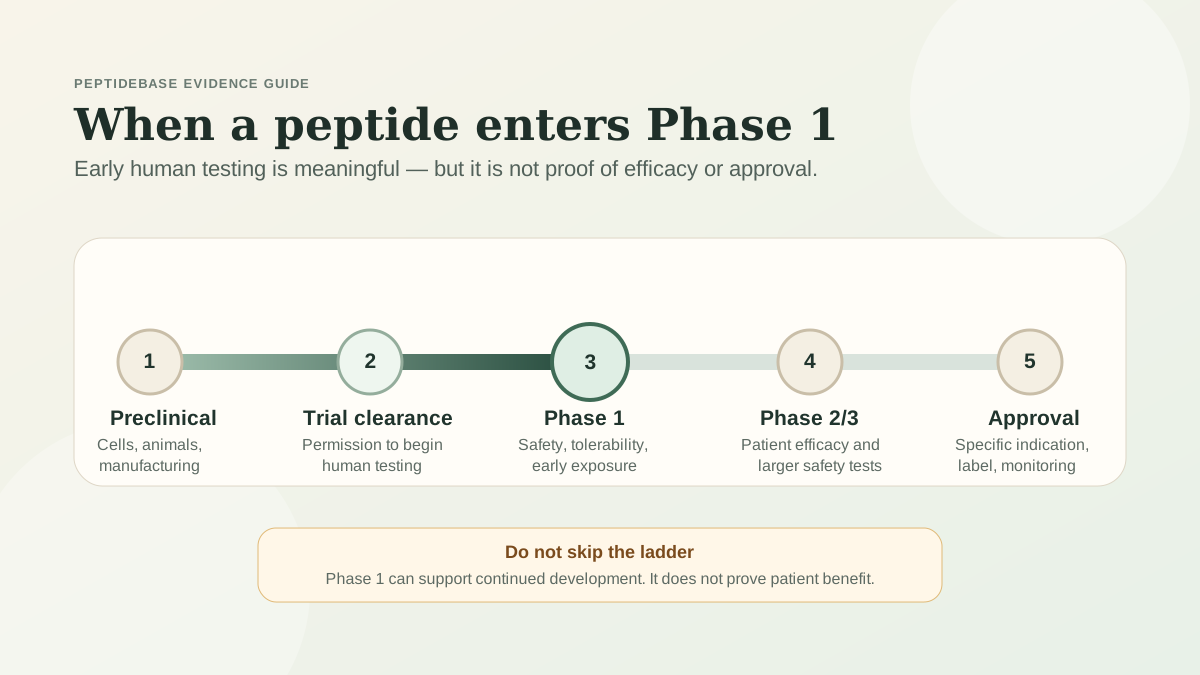 Phase 1 is an early human evidence step. It is not the same as efficacy, approval, or consumer availability.
Quick Answer: What Does Phase 1 Mean for a Peptide?
A Phase 1 peptide trial usually means the candidate is being tested in humans for the first time, often in healthy volunteers or a small patient group. The main questions are typically safety, tolerability, dose escalation, pharmacokinetics, pharmacodynamics, and whether there are obvious problems that would stop further development.
| Milestone | What it can mean | What it does not prove |
|---|---|---|
| FDA clearance to begin a trial | Regulators allowed a proposed human study to start | The peptide is approved or effective |
| Phase 1 in healthy volunteers | Early safety/tolerability and exposure data under controlled conditions | Benefit in patients with the target disease |
| Phase 1a/1b in patients | Early human safety plus possible exploratory signals in a target population | Durable clinical efficacy or broad safety |
| Phase 2 | More focused dose/effect and proof-of-concept testing | Final approval-level evidence |
| Phase 3 | Larger confirmatory testing for efficacy and safety | Automatic approval or risk-free use |
Answer block: does Phase 1 mean a peptide works?
No. Phase 1 can be important, but it usually does not prove a peptide treats the target disease. It mostly asks whether the candidate can be given to humans under trial conditions without unacceptable early safety or tolerability issues. The broader peptide research-status evidence ladder shows where this milestone sits without treating it as approval or proof of benefit.
Example 1: KIT2014 and Inhaled Peptide Development
Kither Biotech announced that KIT2014, described by the company as a novel inhaled peptide therapy for respiratory diseases, completed a first-in-human Phase 1 clinical trial. The company said the study enrolled 56 healthy participants and evaluated safety and tolerability across single- and multiple-ascending-dose parts of the trial.
This is a meaningful update because it puts KIT2014 in a category very different from casual “peptide therapy” marketing. It is not just a peptide name on a clinic menu or a research-use-only vial. It is a specific investigational candidate moving through a regulated drug-development pathway.
But the key phrase is healthy participants. A healthy-volunteer Phase 1 study can help answer whether the peptide was tolerated in that population, at those doses, with that formulation, under that protocol. It does not show whether the peptide improves outcomes for people with COPD, cystic fibrosis, bronchiectasis, or any other respiratory condition.
That is the category mistake to avoid: Phase 1 tolerability is not disease efficacy.
What KIT2014 Can Teach Readers
KIT2014 is useful for PeptideBase because it illustrates several evidence concepts at once:
- Route of delivery matters. An inhaled peptide is not the same evidence story as an injectable peptide, oral supplement claim, or topical cosmetic peptide.
- Systemic exposure matters. Company statements about low plasma exposure are pharmacokinetic claims that need to be interpreted in the context of the study design.
- Target disease matters. A respiratory-disease program should eventually be judged in respiratory-disease populations, not just healthy volunteers.
- Company announcements are not peer review. A press release can accurately report a milestone while still emphasizing the most favorable framing.
Answer block: should a healthy-volunteer peptide trial be treated as patient evidence?
No. It can support continued development, but patient benefit requires patient data. Healthy-volunteer safety and tolerability are not a substitute for clinical outcomes in the disease being targeted.
Example 2: Nubytide / 8M2D and FDA Clearance to Start Human Testing
Cenna Biosciences announced that it received FDA clearance to begin a Phase 1a/1b clinical trial of 8M2D / Nubytide, described by the company as a peptide designed to reduce amyloid-beta production in Alzheimer’s disease.
This is another real milestone, but it sits even earlier than completed Phase 1 results. FDA clearance to begin a trial means the proposed study can proceed. It does not mean the peptide is approved. It does not mean regulators have confirmed that the mechanism will work in humans. It does not mean the candidate has shown clinical benefit.
Alzheimer’s disease also deserves extra caution. The field has a long history of mechanisms that looked plausible, even compelling, before failing to translate cleanly into patient outcomes. A peptide designed around amyloid biology can be scientifically interesting without being clinically proven.
The right reading is cautious:
- Real event: a formal human trial can begin.
- Reasonable interest: the program is trying a mechanistically specific peptide approach.
- Boundary: there are no Phase 1a/1b outcome results yet from the newly cleared trial.
- Do not overclaim: trial clearance is not efficacy.
FDA Clearance Is Not FDA Approval
One of the easiest errors in peptide news is confusing FDA clearance to start a clinical trial with FDA approval to market a treatment.
Those are very different.
When a sponsor receives clearance to begin a clinical trial, the regulatory question is roughly: is there enough information for the proposed human study to proceed under oversight? When a drug is approved, the regulatory question is much larger: has the sponsor provided adequate evidence of safety and effectiveness for a specific use, with labeling, manufacturing, risk information, and post-market responsibilities?
A reader should mentally translate:
- “FDA-cleared Phase 1 trial” → allowed to begin early human testing
- “completed Phase 1” → early human safety/tolerability step completed
- “Phase 2 planned” → more testing needed
- “approved” → regulator has authorized a specific marketed use
Those phrases should not be blended together.
Why This Matters for PeptideBase Readers
PeptideBase spends a lot of time separating evidence from peptide marketing because the same word — peptide — appears in very different worlds.
There are:
- approved peptide medicines with labels and regulated indications
- investigational peptide drugs in formal clinical trials
- peptide imaging agents and radiopharmaceuticals
- cosmetic peptides used in topical products
- preclinical peptides studied in animals or cells
- research-use-only peptides sold outside normal drug-approval pathways
- clinic or influencer claims that borrow scientific language without matching evidence
KIT2014 and Nubytide belong in the formal investigational-drug bucket. That makes them more serious than casual marketplace claims, but it does not make them proven treatments.
The useful lesson is not “these peptides work.” The useful lesson is how to read development milestones without falling for either hype or cynicism.
A Simple Reading Framework for Peptide Trial News
When a peptide headline mentions Phase 1, ask five questions before trusting the implication:
1) Was this a completed trial or permission to start one?
A completed Phase 1 trial and clearance to begin Phase 1 are both milestones, but they are not the same. One has generated early human data. The other has permission to generate it.
2) Who was studied?
Healthy volunteers, adults with obesity, people with Alzheimer’s disease, patients with cancer, and people with rare respiratory diseases are not interchangeable populations. Safety and tolerability in one group do not automatically translate to another.
3) What was the main endpoint?
Phase 1 endpoints often focus on safety, tolerability, pharmacokinetics, and dose escalation. If the endpoint is not clinical improvement, the headline should not be read as clinical improvement.
The 38-person first-in-human TE-8105 study is a concrete example: its roughly 120-hour half-life supports further dosing research, not claims of superior weight loss, safety, adherence, or convenience.
4) Is the source a company announcement, trial registry, peer-reviewed paper, or regulator?
Company announcements can be useful, especially for development milestones, but they are not neutral evidence summaries. Peer-reviewed papers, trial registries, regulatory labels, and press releases all answer different questions.
5) What would the next evidence step need to show?
For KIT2014, the next meaningful questions are likely patient-population safety, target engagement, dose selection, and respiratory clinical outcomes. For Nubytide/8M2D, the next step is whether the Phase 1a/1b trial can establish acceptable early human safety and generate interpretable exploratory data.
What Not to Conclude From These Updates
Do not conclude that:
- KIT2014 treats COPD, cystic fibrosis, or bronchiectasis in patients.
- Nubytide/8M2D treats Alzheimer’s disease.
- either peptide is approved for public use.
- either peptide belongs in a clinic “peptide therapy” offering.
- Phase 1 safety language means long-term safety is known.
- a company’s mechanism description is the same as clinical proof.
That may sound strict, but it is the only way to keep peptide coverage honest.
The Better Takeaway
The better takeaway is that peptide drug development is broadening. Some peptide candidates are being built as inhaled respiratory drugs. Others are being tested around neurodegenerative mechanisms. Elsewhere, peptides are used in diagnostics, radiopharmaceuticals, metabolic drugs, topical products, and preclinical delivery systems.
That diversity is exactly why evidence categories matter.
A peptide entering Phase 1 deserves attention. It may represent serious science, real investment, and a legitimate regulatory path. But until later trials show patient benefit, the most accurate sentence is not “this peptide works.” It is:
This peptide has reached an early human-testing milestone, and the next studies will determine whether the early promise survives contact with patient data.
FAQ
Is a peptide in Phase 1 FDA-approved?
No. Phase 1 means the peptide is being tested under a clinical protocol. FDA approval for marketed use requires a separate evidence and review process.
Can a Phase 1 peptide still fail?
Yes. Many drug candidates fail after Phase 1 because later studies show insufficient efficacy, safety problems, poor pharmacokinetics, manufacturing issues, or weak benefit-risk balance.
Why do companies announce Phase 1 results if they do not prove efficacy?
Phase 1 results can be important for investors, researchers, regulators, partners, and future trial planning. They can show that a candidate is tolerable enough to continue development. That is meaningful, but limited.
Is FDA clearance to begin a trial the same as positive trial data?
No. Clearance to begin a trial means the study can start. Positive trial data would require results after participants are studied.
How should readers compare investigational peptides with research-use-only peptides?
An investigational peptide in a formal clinical trial has a defined sponsor, protocol, regulatory oversight, manufacturing controls, and evidence-generation plan. A research-use-only product sold online is a very different category and should not borrow credibility from formal drug-development milestones.
Sources
- Kither Biotech. “Kither Biotech Successfully Completes Phase 1 Clinical Trial of KIT2014, a Novel Inhaled Peptide Therapy for Respiratory Diseases.” GlobeNewswire, June 19, 2026.
- Cenna Biosciences. Company news page and Access Newswire release, “Cenna Biosciences Receives FDA Clearance to Begin Phase 1a/1b Clinical Trial of 8M2D, a First-in-Class Peptide Designed to Stop the Production of Amyloid in Alzheimer’s Disease,” June 17, 2026: https://www.accessnewswire.com/newsroom/en/biotechnology/cenna-biosciences-receives-fda-clearance-to-begin-phase-1a/1b-clinical-trial-of-8m2d-1178769