A Peptide Changed a Biomarker. Did It Help Patients? Surrogate Endpoints Explained
A peptide can change a laboratory value, activate a receptor, shrink something on an image, or trigger an immune response without yet proving that patients benefit. The key question is whether the measured change is merely a biomarker, an accepted surrogate endpoint, an intermediate clinical outcome, or a direct clinical outcome showing that people feel better, function better, or survive longer.
Some surrogate endpoints are sufficiently established to support regulatory decisions. Others are only candidates or are considered reasonably likely to predict benefit in a specific setting. The label belongs to the endpoint in context—not to the biomarker forever and everywhere.
Quick answer: A biomarker shows biology. A surrogate endpoint is a biomarker used instead of a direct clinical outcome because it is expected to predict benefit. A direct clinical outcome measures what happens to patients. The first does not automatically establish the last.
This article is educational only. It does not provide medical advice, treatment guidance, dosing protocols, purchasing advice, or sourcing information.
In this guide
- Surrogate endpoint vs clinical endpoint
- When a biomarker becomes a surrogate
- Validated, reasonably likely, and candidate surrogates
- Peptide-drug and peptide-vaccine examples
- Regulatory pathways
- How to read a peptide trial
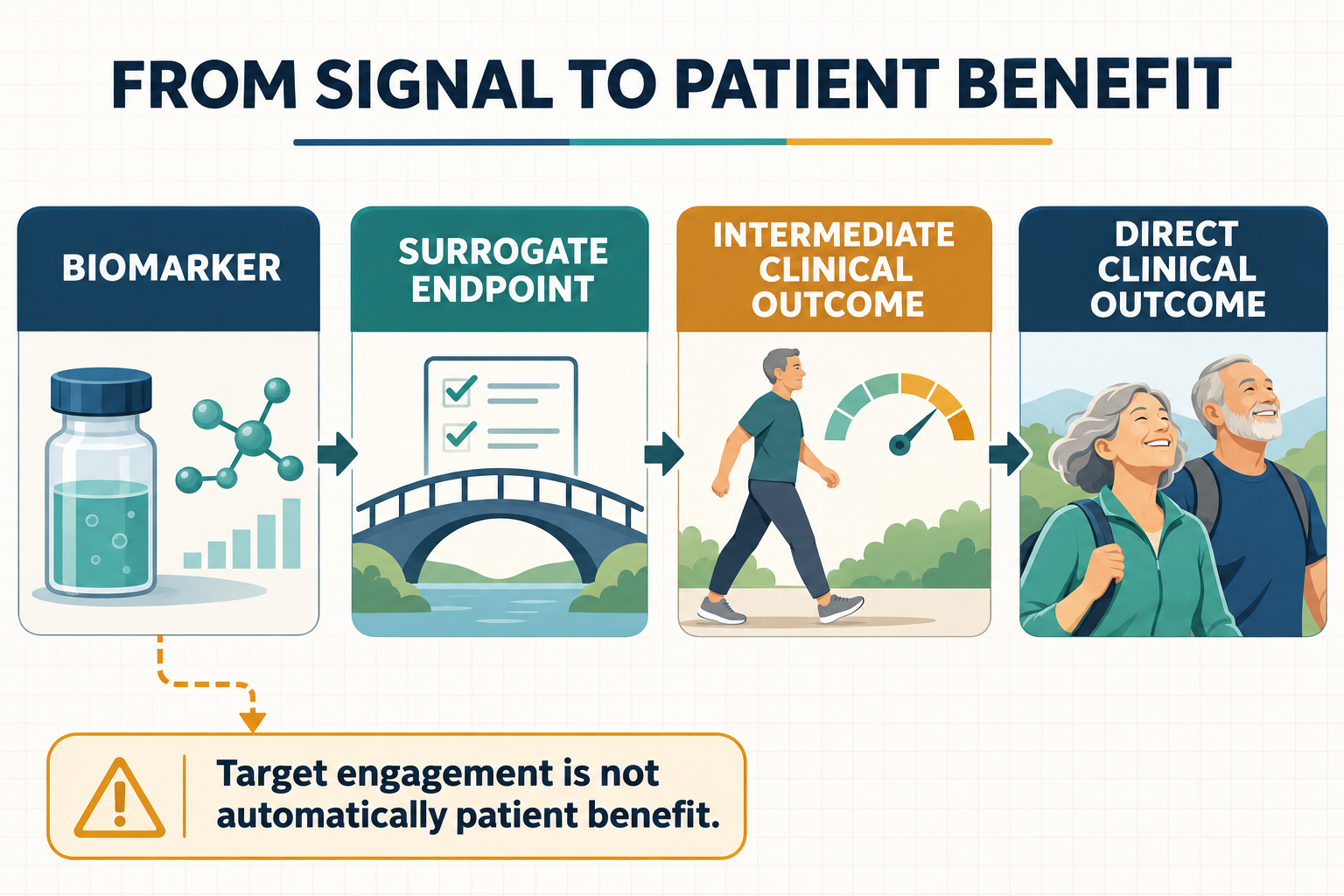
A biological signal can be important without being the final answer. The evidentiary bridge to patient benefit must be established for the exact endpoint and context.
Surrogate endpoint vs clinical endpoint: what is the difference?
A surrogate endpoint predicts patient benefit; a clinical endpoint measures patient benefit directly. The FDA-NIH BEST glossary separates biomarkers from how people feel, function, or survive because these measurements answer different questions.
| Term | What it measures | Example | What it can establish |
|---|---|---|---|
| Biomarker | A biological process, response, or exposure | Hormone level, receptor occupancy, antibody titer, tumor DNA, imaging measurement | The biology changed |
| Surrogate endpoint | A biomarker used as a substitute for a direct clinical outcome | A context-accepted laboratory or imaging measure | Predicted clinical benefit, with confidence depending on validation and context |
| Intermediate clinical outcome | A symptom or functional outcome occurring earlier than the ultimate outcome | Earlier improvement in symptoms or function when irreversible morbidity or survival takes longer to observe | A real patient effect, but not necessarily the final outcome of greatest interest |
| Direct clinical outcome | How a patient feels, functions, or survives | Pain, mobility, hospitalization, heart attack, disease recurrence, survival | Clinical benefit itself |
An endpoint is the prespecified result used to answer a trial question. A biomarker can be measured without serving as an endpoint, and a trial can use a biomarker endpoint without that marker being a validated surrogate.
That distinction kills a common shortcut: “the marker moved, therefore the treatment worked.” The marker may show that the intervention reached its target. It may not show that the target mattered enough to improve a person's life.
What counts as a biomarker?
A biomarker is a defined characteristic measured as an indicator of a biological process, response, or exposure—not a measure of how a person feels or functions. It can be molecular, cellular, physiologic, imaging-based, or digital.
In peptide research, biomarkers can include:
- receptor occupancy or downstream signaling;
- hormone concentrations such as growth hormone, insulin, or IGF-1;
- glucose, HbA1c, lipids, or inflammatory markers;
- antibody titers or antigen-specific T-cell responses after a peptide vaccine;
- circulating tumor DNA or serum tumor markers;
- lesion size or plaque burden on imaging;
- pharmacokinetic measures showing drug exposure.
These measurements can be extremely useful. They can confirm exposure, target engagement, biological activity, dose-response relationships, or proof of mechanism. But usefulness is not the same as surrogacy.
Mechanistic evidence answers: Did the intervention do something biologically measurable? Clinical evidence answers: Did that change help patients?
Receptor binding, enzyme inhibition, and signaling changes in a cell dish sit even earlier in the chain. They are mechanistic findings, not human clinical endpoints. Likewise, a marker associated with outcomes in animals is not automatically a human surrogate. See What Preclinical Actually Means for that earlier evidence boundary.
When does a biomarker become a surrogate endpoint?
A biomarker becomes a surrogate endpoint only when it is used to substitute for a clinical outcome—not simply because it correlates with that outcome. A useful surrogate should reliably capture enough of the treatment's effect on the outcome that matters.
This is harder than showing that people with better biomarker values tend to do better. Correlation can fail as a substitute for treatment benefit because:
- the marker may reflect disease severity without causing the outcome;
- the intervention may improve the marker through a pathway that does not improve health;
- the intervention may have benefits or harms outside the marker's pathway;
- the marker may predict outcomes in one disease stage but not another;
- the same marker may behave differently with a different drug class or mechanism.
Validation therefore depends on accumulated biological, epidemiologic, and—most importantly—intervention evidence. The strongest case usually shows across trials that treatment-induced changes in the marker reliably predict treatment-induced changes in the clinical outcome.
The FDA's surrogate endpoint table makes this context visible by pairing each endpoint with a particular disease, population, approval pathway, and drug mechanism. A marker's appearance in the table is not a universal permission slip for every product that can move it.
Validated, reasonably likely, and candidate surrogates
Surrogates exist on an evidentiary spectrum, and the regulatory consequence depends on where an endpoint sits in a particular development program. Three labels are especially useful.
Validated surrogate endpoint
A validated surrogate endpoint is supported by a clear mechanistic rationale and clinical data showing that its treatment effect predicts a specific clinical benefit. It may support traditional approval when the evidence and program justify that use.
“Validated” does not mean infallible or universal. It means sufficiently established for a defined use. Change the disease, population, disease stage, mechanism, or intended benefit, and the validation question may need to be revisited.
Reasonably likely surrogate endpoint
A reasonably likely surrogate endpoint has substantial support but is not fully validated. For serious conditions with unmet need, FDA's Accelerated Approval pathway can allow approval based on an effect on a surrogate—or an intermediate clinical endpoint—considered reasonably likely to predict clinical benefit.
That is an earlier regulatory decision under uncertainty, not a declaration that benefit has already been directly demonstrated. Post-approval confirmatory studies are intended to verify the anticipated clinical benefit. If benefit is not confirmed, the approval can face withdrawal.
Candidate surrogate endpoint
A candidate surrogate is still being evaluated as a possible substitute for a clinical outcome. It may be biologically plausible, prognostic, or useful in exploratory trials without being accepted as the basis for approval.
Calling a candidate marker “clinically validated” because it changed in a small study is marketing doing karaoke with regulatory vocabulary. The words sound familiar; the evidence is not the same song.
Where do intermediate clinical outcomes fit?
An intermediate clinical outcome is a genuine measure of symptoms or function that occurs earlier than the ultimate outcome of interest. Unlike a biomarker surrogate, it directly reflects an aspect of how the patient feels or functions.
For example, an earlier functional improvement could be clinically meaningful even when a trial is too short to measure irreversible disability or survival. In accelerated approval, an intermediate clinical endpoint may support a decision when it is reasonably likely to predict the later clinical benefit.
The word intermediate does not make the endpoint biological or indirect. It means the outcome occurs earlier in the disease pathway than the final outcome. A symptom score can be an intermediate clinical outcome; a laboratory value is generally a biomarker.
Peptide-drug example: a metabolic marker is not a cardiovascular outcome
A peptide drug can improve HbA1c, body weight, or another metabolic measure without that measurement alone proving fewer heart attacks or longer survival. Each endpoint answers its own question.
GLP-1 receptor agonists are peptide medicines. In diabetes trials, HbA1c is an accepted efficacy endpoint for glycemic control in the relevant regulatory context. If a drug lowers HbA1c, that supports a conclusion about glucose control. It does not, by itself, establish every downstream benefit someone might infer from better glucose.
Cardiovascular benefit requires cardiovascular evidence. The SELECT trial, for example, tested semaglutide against a direct composite clinical outcome—cardiovascular death, nonfatal myocardial infarction, or nonfatal stroke—in people with established cardiovascular disease and overweight or obesity but without diabetes. That outcome is qualitatively different from showing weight loss or a laboratory change.
The lesson is not that biomarkers are weak. It is that the claim must match the endpoint:
- HbA1c change can establish an effect on glycemic control in context.
- Weight change can establish an effect on body weight.
- A cardiovascular outcomes trial can establish an effect on cardiovascular events in the studied population.
- None should be silently substituted for the others.
For a related distinction between mechanisms and outcomes, see Semaglutide Heart Benefits Beyond Weight Loss.
Peptide-vaccine example: immune response is not automatically clinical benefit
A peptide vaccine can generate a strong immune response without proving that it prevents recurrence or extends survival. Immunogenicity shows that the immune system recognized the intended antigen. That is necessary for many vaccine strategies, but it may not be sufficient.
The phase 1 AMPLIFY-201 study of ELI-002 2P used mutant-KRAS peptide antigens in people with pancreatic or colorectal cancer who had completed local treatment but still had molecular or serum evidence of residual disease. Researchers measured KRAS-specific T-cell responses, circulating tumor DNA or serum tumor biomarkers, radiographic relapse-free survival, and overall survival.
The final phase 1 report found durable immune responses and associations between stronger T-cell responses and better biomarker and clinical outcomes. Those findings are encouraging. They still do not turn the immune response into a proven surrogate: the study was small, nonrandomized, and exploratory, and some participants received subsequent therapy. Association within a trial cannot by itself prove that inducing the marker caused the outcome.
The right interpretation is layered:
- T-cell response: evidence of immunogenicity and biological activity.
- ctDNA or serum-marker reduction: evidence that tumor-associated biomarkers changed.
- radiographic relapse-free survival: a patient-level clinical outcome involving recurrence or death.
- overall survival: a direct clinical outcome.
- causal efficacy: still requires a design capable of comparing outcomes and separating treatment effects from prognosis, selection, and later therapies.
Our related article on Personalized Pancreatic Cancer Vaccines: Immune Response Is Not Survival Proof applies the same discipline to a narrower case.
What about imaging changes and target engagement?
Imaging and target-engagement findings are endpoint types, not automatic grades of proof. Their meaning depends on what is measured and whether it is linked reliably to patient benefit.
An imaging measure can be:
- a diagnostic or monitoring biomarker;
- an exploratory pharmacodynamic endpoint;
- a candidate surrogate;
- a context-accepted surrogate;
- or part of a clinical outcome, such as radiographic progression combined with death.
Likewise, target engagement can be decisive for mechanism. If a peptide occupies its intended receptor and changes downstream signaling, researchers have evidence that the molecule reached and affected the target. They do not yet know whether the target is the right lever, whether the effect is large enough, or whether off-target effects cancel the benefit.
This is why “target engaged” and “statistically significant biomarker change” should never be rewritten as “patients improved” unless patient outcomes were actually measured and supported that conclusion.
Traditional approval, accelerated approval, and exploratory trials are not interchangeable
The same endpoint language can carry different weight across trial and regulatory settings. Readers should identify the pathway before interpreting the result.
- Exploratory trial use: A marker may help researchers understand mechanism, select participants, or generate a hypothesis. No regulatory acceptance is implied.
- Traditional approval: FDA may accept a direct clinical endpoint or a sufficiently established surrogate in a defined context.
- Accelerated approval: For serious conditions, a reasonably likely surrogate or intermediate clinical endpoint can support earlier approval, with confirmatory evidence needed to verify benefit.
FDA also distinguishes drug-development tools qualified for a defined context of use from endpoints accepted in an individual product program. An endpoint accepted once is not automatically qualified for every sponsor, peptide, or indication.
How to read a peptide trial without being fooled by the headline
Start by naming the endpoint before judging the result. A six-question check prevents most category errors:
- What exactly changed? Receptor binding, hormone level, immune response, imaging, symptoms, function, hospitalization, recurrence, or survival?
- Was it prespecified? Primary endpoints carry different weight from exploratory and post hoc analyses.
- Is it a biomarker or a clinical outcome? Do not let “response” hide the difference.
- If it is a surrogate, what is its status here? Validated, reasonably likely, candidate, or merely assumed?
- Accepted for what context? Check the disease, population, drug mechanism, disease stage, and regulatory pathway.
- Does the claim match the endpoint? A mechanism result supports a mechanism claim; a patient-outcome result supports a patient-benefit claim.
Then inspect the study design. Randomization, comparator choice, sample size, follow-up, missing data, multiplicity, and subsequent treatment determine how confidently the observed difference can be attributed to the intervention. How to Audit Peptide Trial Registry Records explains how to compare a published claim with the prespecified plan.
For the broader claim-checking framework, see How to Evaluate Peptide Claims Online.
Bottom line
A changed biomarker can prove biological activity without proving clinical benefit. A surrogate endpoint goes further because it is used to predict benefit, but the strength of that prediction ranges from candidate to reasonably likely to validated—and always depends on context.
The most defensible reading is precise:
- Biomarkers show what changed in the biology.
- Surrogates predict what may happen to patients, with context-specific confidence.
- Intermediate clinical outcomes measure earlier effects on symptoms or function.
- Direct clinical outcomes show whether people feel better, function better, or survive longer.
Some surrogates legitimately support traditional or accelerated regulatory decisions. But a peptide's target engagement, hormone change, immune response, imaging result, or laboratory shift should never be promoted into patient benefit without the evidentiary bridge to support that step.
Frequently asked questions
Is every surrogate endpoint a biomarker?
Many surrogate endpoints are biomarkers, but not every biomarker is a surrogate. A marker becomes a surrogate endpoint when it is used as a substitute for a clinical outcome and is expected to predict benefit. Accelerated approval can also use an intermediate clinical endpoint, which measures symptoms or function rather than biology.
Does a statistically significant biomarker change prove a peptide works?
It proves that the measured biomarker differed under the study's analysis, assuming the design and data are sound. Whether that means the peptide improved health depends on the marker's role, validation, effect size, study context, and patient outcomes.
What is the difference between a validated and reasonably likely surrogate?
A validated surrogate has stronger clinical evidence that treatment effects on the marker predict a specific clinical benefit. A reasonably likely surrogate has substantial but incomplete support and may be used for accelerated approval in a serious condition, with confirmatory studies needed to verify benefit.
Can an immune response be a surrogate endpoint?
Yes, in some vaccine contexts an immune marker is accepted as a surrogate. That acceptance does not transfer automatically to a different pathogen, cancer vaccine, antigen, assay, population, or intended benefit.
Is progression-free survival a surrogate or a clinical outcome?
It is a time-to-event endpoint that combines disease progression and death, but its regulatory interpretation is context-specific. It may be used as a clinical endpoint or as a surrogate for a later outcome such as overall survival; the exact claim and disease setting matter.
Where can I check FDA-accepted surrogate endpoints?
FDA publishes a table of surrogate endpoints used as the basis for approval or licensure. The table is a development resource, not a guarantee that an endpoint will be accepted for a new product or context.
Sources and further reading
- FDA-NIH Biomarker Working Group. BEST (Biomarkers, EndpointS, and other Tools) Resource.
- U.S. Food and Drug Administration. Surrogate Endpoint Resources for Drug and Biologic Development.
- U.S. Food and Drug Administration. Table of Surrogate Endpoints That Were the Basis of Drug Approval or Licensure.
- U.S. Food and Drug Administration. Accelerated Approval.
- Lincoff AM, et al. Semaglutide and Cardiovascular Outcomes in Obesity without Diabetes. New England Journal of Medicine. 2023.
- Pant S, et al. Lymph node-targeted, mKRAS-specific amphiphile vaccine in pancreatic and colorectal cancer: phase 1 AMPLIFY-201 trial final results. Nature Medicine. 2025.