Does Semaglutide Protect the Heart Beyond Weight Loss? What the SELECT Mediation Analysis Shows
SELECT showed fewer major cardiovascular events with semaglutide. A 2026 mediation analysis found that measured weight and risk-factor changes explained only part of the result, without proving a direct heart mechanism.
Does Semaglutide Protect the Heart Beyond Weight Loss? What the SELECT Mediation Analysis Shows
Semaglutide reduced major cardiovascular events in the randomized SELECT trial, and a new mediation analysis suggests that measured changes in weight and familiar cardiovascular risk markers explain only part of that benefit. But the unexplained remainder is not proof that semaglutide directly protects the heart, blood vessels, or immune system through one specific mechanism.
That distinction is the whole story. SELECT provides strong randomized evidence about a clinical outcome in a defined population. The September 2026 analysis by Colhoun and colleagues is a post hoc statistical attempt to understand why the outcome differed. It generates useful clues, not a newly randomized mechanism experiment.

SELECT established an outcome difference. The later mediation analysis tested how much of that difference could be statistically assigned to measured changes in adiposity, blood pressure, lipids, glycaemia, inflammation, and kidney markers.
Quick answer: are semaglutide's heart benefits independent of weight loss?
The evidence supports “not fully explained by measured weight change,” not “proven independent of weight loss.”
In the new analysis, body weight alone had an estimated mediation proportion of 19.5%, but its 95% confidence interval ranged from -33.0% to 110.7%. Waist circumference produced a larger point estimate of 64.0%, but supplementary analyses raised concerns that the weight and waist estimates were unreliable.
When the researchers considered all measured mediators together, the estimated mediated proportion was 31.4%, with a very wide 95% confidence interval from -30.1% to 143.6%. In a model excluding body weight and waist circumference, the point estimate was 46.0%, again with a wide interval from -6.0% to 161.0%.
Those estimates do not divide the benefit into clean, known percentages. They say the available models could not confidently assign the full cardiovascular effect to the measured variables.
What did the original SELECT trial prove?
SELECT showed that semaglutide lowered the rate of major adverse cardiovascular events compared with placebo in adults with overweight or obesity, established cardiovascular disease, and no diabetes.
The multicenter trial randomly assigned 17,604 adults aged 45 or older to semaglutide or placebo. All participants had a body-mass index of at least 27 and pre-existing cardiovascular disease, but no history of diabetes.
The primary outcome combined cardiovascular death, nonfatal heart attack, and nonfatal stroke. Over a mean follow-up of 39.8 months:
- 569 of 8,803 participants in the semaglutide group had a primary event, or 6.5%.
- 701 of 8,801 participants in the placebo group had a primary event, or 8.0%.
- The hazard ratio was 0.80, with a 95% confidence interval from 0.72 to 0.90.
That is the basis for the widely reported 20% relative reduction in major cardiovascular events. The absolute event-rate difference was 1.5 percentage points over the trial's follow-up period.
Randomization makes this outcome comparison persuasive because it helps balance measured and unmeasured baseline differences between groups. It does not, by itself, reveal which biological changes produced the benefit.
What did the 2026 mediation analysis ask?
The mediation analysis asked how much of SELECT's cardiovascular effect could be statistically linked to changes in several measured risk factors over the first 24 months.
The investigators examined changes in:
- body weight and waist circumference;
- blood pressure and blood lipids;
- glycated haemoglobin, or HbA1c;
- high-sensitivity C-reactive protein, or hsCRP, as an inflammation marker;
- estimated glomerular filtration rate; and
- urinary albumin-to-creatinine ratio.
They used a counterfactual repeated-regression method designed for a time-to-event outcome with repeatedly measured mediators. In plain English, the models estimated how the event curves might have differed if a potential mediator had followed a different path while other parts of the comparison were held under the model's assumptions.
Semaglutide improved every investigated mediator on average. The largest single-mediator point estimates were 64.0% for waist circumference, 42.1% for hsCRP, 29.0% for HbA1c, and 19.5% for body weight. The confidence intervals were wide, however, and some extended below 0% and above 100%.
An estimate above 100% or below 0% is not a sensible literal share of biology. It is a warning that the statistical estimate is imprecise or unstable.
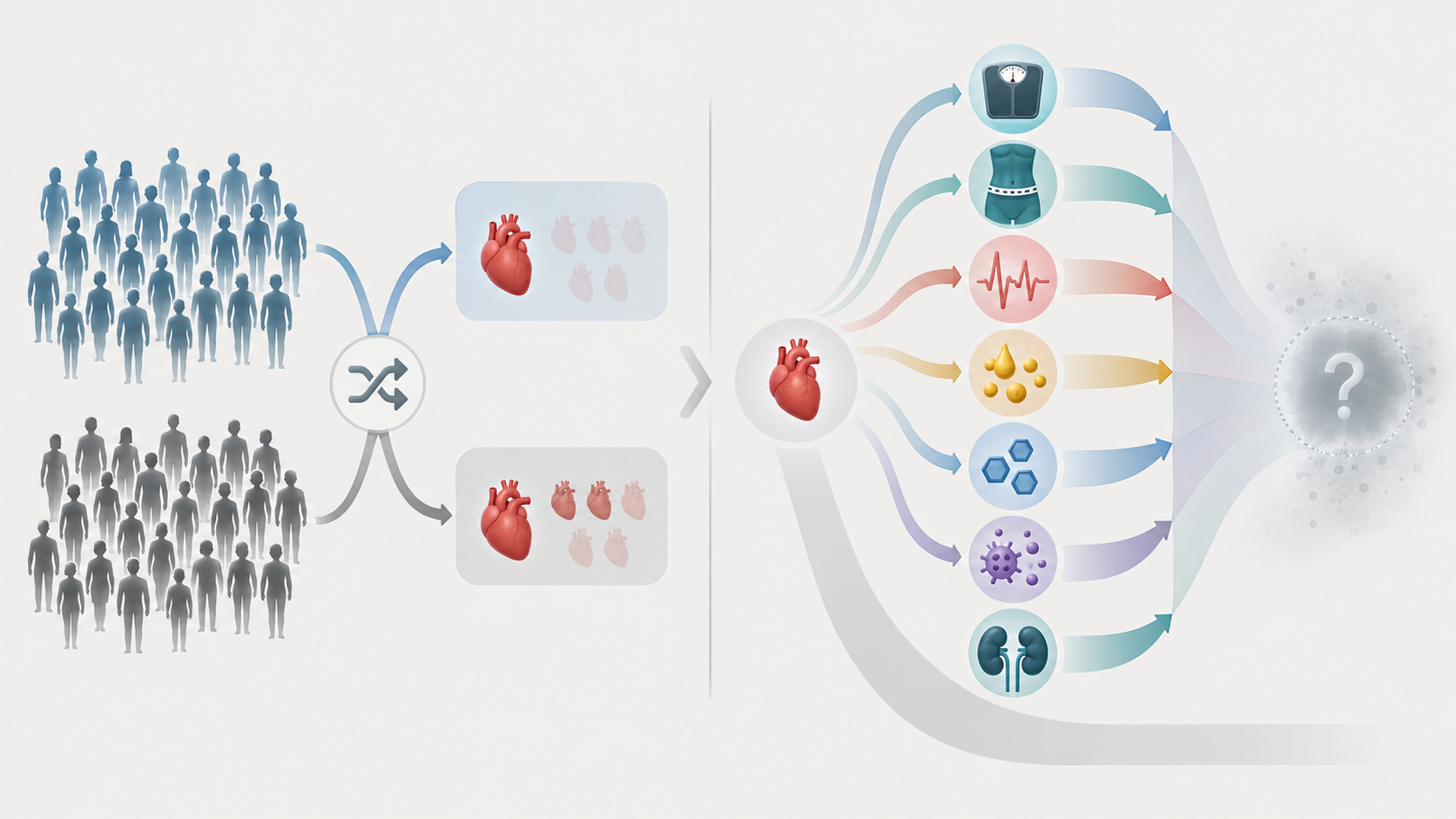
The treatment assignment was randomized; the later relationships between changes in biomarkers and cardiovascular events were modeled. Those are different levels of causal evidence.
Why “unexplained” does not mean “direct heart protection”
A residual effect after adjustment is a gap in the model, not the discovery of a mechanism.
It is tempting to reason this way: if weight, blood pressure, lipids, glycaemia, inflammation, and kidney measures explain only part of the observed benefit, the rest must be a direct effect on the heart or blood vessels. That conclusion does not follow.
The unexplained portion could reflect:
- biological pathways that were not measured;
- measured variables captured too infrequently or with error;
- a mediator represented by an imperfect surrogate marker;
- interactions among mediators that the model did not capture;
- differences in when mediator changes and events occurred;
- missing data and selection into the analyzed measurements; or
- failure of the assumptions required for causal mediation estimates.
Anti-inflammatory, vascular, autonomic, metabolic, and direct tissue effects remain plausible research hypotheses. The analysis does not identify one as the answer. Even hsCRP, which had a 42.1% single-mediator point estimate, is a broad marker associated with inflammation; changing hsCRP does not by itself prove a particular anti-inflammatory pathway caused fewer events.
Why the timing and missing data matter
Mediation depends on measuring the right variable at the right time, and SELECT's follow-up created several practical complications.
The primary mediation window used changes from randomization to 24 months. Cardiovascular events occurred across the broader trial follow-up, while body weight and biomarkers changed over time. A 24-month summary can miss earlier changes, later changes, nonlinear patterns, and the sequence linking a mediator to an event.
The COVID-19 period also disrupted scheduled measurements and increased missingness. If people with complete 24-month measurements differed from those without them, modeling and imputation choices can affect the result. Statistical methods can reduce that problem, but they cannot guarantee that missing values behave exactly as assumed.
Weight change is especially difficult to interpret after randomization. Intentional fat loss may improve risk, but illness, frailty, loss of muscle, or other health changes can also reduce body weight while signaling higher risk. The paper's supplementary analyses found that the relationship of weight or waist change to cardiovascular events differed between the semaglutide and placebo groups. That makes a simple “kilograms lost equals cardiovascular benefit mediated” story unreliable.
Why this is not a second randomized mechanism trial
SELECT randomized treatment, not weight loss, hsCRP reduction, blood-pressure change, or kidney-marker change.
After randomization, mediators are no longer protected by the original random assignment. People who lose more weight or show a larger biomarker change can differ from others in adherence, underlying health, frailty, medication changes, illness, measurement availability, and many other ways.
Mediation methods try to address such differences, but their causal interpretation depends on assumptions that cannot all be tested directly. These include adequate control of confounding between the mediator and outcome, correct model specification, and appropriate handling of time-varying factors affected by treatment.
For a broader guide to separating randomized, observational, mechanistic, and preclinical evidence, see Peptide Research Status Explained and What Preclinical Actually Means.
What should readers take from the “about half” figure?
The fairest summary is that the multivariable models attributed roughly one-third to, at most by point estimate, just under one-half of the observed effect to the measured mediator set, with uncertainty too wide for a precise percentage claim.
The all-mediator point estimate was 31.4%. The model excluding body weight and waist circumference reached 46.0%. Neither estimate was statistically precise, and neither means the remaining 68.6% or 54.0% is a proven direct drug effect.
This is still informative. It argues against reducing SELECT to “people lost weight, therefore fewer events occurred” as a complete explanation. It also argues against the opposite overreach: “weight did not matter.” Weight and waist measures were among the candidate mediators, but their estimates behaved in ways that made simple causal attribution difficult.
Readers interested in how GLP-1 medicines differ from loosely grouped research compounds can read GLP-1 Peptides vs Research Peptides. The distinction matters because evidence from a large randomized trial of a defined medicine cannot be transferred to unrelated products merely labeled “peptides.”
How should funding and author relationships be read?
The study's industry relationships should be disclosed clearly and interpreted as context, not as automatic proof that the findings are invalid.
SELECT and the mediation analysis were funded by Novo Nordisk. Five coauthors were listed with Novo Nordisk A/S affiliations: G. Kees Hovingh, Søren Hardt-Lindberg, Tugce Kalayci Oral, Peter E. Weeke, and Martin Linder. The paper also reports extensive industry relationships across the author group, including relationships involving Novo Nordisk and other pharmaceutical companies.
These relationships can affect study design, analytic choices, interpretation, and publication incentives, which is why transparent disclosure and independent scrutiny matter. They do not, by themselves, establish misconduct or make the randomized outcome disappear. The right response is to examine the methods, uncertainty, and reproducibility more carefully—not to ignore the disclosure or use it as a substitute for methodological criticism.
Bottom line
Semaglutide's cardiovascular benefit in SELECT is supported by a large randomized placebo-controlled trial. The claim that the benefit is “beyond weight loss” is more cautious: measured weight and risk-factor changes did not fully explain the effect under the authors' post hoc models, but the analysis did not prove a specific direct cardiac, vascular, or anti-inflammatory mechanism.
The strongest evidence is the randomized event reduction. The mediation analysis is a useful map of what remains unresolved.
Frequently asked questions
Did SELECT prove that semaglutide prevents heart attacks for everyone?
No. SELECT showed a lower composite rate of cardiovascular death, nonfatal heart attack, or nonfatal stroke in adults with overweight or obesity, established cardiovascular disease, and no diabetes. It does not automatically generalize to every population or individual.
Did weight loss explain none of the benefit?
No. The body-weight point estimate suggested partial mediation, but it was imprecise, and supplementary analyses raised reliability concerns for both weight and waist circumference. The study cannot support either “all weight” or “no weight.”
Does the unexplained portion prove a direct anti-inflammatory effect?
No. hsCRP was one investigated mediator, but it is a broad marker. Residual benefit could reflect unmeasured biology, measurement error, timing, missing data, interactions, or model assumptions as well as additional biological pathways.
Was the mediation analysis randomized?
Treatment assignment in SELECT was randomized. The changes in weight, inflammation, blood pressure, and other potential mediators were not separately randomized, so the mechanism analysis relies on statistical assumptions.
Should this article guide treatment choices?
No. This is an evidence-literacy explanation. It does not provide diagnosis, treatment selection, dosing, switching, or individualized medical advice.
Sources
- Colhoun HM, et al. “Semaglutide and cardiovascular risk reduction: a mediation analysis of the SELECT trial.” European Heart Journal. Published online September 23, 2026. doi:10.1093/eurheartj/ehag524; PubMed PMID 42777687.
- Lincoff AM, et al. “Semaglutide and Cardiovascular Outcomes in Obesity without Diabetes.” New England Journal of Medicine. 2023;389:2221–2232. doi:10.1056/NEJMoa2307563; PubMed PMID 37952131.
This article is for general education. It is not medical advice and does not recommend starting, stopping, switching, or changing any medication.