An Immune Response Is Not a Survival Benefit: What Personalized Pancreatic Cancer Vaccines Actually Show
Two small pancreatic cancer vaccine trials showed immune responses—not proven survival benefit. Understand the denominators, assay limits, safety, and registry gaps.
An Immune Response Is Not a Survival Benefit: What Personalized Pancreatic Cancer Vaccines Actually Show
Personalized pancreatic cancer vaccines produced measurable immune responses in two small phase 1 trials, but did not establish that vaccination prolonged life or prevented recurrence. That is the essential distinction in the September 4, 2026 Science Advances report by Zhang Perkins and colleagues: a personalized pancreatic cancer peptide vaccine immune response is evidence of immune recognition, not automatically evidence of patient benefit.
The paper concerns two separate, nonrandomized trials after pancreatic cancer surgery and adjuvant chemotherapy. One used synthetic long-peptide (SLP) vaccines; the other used DNA vaccines. It was not a randomized peptide-versus-DNA comparison, preventive vaccination in healthy people, or an mRNA vaccine trial.
What did the personalized pancreatic cancer peptide vaccine immune response show?
All 16 patients in the main immune-evaluable group responded to at least one vaccine neoantigen. That group was smaller than either the enrolled population or the vaccinated population, and “response” meant an immune-assay result—not cancer shrinkage, cure, or a survival improvement.
Keep four findings separate:
- Feasibility: researchers could make and deliver personalized vaccines to some enrolled patients; others did not reach vaccination.
- Immunogenicity: the vaccines elicited detectable neoantigen-specific T-cell responses in the main evaluable group.
- Safety: no grade 3-or-higher treatment-related adverse events were observed among the 20 vaccinated participants, but milder reactions occurred.
- Clinical efficacy: exploratory comparisons with matched institutional controls did not establish an overall-survival or disease-free-survival benefit.
These findings come from the primary report's Results and Methods. Safety was the primary endpoint, immunogenicity was secondary, and survival outcomes were exploratory. Our guide to what entering phase 1 means explains why those distinctions matter.
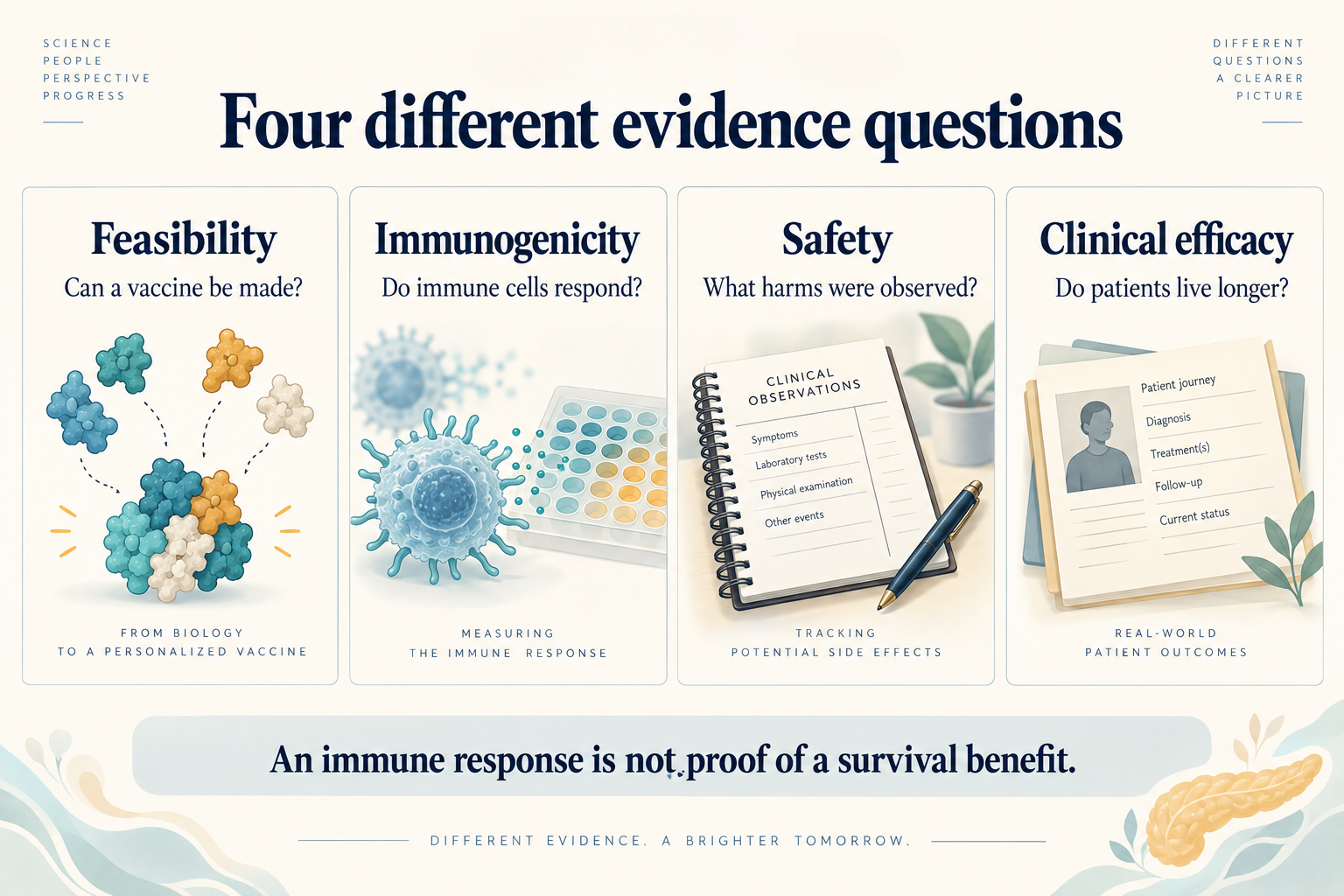
Original AI-generated conceptual illustration. The four categories ask different questions; an immune-assay response cannot substitute for evidence of longer survival. This is not a study figure or a depiction of measured results.
On this page
- Neoantigens and delivery platforms
- The enrollment funnel
- What immune assays measure
- Survival and matching limitations
- Safety and manufacturing
- Registry differences
- Conflicts of interest
- Evidence checklist
What are personalized neoantigens, and how do SLP and DNA differ?
Personalized neoantigens are potential immune targets arising from mutations in an individual person's tumor. Researchers compare tumor and normal genetic information, consider which altered genes are expressed, and prioritize candidate targets. A mutation's existence does not guarantee that immune cells will recognize it or that targeting it will control cancer.
Cells display protein fragments through molecules called HLA, part of the major histocompatibility complex, or MHC. T cells can recognize particular fragments in that display. A personalized vaccine aims to encourage recognition of selected tumor-associated mutant fragments rather than deliver one universal pancreatic cancer target.
The two delivery concepts are different:
- SLP vaccine: supplies synthetic peptide material containing the selected targets. Antigen-presenting cells process that material and display fragments to T cells.
- DNA vaccine: supplies DNA encoding target-containing material. Cells use that genetic information to produce material that can enter antigen-presentation pathways. It is not a peptide injection simply because peptides eventually appear in the recognition process.
Neither conceptual explanation establishes clinical efficacy. Nor does this paper establish which delivery platform works better. Vaccination schedules, blood-sampling timing, and enrollment periods differed. The authors specifically caution against drawing platform-superiority conclusions from immune-response magnitude.
These postoperative studies are also distinct from the pancreatic mKRAS-VAX prevention study. People who have already undergone cancer surgery are not the same study population as healthy or high-risk people receiving preventive vaccination.
Who was enrolled, vaccinated, and immune-evaluable?
The denominator changes at each stage, so the headline immune-response finding cannot be applied to everyone enrolled. The paper's patient-flow description reports:
- SLP trial: 14 enrolled → 9 received vaccine → 8 completed the series without recurrence and were immune-evaluable.
- DNA trial: 18 enrolled → 11 received vaccine → 8 completed the series without recurrence and were immune-evaluable.
- Main immune analysis: all 16 of those evaluable patients responded to at least one neoantigen.
- Separate testing: two additional patients with recurrence, one from each trial, were assessed separately and showed neoantigen responses. They should not be silently folded into the main 16-person denominator.
The 9 SLP and 11 DNA recipients formed the paper's safety and survival populations. That is a different denominator from the main immune-evaluable group.
Before vaccination, some participants withdrew because of recurrence; others could not proceed because of tissue or sequencing quality, too few mutations, or patient preference. Recurrence during the vaccination period further separated vaccinated patients from those completing without recurrence.
Quick answer: Was this a 100% cancer response rate? No. The universal response in the main evaluable group was to at least one neoantigen in an immune assay. It was not a measure of tumors disappearing. Completing vaccination without recurrence at that point also does not mean remaining recurrence-free indefinitely.
What does a laboratory immune response measure?
The assays establish immune recognition under the tested conditions, not elimination of cancer inside the patient. Much of the monitoring used patient blood cells restimulated and cultured with neoantigen material in the laboratory before analysis.
One assay, interferon-gamma ELISpot, detects cells releasing an immune-signaling protein after encountering a target. Laboratory restimulation can expand rare responsive cells, making a signal easier to detect. That is useful for asking whether target-specific immune cells exist, but the resulting magnitude is not a direct count of active cancer-killing cells throughout the body.
The study also included ex vivo assessments—testing without the same extended culture step. The supplement's Figure S2 narrative describes those measurements. The main paper acknowledges that short-term culture likely revealed responses below the ex vivo detection threshold. “All responded” therefore needs its assay context, not just its denominator.
Other analyses strengthen the immunology finding:
- Cytokine analyses characterized functional responses in selected CD4 and CD8 T cells.
- T-cell receptor, or TCR, sequencing tracked expansion of particular T-cell lineages.
- Selected receptor-validation experiments supported recognition of particular neoantigens.
These are complementary lines of evidence, not interchangeable measurements in every participant. They do not demonstrate that responding T cells reached all residual cancer sites, recognized every relevant tumor cell, overcame the tumor environment, or changed survival.
Because vaccination followed surgery, the investigators also could not assess its effect on the removed primary tumor's immune environment. The broader immunopeptidome and cancer-target safety framework explains why identifying an immune target is only one part of evaluating it.
Did the vaccines improve survival or prevent recurrence?
Neither overall survival nor disease-free survival established a benefit in this study. The exploratory clinical-outcome analysis compared vaccinated participants with propensity-matched institutional controls, not randomly assigned controls.
The reported medians were:
- Overall survival (OS): 4.4 years with vaccination versus 3.5 years in controls; P = 0.23.
- Disease-free survival (DFS): 1.7 years versus 2.2 years; P = 0.77.
- Survival after recurrence: 2.0 years versus 0.7 years; P = 0.01.
OS and DFS were measured from surgery. DFS counted recurrence or death, whichever occurred first. Survival after recurrence used recurrence as its starting point.
The first two comparisons were not statistically significant. The OS medians should not be rewritten as “the vaccine added nine months of life.” The DFS result does not establish recurrence prevention, and its numerically shorter median does not by itself prove harm either. Small exploratory studies can leave substantial uncertainty in both directions.
The post-recurrence result is a signal worth investigating, but P = 0.01 does not establish that vaccination caused longer survival. It concerns a subgroup defined by recurrence within a nonrandomized comparison. Differences in underlying disease, subsequent care, and selection remain possible explanations; this analysis cannot determine their contributions.
The paper also reports no association between greater ELISpot response magnitude and increased survival in its subgroup analysis. That finding does not prove immune responses are irrelevant. It reinforces why a larger assay signal cannot simply be converted into a clinical-benefit claim.
Why does matching not establish causality?
Propensity matching can improve comparability on measured characteristics; it cannot recreate random assignment. The researchers drew controls from an institutional database and matched on characteristics including age, comorbidity, surgery and tumor features, and surgery date.
They also restricted controls to people remaining alive and disease-free for approximately six months after surgery. That matters because vaccine recipients had to get through surgery, chemotherapy, and the pre-vaccination interval before entering the treated analysis. The time needed to reach vaccination is part of the selection problem, not an irrelevant administrative detail.
These design choices address some obvious differences, but do not guarantee equivalence in unmeasured prognosis, recovery, immune fitness, or later treatment. Comparing people who received vaccine is also different from estimating what happens to everyone who enrolls in a personalized-vaccine pathway.
The paper describes matched survival curves and log-rank comparisons. It does not justify inventing an additional adjusted analysis that removes these limitations. The authors state that neither trial was powered to detect a survival benefit and call for adequately powered randomized trials.
What did the safety findings show?
No grade 3-or-higher treatment-related adverse events were observed among the 9 SLP and 11 DNA vaccine recipients. No participant discontinued vaccination because of a treatment-related adverse event, according to the main safety results.
That is encouraging early tolerability evidence, not proof that the vaccines are broadly safe. All vaccinated participants experienced at least one grade 1 event. Grade 2 events occurred in one SLP recipient and two DNA recipients. Reported reactions included local pain or swelling, muscle aches, headache, fever, and fatigue, with patterns differing between cohorts.
A 20-person safety population is too small to characterize uncommon harms reliably. Eligibility restrictions also limit how well the results generalize to people unlike the participants. “No severe treatment-related events observed” is the accurate statement; “no side effects” is not.
Was personalized manufacture feasible for everyone?
The study demonstrated that individualized vaccines could be produced and administered, but not that every enrolled patient could reach treatment. The workflow depended on suitable tumor material, usable sequencing, candidate targets, and successful manufacture.
The paper's Discussion reports median manufacturing times of 119 days for SLP and 184 days for DNA. These are observations from these historical trials, not promised turnaround times or proof that one platform is inherently faster. The SLP trial began later, and the authors note that workflow improvements over time may help explain the difference.
Manufacturing delay matters clinically because recurrence can occur before a vaccine becomes available. It also matters analytically: the people ultimately vaccinated are a selected subset of those entering the process. Feasibility should therefore be read alongside attrition, not reduced to “a vaccine was made.”
Why do registry records look different?
The publication is new; the underlying trials and registry updates are historical. The archived ClinicalTrials.gov snapshots reviewed for this article list both studies as single-group, open-label phase 1 trials, with termination reasons related to resources:
- SLP, NCT03956056: recorded enrollment 12, latest-posted update July 17, 2024; termination reason “Insufficient funding/staff.”
- DNA, NCT03122106: recorded enrollment 15, latest-posted update October 10, 2023; termination reason “Loss of funding.”
Those enrollment counts differ from the paper's 14 SLP and 18 DNA. This article uses paper counts for paper results and labels the registry counts separately. The reviewed material does not establish why the counts differ; silently reconciling them would hide a documentation discrepancy.
These registry entries should not be presented as new September 2026 events or evidence of a newly discovered safety-related termination.
What commercial interests were disclosed?
The paper discloses financial interests relevant to interpreting its claims. Elizabeth M. Jaffee is a founder, equity holder, and consultant for Adventris Pharmaceuticals. Adventris licensed technology described in the study from Johns Hopkins University; Jaffee and the university are entitled to related royalty distributions.
Her disclosure also lists support from Abmeta and Adventris; personal fees from Neuvogen, Surge Tx, Mestag, Candel Therapeutics, and HDTbio; and grants from Lustgarten, Genentech, BMS, NeoTx, and Break Through Cancer. Kartik Singhal, Malachi Griffith, and Obi L. Griffith disclose consulting for the Jaime Leandro Foundation and Pathfinder Oncology. Other authors declare no competing interests related to this work.
These relationships do not automatically invalidate the results. They belong alongside the design limitations and outcome definitions when evaluating the paper. See the full competing-interests statement.
Source and scope note
This educational appraisal uses Zhang Perkins et al., Science Advances, September 4, 2026, DOI 10.1126/sciadv.aei1190, the archived full text, publisher-supplement text extraction, and the registry snapshots identified above. Supplement table values were not used as independent evidence because the original PDF was not available for visual verification. The separate source-data/protocol ZIP was not inspected. A PubMed bibliographic link is provided for reference; this appraisal relies on the full paper rather than that record.
This article explains research evidence. It provides no treatment, dosing, administration, purchasing, or self-experimentation guidance.
Checklist: which kind of evidence is being claimed?
Before accepting a vaccine headline, identify the question it actually answered. Our guide to evaluating peptide claims online offers a broader version of the same approach.
- Feasibility: Could the vaccine be made and delivered? Count those who enrolled, those who reached vaccination, and those lost along the way.
- Immunogenicity: Did immune cells recognize a target? Check the assay, laboratory restimulation, response definition, and evaluable denominator. Here, 16/16 refers to the main immune-evaluable group—not cancer eradication.
- Safety: What treatment-related harms were observed, in how many people? Here, no grade 3-or-higher events were observed in 20 vaccinated participants, but grade 1/2 reactions occurred and uncommon harms remain uncertain.
- Clinical efficacy: Did patients live longer or remain recurrence-free because of vaccination? These small nonrandomized trials did not establish either benefit. The post-recurrence signal remains hypothesis-generating.
Bottom line: evidence that a vaccine engages the immune system is an important biological result. Evidence that it improves patients' lives requires a separate clinical demonstration.