Afamelanotide and EPP: What Canada’s SCENESSE Approval Shows About Real Peptide Medicine
Afamelanotide SCENESSE EPP is a useful case study in what real peptide medicine looks like: a defined molecule, a quality-controlled product, a narrow disease indication, randomized human trials, regulatory review, specialist administration, and ongoing safety monitoring. It is not evidence that melanocortin products broadly work for tanning, anti-aging, wellness, or unrelated conditions.

For people with EPP, ordinary daylight can trigger severe phototoxic pain. SCENESSE was developed for that specific clinical problem—not as a general-purpose tanning or wellness peptide.
On July 13, 2026, CLINUVEL announced that Health Canada had granted a Notice of Compliance for SCENESSE (afamelanotide) for the prevention of phototoxicity in adults with erythropoietic protoporphyria (EPP). As of this article’s July 23, 2026 verification, a searchable Health Canada product record, Canadian product monograph, or regulatory decision summary was not yet publicly retrievable. The Canadian approval date, status, and indication are therefore attributed here to CLINUVEL’s company release, not presented as independent regulator confirmation.
The broader medical evidence does not depend on that announcement alone. Afamelanotide has been evaluated in randomized, placebo-controlled EPP trials, authorized in the European Union in 2014 and approved by the US Food and Drug Administration in 2019. Those sources provide a much better basis for understanding what the medicine does—and what its approval does not mean.
For another product-specific example, the randomized phase 3 COMPETE trial of lutetium-177 edotreotide shows how a peptide-targeted radiopharmaceutical must be judged in its exact cancer population, against its actual comparator, and with its own safety data.
Quick facts
- Condition: Erythropoietic protoporphyria, a rare inherited disorder that can make visible light intensely painful.
- Medicine: SCENESSE, a regulated implant containing afamelanotide.
- Molecule: A synthetic analogue of alpha-melanocyte-stimulating hormone and an agonist at the melanocortin-1 receptor.
- Intended benefit: More time exposed to light without phototoxic pain, within the approved adult EPP indication.
- Evidence: Randomized placebo-controlled trials, regulatory reviews, and post-authorization monitoring.
- Important boundary: Product-specific EPP evidence cannot be generalized to cosmetic melanocortin products, research peptides, different formulations, or other conditions.
What is EPP, and why can visible light cause severe pain?
EPP is a rare metabolic disorder in which protoporphyrin IX accumulates and becomes harmful when activated by light. The resulting phototoxic reaction can cause burning, tingling, swelling, and severe pain after surprisingly short exposure.
This is not an ordinary sunburn. EPP reactions may begin before there is much to see on the skin, and pain can be disproportionate to visible redness. That mismatch has historically made the condition difficult for other people to understand.
The trigger is also broader than ultraviolet radiation. Protoporphyrin IX absorbs energy strongly in the visible-light range, particularly around blue-violet wavelengths. Sunlight is the most obvious source, but bright light passing through windows can also matter. Sunscreen designed mainly around ultraviolet protection may therefore be insufficient for the central problem in EPP.
Avoiding light can reduce reactions, but it can also reshape school, work, travel, exercise, and ordinary outdoor life. That is why a modest-looking change in pain-free light exposure can be meaningful in this disease.
What is afamelanotide?
Afamelanotide is a synthetic peptide analogue of alpha-melanocyte-stimulating hormone, often shortened to alpha-MSH. It activates the melanocortin-1 receptor, or MC1R, on melanocytes—the pigment-producing cells in skin.
MC1R activation shifts pigment production toward eumelanin, the brown-black form of melanin. Eumelanin absorbs and scatters light and can reduce how deeply it penetrates the skin. It also has antioxidant properties relevant to light-induced cellular stress.
SCENESSE is the specific regulated product studied and authorized for EPP. Its evidence belongs to that product, formulation, manufacturing standard, administration system, population, and indication. “Afamelanotide is a peptide” is chemically true, but far too broad to support claims about other products sold under melanocortin, tanning-peptide, or research-use language.
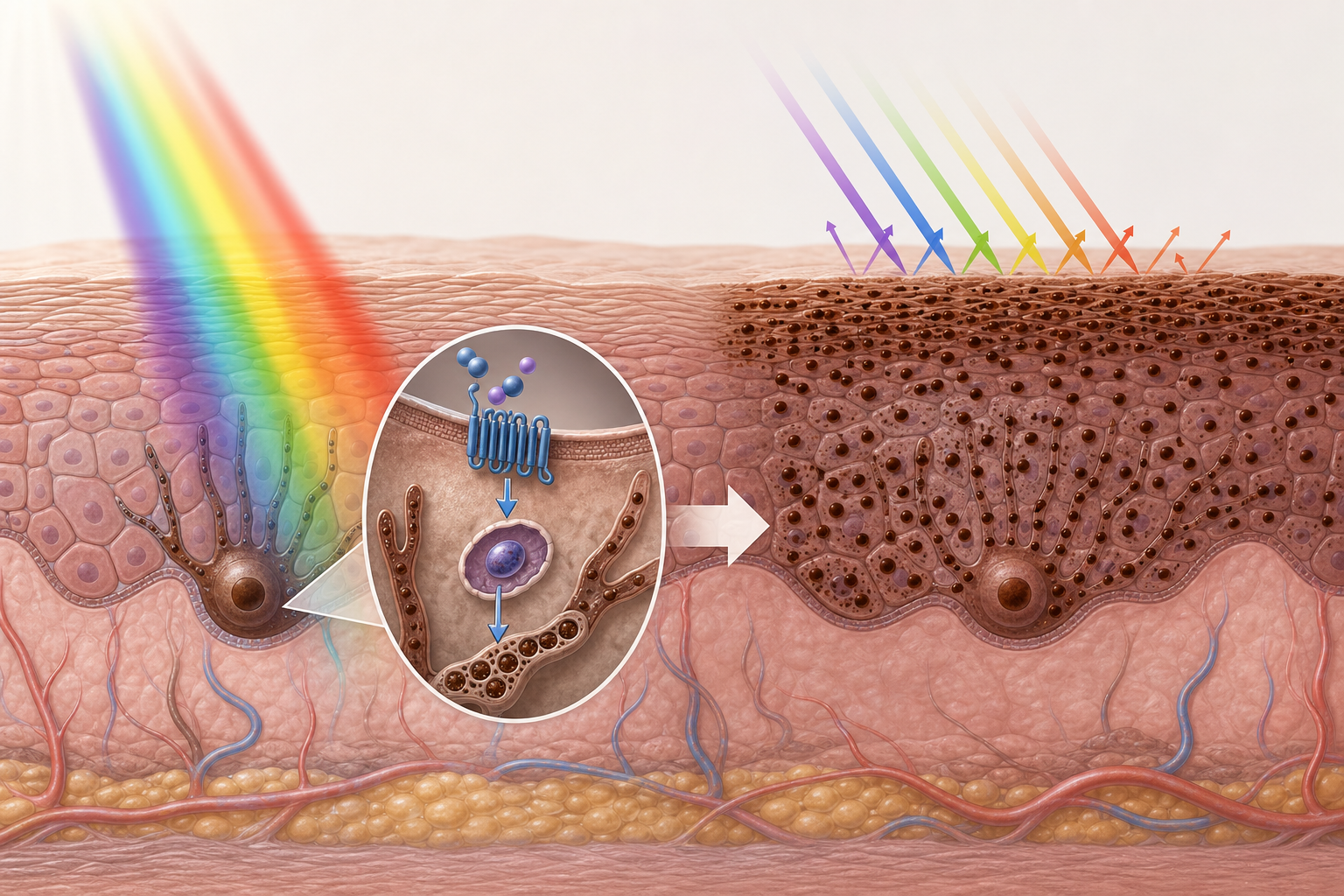
Afamelanotide activates MC1R signaling in melanocytes and increases eumelanin. The resulting photoprotection reduces light penetration; it does not make the skin completely light-proof.
How does increased eumelanin relate to photoprotection?
More eumelanin can create a stronger optical and antioxidant barrier, lowering the amount of activating light that reaches phototoxic protoporphyrin in tissue. The mechanism is photoprotection, not removal of the underlying genetic disorder.
This distinction matters. Afamelanotide does not eliminate protoporphyrin IX or prove that a person can ignore light precautions. It changes how the skin responds to light and can increase the time before pain occurs.
The visible increase in pigmentation is linked to the same biological pathway, but pigmentation is not the approved therapeutic goal by itself. Turning a disease-specific mechanism into “this peptide gives a safer tan” strips away the condition, endpoints, product controls, and medical oversight that make the evidence interpretable.
What did the randomized trials find?
The pivotal trials found that afamelanotide increased pain-free light exposure, but the absolute gains were measured in the context of a rare disease and variable patient behavior—not as a cure or complete normalization.
A 2015 New England Journal of Medicine report described two randomized, multicentre, placebo-controlled trials involving adults with EPP in Europe and the United States. The main outcomes focused on time spent in light without pain.
In the US trial, participants receiving afamelanotide recorded more pain-free time in direct sunlight during the prespecified daytime window than those receiving placebo. In the European trial, the afamelanotide group also recorded more pain-free light exposure under its prespecified conditions. Quality-of-life measures improved in the active-treatment groups, while the number and duration of phototoxic reactions provided additional context.
The FDA prescribing information describes SCENESSE as increasing pain-free light exposure in adults with a history of phototoxic reactions from EPP. The EMA public assessment likewise concludes that the medicine increased the amount of time patients could spend in direct sunlight without pain.
The EMA also puts the result in perspective: the additional recorded time was relatively small, but regulators considered the unmet need, quality-of-life implications, rarity of EPP, and observed safety profile. That is a more honest reading than either “miracle drug” or “the average difference sounds too small to matter.”
Why these endpoints are difficult to measure
Light-exposure trials in EPP are unusually hard because participants control their own exposure. People who have learned over years that light causes extreme pain may not immediately spend much more time outdoors, even when receiving treatment. Weather, geography, clothing, season, daily routines, and fear of a reaction all affect recorded exposure.
Those limitations do not erase a randomized treatment difference. They explain why the evidence should be interpreted alongside disease burden, quality of life, regulatory assessment, and continued real-world monitoring.
What does the reported Canadian authorization actually establish?
If confirmed in Health Canada’s public records, the authorization establishes that SCENESSE met Canadian requirements for its specific labeled use; it does not validate afamelanotide for every proposed use.
CLINUVEL’s July 13 release says the Notice of Compliance covers prevention of phototoxicity in adult patients with EPP. It also says trained Canadian specialty centres had treated patients through special access arrangements before commercial authorization.
Until Health Canada’s database and Canadian product monograph become publicly retrievable, details beyond the company-announced indication should not be improvised. In particular, Canadian contraindications, warnings, adverse-reaction frequencies, monitoring instructions, and exact authorization date should be checked against the regulator’s documents when posted.
The announcement nevertheless fits an established international regulatory history:
- The European Commission authorized SCENESSE for adult EPP in December 2014 under exceptional circumstances, reflecting the difficulty of collecting comprehensive data in an ultra-rare condition.
- The FDA approved SCENESSE in October 2019 to increase pain-free light exposure in adults with a history of phototoxic reactions from EPP.
- Both regulators tied their conclusions to a named product and a narrow population—not to melanocortin peptides as a consumer category.
What are the limitations and safety concerns?
SCENESSE has a defined safety profile, not a blank cheque. Official US and European materials identify common reactions and require attention to pigmentation and skin changes.
Commonly reported adverse reactions in official labeling include implant-site reactions, nausea, headache, and changes in skin pigmentation. US labeling also warns that SCENESSE may cause generalized increased pigmentation and darkening of existing moles or freckles. It calls for full-body skin examinations at regular intervals to monitor existing and new pigmentary lesions.
Administration is restricted to trained healthcare professionals or specialist centres in approved settings. That requirement is part of the medicine’s safety system. It is not merely a packaging detail.
Other limits are equally important:
- The indication is narrow: adults with EPP.
- Trial populations were small because EPP is rare.
- European authorization was granted under exceptional circumstances, with continued data collection required.
- Benefits and harms observed with SCENESSE cannot be assumed for an unapproved product, different formulation, different route, or different dose.
- Evidence in EPP cannot establish benefit for cosmetic tanning, anti-aging, vitiligo, sexual function, weight loss, or general “photoprotection.”
- Increased pigmentation does not replace ordinary clinical follow-up or individualized light-management advice.
This article does not provide implantation, dosing, purchasing, sourcing, or treatment instructions. Those details belong within official labeling and specialist care.
Why SCENESSE is categorically different from “research peptide” marketing
A regulated peptide medicine is a product-and-indication package, not just a molecule with an interesting mechanism. SCENESSE combines controlled manufacturing, verified identity and quality, clinical trials, an authorized label, trained administration, pharmacovigilance, and regulator-enforceable requirements.
An online product sold as a tanning peptide or “research use only” does not inherit those features because it targets a related receptor or uses a similar-sounding name. It may differ in identity, purity, sterility, formulation, delivery, stability, and clinical evidence. A mechanism diagram cannot repair those gaps.
This is the same distinction explained in GLP-1 Peptides vs Research Peptides and Research Use Only Peptides. For the broader clinic and evidence landscape, see Peptide Therapy Explained. Our guides to Peptide Research Status and Peptide Side Effects explain why exact product status and human evidence matter.
What Canada’s SCENESSE decision shows about real peptide medicine
The main lesson is specificity. The credible claim is not “peptides work.” It is that a specific afamelanotide product has shown an indication-specific benefit in adults with EPP and has undergone multiple regulatory reviews.
Real peptide medicine can look less spectacular than wellness marketing. The endpoint may be extra pain-free time in light rather than a dramatic transformation. The indication may cover a small group. The label may require specialist administration and skin monitoring. The evidence may contain real limitations.
Those constraints are not weaknesses to hide. They are what make the claim testable.
Frequently asked questions
Is SCENESSE approved in Canada?
CLINUVEL announced on July 13, 2026 that Health Canada granted SCENESSE a Notice of Compliance for prevention of phototoxicity in adults with EPP. At the July 23 verification cutoff for this article, a corresponding searchable Health Canada product record or monograph was not yet publicly retrievable, so this detail remains attributed to the company announcement pending regulator publication.
Is afamelanotide a tanning peptide?
Afamelanotide can increase eumelanin and skin pigmentation through MC1R activation, but SCENESSE is an approved rare-disease medicine with an EPP-specific indication. Calling it a tanning peptide erases the product controls, trial population, therapeutic endpoint, and monitoring requirements.
Does SCENESSE cure EPP?
No. The evidence supports increased pain-free light exposure and prevention or reduction of phototoxic symptoms within the approved indication. Afamelanotide does not correct the inherited metabolic cause of EPP or eliminate all light sensitivity.
Does Canadian approval prove afamelanotide works for other conditions?
No. Regulatory authorization is tied to a specific product, population, formulation, and indication. It cannot be generalized to cosmetic use, other diseases, or unapproved melanocortin products.
What are the main safety issues?
Official US and European materials identify implant-site reactions, nausea, headache, and pigmentation changes among the common concerns. Labeling also calls for monitoring of moles, freckles, and other pigmentary lesions. The eventual Canadian monograph should be used for Canada-specific safety language.
Bottom line
SCENESSE is meaningful because it is narrow, evidence-based peptide medicine—not because it licenses broad claims about peptides. Randomized trials and regulatory reviews support an increase in pain-free light exposure for adults with EPP. The same evidence does not support cosmetic, wellness, or unrelated medical claims.
The reported Canadian Notice of Compliance adds another regulatory jurisdiction to that story, but the Canadian details should remain attributed to CLINUVEL until Health Canada publishes a searchable product record and official monograph. That source discipline is part of the lesson: real medicine is defined by the exact product, exact evidence, exact indication, and exact regulatory record.
This article is for general educational purposes and is not medical advice. It does not provide treatment, dosing, implantation, or purchasing guidance. People with EPP should discuss care with an appropriately qualified specialist.
Sources
- CLINUVEL. SCENESSE approved for EPP in Canada. July 13, 2026. Company announcement; Canadian authorization details are attributed accordingly pending a public Health Canada product record.
- Health Canada. Drug Product Database and Notice of Compliance Database. Checked July 23, 2026.
- US Food and Drug Administration. SCENESSE prescribing information. Revised 2024.
- European Medicines Agency. Scenesse European Public Assessment Report. Page updated January 30, 2026.
- Langendonk JG, et al. Afamelanotide for Erythropoietic Protoporphyria. New England Journal of Medicine. 2015;373:48–59.