GLP-1 Drugs and Rare Optic-Nerve Risk: What the New NAION Studies Actually Show
Two large observational studies published in Annals of Internal Medicine on July 14, 2026 found that ischemic optic neuropathy was diagnosed somewhat more often after people started a GLP-1 receptor agonist than after they started certain other diabetes drugs. The association deserves further study, but the event remained rare and the studies cannot show that GLP-1 drugs caused the optic-nerve injury.
The clearest number comes from the Swedish nationwide study. At one year, estimated risk was 0.04% among GLP-1 receptor agonist initiators versus 0.02% among SGLT-2 inhibitor initiators—about 4 versus 2 cases per 10,000 people. That is roughly a doubling in relative terms, but an absolute difference of about 2 cases per 10,000.

The July 2026 studies examined diagnosis patterns in health records. They did not prove a direct injury mechanism.
Quick answer: do GLP-1 drugs cause NAION?
No causal link has been established. The new studies found an association between starting a GLP-1 receptor agonist and a higher recorded rate of ischemic optic neuropathy compared with starting SGLT-2 inhibitors or DPP-4 inhibitors. Both were observational analyses, not randomized trials.
Their results are notable because two independent datasets pointed in a similar direction. Their limitations are equally important: very few events, incomplete clinical detail, imperfect diagnosis codes, and possible differences between the people prescribed each drug class.
The responsible conclusion is narrower than either “GLP-1 drugs damage the optic nerve” or “there is no risk.” The current evidence indicates a possible rare safety signal with substantial uncertainty about causation.
What is NAION?
Nonarteritic anterior ischemic optic neuropathy, or NAION, is an optic-nerve disorder associated with insufficient blood flow to the front portion of the optic nerve. It can produce sudden, usually painless vision loss, often in one eye.
“Nonarteritic” distinguishes it from an inflammatory blood-vessel condition called arteritic anterior ischemic optic neuropathy. “Anterior” identifies the part of the optic nerve involved. In real-world databases, however, researchers do not always have a diagnosis code specific enough to isolate NAION perfectly.
That coding problem matters here. The Swedish study measured anterior ischemic optic neuropathy (AION), which the authors said predominantly comprises NAION. The U.S. study used ischemic optic neuropathy (ION) as a proxy because claims data lacked a specific NAION code. Neither outcome is a perfectly verified set of specialist-adjudicated NAION cases.
What did the Swedish nationwide study find?
The Swedish cohort found a higher relative rate but a very small absolute difference. Researchers compared people with type 2 diabetes who newly started GLP-1 receptor agonists with those who newly started SGLT-2 inhibitors from 2013 through 2024.
The observed event counts were:
- 62 events among 107,518 GLP-1 receptor agonist initiators
- 64 events among 185,898 SGLT-2 inhibitor initiators
After adjustment, the estimated one-year risks were:
- GLP-1 receptor agonists: 0.04%
- SGLT-2 inhibitors: 0.02%
- Absolute risk difference: 0.02 percentage points
- Relative risk: 1.93
The confidence interval around that relative estimate was wide: 1.00 to 3.73. That reflects how unstable estimates can be when an outcome is very rare.
At five years, estimated risks were 0.12% versus 0.07%, an absolute difference of 0.05 percentage points. The five-year relative-risk confidence interval crossed 1.0, meaning the data were compatible with no relative difference as well as with a meaningful increase.
Why the metformin-restricted analysis matters
When the Swedish researchers restricted the analysis to people receiving metformin at baseline, the difference became much smaller. At one year, risk difference was 0.01 percentage points and relative risk was 1.40, with confidence intervals spanning no difference. The relative estimate was 1.23 at five years, again with a wide interval spanning no difference.
This restriction was an attempt to compare people at a more similar point in their diabetes treatment. The attenuation does not prove that the original result was entirely confounded. It does suggest that differences in diabetes severity or treatment history may explain some of the association.
Relative risk can sound large while absolute risk stays small
Relative and absolute risk answer different questions, and both are necessary. Moving from 0.02% to 0.04% is a 100% relative increase, because 0.04 is twice 0.02. In absolute terms, it is an estimated increase of 0.02 percentage points—about 2 additional cases per 10,000 people over one year.
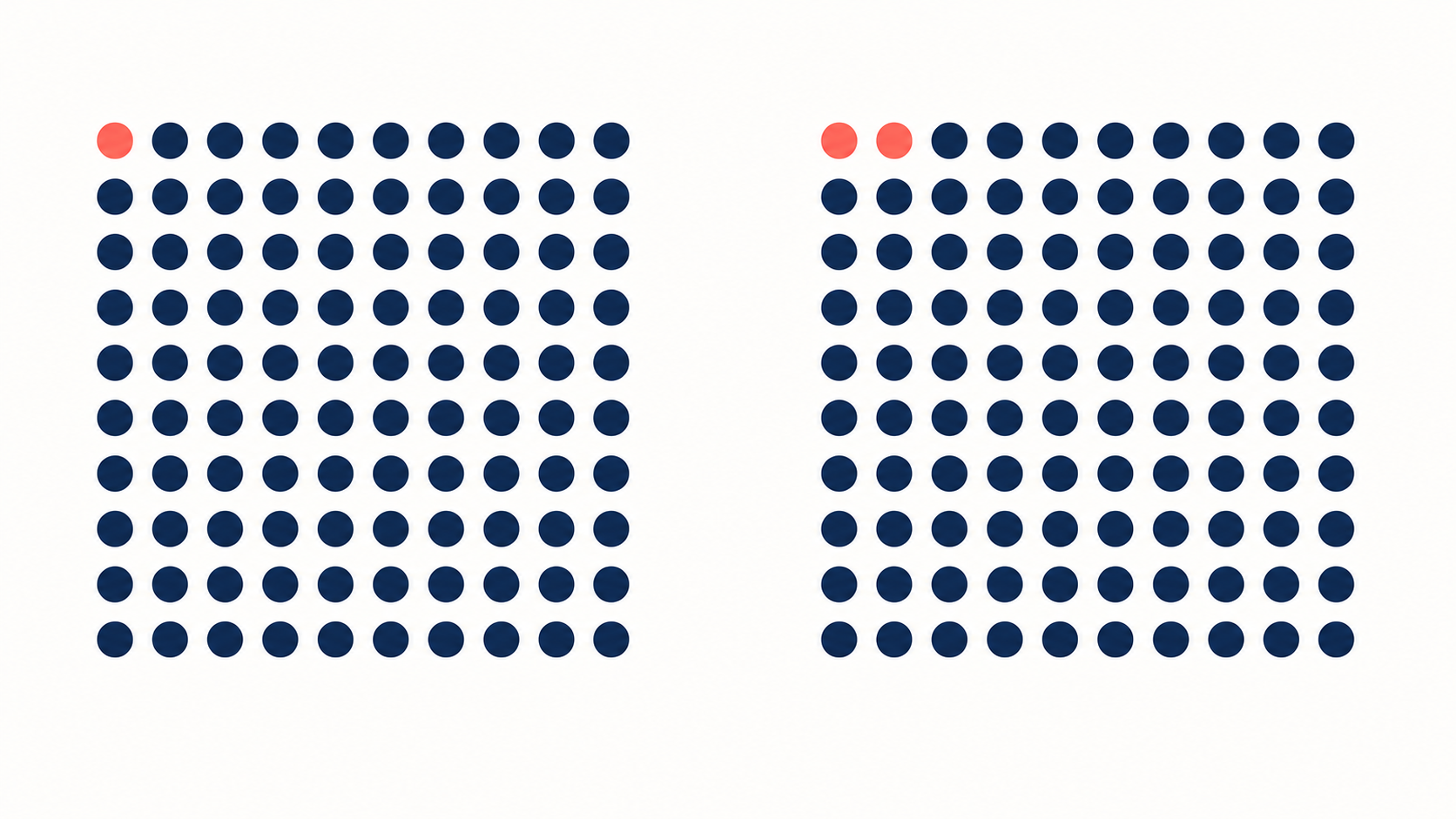
Conceptual illustration only: the highlighted dots show why “twice the risk” can still describe an uncommon outcome. The study’s actual one-year estimates were about 4 versus 2 cases per 10,000.
Neither framing should be used alone:
- Reporting only “nearly doubled risk” can make a rare outcome sound common.
- Reporting only “a 0.02% difference” can make a potentially serious event sound irrelevant.
- Reporting both shows the scale and the uncertainty.
For rare outcomes, a small number of case-classification errors or unmeasured differences between groups can also move the relative estimate substantially.
What did the U.S. target-trial emulation find?
The companion U.S. analysis pointed in the same direction while keeping the absolute risk below 1 event per 1,000 over 18 months. Researchers used commercial claims from 2017 through 2022 to emulate some design features of a clinical trial among adults aged 18 to 65 with type 2 diabetes.
At 18 months, estimated ION risks were:
- 8.5 per 10,000 for GLP-1 receptor agonists versus 5.5 per 10,000 for SGLT-2 inhibitors
- 7.8 per 10,000 for GLP-1 receptor agonists versus 4.2 per 10,000 for DPP-4 inhibitors
The corresponding absolute differences were 3.0 and 3.6 events per 10,000. The researchers adjusted for more than 80 measured characteristics, which strengthens the comparison. It cannot adjust for important information that claims data do not contain or measure well.
The study lacked a NAION-specific diagnostic code, so ION was used as a proxy. It also lacked complete data on factors such as body mass index and diabetes duration. The authors concluded that the observed differences might still reflect residual confounding.
Why two observational studies still do not prove causation
Converging observational results strengthen a safety signal, not a causal verdict. Both studies used active comparators—other commonly used diabetes medicines—rather than comparing treated people with untreated people. That is a better design because it makes the groups more clinically similar.
Several problems remain.
Few events
The outcome was rare in both datasets. Sweden recorded 126 total events across the two primary groups. In the U.S. analysis, 81 events occurred among GLP-1 receptor agonist users. Few events produce wide confidence intervals and make subgroup estimates especially uncertain.
Residual confounding
Researchers can balance measured variables, but they cannot fully balance what was not captured. Diabetes duration, glycemic history, obesity severity, sleep apnea, cardiovascular risk, kidney disease, smoking, eye anatomy, and access to specialist care could affect both treatment selection and optic-nerve risk.
Comparator choice
Comparing GLP-1 receptor agonists with SGLT-2 or DPP-4 inhibitors asks a specific question: what happened after people started one class rather than another? It does not estimate risk versus no treatment, and the result can change if the comparator has different prescribing patterns or its own relationship with the outcome.
Diabetes-severity differences
Drug choice is not random in routine care. Clinicians may select GLP-1 receptor agonists for people with different body weight, cardiovascular risk, glycemic control, or disease history. The Swedish metformin-restricted findings are a concrete sign that treatment-stage differences may matter.
Outcome-code limitations
Administrative codes are useful for studying huge populations, but a billing or registry code is not the same as a standardized ophthalmology review. The studies measured broader AION or ION outcomes as practical proxies for NAION, creating room for misclassification.
Together, these limitations mean the association could reflect a drug effect, patient differences, diagnostic patterns, or some combination of them.
How do these studies fit with earlier evidence?
Earlier observational findings have been mixed, which makes the new studies informative but not final. Some database and specialty-clinic analyses have reported higher NAION or optic-nerve event rates among GLP-1 drug users. Other analyses have found weaker, inconsistent, or comparator-dependent associations.
That pattern is common in rare-event safety research. Different studies include different patients, drugs, follow-up periods, outcome definitions, and adjustment variables. A specialty eye clinic can enrich for eye disease but may not represent the broader population. A national registry offers scale but less clinical detail. A claims database can compare treatment pathways but is limited by billing codes.
The July 2026 studies improve the evidence base because they used large active-comparator cohorts and reported absolute risks clearly. They do not erase the inconsistency in earlier work or identify a biological mechanism.
For a broader map of how trials, labels, and online reports answer different questions, see GLP-1 Side Effects: What Trials, Labels, and Online Communities Can Each Tell Us. How to Evaluate Peptide Claims Online explains why study design and comparator choice matter as much as a headline risk ratio.
What is the most accurate takeaway?
The best current takeaway is that ischemic optic neuropathy may occur slightly more often after GLP-1 receptor agonist initiation than after certain comparator drugs, but the absolute rate was very low and residual confounding leaves causation unresolved.
This is safety-signal evidence, not an efficacy guide and not individualized medical advice. The studies do not support telling people to start, stop, switch, or avoid a medication based on a population estimate alone. They also do not justify dismissing the signal as nonexistent.
Readers comparing regulated GLP-1 medicines with unrelated research compounds may find GLP-1 Peptides vs Research Peptides useful. For wider context on interpreting risk across very different compounds, see Peptide Side Effects and Peptide Research Status Explained.
Frequently asked questions
How rare was optic neuropathy in the new studies?
It was rare. The Swedish one-year estimates were 0.04% versus 0.02%, while the U.S. estimates remained below 1 event per 1,000 people over 18 months in all compared groups.
Does a relative risk near 2 mean 2% of users were affected?
No. Relative risk compares two rates; it does not state the event rate. In the Swedish study, a relative estimate near 2 corresponded to estimated one-year risks of 0.04% and 0.02%.
Were the studies randomized clinical trials?
No. One was a nationwide register-based cohort study and the other was an observational target-trial emulation. Both used statistical methods to improve comparability, but neither randomized treatment.
Did the studies measure only confirmed NAION?
No. The Swedish study measured AION, which predominantly includes NAION. The U.S. study measured ION as a proxy because a NAION-specific claims code was unavailable.
Do these findings apply equally to everyone using a GLP-1 drug?
That is unknown. Both studies focused on people with type 2 diabetes, and the U.S. dataset included commercially insured adults aged 18 to 65. Results may not generalize cleanly to other populations or every GLP-1 receptor agonist.
Sources
- Ueda P, et al. “Glucagon-like Peptide-1 Receptor Agonists and Risk for Anterior Ischemic Optic Neuropathy: A Nationwide Cohort Study.” Annals of Internal Medicine. Published July 14, 2026. doi:10.7326/ANNALS-25-02096; PubMed PMID 42441962.
- Reynolds KR, et al. “Glucagon-Like Peptide-1 Receptor Agonists and Risk for Ischemic Optic Neuropathy: A Target Trial Emulation.” Annals of Internal Medicine. Published July 14, 2026. doi:10.7326/ANNALS-25-00860; PubMed PMID 42441967.
- Recent supporting cohort evidence: JAMA Network Open article.
This article is for general education. It does not provide medical advice or instructions to start, stop, or change medication.