Survodutide and MASH: How Much Liver Improvement Was Explained by Weight Loss?
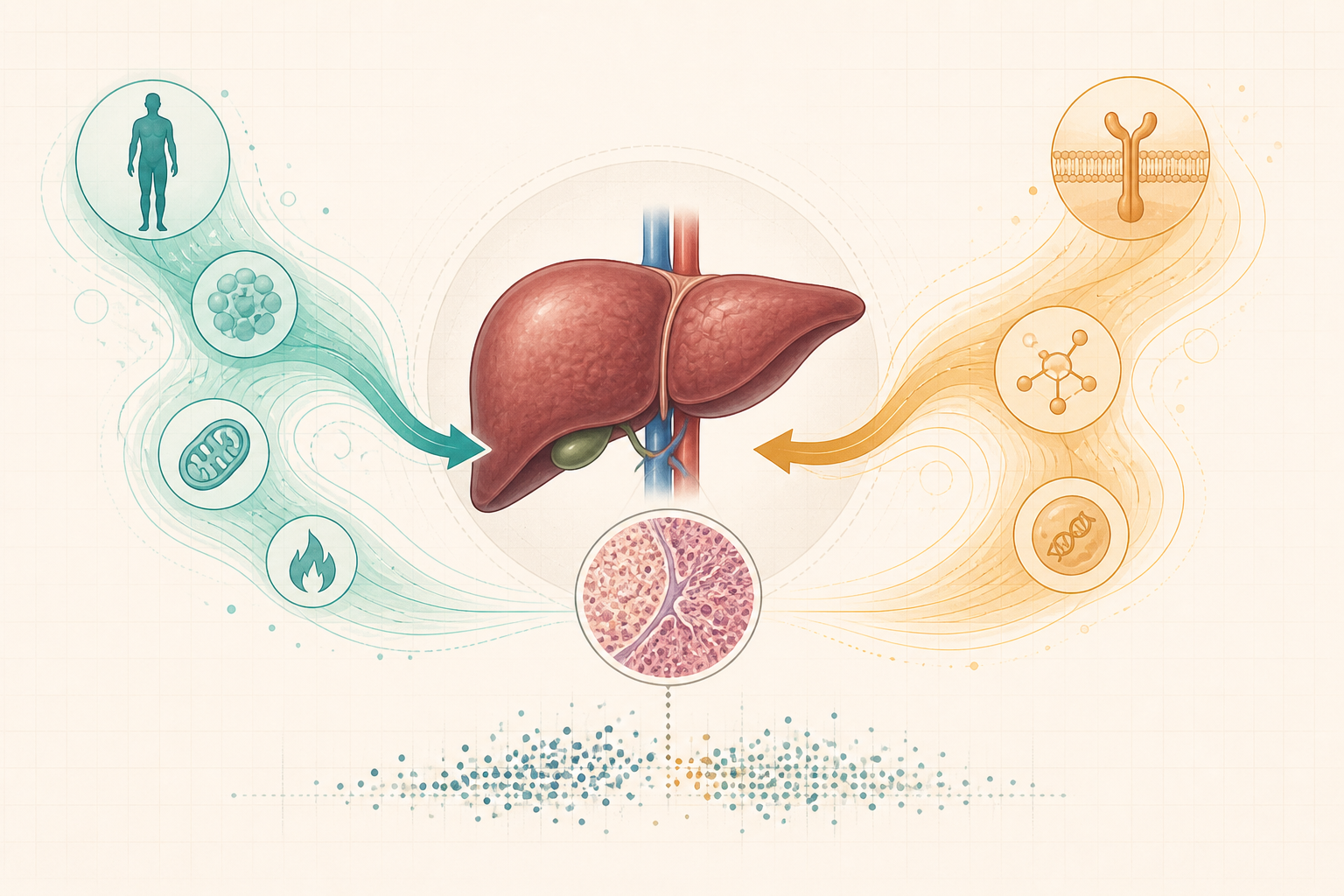
The mediation analysis divided the estimated treatment effect into a pathway through measured weight reduction and a remaining weight-reduction-independent pathway. It did not identify one proven biological cause for either pathway.
The August 3, 2026 Hepatology analysis of the survodutide MASH trial estimated that weight reduction explained much—but not all—of several liver outcomes. It attributed 66.7% of the estimated effect on MASH resolution without fibrosis worsening and 71.8% of the effect on MASH improvement without fibrosis worsening to the weight-reduction pathway. For fibrosis improvement without MASH worsening, the estimated mediated share was smaller: 36.3%.
Those percentages are model-based pathway estimates, not a second randomized trial and not proof that survodutide directly repaired the liver through glucagon receptor agonism. The analysis is useful precisely because it narrows the question: how much of the observed treatment effect was statistically compatible with occurring through weight loss, and how much remained after that pathway was modeled?
Quick answer: In the paired-biopsy subset, weight reduction was estimated to mediate about two-thirds to nearly three-quarters of the MASH activity endpoints, but only about one-third of the fibrosis-improvement endpoint. The remainder was “direct” only in the statistical sense: independent of the measured weight-change mediator under the model’s assumptions.
Educational note: Survodutide remains investigational. This article explains research methods and reported findings; it is not approval, treatment, dosing, purchasing, sourcing, or comparative-efficacy guidance.
What is survodutide?
Survodutide (also called BI 456906) is an investigational dual agonist of the glucagon-like peptide-1 (GLP-1) receptor and glucagon receptor. GLP-1 receptor signaling is associated with appetite and metabolic effects, while glucagon receptor signaling is being studied for possible effects on energy expenditure and liver metabolism.
That dual-receptor design creates a plausible biological reason to ask whether liver changes reflect weight loss alone. But a plausible mechanism is not the same as a demonstrated mediator. To understand why, it helps to separate the original trial from the later analysis.
For a broader explanation of how study stage affects confidence, see Peptide Research Status Explained. The distinction between established medicines and investigational compounds is also covered in GLP-1 Peptides vs Research Peptides.
The 295-person trial and the 170-person analysis are not interchangeable
The registered phase 2 study, NCT04771273, enrolled 295 adults with biopsy-confirmed MASH and fibrosis. The original publication reported that 293 randomized participants received at least one dose. Participants were assigned to three survodutide dose groups or placebo for 48 weeks.
The 2026 mediation paper did something narrower. It included 170 participants who had F2–F3 fibrosis and paired, readable liver biopsies at baseline and the end of treatment. It pooled the three survodutide dose arms, then compared pooled survodutide with placebo.
| Evidence set | Population | What it was designed to answer | |---|---:|---| | Registered randomized phase 2 trial | 295 enrolled; 293 treated | Whether survodutide improved prespecified liver endpoints versus placebo over 48 weeks | | Post hoc mediation subset | 170 with F2–F3 fibrosis and paired biopsies | How much of selected estimated treatment effects was statistically mediated by percentage weight change |
The second analysis inherits useful randomized treatment assignment, but selection into a complete paired-biopsy subset was not itself randomized. Pooling dose arms also means the results are not dose-specific estimates.
What did the original randomized trial find?
The original phase 2 trial found a higher rate of MASH improvement without fibrosis worsening with survodutide than with placebo. In the published treated population, that endpoint occurred in 47%, 62%, and 43% of the three survodutide groups versus 14% with placebo.
At least a 30% reduction in liver fat occurred in 63%, 67%, and 57% of the survodutide groups versus 14% with placebo. Fibrosis improvement of at least one stage occurred in 34%, 36%, and 34% versus 22%, respectively.
Those are trial outcome rates. They do not say why the outcomes changed. The mediation analysis was an attempt to partition the estimated treatment effect by pathway.
What do “indirect” and “direct” effects mean here?
In this model, the indirect effect is the part of the survodutide-versus-placebo effect estimated to operate through percentage change in body weight. The paper calls it weight-reduction-dependent.
The direct effect is the estimated remainder after that mediator is accounted for. The paper calls it weight-reduction-independent.
The model treated randomized treatment as the exposure and percentage body-weight change as the mediator. It adjusted for baseline body weight, type 2 diabetes status, and fibrosis stage.
Quick answer: “Direct” does not mean researchers watched a molecule act directly on liver tissue. It means the model estimated a treatment effect not transmitted through the measured weight-change variable, assuming the mediation model and its causal assumptions are valid.
That remainder could reflect hepatic glucagon receptor signaling. It could also include pathways not captured by percentage weight change, mediator measurement error, model misspecification, post-randomization factors, or residual confounding between weight change and the liver outcome.
How much of each liver endpoint was attributed to weight reduction?
The estimated mediated share differed substantially by endpoint.
| Endpoint after 48 weeks | Estimated share mediated by weight reduction | Plain-English reading | |---|---:|---| | MASH resolution without fibrosis worsening | 66.7% | About two-thirds of the modeled effect followed the weight-reduction pathway | | MASH improvement without fibrosis worsening | 71.8% | Nearly three-quarters followed the weight-reduction pathway | | Fibrosis improvement without MASH worsening | 36.3% | A minority followed the weight-reduction pathway; the larger modeled share remained independent of measured weight change | | Selected inflammation/fibrosis non-invasive tests | 16.5%–38.6% | Less than half of selected NIT effects was attributed to weight reduction |
The NIT range ran from 16.5% for AST to 38.6% for the Enhanced Liver Fibrosis test. The paper also reported higher mediated shares for steatosis-related measures: 58.2% for MRI-PDFF and 77.4% for FibroScan Controlled Attenuation Parameter.
The pattern is coherent with weight loss explaining more of liver-fat change than some inflammation or fibrosis signals. It is still an estimated pattern within one post hoc model—not a biological tracing experiment.
Why the percentages should not be treated as exact biological fractions
Mediation percentages look unusually precise, but precision after the decimal point does not remove uncertainty. They depend on model specification, covariates, how the mediator and outcomes were measured, and assumptions that cannot all be verified from the data.
Several limitations matter:
- The analysis was post hoc rather than a prespecified primary comparison.
- It used a 170-person complete paired-biopsy subset, not everyone enrolled in the randomized trial.
- Survodutide dose groups were pooled.
- Weight change occurs after randomization, so the mediator-outcome relationship is not protected by the original random assignment in the same way as the treatment comparison.
- Liver biopsy has sampling and reader variability, while NITs are surrogate measurements rather than direct clinical outcomes.
- “Percent mediated” can be unstable when effects are small or modeled components behave differently.
This is why the paper can support a pathway hypothesis without establishing the receptor-level cause of the remaining effect.
Did glucagon receptor agonism cause the weight-independent component?
No causal mediation analysis alone can prove that glucagon receptor agonism caused the weight-independent component. The authors described the pattern as suggestive of a potential role for direct glucagon receptor agonism in the liver. “Suggestive” is doing real work in that sentence.
To isolate receptor-specific causation more convincingly, researchers would need evidence designed around that question—for example, suitable active comparators, receptor-selective interventions, mechanistic biomarkers, or other experiments capable of distinguishing glucagon receptor effects from the rest of survodutide’s biology.
The correct conclusion is narrower: the model estimated that measured weight reduction did not account for all selected liver effects, especially the fibrosis endpoint and selected inflammation/fibrosis NITs.
What this analysis changes—and what it does not
The analysis strengthens the case for studying survodutide’s liver effects as more than a simple by-product of weight loss. It also shows why endpoint choice matters: mediation estimates for MASH activity, fibrosis, liver fat, AST, and ELF were not interchangeable.
It does not establish that survodutide is approved for MASH, identify a treatment protocol, prove long-term clinical benefit, or show superiority to other GLP-1-based or MASH drug candidates. The study was 48 weeks, used histology and surrogate tests, and was not designed as comparative-efficacy guidance.
Readers evaluating similar claims may find How to Evaluate Peptide Claims Online and What Preclinical Actually Means useful for separating mechanism language from clinical evidence.
Bottom line
The 2026 analysis of the survodutide MASH trial estimated that weight reduction mediated most of the treatment effect on MASH resolution and MASH improvement, but a smaller share of the fibrosis-improvement effect and selected inflammation/fibrosis NIT effects.
That is evidence for a possible weight-loss-independent pathway, not proof that glucagon receptor agonism directly caused it. The most defensible reading is methodological: survodutide’s observed liver signals were not statistically explained by measured weight reduction to the same degree across endpoints, and that difference deserves prospective mechanistic testing.
Frequently asked questions
Is survodutide approved for MASH?
No. Survodutide is investigational, and this post hoc analysis is not a regulatory approval or treatment recommendation.
Why were only 170 participants included in the mediation analysis?
The analysis required F2–F3 fibrosis plus paired baseline and end-of-treatment biopsy readings. That produced a narrower subset than the 295 participants enrolled in the registered trial.
Does 66.7% mediated mean 66.7% of participants improved because they lost weight?
No. It is a model-based proportion of the estimated treatment effect for an endpoint, not a proportion of individual participants whose improvement had a known cause.
What does weight-loss-independent mean?
It means the estimated effect was not transmitted through percentage body-weight change in the specified model. It does not identify the biological mechanism responsible for the remainder.
Sources
- Noureddin M, et al. Weight reduction-dependent/-independent effects of survodutide on liver endpoints: Mediation analysis of a phase 2 trial in MASH. Hepatology. Published online August 3, 2026.
- Sanyal AJ, et al. A Phase 2 Randomized Trial of Survodutide in MASH and Fibrosis. New England Journal of Medicine. 2024;391:311–319.
- ClinicalTrials.gov. NCT04771273. Phase 2 trial record and posted results.