Retatrutide and Sleep Apnea: What Two Phase 3 Trials Show—and What Weight Loss Complicates
Two randomized phase 3 trials found that retatrutide reduced the apnea–hypopnea index more than placebo over 80 weeks in adults with moderate-to-severe obstructive sleep apnea and overweight or obesity. The result is important, but narrower than a claim that retatrutide directly treats the airway: participants also lost substantial weight, the main outcome was a sleep-study surrogate, symptom results were mixed across the two trials, and cardiovascular or long-term clinical benefit was not established.
Retatrutide remains investigational. Publication in The New England Journal of Medicine is not regulatory approval, and the trial-arm labels below describe research—not treatment instructions.
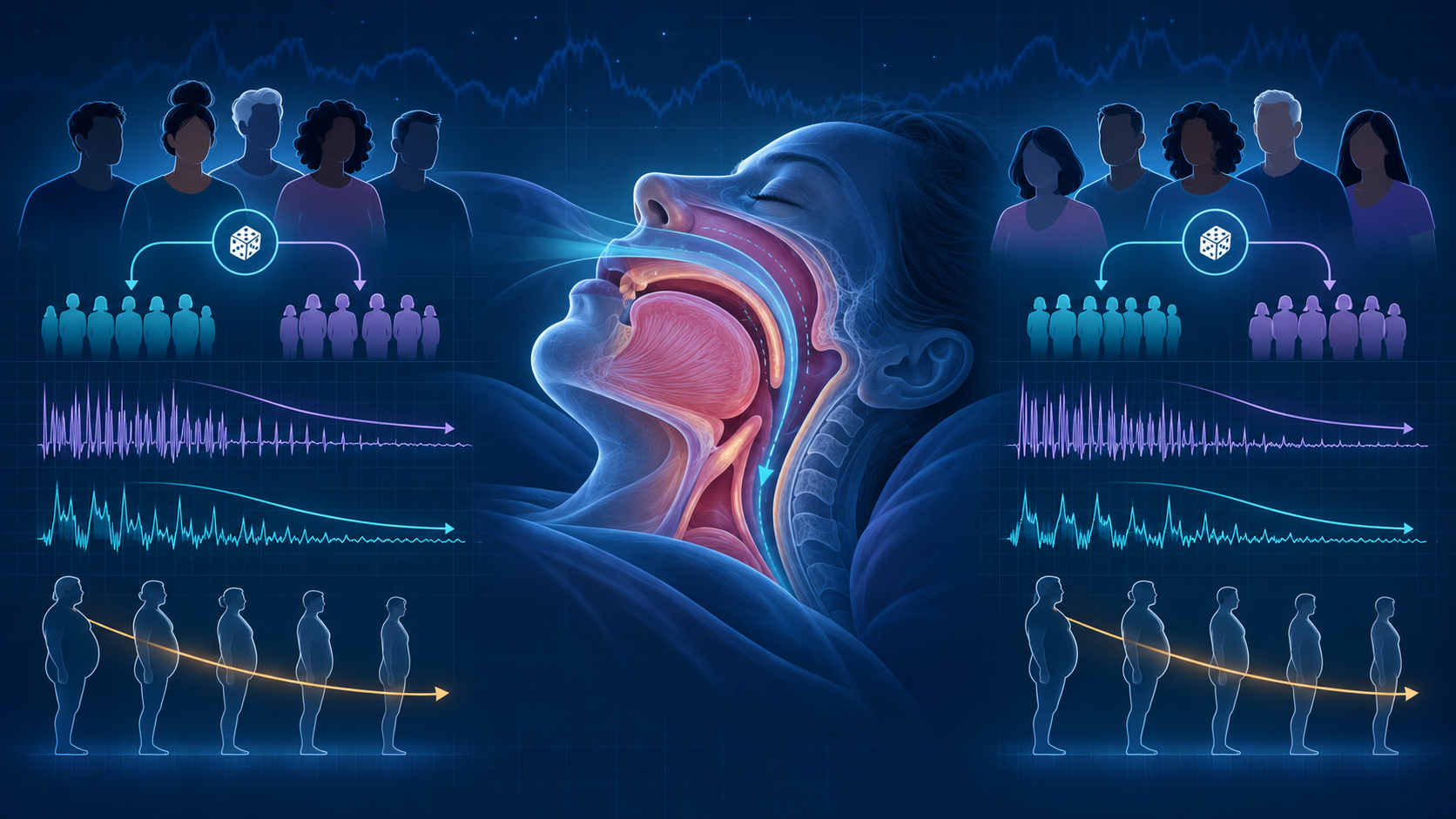
The two nested trials measured sleep-study changes while body weight changed at the same time, making the efficacy result real but the mechanism harder to isolate.
Quick answer: what did the retatrutide sleep apnea trials find?
Retatrutide produced larger average reductions in breathing interruptions than placebo, with the biggest placebo-adjusted changes around 22 to 24 events per hour in the trial without diabetes and 14 to 15 events per hour in the trial with type 2 diabetes.
The October 21, 2026 NEJM report combined two prespecified obstructive-sleep-apnea substudies nested within larger TRIUMPH basket trials:
- TRIUMPH-1-OSA: 243 adults without type 2 diabetes;
- TRIUMPH-2-OSA: 448 adults with type 2 diabetes.
All participants had moderate-to-severe obstructive sleep apnea, a body-mass index of at least 27, and random assignment to one of three retatrutide trial arms or placebo. Mean baseline apnea–hypopnea index (AHI) was 58.6 events per hour in TRIUMPH-1-OSA and 55.9 events per hour in TRIUMPH-2-OSA—well into the severe range on average.
The primary endpoint was change in AHI at week 80 for the two higher retatrutide arms. AHI is the average number of apneas and hypopneas per hour of sleep. It is clinically useful, but it is still a measured sleep-study endpoint rather than a heart attack, stroke, survival, daily-function, or long-term quality-of-life outcome.
How large were the 80-week AHI changes?
Every retatrutide arm showed a larger model-estimated AHI reduction than placebo under the trial’s primary hybrid-treatment estimand.
| Trial and randomized arm | Mean AHI change at week 80 (events/hour) | Placebo-adjusted difference (95% CI) |
|---|---|---|
| TRIUMPH-1-OSA, 4 mg trial arm | −22.9 | −13.0 (−23.0 to −3.0) |
| TRIUMPH-1-OSA, 9 mg trial arm | −34.3 | −24.4 (−34.1 to −14.7) |
| TRIUMPH-1-OSA, 12 mg trial arm | −31.7 | −21.9 (−32.2 to −11.5) |
| TRIUMPH-1-OSA, placebo | −9.9 | — |
| TRIUMPH-2-OSA, 4 mg trial arm | −19.2 | −8.9 (−15.9 to −2.0) |
| TRIUMPH-2-OSA, 9 mg trial arm | −24.7 | −14.4 (−21.6 to −7.2) |
| TRIUMPH-2-OSA, 12 mg trial arm | −25.4 | −15.1 (−22.5 to −7.7) |
| TRIUMPH-2-OSA, placebo | −10.3 | — |
The placebo group also improved. That is why the placebo-adjusted column matters: a headline that reports only the within-group retatrutide change overstates what randomization can attribute to the intervention.
The prespecified intention-to-treat (ITT) analysis was similar. Placebo-adjusted AHI differences were −13.2, −24.7, and −22.5 events per hour in TRIUMPH-1-OSA and −8.8, −13.9, and −15.0 in TRIUMPH-2-OSA, with all corresponding 95% confidence intervals excluding zero.
The trials also reported larger reductions in sleep-apnea–specific hypoxic burden and higher modeled proportions reaching either an AHI below 5 or an AHI of 5 to 14 without excessive daytime sleepiness. Those measures support a physiologic sleep-breathing effect. They do not establish a cure, show that benefit persists after treatment ends, or determine whether positive-airway-pressure therapy can be stopped.
Why do the estimands matter?
The hybrid-treatment and ITT estimates ask different questions about what to do with events that occur after randomization, so the analysis label belongs beside every result.
An estimand defines the treatment effect a trial is trying to estimate, including how it handles events such as stopping assigned treatment or starting another intervention.
- Hybrid-treatment estimand: the primary OSA analysis used a hypothetical strategy for intercurrent events considered evidence of treatment failure and a treatment-policy strategy elsewhere.
- ITT estimand: the reported ITT analysis used a treatment-policy strategy for all relevant intercurrent events, keeping the question closer to outcomes after assignment regardless of those events.
- Hypothetical efficacy estimand: the supplement also reported an analysis estimating what might have happened if participants had remained on assigned intervention for 80 weeks without specified intercurrent events.
- Treatment-regimen estimand for body weight: weight outcomes were analyzed regardless of treatment discontinuation or initiation of prohibited weight-management treatment.
The close agreement between the hybrid-treatment and ITT AHI estimates is reassuring. It does not make the estimands interchangeable, and it does not remove uncertainty from missing-data modeling.
For a deeper explanation of why two valid analyses can produce different numbers, see the PeptideBase guide to retatrutide estimands.
How much weight did participants lose?
Weight loss was large and occurred alongside the AHI improvement, which makes it difficult to claim that retatrutide acted through a separate, direct airway or sleep mechanism.
Under the treatment-regimen estimand, mean body-weight changes at week 80 were:
| Trial and randomized arm | Mean body-weight change | Placebo-adjusted difference (95% CI) |
|---|---|---|
| TRIUMPH-1-OSA, 4 mg trial arm | −12.5% | −7.7 points (−11.3 to −4.0) |
| TRIUMPH-1-OSA, 9 mg trial arm | −22.2% | −17.3 points (−21.3 to −13.4) |
| TRIUMPH-1-OSA, 12 mg trial arm | −20.6% | −15.8 points (−20.0 to −11.5) |
| TRIUMPH-1-OSA, placebo | −4.8% | — |
| TRIUMPH-2-OSA, 4 mg trial arm | −12.1% | −6.6 points (−8.6 to −4.5) |
| TRIUMPH-2-OSA, 9 mg trial arm | −17.9% | −12.3 points (−14.9 to −9.8) |
| TRIUMPH-2-OSA, 12 mg trial arm | −18.5% | −13.0 points (−15.4 to −10.6) |
| TRIUMPH-2-OSA, placebo | −5.6% | — |
Excess adiposity is a major modifiable contributor to obstructive sleep apnea. Losing weight can reduce fat around the upper airway, improve lung volumes, and lessen airway collapsibility during sleep. The paper’s discussion notes that the observed AHI reductions were similar to reductions associated with comparable weight loss in prior analyses.
That pattern is consistent with weight loss mediating at least part of the benefit. But the trials did not randomize participants to equal weight loss produced by different methods, and the report did not establish what fraction of the AHI effect was mediated by weight. The defensible conclusion is therefore two-sided:
- the randomized trials support an effect of assignment to retatrutide on AHI;
- they do not isolate a weight-independent airway mechanism.
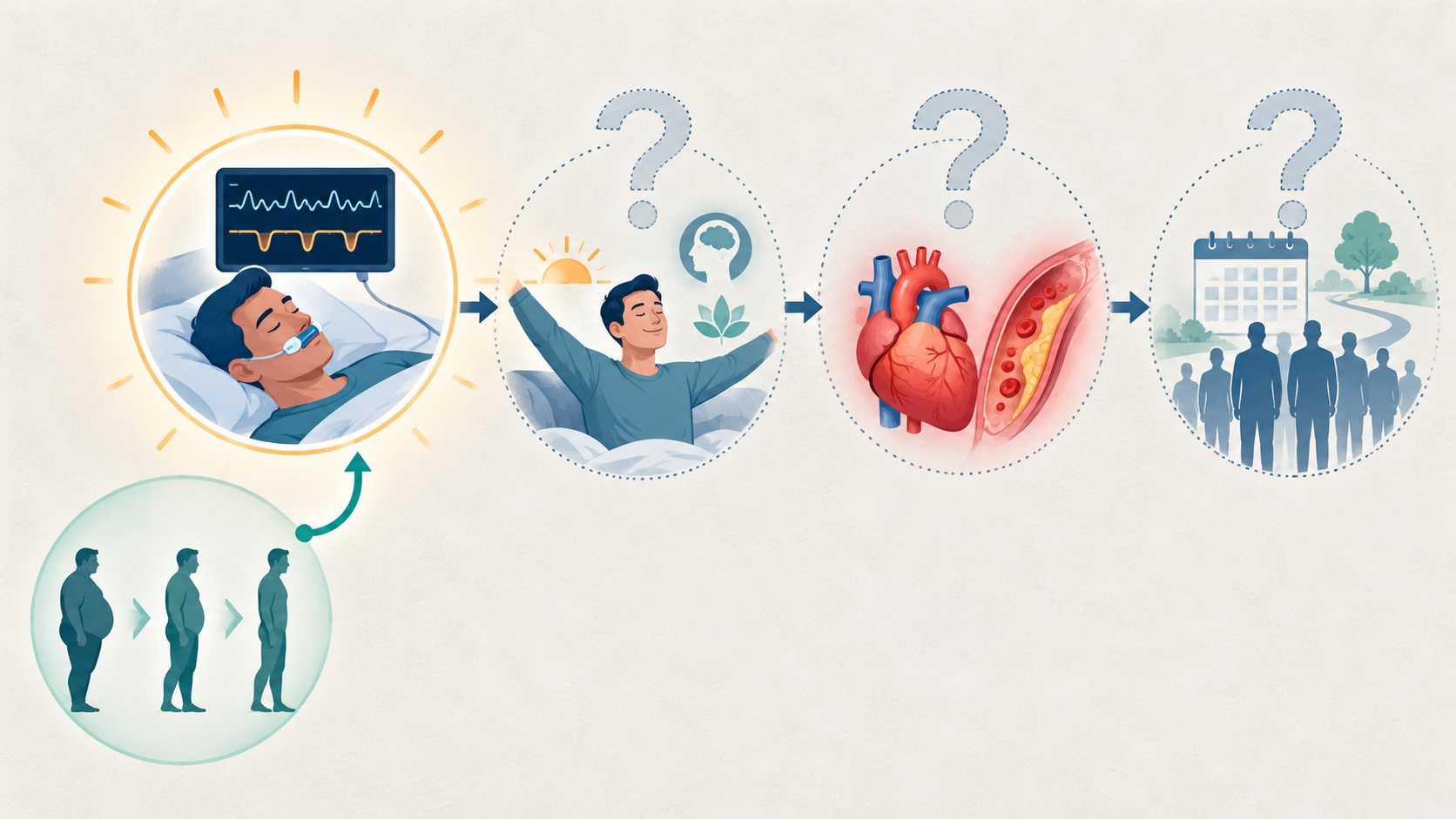
AHI improved, but symptom, cardiovascular, and long-term outcomes sit farther down the evidence chain. Concurrent weight loss may help explain the measured sleep-study change.
Did participants feel better?
The trials provide some symptom evidence, but it is less uniform than the AHI result and starts from a population with relatively low symptom burden.
Sleep-related impairment was measured with the PROMIS-SRI questionnaire. In TRIUMPH-2-OSA, placebo-adjusted improvements for the 9 mg and 12 mg trial arms were −4.1 points (95% CI, −6.9 to −1.2) and −5.7 points (95% CI, −8.4 to −3.0), respectively, and passed the trial’s multiplicity-controlled testing hierarchy.
In TRIUMPH-1-OSA, the corresponding 9 mg and 12 mg differences were −5.6 points (95% CI, −9.3 to −1.9) and −4.8 points (95% CI, −8.8 to −0.8), but the paper states that this endpoint did not clear the prespecified statistical hierarchy in that trial. That distinction matters: a confidence interval that looks favorable does not override the trial’s multiple-testing plan.
The investigators also noted that participants had low-to-mild sleep-related symptom burden on average at baseline. A trial can show a large change in a physiologic measure yet have limited room to demonstrate how much daily life improves.
What did the trials show about cardiovascular outcomes?
They did not establish cardiovascular benefit.
The sleep studies found reductions in sleep-apnea–specific hypoxic burden, a measure that captures the frequency, depth, and duration of event-related oxygen desaturation. Higher hypoxic burden is associated with cardiovascular risk, but improving that surrogate is not the same as proving fewer cardiovascular events.
The trials were not cardiovascular-outcomes trials, event counts were small, and the report explicitly says prospective studies are needed to determine whether reduced hypoxic burden translates into better long-term cardiovascular outcomes. Long-term cardiovascular and kidney outcomes are being assessed separately.
The same boundary applies to mortality, work injuries, motor-vehicle events, sustained quality of life, and durability after stopping the intervention: these trials were not designed to answer those questions.
What adverse events were reported?
Gastrointestinal adverse events were the dominant pattern, while the sample sizes were too small to settle uncommon or long-term safety questions.
Any adverse event was reported in 88% to 93% of retatrutide recipients versus 76% with placebo in TRIUMPH-1-OSA, and in 73% to 84% versus 71% in TRIUMPH-2-OSA. Diarrhea, nausea, constipation, and dyspepsia were common; the paper describes gastrointestinal events as generally mild to moderate and occurring most often during dose escalation. Dysesthesia was reported more often with retatrutide than placebo.
Aggregated serious-adverse-event rates were similar between retatrutide and placebo: 8% versus 10% in each trial. One participant died while receiving retatrutide and three died while receiving placebo; these sparse events do not establish causation or comparative mortality. Pulse rate rose during treatment, peaking around 5 to 7 beats per minute above baseline before narrowing to roughly 1 to 2 beats per minute at week 80.
Safety tables describe events observed during the trials, not a final safety profile. Retatrutide has no approved prescribing information, and phase 3 publication does not resolve rare, delayed, or broader-population harms.
For a general framework on separating trial data, labels, and online anecdotes, read how PeptideBase evaluates GLP-1 side-effect claims.
Who funded and conducted the research?
Eli Lilly funded the trials and had a broad operational and analytical role, which should be disclosed without treating sponsorship as proof that the results are invalid.
The paper states that Lilly was involved in trial design and conduct; data collection, management, analysis, and interpretation; manuscript preparation, review, and approval; and the decision to submit. Several authors were Lilly employees and shareholders.
Randomization, blinding, prespecified endpoints, multiplicity control, and publication of confidence intervals strengthen the evidence. Sponsor involvement remains relevant when judging analytical choices, interpretation, and the need for replication or regulatory review.
Does publication mean retatrutide is approved for sleep apnea?
No. Retatrutide remains investigational, and an NEJM publication is not approval.
A journal evaluates a scientific report. A regulator evaluates a much broader application that includes manufacturing quality, the complete efficacy and safety record, labeling, inspections, and benefit–risk for a defined population. Those processes are related, not interchangeable.
The PeptideBase retatrutide database page groups educational coverage about the molecule. It is not a product listing. The broader GLP-1 peptides versus research peptides guide explains why a named mechanism or published trial does not turn an investigational product into an approved medicine.
Bottom line
The two phase 3 trials provide strong randomized evidence that assignment to retatrutide reduced AHI and body weight more than placebo over 80 weeks in the studied populations. They do not prove a direct, weight-independent airway mechanism or establish cardiovascular, mortality, long-term, or universal symptom benefit.
The fairest reading is neither “just weight loss” nor “a new airway drug proven to fix sleep apnea.” The measured sleep-study effect is real within the trials. Its mechanism and clinical reach are less settled.
Frequently asked questions
What was the starting sleep-apnea severity?
Mean baseline AHI was 58.6 events per hour without type 2 diabetes and 55.9 with type 2 diabetes, meaning the average participant started in the severe range.
Was AHI the only outcome?
No. The trials also measured hypoxic burden, body weight, symptom questionnaires, cardiometabolic markers, and safety. AHI was the primary OSA endpoint for the two higher trial arms.
Did retatrutide cure sleep apnea?
No cure was established. More participants reached no OSA or mild OSA without excessive daytime sleepiness, but many did not, and durability after treatment ended was not tested.
Did the trials prove the effect was independent of weight loss?
No. Weight and AHI improved concurrently, and the design did not isolate a weight-matched direct airway effect.
Did the trials prove fewer heart attacks or strokes?
No. They measured physiologic and risk-related surrogates, not enough cardiovascular events to establish clinical cardiovascular benefit.
Is retatrutide approved?
No. Retatrutide remains investigational. Peer-reviewed publication is evidence, not regulatory approval.
Educational information only. This article explains published research and does not provide medical advice, treatment selection, dosing, administration, or purchasing guidance.