Three Nerve-Injury Cases Do Not Prove BPC-157 or TB-500 Is Effective: How to Read a Multimodal Case Report
What three inferior alveolar nerve injury cases show—and why they do not prove BPC-157, TB-500, ARA-290, or the combination is effective.
Three Nerve-Injury Cases Do Not Prove BPC-157 or TB-500 Is Effective: How to Read a Multimodal Case Report
The BPC-157 nerve injury evidence in this report is a signal worth studying, not proof that BPC-157, TB-500, ARA-290, or their combination restored damaged nerves. Three patients improved while receiving a multimodal intervention, but the report had no control group, randomization, blinding, or standardized comparator. It also cannot separate the effects of its individual components from spontaneous recovery or other explanations.[^frontiers]
That distinction matters because a case report can document what happened after an intervention without establishing why it happened. The September 30, 2026 Frontiers in Oral Health paper is unusually explicit about that boundary: its authors call the cases “hypothesis-generating” and say they should not be interpreted as evidence of efficacy or causality.[^frontiers]
Quick answer: Three improved cases show that the observation occurred and may justify a controlled study. They do not show that BPC-157 or TB-500 caused the improvement, that the combination works, or that it is safe.
This article is educational and does not provide treatment, dosing, administration, sourcing, purchasing, or compounding guidance.
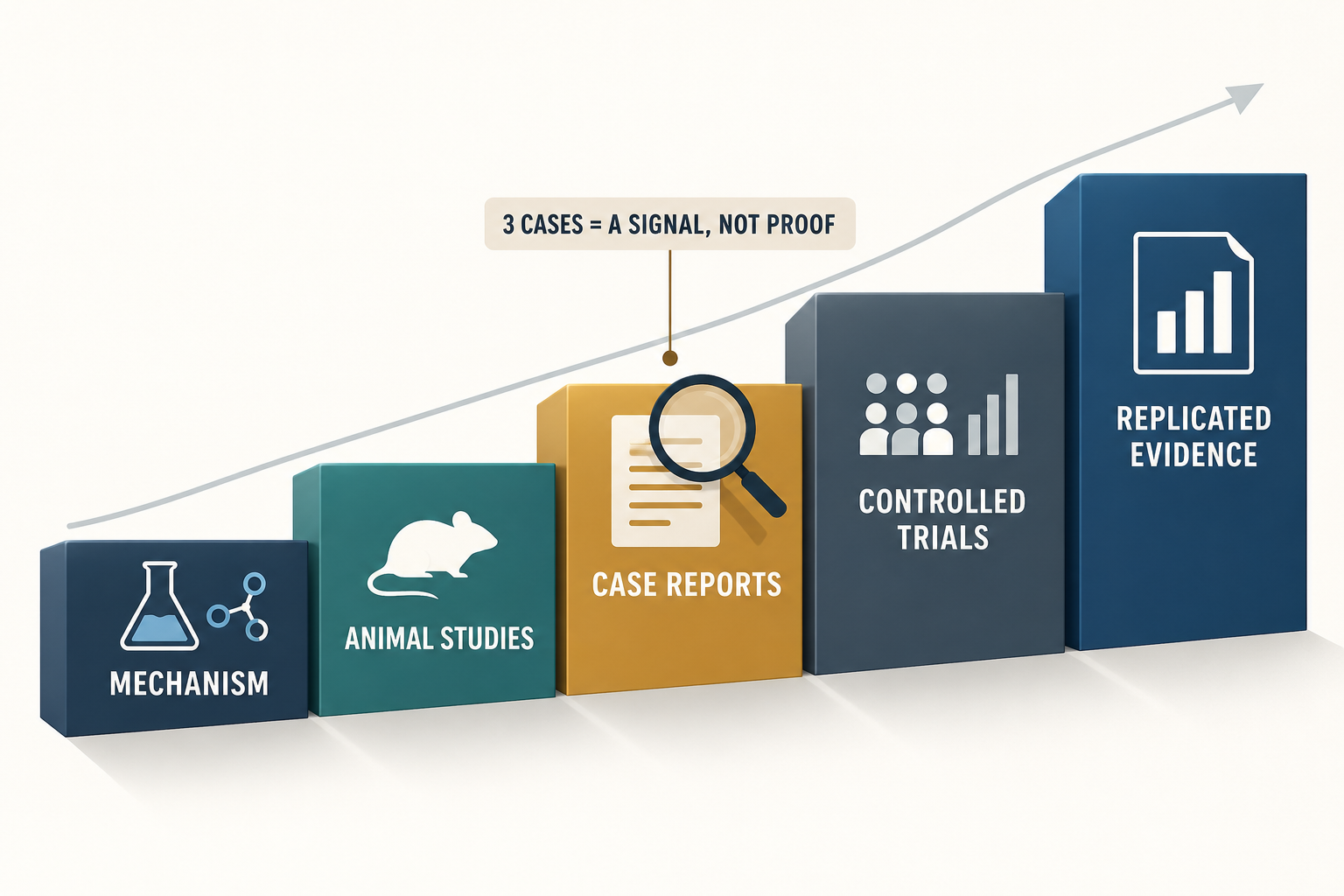
Case reports sit above mechanism-only reasoning because they describe people, but far below controlled and replicated evidence for efficacy.
What did the three-patient report actually observe?
The paper observed neurosensory improvement in three people with inferior alveolar nerve injury during follow-up after a multicomponent intervention. The inferior alveolar nerve supplies sensation to parts of the lower jaw, lower lip, and chin. Injury can follow dental or maxillofacial procedures and may cause numbness, altered sensation, or painful abnormal sensation.
The three cases differed in age, injury circumstances, clinical history, and likely injury mechanism. The intervention included BPC-157, a thymosin-beta-4-derived product described as TB-500, ARA-290, dexamethasone, and a local anaesthetic. All three patients were reported to improve, and no adverse events were reported in the cases.[^frontiers]
Those are the published observations. They support a narrow statement:
- three people improved during follow-up;
- the improvement occurred while several interventions were being used together; and
- the report cannot determine what caused the improvement.
They do not support the broader claims that BPC-157 repaired the nerve, TB-500 repaired the nerve, the peptides were necessary, the combination was superior to standard care, or similar patients should expect the same result.
Where does this report sit on the evidence ladder?
An uncontrolled three-case report is near the bottom of the clinical evidence ladder for testing treatment efficacy. It is useful for detecting unusual observations, describing feasibility, and generating research questions. It is poorly suited to estimating treatment effects.
A compact evidence ladder looks like this:
- Mechanistic rationale: A pathway could plausibly matter in nerve repair.
- Cell and animal studies: An intervention changes selected outcomes in controlled experimental models.
- Case reports or case series: People improved after an intervention, but causality remains unresolved.
- Controlled clinical trials: Outcomes are compared against a credible control under a predefined protocol.
- Replicated evidence: Independent studies produce consistent clinically meaningful findings with acceptable safety.
The Frontiers paper combines the first three rungs: a narrative review of mechanisms and preclinical findings, plus three clinical observations. It does not provide the fourth or fifth rung.[^frontiers]
This is why the paper can be scientifically interesting without proving efficacy. “Worth testing” and “shown to work” are not synonyms.
Why can’t the report isolate BPC-157 or TB-500?
Because every case received a bundle of interventions, no observed change can be attributed to any one component. Even if the full combination contributed to recovery, this design cannot tell whether the relevant factor was BPC-157, the product described as TB-500, ARA-290, dexamethasone, the local anaesthetic, an interaction among components, or something unrelated to treatment.
The report also lacked:
- an untreated or standard-care control group;
- random assignment;
- blinded patients, clinicians, or outcome assessors;
- a standardized active comparator;
- prospective quantitative sensory testing across cases; and
- a design that varied one component at a time.
Without those protections, the intervention and the passage of time move together. Improvement afterward cannot reveal which part—if any—made the difference.
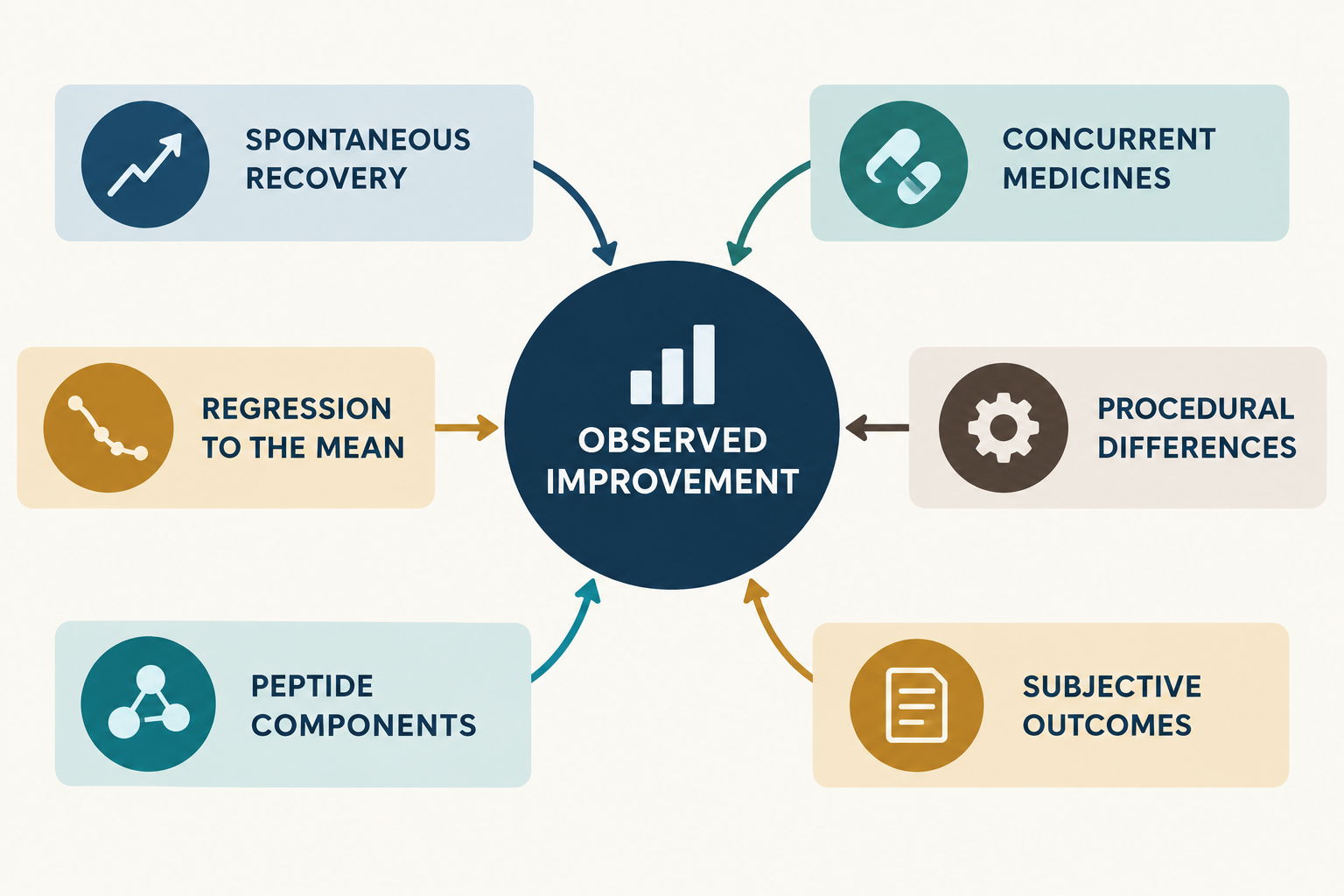
Observed improvement can have several causes. An uncontrolled multimodal report cannot calculate the contribution of each one.
What alternative explanations remain plausible?
Several explanations can fit the same three improvements without requiring BPC-157 or TB-500 to be effective. These are not accusations that the cases are false. They are reasons the causal question remains open.
Spontaneous nerve recovery
Some inferior alveolar nerve injuries improve naturally, particularly when the nerve is compressed, inflamed, or temporarily impaired rather than severed. The paper notes that two cases had no definitive radiographic sign of direct canal penetration and explicitly identifies spontaneous recovery as a plausible explanation.[^frontiers]
Concurrent medicines
Dexamethasone and local anaesthetic were part of the same intervention. Those agents can affect inflammation, swelling, pain, or symptom perception. Because they were not separated from the peptide components, their contribution cannot be estimated.
Procedural and injury differences
The cases did not represent one uniform injury. Different procedures, tissue conditions, injury mechanisms, baseline severity, timing, and healing trajectories can produce different outcomes even when patients receive the same nominal intervention.
Subjective and incompletely standardized outcomes
The report relied substantially on clinical examination, photographs, and patient-reported sensory change. It did not prospectively collect a full standardized set of quantitative sensory or electrophysiological measures. Real improvement can occur while its magnitude remains difficult to compare objectively.
Regression to the mean
People often seek additional care when symptoms are unusually severe. Some improvement may follow simply because extreme measurements or experiences tend to move closer to a person’s typical state over time.
Expectation and observer effects
When patients and clinicians know what intervention was given, expectations can influence symptom reporting, examination, interpretation, and documentation. Blinding does not imply dishonesty; it reduces ordinary human bias.
What does the mechanistic review show—and what does it not show?
The mechanistic review explains why researchers might test these compounds; it does not demonstrate that the proposed pathways operated in these patients. The paper discusses inflammation, cytoprotection, blood-vessel signaling, extracellular-matrix remodeling, Schwann-cell biology, and axonal regeneration. Most of the peptide-related support comes from preclinical or indirect literature.[^frontiers]
That produces hypotheses such as:
- BPC-157-related findings in experimental models might be relevant to vascular or inflammatory aspects of repair;
- thymosin beta-4 biology might be relevant to cell migration and tissue remodeling; and
- ARA-290 might affect tissue-protective or immune-regulatory pathways.
But the case report did not directly measure those pathways in the three patients. It did not show target engagement, pathway activation, axonal regrowth caused by a peptide, or a component-specific biological effect.
There is also a naming problem worth keeping visible: literature about thymosin beta-4 is not automatically direct evidence for every product described as TB-500. Related biology can support a research question, but it cannot silently substitute for clinical evidence about the exact product and use.
For background on that broader distinction, see BPC-157 and TB-500 together: evidence, claims, and what’s still speculative and what preclinical evidence actually means.
Does ARA-290’s early-human literature strengthen this exact claim?
ARA-290 has separate early-human research, but that does not establish efficacy for inferior alveolar nerve injury or for this multicomponent combination. One randomized, double-blind pilot study evaluated ARA-290 in people with sarcoidosis-associated small-fiber neuropathy.[^ara290]
That study is relevant to the general research history of ARA-290. It is not direct evidence for:
- dental or maxillofacial nerve injury;
- the specific injury patterns in these three cases;
- BPC-157 or TB-500;
- the exact multicomponent intervention; or
- the claim that combining the components improves outcomes.
Evidence does not transfer intact merely because two conditions both involve nerves. Different causes, anatomy, outcome measures, comparators, and interventions mean the separate ARA-290 literature should remain in its own evidence bucket.
Does “no adverse events reported” establish safety?
No. Three cases with no reported adverse events provide very little ability to establish safety. A sample of three cannot reliably detect uncommon harms, delayed harms, risks limited to specific populations, component interactions, or problems that require systematic surveillance.
The wording also matters. “No adverse events reported” means the article did not report adverse events in these cases. It does not necessarily mean every possible harm was actively sought with a predefined schedule, standardized definitions, independent adjudication, laboratory monitoring, and long follow-up.
A serious safety assessment would need a much larger and more diverse population, prospective event collection, clear attribution rules, adequate follow-up, and transparent reporting of withdrawals and missing data. See BPC-157 side effects and unknowns and TB-500 side effects and unknowns for compound-specific context.
What would a credible controlled trial need?
A credible trial would need to separate natural recovery and standard care from any added effect of the investigational intervention. At minimum, researchers would need:
- Clear eligibility criteria: well-characterized injury mechanism, severity, timing, and baseline sensory status.
- A prespecified comparator: placebo where ethically appropriate, standard care, or another justified control.
- Randomization and allocation concealment: to reduce systematic differences between groups.
- Blinding: ideally covering participants, treating teams where feasible, assessors, and analysts.
- Standardized outcomes: quantitative sensory testing, validated patient-reported measures, functional outcomes, and clinically meaningful thresholds.
- Fixed assessment windows: so groups are measured at comparable stages of recovery.
- Adequate sample size: powered for a realistic treatment effect and useful safety observation.
- Component logic: factorial or staged designs that can distinguish individual agents from the full combination.
- Prospective registration and analysis plan: including primary outcomes, exclusions, missing-data methods, and adverse-event definitions.
- Longer follow-up and replication: to test durability, delayed harms, and whether independent teams obtain similar results.
The first useful trial would not need to answer every question. It would need to answer one clean question without letting five interventions and natural recovery all take credit for the same result.
What should readers check about authors, funding, and conflicts?
Disclosure checks do not prove or disprove a result, but they help readers judge transparency and possible sources of bias. For this paper, the published statements say:
- the authors received no financial support for the work or publication;
- the authors declared no commercial or financial relationships that could be construed as conflicts;
- author roles included conceptualization, data curation, investigation, methodology, supervision, visualization, and writing; and
- the publisher states that product claims are not guaranteed or endorsed.[^frontiers]
Readers should still ask who selected the cases, who delivered the intervention, who assessed outcomes, whether all treated patients were reported, whether there was a prespecified protocol, and whether any relevant affiliations or product relationships exist beyond the formal declaration. Disclosure is one check, not a replacement for study design.
How should the BPC-157 nerve injury evidence be described?
The most accurate description is: three uncontrolled, hypothesis-generating observations within a multimodal intervention, supported by mechanistic rationale but not by direct proof of peptide efficacy. That sentence preserves what was published without inflating it.
Good evidence language:
- “The patients improved during follow-up.”
- “The cases generate a testable hypothesis.”
- “Mechanistic and preclinical findings provide biological rationale.”
- “The contribution of each component is unknown.”
- “Controlled trials are needed.”
Overstated language:
- “BPC-157 healed the injured nerves.”
- “TB-500 was effective in all three patients.”
- “The peptide combination is proven.”
- “No adverse events means the protocol is safe.”
- “Human evidence now confirms the mechanism.”
The paper itself draws this line responsibly. The risk appears when a three-case observation is shortened into a treatment claim while its controls, co-interventions, and uncertainty disappear.
Bottom line
Three improving patients are a reason to investigate, not a reason to declare BPC-157 or TB-500 effective for nerve injury. The report contributes a clinical observation and a mechanistic research argument. It does not provide the controlled comparison needed to establish causality, component-specific benefit, comparative effectiveness, or safety.
The right next step is not a stronger testimonial. It is a cleaner experiment.
Frequently asked questions
Does this report prove BPC-157 can repair nerve damage?
No. BPC-157 was one part of a multimodal intervention in three uncontrolled cases. Natural recovery, other medicines, procedural differences, subjective outcomes, and regression to the mean remain plausible explanations.
Does the report prove TB-500 works for inferior alveolar nerve injury?
No. The product described as TB-500 was not tested independently, and thymosin beta-4 mechanism literature is not the same as direct clinical evidence for that product in this injury.
Were the patient improvements real?
The report documents improvement during follow-up. The main uncertainty is causal: the design cannot determine why the patients improved or quantify the intervention’s effect against a comparator.
Is ARA-290 supported by human evidence?
ARA-290 has separate early-human literature in other conditions, including a small randomized pilot study in sarcoidosis-associated small-fiber neuropathy. That does not prove benefit for inferior alveolar nerve injury or for the combination in this report.
Is the combination safe because no adverse events were reported?
No. Three cases are far too few to characterize safety, uncommon harms, delayed effects, or interactions among components.
[^frontiers]: Froum S, Estrin N, Pico G, Yakubov M, Ahmad P, LaValle J. “Case Report: Regenerative peptides for Inferior alveolar nerve injury: a narrative review with hypothesis-generating three clinical cases.” Frontiers in Oral Health. Published September 30, 2026. doi:10.3389/froh.2026.1907109. [^ara290]: Heij L, Niesters M, Swartjes M, et al. “Safety and efficacy of ARA 290 in sarcoidosis patients with symptoms of small fiber neuropathy: a randomized, double-blind pilot study.” Molecular Medicine. 2012;18:1430–1436. doi:10.2119/molmed.2012.00332.