TB-500 Side Effects and Unknowns
TB-500 side effects are hard to summarize honestly because the biggest safety issue is not a long, well-mapped list of human adverse effects. It is the opposite problem: TB-500 has far less human safety evidence than its online popularity suggests.
That distinction matters. A peptide can have interesting biology, animal research, mechanistic plausibility, and many confident recovery claims without having a mature human safety profile. "Not many side effects are reported" can mean a compound is well tolerated. It can also mean it has not been studied in enough people, for long enough, through enough real-world scenarios, to reveal uncommon, delayed, route-related, or population-specific risks.
This article explains what is known about TB-500 safety, what remains unknown, and why preclinical or mechanism-based claims do not establish human safety. It is educational only. It is not medical advice, treatment guidance, or a recommendation to use TB-500.
Quick answer: what are the side effects of TB-500?
The most honest answer is that TB-500 does not have a well-established human side-effect profile. Public discussion often mentions injection-site reactions, headaches, fatigue, nausea, flushing, or general discomfort, but those reports should not be treated as a complete safety map.
The larger unknowns are more important: long-term effects, repeated systemic exposure, immune reactions, effects in people with active disease, interactions with medications, product purity, sterility, and whether mechanisms linked to tissue repair or angiogenesis could create risk in the wrong context.
For readers, the useful takeaway is simple: limited reported side effects are not the same as proven safety. TB-500 sits in a safety evidence gap, especially when used outside controlled research settings.
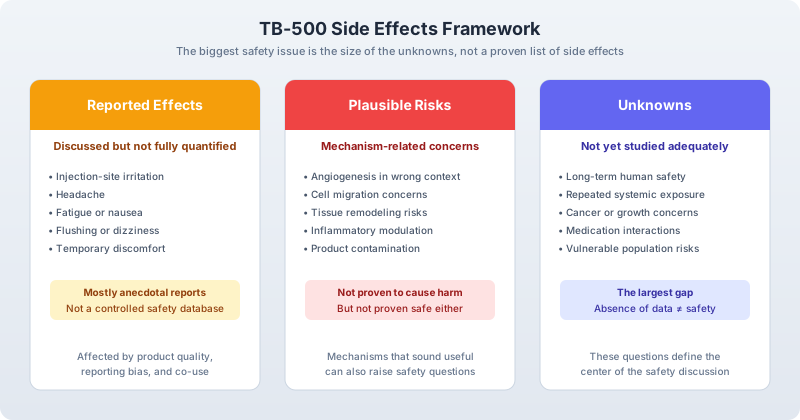 The most important TB-500 safety issue is not a proven long list of side effects; it is the size of the unknowns.
What is TB-500, and why is safety hard to judge?
TB-500 is commonly described as a synthetic peptide related to thymosin beta-4, a naturally occurring peptide involved in cell movement, tissue-repair signaling, inflammation modulation, and angiogenesis-related biology. That mechanism story is why TB-500 is discussed in recovery and soft-tissue contexts.
But safety interpretation gets messy because people often blur several different things together:
- thymosin beta-4 as a naturally occurring molecule
- thymosin beta-4 studied in specific clinical or experimental contexts
- TB-500 or thymosin-beta-4 fragments sold or discussed online
- topical research settings versus systemic use
- controlled study materials versus unregulated products
Those are not interchangeable. Evidence from one form, route, population, or research setting does not automatically prove safety for another. That is the part a lot of peptide marketing quietly walks past while whistling.
Known side effects vs plausible risks vs unknowns
A useful way to read TB-500 safety claims is to separate known reports, plausible risks, and true unknowns. If those categories get mixed together, the article usually turns into either hype or panic. Neither helps.
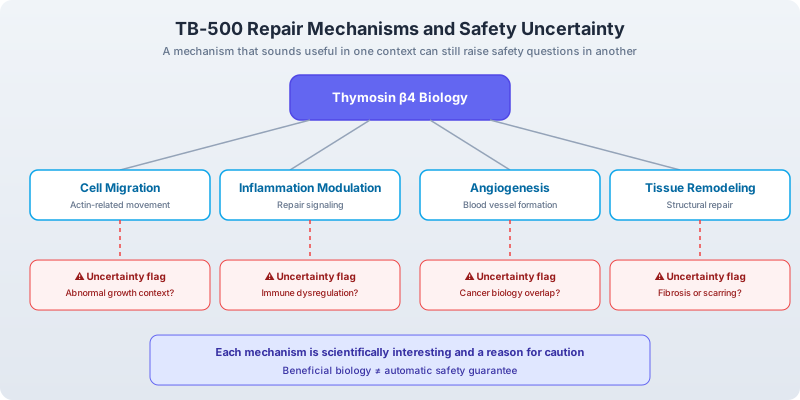 A mechanism that sounds useful in one context can still raise safety questions in another.
Reported or commonly discussed effects
Some online summaries and user discussions mention relatively nonspecific issues such as injection-site irritation, redness, swelling, headache, fatigue, nausea, dizziness, flushing, or temporary discomfort. These reports are not useless, but they are not the same as a controlled safety database.
They can be affected by product quality, sterility, route, expectation, co-use with other substances, underlying injury, and reporting bias. People are also more likely to talk about dramatic results than boring uncertainty. The internet is not a pharmacovigilance system; it is a casino with comments.
Plausible mechanism-related concerns
Thymosin beta-4 biology is tied to cell migration, tissue remodeling, angiogenesis, inflammation signaling, and repair processes. Those mechanisms are part of why researchers find it interesting.
They are also why safety deserves caution. A mechanism that sounds beneficial in one context can be undesirable in another. For example, anything discussed around angiogenesis, cell movement, or tissue remodeling invites careful questions about cancer biology, abnormal tissue growth, fibrosis, inflammatory disease, and vascular conditions. That does not mean TB-500 has been proven to cause those outcomes. It means the mechanism is not a free safety pass.
The true unknowns
The most important TB-500 unknowns are the ones readers cannot solve with a testimonial:
- long-term safety in humans
- safety of repeated or sustained exposure
- effects in older adults or medically complex people
- effects in people with cancer history or abnormal growth concerns
- immune or allergic reactions
- interaction risks with medications or other compounds
- product impurity, contamination, or mislabeling risk
- whether animal or cell findings translate meaningfully to real human outcomes
These gaps are not minor footnotes. They are the center of the safety discussion.
Why preclinical evidence does not establish human safety
Preclinical evidence can explain why TB-500 is scientifically interesting, but it cannot establish that TB-500 is safe for humans. Cell studies and animal studies can show mechanisms, biological signals, and possible directions for future research. They cannot fully predict human safety.
There are several reasons for that:
- animals are not small humans with worse rent
- controlled lab conditions do not match real-world use
- short studies can miss delayed effects
- small studies can miss uncommon adverse events
- healthy or selected research populations may not represent typical users
- route and formulation can change risk
- mechanistic plausibility does not prove clinical safety
This is especially important for TB-500 because the strongest claims tend to lean on repair biology: cell migration, actin-related processes, angiogenesis, inflammation, and tissue remodeling. Those mechanisms may be relevant. They are not automatically reassuring.
A safety claim should be proportional to the evidence behind it. If the evidence is mostly mechanistic or preclinical, the claim should stay cautious.
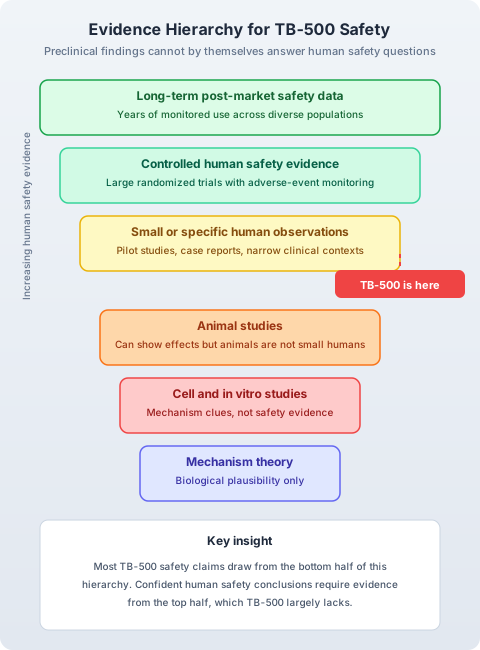 Preclinical evidence can justify questions worth studying; it cannot by itself answer human safety questions.
What human evidence can and cannot tell us
Human research involving thymosin beta-4-related compounds is much narrower than the broad claims made around TB-500 online. Some studies have explored thymosin beta-4 in specific contexts such as wound healing or other clinical areas, often with controlled protocols and defined products.
That kind of evidence can be useful, but it has limits. It may tell us something about tolerability in a particular study design. It does not automatically answer whether widely marketed TB-500 products are safe, whether long-term use is safe, whether repeated systemic use is safe, or whether people with different health conditions face different risks.
This is where readers need to be picky with wording. "Studied in humans" is not the same as "proven safe for broad unsupervised use." "No serious adverse events in a small or specific study" is not the same as "no serious adverse events are possible."
The gap is not semantics. It is the difference between a limited observation and a broad safety conclusion.
Product quality may be one of the biggest real-world risks
For many peptide discussions, the product-quality problem may be more immediate than the molecule-level side-effect list. A controlled research compound and an online product are not the same thing.
Real-world peptide risks can include:
- incorrect identity
- incorrect concentration
- contamination
- sterility problems
- degradation from poor handling
- misleading labeling
- undisclosed additives
- inconsistent batches
This article will not provide sourcing or purchasing advice. The point is broader: if a compound has limited human safety data, adding uncertain product quality makes the safety picture even harder to interpret.
When someone says "TB-500 is well tolerated," ask: which product, in what setting, verified how, in which population, monitored for what, and for how long? If the answer is a shrug wearing a lab coat, that is not evidence.
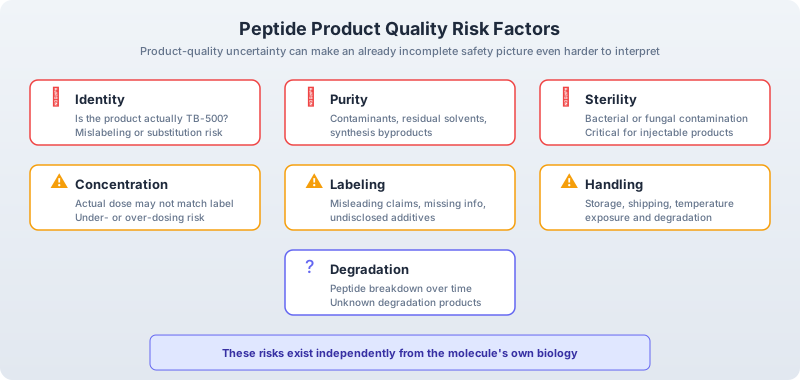 Product-quality uncertainty can make an already incomplete safety picture even harder to interpret.
Who should be especially cautious about TB-500 claims?
Anyone with medical complexity should treat TB-500 safety claims as incomplete, not reassuring. That includes people with active disease, prior cancer, abnormal growth concerns, immune conditions, cardiovascular disease, wound-healing disorders, pregnancy or breastfeeding, medication use, or planned surgery.
This is not because TB-500 has been proven dangerous in all of those groups. It is because the evidence is not strong enough to confidently rule out risk in those groups.
The more a person's health situation depends on carefully balanced immune, vascular, inflammatory, or tissue-repair processes, the less useful generic internet reassurance becomes.
How to read "TB-500 has no side effects" claims
Claims that TB-500 has "no side effects" should be treated as a red flag. That phrasing is too certain for the current evidence base, and the broader guide to peptide side effects, knowns, and unknowns explains why sparse reporting cannot establish safety.
A better evidence-aware statement would be:
TB-500 does not have a well-defined human side-effect profile, and available evidence is not strong enough to establish long-term safety or broad real-world tolerability.
That sentence is less exciting. It also has the benefit of not lying to you.
Watch for these red flags in safety content:
- "no side effects" or "completely safe"
- human claims built mostly from animal studies
- no distinction between thymosin beta-4 and TB-500 products
- no mention of route, formulation, or product quality
- no discussion of long-term unknowns
- no discussion of vulnerable groups
- safety claims attached to a sales funnel
The strongest safety content usually sounds more boring because it has to keep the categories straight.
TB-500 vs BPC-157 safety uncertainty
TB-500 and BPC-157 are often grouped together as recovery peptides, but their evidence stories and uncertainty patterns are not identical. Both are discussed for tissue repair and recovery. Both have preclinical-heavy evidence. Both are surrounded by marketing that can outrun the data.
The main difference is mechanism framing. TB-500 is usually discussed through thymosin beta-4-related repair biology, cell movement, angiogenesis, and inflammation modulation. BPC-157 is usually discussed through gastrointestinal, tendon, ligament, and wound-healing animal models, with different proposed pathways.
For safety, the shared lesson is more important than the rivalry: neither peptide should be treated as proven safe for broad human use just because people online stack anecdotes into a tower and call it research.
Internal comparison pages can be useful here, especially if they separate mechanism, evidence quality, and risk uncertainty instead of asking which peptide is "better." Better for what, proven how, and safer for whom? Those questions matter more than peptide team sports.
Practical interpretation: what should readers take away?
The safest way to interpret TB-500 side-effect claims is to focus less on the absence of dramatic reports and more on the absence of mature evidence. That is the honest center of the topic.
Here is the practical reading framework:
- Treat preclinical findings as hypothesis-building, not safety proof.
- Treat small or narrow human studies as limited observations, not broad clearance.
- Treat product quality as a real-world safety variable.
- Treat "no side effects" claims as overconfident unless backed by strong evidence.
- Treat long-term and population-specific risks as unresolved.
- Treat medical decisions as something to discuss with qualified healthcare professionals, not anonymous comment sections.
TB-500 may continue to be researched, and future evidence may clarify its risk profile. For now, the responsible conclusion is cautious: TB-500's safety profile remains uncertain, and the unknowns are large enough that confident claims should be viewed skeptically.
FAQ
Is TB-500 safe?
TB-500 cannot be described as proven safe for broad human use based on the current public evidence base. Some thymosin beta-4-related research may report tolerability in specific settings, but that does not establish long-term safety, real-world product safety, or safety across different populations.
What are the most common TB-500 side effects?
Commonly discussed effects include nonspecific issues such as injection-site irritation, headache, fatigue, nausea, flushing, or discomfort. However, these reports do not create a complete or reliable human safety profile.
Does animal research prove TB-500 is safe?
No. Animal and cell research can help explain mechanisms and possible research directions, but it cannot prove human safety. Translation from preclinical evidence to human outcomes is uncertain.
Is TB-500 approved for medical use?
Readers should not assume TB-500 is approved for medical use. Regulatory status can vary by jurisdiction and product context, and this article does not provide legal, sourcing, or treatment advice.
Why is product quality such a concern with TB-500?
When products are not held to reliable medical manufacturing and verification standards, risks can include contamination, mislabeling, incorrect concentration, degradation, or undisclosed ingredients. Those risks can exist separately from the molecule's own biology.
Bottom line
TB-500 side effects are not well enough mapped to justify confident safety claims. The more accurate view is that TB-500 has mechanistic and preclinical interest, limited human safety clarity, and major unresolved questions around long-term use, route, population risk, and product quality.
For an evidence-aware reader, that uncertainty is not a small asterisk. It is the headline.