BPC-157 Side Effects and Unknowns
BPC-157 is often discussed as if it has a clean safety profile, but that wording can be misleading. A better summary is this: BPC-157 has shown relatively few reported adverse effects in the limited human and preclinical literature, but the human safety database is still too small to make broad long-term safety claims.
That difference matters. "Few side effects have been reported" does not mean "side effects are impossible." It can also mean that the compound has not been studied in enough people, for enough time, at enough doses, with enough monitoring, to reveal uncommon or delayed problems.
BPC-157 sits in an awkward evidence zone. It has a large amount of animal and mechanistic research, strong online popularity, and limited human data. That combination creates a lot of confident marketing and not nearly enough clinical certainty.
For the broader context behind those claims, our BPC-157 overview examines the compound’s proposed mechanisms, common uses, and overall evidence base.
This guide breaks down the known side effects, the theoretical risks, and the unknowns that are easy to miss.
Educational note: This article is for general information only. It is not medical advice, diagnosis, treatment guidance, or a recommendation to use BPC-157. If you are considering any peptide, especially an injectable product, speak with a qualified healthcare professional.
Quick answer: what are the side effects of BPC-157?
The most honest answer is that a complete side-effect profile for BPC-157 has not been established in humans. Reviews report limited adverse effects in the available literature, but they also emphasize the lack of rigorous, large-scale human trials.
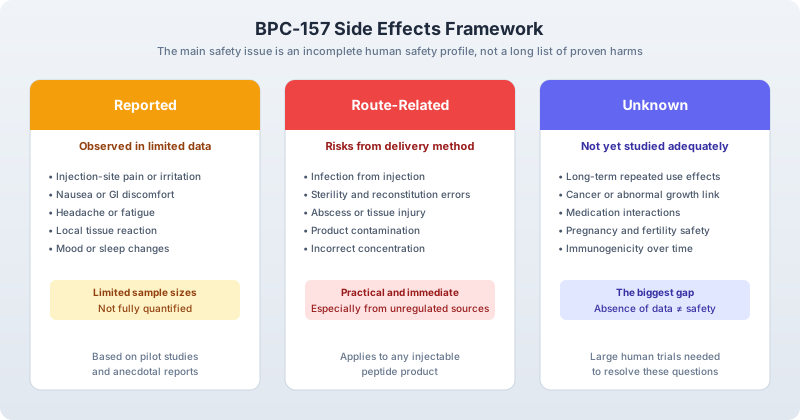
Reported or plausible concerns include:
- injection-site pain, irritation, infection, or tissue injury
- product purity, contamination, or dosing inconsistency from non-regulated sources
- immune reactions or immunogenicity concerns that can apply to peptide products
- unknown long-term effects from repeated use
- uncertain effects in people with cancer history, autoimmune disease, pregnancy, cardiovascular disease, liver/kidney disease, or complex medication use
- regulatory and anti-doping risk
- false confidence that may delay proper diagnosis or evidence-based care
The biggest safety issue is not that BPC-157 has a long proven list of severe side effects. The bigger issue is that human safety evidence is incomplete while real-world use is already widespread.
This article does not provide dosing, cycling, injection, or protocol guidance. That omission is deliberate because BPC-157 is not an approved standard therapy and route-specific human safety data remain incomplete.
Why "no major side effects reported" is not the same as "safe"
When people say BPC-157 is safe, they are usually leaning on three ideas:
- animal toxicology studies have not shown obvious severe toxicity in some models
- reviews describe relatively few reported adverse effects
- anecdotal users often report tolerability
Those points are worth noting, but they are not the same as a mature human safety profile.
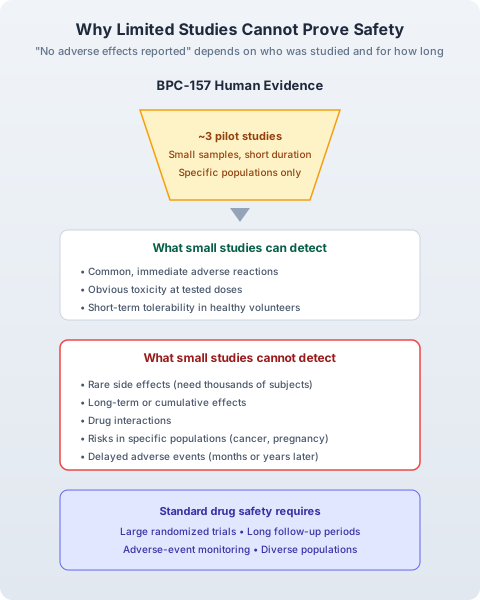
A 2025 review of BPC-157 for musculoskeletal healing notes that only three pilot human studies had examined BPC-157 in humans, including intra-articular knee pain, interstitial cystitis, and intravenous safety/pharmacokinetics. The review states that no adverse effects were reported in those pilot studies, but also emphasizes that rigorous, large-scale trials are lacking.[^musculoskeletal-review]
That is the key phrase: large-scale trials are lacking. Small pilot studies can miss uncommon side effects, long-term risks, drug interactions, and risks in higher-risk populations.
Known and reported side effects
Because the human literature is limited, it is more accurate to separate side effects into "reported," "route-related," and "theoretical or insufficiently studied."
Injection-site reactions
Many real-world BPC-157 discussions involve injectable products. Injection creates risks that are separate from the peptide itself:
- pain or burning
- redness or swelling
- bruising
- irritation
- infection
- abscess risk
- improper injection technique
- tissue injury
A literature review notes that BPC-157 has been known to cause pain and/or necrosis when injected in an aqueous solution or physiological saline in cited research contexts.[^literature-review] That does not mean every injection causes tissue injury, but it does mean injection-route safety should not be treated casually.
Gastrointestinal symptoms
Some users report nausea, appetite changes, stomach discomfort, or digestive changes, but these reports are not well quantified in large controlled trials. Because BPC-157 is often discussed for gut-related effects, people may also confuse changes in the underlying condition with effects of the compound.
Headache, fatigue, or mood changes
Anecdotal reports sometimes mention headache, fatigue, lightheadedness, sleep changes, anxiety, or mood shifts. These are not well established as predictable BPC-157 side effects, but they are worth watching because BPC-157 is discussed in relation to multiple signaling systems, including brain-gut and nitric oxide pathways.
Allergic or immune reactions
Any peptide product can raise immune-related questions. The FDA has raised concerns for some compounded peptides around immunogenicity, aggregation, impurities, and limited route-specific safety information.[^fda] For BPC-157 specifically, the regulatory concern is not simply "one known side effect"; it is the combination of insufficient human safety data, product-quality uncertainty, and peptide-related risk categories.
Theoretical risks and unknowns
The unknowns are where BPC-157 safety gets serious. They are not proof of harm, but they are reasons not to oversell safety.
1. Long-term repeated use
Short pilot studies and animal models cannot fully answer what happens when people use BPC-157 repeatedly over months or years. Long-term use raises questions about immune response, tissue remodeling, vascular signaling, organ stress, and unknown downstream effects.
If a compound is being used for chronic injuries, chronic gut symptoms, or repeated recovery cycles, long-term safety becomes especially important.
2. Cancer and abnormal tissue growth concerns
BPC-157 is often discussed in relation to angiogenesis, fibroblast activity, and tissue repair. Those are not automatically dangerous pathways; they are also part of normal healing. But anything that influences repair, blood-vessel signaling, or cell migration invites careful questions in people with cancer history or abnormal tissue growth concerns.
There is no responsible way to claim that BPC-157 causes cancer based on current evidence. There is also no responsible way to casually declare it risk-free for people with cancer history. The honest position is uncertainty.
3. Autoimmune and inflammatory conditions
People with autoimmune disease or complex inflammatory conditions should be cautious with immune-active or repair-signaling compounds. BPC-157 is sometimes described as anti-inflammatory in models, but "anti-inflammatory" does not automatically mean safe for every immune condition.
The immune system is not a dimmer switch. It is more like a very expensive control panel designed by committee. Turning one knob may affect something else.
4. Pregnancy, fertility, and breastfeeding
There is not enough human evidence to establish safety during pregnancy, attempts to conceive, or breastfeeding. This is a high-caution category by default.
5. Medication interactions
BPC-157 is discussed in relation to nitric oxide signaling, vascular function, inflammation, and tissue repair. That creates unanswered questions for people taking medications that affect blood pressure, clotting, immune function, hormones, or inflammation.
Absence of documented interactions is not the same as proof of no interactions.
6. Product quality and contamination
This may be the most practical risk. Many BPC-157 products are sold outside normal regulated pharmaceutical channels. That raises questions about:
- whether the vial contains what the label says
- peptide purity
- degradation
- bacterial contamination
- endotoxins
- incorrect concentration
- storage and shipping conditions
- counterfeit or mislabeled products
For injectable products, quality control matters even more. A contaminated or mislabeled injection can be dangerous even if the underlying peptide has a relatively benign profile in controlled research.
Regulatory and sports risks
BPC-157 is not FDA-approved as a standard medical treatment. A 2025 review notes that the FDA restricted BPC-157 by classifying it as a Category 2 bulk drug in 2023, effectively barring its inclusion in compounded medications under current FDA regulations, due to concerns including safety, impurities, and insufficient human data.[^musculoskeletal-review]
The same review notes that BPC-157 was banned by WADA in 2022 under the S0 Unapproved Substances category due to lack of human clinical approval.[^musculoskeletal-review] Athletes should always check the current prohibited list and their sport's governing body rules directly, because anti-doping rules can change.
Regulatory status is not just a bureaucratic footnote. It affects product quality, legal access, medical oversight, adverse-event reporting, and whether a person is getting something made under appropriate controls.
Who should be especially cautious?
BPC-157 should be approached cautiously in general, but some groups should be especially careful:
- pregnant or breastfeeding people
- people trying to conceive
- people with cancer or a history of cancer
- people with autoimmune disease
- people with clotting disorders or cardiovascular disease
- people with liver or kidney disease
- people taking prescription medications
- people using anticoagulants, immune-modulating drugs, blood-pressure drugs, or hormones
- competitive athletes
- anyone considering injectable use from a non-regulated supplier
- anyone using BPC-157 to avoid medical evaluation for an injury or gut symptom
A recurring problem in peptide marketing is that "experimental" gets repackaged as "advanced." Sometimes advanced just means the safety manual is missing.
BPC-157 oral vs injectable side effects
Side-effect risk can differ by route.
Oral BPC-157
Oral products avoid injection-site risks, but they still raise questions about:
- absorption and formulation quality
- product identity and purity
- gastrointestinal symptoms
- inconsistent dosing
- lack of strong clinical evidence
Oral use is often marketed for gut health, but that does not make it automatically safe or proven for gastrointestinal disease.
Injectable BPC-157
Injectable use adds risks from:
- sterility
- reconstitution errors
- injection technique
- local irritation or tissue injury
- incorrect concentration
- contamination
- systemic exposure patterns that may differ from oral use
If someone is comparing oral and injectable BPC-157, the question should not be "which one works better?" only. It should also be "which risks are being added, and is there enough evidence to justify them?"
What would better safety evidence look like?
To move BPC-157 from "interesting but uncertain" toward a clearer safety profile, researchers would need:
- larger randomized human trials
- clearly defined doses and routes
- standardized pharmaceutical-grade products
- longer follow-up periods
- adverse-event monitoring
- studies in specific conditions rather than vague wellness categories
- interaction studies with common medications
- data in older adults and medically complex populations
- clear reporting on immune, cardiovascular, liver, kidney, and cancer-related outcomes
Until then, confidence should stay limited.
Practical red flags when evaluating BPC-157 products or advice
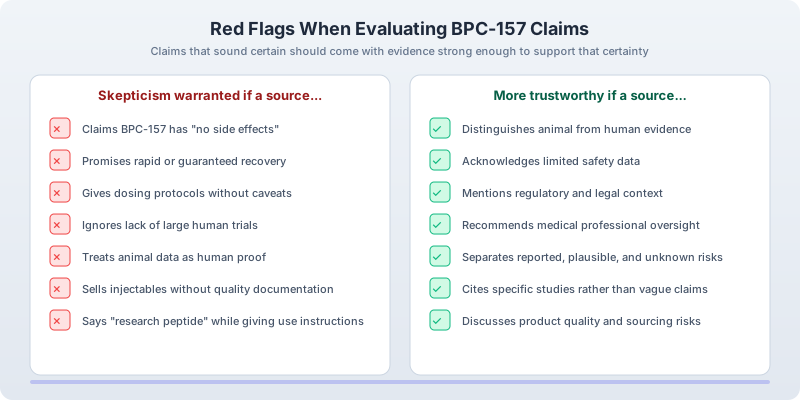
Be skeptical if a source:
- claims BPC-157 has "no side effects"
- promises rapid healing or guaranteed recovery
- gives dosing protocols without discussing regulatory status or medical oversight
- ignores the lack of large human trials
- sells injectable products without clear quality documentation
- treats animal evidence as human proof
- uses FDA or WADA claims that are outdated or vague
- says "research peptide" while giving human use instructions
- downplays injection risks
The more certain the claim sounds, the more evidence it should have. With BPC-157, certainty often outruns the data.
Bottom line
BPC-157 may have a relatively favorable safety signal in some preclinical and limited human research, but its full human side-effect profile is not established. The biggest unknowns involve long-term use, repeated dosing, injectable-product quality, immune effects, medication interactions, cancer-history questions, pregnancy/breastfeeding safety, and use in medically complex people.
The most defensible position is cautious: BPC-157 is an investigational peptide with interesting preclinical evidence and unresolved human safety questions. Anyone considering it should treat "unknown" as a real category, not an inconvenience to be marketed around.
FAQ
Does BPC-157 have side effects?
A complete human side-effect profile has not been established. Some studies and reviews report few adverse effects in limited data, but that does not prove broad or long-term safety.
Is injectable BPC-157 riskier than oral BPC-157?
Injectable use adds route-specific risks such as infection, irritation, tissue injury, sterility problems, and dosing/reconstitution errors. Oral products avoid injection risks but still have product-quality and evidence limitations.
Is BPC-157 safe long term?
Long-term human safety is unknown. There is not enough large-scale, long-duration human research to confidently answer that question.
Can BPC-157 interact with medications?
Possible interactions are not well studied. Because BPC-157 is discussed in relation to vascular, inflammatory, and repair pathways, people taking medications should speak with a qualified clinician before considering use.
Is BPC-157 legal or FDA-approved?
BPC-157 is not FDA-approved as a standard treatment. Compounding and regulatory status can be complex and may change, so current official sources should be checked.
[^musculoskeletal-review]: Regeneration or Risk? A Narrative Review of BPC-157 for Musculoskeletal Healing, Current Reviews in Musculoskeletal Medicine, 2025. [^literature-review]: Multifunctionality and Possible Medical Application of the BPC 157 Peptide—Literature and Patent Review, Pharmaceuticals, 2025. [^fda]: Certain Bulk Drug Substances for Use in Compounding that May Present Significant Safety Risks, U.S. Food and Drug Administration.