Does a More Stable Peptide Still Work? What the PnPP19 Hydrogel Study Actually Measured
The PnPP19 hydrogel study measured HPLC peptide retention—not biological potency, patient benefit or shelf-life. Here is what its findings can support.
Does a More Stable Peptide Still Work? What the PnPP19 Hydrogel Study Actually Measured
Not necessarily. Preserving a peptide’s laboratory signal does not prove that it still produces the same biological response, benefits patients, or has an established shelf-life. The PnPP19 hydrogel study illustrates why peptide stability versus biological activity is a distinction worth checking before accepting a headline.
Frohlich and colleagues compared experimental formulations and measured peptide content during storage. Their paper, published online September 8, 2026, is laboratory formulation and analytical research—not a new human efficacy trial. Its journal volume is dated 2027; that does not change the online publication date.
The useful finding is narrower than “a better-working peptide”: formulation choices were associated with different preservation of HPLC-quantified peptide content under the conditions tested.
Peptide stability versus biological activity: what is the difference?
Chemical content asks how much material an analytical method detects; biological potency asks how strongly a sample produces a defined biological response. Those measurements can be related without being interchangeable.
High-performance liquid chromatography, or HPLC, separates sample components and records signals as they pass a detector. In this study, researchers tracked the chromatographic peak attributed to PnPP19 and compared it with the initial measurement. A smaller decline means better preservation of that measured signal—not automatically better function.
Clinical benefit is another question again: whether an intervention improves meaningful outcomes in people. Product shelf-life asks whether a particular product continues meeting appropriate specifications over a defined period under specified conditions. Neither follows from a preserved HPLC peak alone.
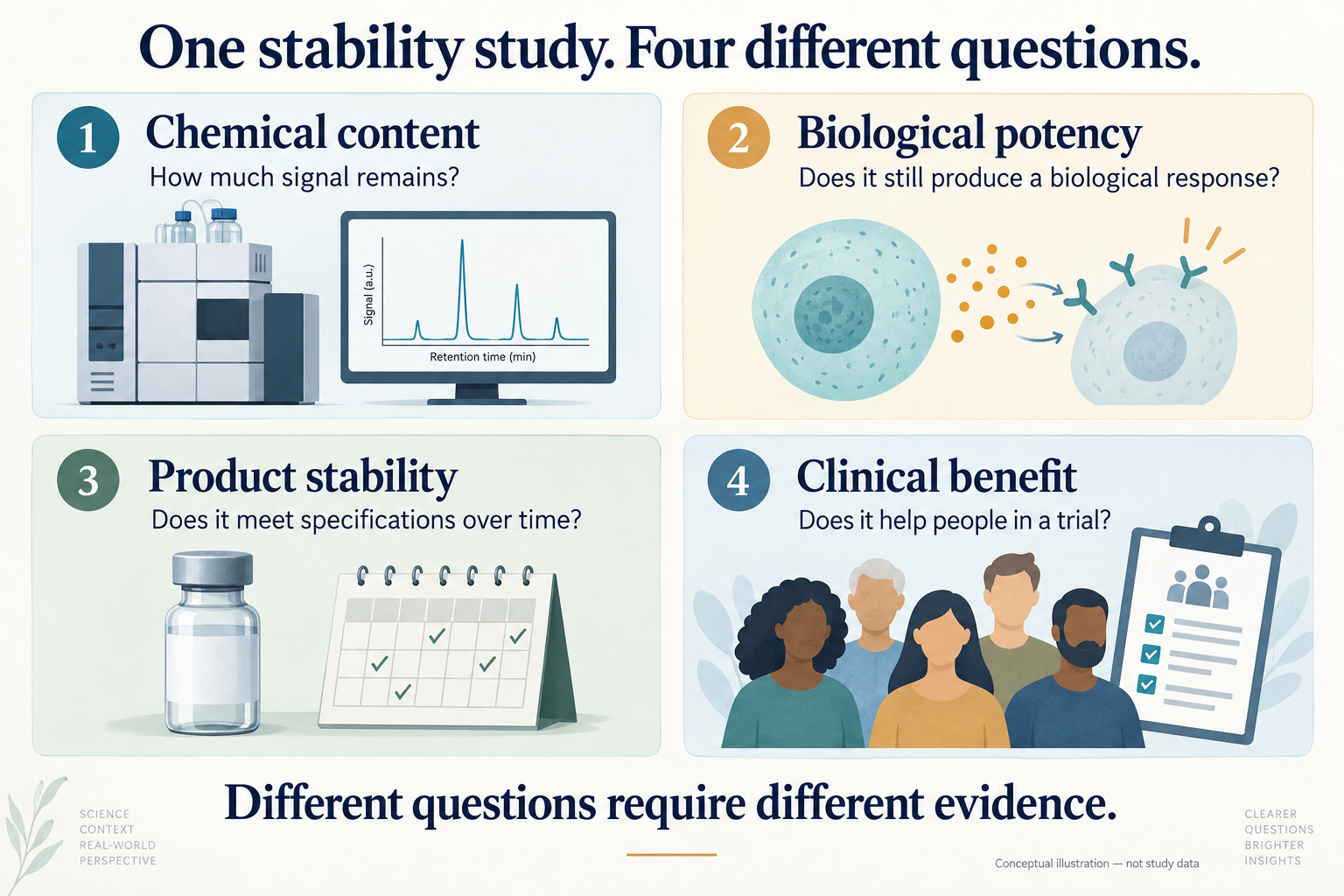
Conceptual illustration, not study data. Each question requires its own evidence; the icons do not represent outcomes demonstrated for PnPP19.
What are PnPP19, thermoresponsive hydrogels and rheology?
PnPP19 is an experimental synthetic peptide studied for topical development; the hydrogel is its carrier, not proof of its effectiveness. This article evaluates the formulation study, not claims about clinical safety or treatment benefit mentioned in its introduction.
A hydrogel is a water-rich material structured by a network or organized assembly. “Thermoresponsive” means its physical behavior changes with temperature: a relatively fluid preparation can become more gel-like as its polymer components organize.
Here, the carrier uses the polymer Poloxamer 407. That is different from a self-assembling peptide hydrogel, in which peptide molecules themselves provide the gel-forming building blocks. A polymer gel carrying a peptide should not be confused with a gel made by peptides.
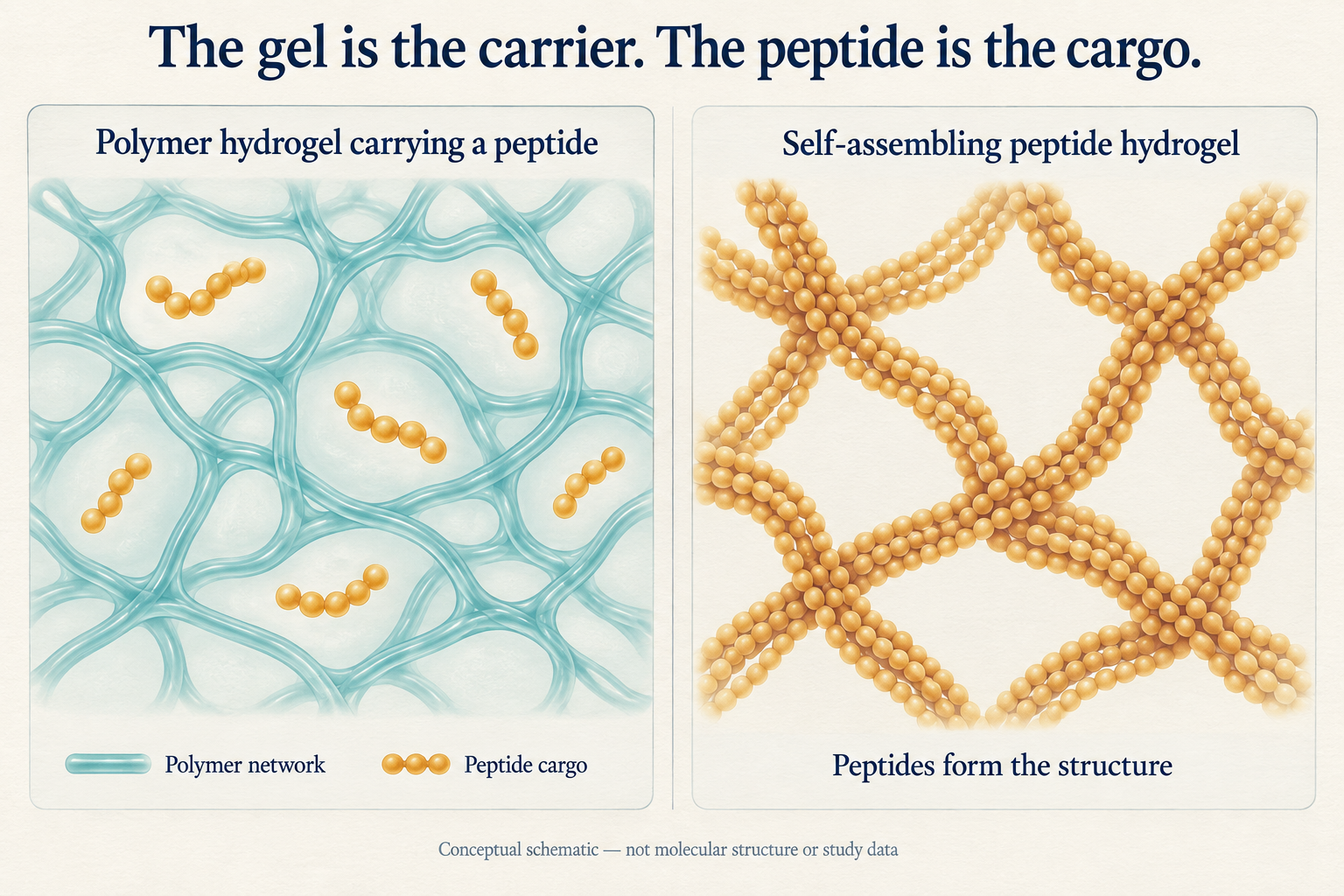
Conceptual carrier-versus-building-block comparison, not the measured microscopic structure of these formulations. PnPP19 is cargo in a polymer-based system; the right-hand panel illustrates a different class of hydrogel.
Rheology is the study of how materials flow and deform. The researchers compared a fluid formulation, 10 S-PEHG, with a more structured formulation, 16 F-PEHG. The latter required an initial push to flow and became less resistant to flow under increasing shear—a behavior called shear-thinning. These are physical properties, not measures of biological activity.
What did the nine-month comparison find?
The structured formulation lost less HPLC-quantified peptide content in the central comparison at nine months and 25 °C. Eight formulations entered stability screening. The central 10 S-PEHG and 16 F-PEHG groups used six independent formulation batches per condition; the other formulations used three.
The original publisher Table 4 reports these losses relative to baseline:
- 10 S-PEHG: 25.71% ± 3.02.
- 16 F-PEHG: 19.39% ± 4.61.
These are means ± standard deviations, describing the measured losses and their variation. Supplementary Table S4 reports P = 0.0053 for the nine-month comparison using an unpaired t-test with Welch’s correction.
The result supports a difference in this analytical endpoint under this condition. It does not mean that clinical efficacy fell by 25.71% or 19.39%, nor that the difference between those numbers is a treatment advantage. No biological potency assay supplied that missing link.
Was the selected hydrogel always best?
No. The selected formulation balanced chemical preservation with physical characteristics; it was not uniformly the smallest numerical degradation result. Selection included gel-transition behavior, rather than simply choosing the lowest number in every table column.
For example, Table 4 reports a nine-month loss of 15.33% ± 2.66 for 14 F-PEHG—numerically below 16 F-PEHG’s value. That does not by itself establish a statistically superior formulation, especially with different batch counts. It does show why “optimized” should not be translated as “best on every measurement.”
The paper describes stronger preservation in the structured formulation under some other storage conditions. But at eight months and 40 °C, the central groups were not significantly different. Early separation does not demonstrate permanent protection.
The photostability comparison also did not reach statistical significance (P = 0.0527). That is not evidence that the formulations are equivalent: failure to detect a difference and demonstrating equivalence are different statistical claims. The preliminary light-exposure experiment also lacked quantified light-source exposure data.
What can HPLC miss?
A well-performing content assay is not automatically a biological potency assay or a fully demonstrated degradation-specific assay. The authors evaluated analytical properties including precision, accuracy and interference from formulation ingredients. Those checks make the results useful, but do not answer every question about an aging sample.
The study did not include a forced-degradation specificity study to establish separation from all potential degradation products. Consequently, interference by every possible breakdown product could not be ruled out. The measured peak was an indirect indicator of degradation, not a complete inventory of molecular changes.
HPLC-DAD also did not establish preserved peptide conformation or biological function. A relevant potency assay would need to test a defined biological response in stored samples; clinical claims would require additional human evidence.
There is a separate causal limitation: multiple composition variables changed together. Polymer content, buffer environment and other formulation features can influence both flow behavior and chemical preservation. The study did not isolate viscosity alone as the cause of the stability difference.
That distinction connects to the TFA counterion evidence explainer: what accompanies a peptide can matter when interpreting an experiment. It is not evidence that the same confound operated identically in both studies.
Why this does not establish shelf-life
The study cannot supply an expiry date or a universal peptide-storage rule. The authors explicitly describe preliminary storage experiments without humidity or light control, rather than a complete shelf-life assessment.
Several additional limits matter:
- Physical properties were assessed initially, not tracked throughout storage. Gel-transition behavior, rheology and texture could change; initial characterization does not show that they remained constant. Appearance and pH were not systematically monitored throughout storage either.
- Rheological analyses were performed once per formulation. The six independent batches in the central stability comparison should not be mistaken for six independent repetitions of every physical test.
- Kinetic fits were exploratory and sometimes poor. Fitting a degradation curve does not guarantee it describes the process well enough to predict beyond the observations.
- Arrhenius estimates used only three temperatures. These exploratory estimates of temperature dependence are not a validated expiry-date calculator.
- Preservative efficacy was not specifically evaluated. Chemical-content retention alone does not establish microbiological product quality.
This is why peptide manufacturing quality involves more than one favorable assay. The present study helps identify formulation questions for further development; it does not validate a finished product’s shelf-life or tell readers how to store personal supplies.
Who funded the research?
Biozeus Biopharmaceutical provided financial support, and three coauthors were company employees. The paper identifies Camilla Nunes dos Reis Trindade, Gabriela Westerlund Peixoto Neves and Paulo Gustavo Lacativa in its competing-interest disclosure.
Those relationships are relevant context, not grounds to assume the results are invalid. The central appraisal remains the same: examine what was measured, the comparisons, the limitations and whether conclusions stay within the evidence.
Four questions to ask about any peptide stability claim
Ask which of these four questions the evidence actually answers:
- Chemical content: What did the analytical method quantify, and could degradation products interfere?
- Biological potency: Were stored samples tested for a relevant biological response?
- Product stability and shelf-life: Were appropriate product specifications evaluated over time under suitable controlled conditions?
- Clinical benefit: Was a meaningful benefit demonstrated in people, rather than inferred from laboratory measurements?
For PnPP19, this paper contributes principally to the first question and to preliminary formulation characterization. It does not settle the other three. The same discipline applies to peptide cyclization and binding claims: improving one property is not the same as demonstrating a better medicine.
For a broader reading framework, see how to evaluate peptide claims online.
Educational evidence appraisal, not medical advice or guidance on preparing, using or storing peptides.
Primary sources
- Frohlich et al. Influence of Formulation Composition and Rheological Properties on the Stability of PnPP19 Peptide in Thermoresponsive Hydrogels. Journal of Pharmaceutical Innovation. Published online September 8, 2026. Full paper and DOI.
- Publisher Table 4: HPLC-quantified losses at 25 °C.
- Original supplementary material, including Table S4.