Why Peptide Manufacturing Quality Is Hard: The EMA Synthetic-Peptide Guideline, Translated
Synthetic peptide manufacturing quality is not established by matching an amino-acid sequence on a label. For a peptide medicine, manufacturers must show what was made, how consistently it was made, which closely related impurities are present, whether the molecule has the intended stereochemistry and structure, how it behaves during storage and formulation, and whether the finished product meets justified specifications.
The European Medicines Agency’s Guideline on the Development and Manufacture of Synthetic Peptides makes those expectations unusually concrete. Adopted in December 2025 and effective June 1, 2026, it applies to synthetic peptides used in medicinal products within its stated EU regulatory scope.[^ema]
That scope matters. The guideline is not a consumer research-chemical rule, a vendor certification scheme, or proof that an online product is pharmaceutical grade. It describes quality information expected in regulated medicine development and authorization. This article translates the science without extending the guidance beyond that lane.
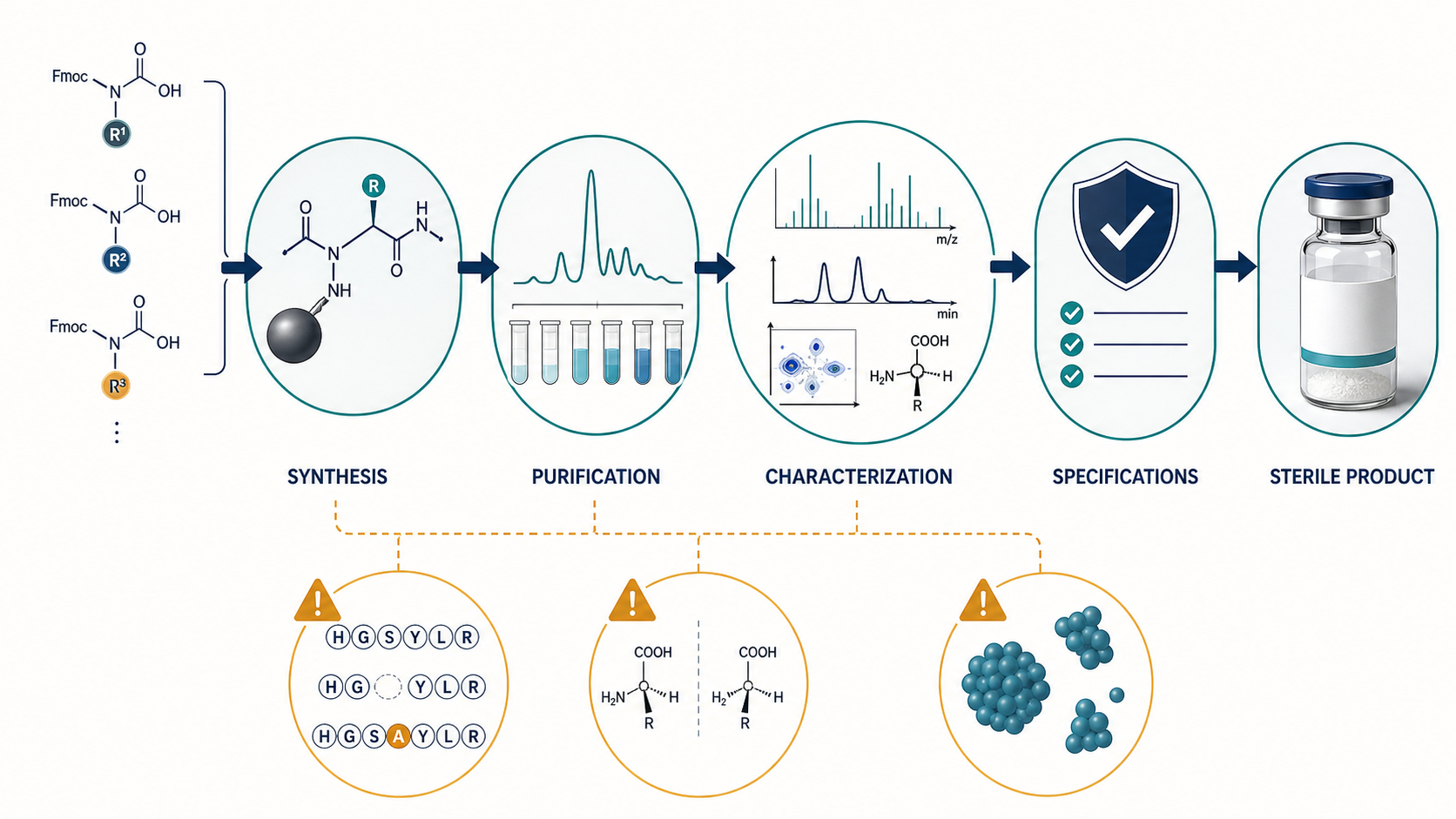
A named sequence is only the target. Pharmaceutical quality depends on the controlled chain of manufacturing and analytical evidence around it.
Quick answer: why is synthetic peptide manufacturing quality difficult?
Peptides are built one amino acid at a time, and every step creates opportunities for small but meaningful errors. A coupling may fail, an amino acid may be inserted twice, a chiral center may invert, a protecting group may remain, or multiple peptide molecules may aggregate. Many of those variants are chemically similar to the intended peptide, so one test may not reliably separate or identify them.
The new nanopore peptide-sequencing proof of concept shows why single-residue discrimination could eventually matter for such near-neighbor variants, but it is not yet a validated pharmaceutical quality-control method.
EMA describes synthetic peptides as sitting “at the interface of small molecules and proteins.”[^ema] That is the basic regulatory problem: they are chemically synthesized, yet their length, three-dimensional behavior, impurity patterns, and biological activity can demand analytical tools more often associated with complex biological products.
What the EMA guideline actually covers
The guideline addresses the development, manufacture, and control of synthetic peptides used in medicinal products. It supplements broader chemistry guidance with peptide-specific expectations for:
- solid-phase and solution-phase peptide synthesis;
- starting materials and process controls;
- structural characterization;
- peptide-related and non-peptide impurities;
- active-substance specifications and analytical methods;
- conjugated peptides;
- finished medicinal products, including sterile products;
- certain development programs referencing biological peptide medicines; and
- investigational medicinal products for humans.
It does not apply to recombinant biological products, and it does not convert every product called a “peptide” into an EMA-regulated medicine. A research-use-only vial and an authorized medicinal product may display the same sequence name while belonging to completely different quality and regulatory systems. For the label distinction, see what “research use only” actually means.
Sequence confirmation: the label is a claim, not an analytical result
A peptide’s primary sequence has to be demonstrated, not merely stated. The EMA guideline lists mass spectrometry, tandem mass spectrometry, peptide mapping for longer peptides, nuclear magnetic resonance, and other suitable techniques among the characterization tools that may be used.[^ema]
Molecular mass alone is not the same as full sequence confirmation. Two molecules can have similar measured mass while differing in sequence, modification, or stereochemistry. The guideline’s example toolbox therefore separates questions:
- Is the molecular mass consistent with the target? MS or LC-MS may help.
- Is the amino-acid order correct? LC-MS/MS, peptide mapping, NMR, or another justified approach may be needed.
- Is the amino-acid composition consistent? Amino-acid analysis can add evidence.
- Does higher-order structure matter? Circular dichroism, NMR, infrared methods, biological assays, or other techniques may be relevant case by case.
This is why “tested by HPLC” is not a complete quality statement. HPLC describes a broad family of separation methods. It does not, by itself, tell the reader whether the method can identify the target, resolve its closest impurities, detect aggregates, or confirm stereochemistry.
Impurities can look almost like the intended peptide
Peptide impurities are difficult because many are near-neighbors of the target molecule. They can originate in starting materials, form during synthesis and purification, or appear through degradation during manufacturing or storage.
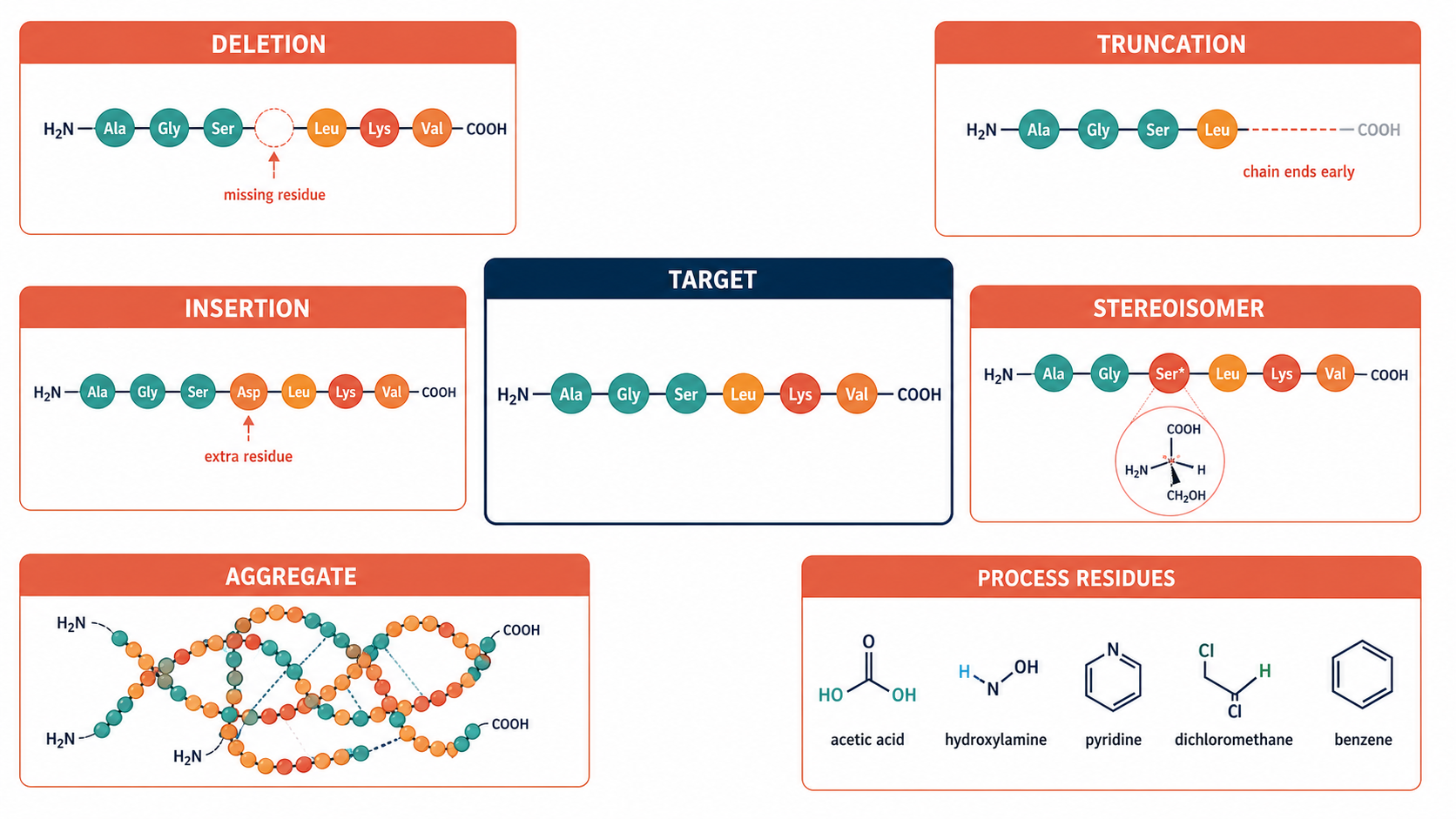
Impurities are not one generic bucket. Different formation routes require different controls and analytical methods.
The EMA guideline highlights several families:
| Impurity family | What changed | Why it can be hard to control | |---|---|---| | Deletion sequence | One or more amino acids are missing | Incomplete coupling or deprotection can produce a molecule close to the target | | Truncated sequence | The chain ends early | Capping can stop an incomplete chain from continuing, leaving a shorter fragment | | Insertion sequence | An amino acid appears more than once | Excess material, premature deprotection, or inadequate washing can contribute | | Stereoisomer | Connectivity may match, but spatial configuration differs | Epimerization can create diastereomers that standard identity tests may miss | | Degradation product | Oxidation, hydrolysis, deamidation, isomerization, or another change occurs | Levels may rise during processing or storage | | High-molecular-weight impurity | Dimers, oligomers, branched products, or aggregates form | Covalent or noncovalent association may require size-sensitive methods | | Non-peptide impurity | Reagents, solvents, elemental impurities, or other residues remain | These arise from the process rather than the peptide sequence itself |
The practical lesson is simple: a purity percentage is meaningful only in the context of the method, its resolution, the impurities it can detect, and the reference standards or orthogonal evidence supporting identification.
Stereochemistry: the same formula can describe a different molecule
Peptide quality includes the three-dimensional configuration of amino acids. Except for glycine, natural amino acids have at least one stereogenic center. Incorrect enantiomers in starting materials or epimerization during manufacturing can create stereoisomers of the final peptide.
Those variants may share the same elemental composition and nominal mass as the target. A basic mass check can therefore look reassuring while missing a stereochemical difference. EMA discusses chiral chromatography and related approaches, plus risk-based justification for when enantiomeric purity needs routine release control.[^ema]
This is a clean example of why “same sequence” is incomplete shorthand. Sequence notation usually records amino-acid order; it may not communicate every configuration, terminal modification, counter-ion, disulfide arrangement, or higher-order attribute relevant to the actual material.
Aggregation changes the quality question
A peptide can have the intended primary structure and still form unwanted dimers, oligomers, or aggregates. EMA says aggregation should be investigated where relevant and lists tools such as size-exclusion chromatography, Thioflavin T assays, and intrinsic tryptophan fluorescence as possible approaches.[^ema]
Aggregation matters because it can change physical behavior, complicate formulation, reduce consistency, and in some contexts raise biological or immunogenicity questions. The guideline also says that a vague specification called only “high molecular weight impurities” is not enough; the relevant species should be described—for example, dimers, trimers, oligomers, or aggregates—so the control has a defined target.
Stress matters too. Heat, light, pH, concentration, freeze-thaw conditions, surfaces, and storage time can influence association or degradation. Quality is therefore not just a release snapshot. Stability-indicating methods are needed to show whether the material remains within specification over time.
Conjugation adds another layer of identity and impurity control
Conjugating a peptide to a fatty acid, polymer, linker, payload, or other moiety creates new quality attributes. Conjugation may be used to alter half-life, distribution, targeting, or another product property, but it also introduces additional starting materials, reactions, and possible impurities.
EMA calls for control of the unconjugated peptide, free conjugation moiety, relevant linkers, and products such as multiple or non-site-specific conjugates when they could occur.[^ema] The manufacturer also needs to understand which peptide impurities can themselves become conjugated.
This is especially relevant when comparing a regulated long-acting peptide medicine with a loosely described product sold under the base peptide name. A modification is not decorative fine print; it may be part of the molecule’s identity, behavior, manufacturing process, and evidence package.
Specifications turn characterization into batch-by-batch control
Characterization asks what the molecule and its variants are; specifications define what each released batch must meet. EMA’s non-exhaustive active-substance list includes identity, purity, specified and unspecified impurities, relevant high-molecular-weight species, assay, water, counter-ion content, residual solvents, elemental impurities, bacterial endotoxins, and microbiological quality.[^ema]
The guideline recommends at least two orthogonal methods for identification. “Orthogonal” means the methods distinguish material using different scientific properties—for example, mass and chromatographic behavior—so the same blind spot is less likely to survive both tests.
Acceptance criteria are not supposed to be arbitrary numbers pasted onto a certificate. EMA says they should be justified using batch data, process understanding, clinical and production experience where applicable, pharmacopoeial expectations, and the actual impurity qualification history.
Quick distinction:
- A certificate of analysis reports selected test results for a batch.
- A pharmaceutical control strategy connects material controls, process knowledge, validated methods, justified limits, stability, and lifecycle oversight.
The first document can be part of the second system. It is not a substitute for the whole system.
Sterile peptide products have a finished-product problem too
Purified active substance is not automatically a safe, stable sterile medicinal product. Many peptide medicines are parenteral, so formulation, container closure, sterilization, endotoxin control, degradation, particles, and aggregation must be considered at the finished-product stage.
The EMA guideline points to terminal sterilization as the preferred approach unless it is shown to be unsuitable. If heat stresses the peptide, manufacturers must evaluate formulation and container options, characterize resulting degradants, and justify an alternative such as sterile filtration with aseptic processing.[^ema]
That is a real engineering tradeoff. Stronger sterility assurance can create chemical stress; gentler processing may require tighter aseptic controls. The quality package has to resolve that tradeoff with data, not slogans.
Investigational products do not get a quality-free pass
Clinical-stage peptides can have evolving controls, but early development still requires meaningful identity and impurity work. EMA’s investigational-product section expects details such as resin type, coupling agents, and capping; early monitoring of impurities in amino-acid building blocks; primary-structure characterization; attention to aggregation and epimerization; and orthogonal analytical procedures to reduce the risk of co-eluting impurities.[^ema]
Expectations mature with development. EMA notes that some early Phase I assessments may be risk-based, while later Phase II and III work should increasingly be supported by experimental data and limits based on greater process and safety knowledge.
“Investigational” therefore does not mean “uncharacterized.” It means the product is still being studied under a development framework whose controls should become more complete as exposure, scale, and knowledge increase.
Approved medicine, compounded product, and research chemical are not equivalent categories
The same peptide name does not carry the same evidence or quality package across product categories. A regulated medicine is reviewed as a specific product with a defined manufacturer, process, formulation, specification, stability program, labeling, and intended use. A compounded preparation operates under a different legal and quality framework. A research-use product is not converted into a medicine by matching a sequence name or publishing a purity claim.
This does not mean every non-approved material is identical, contaminated, or covered by EMA rules. It means the evidence needed to establish pharmaceutical quality cannot be inferred from marketing language.
For the broader category distinction, read GLP-1 peptides vs research peptides, the FDA peptide compounding review explained, and peptide therapy explained.
What readers can responsibly conclude
The EMA guideline’s central lesson is that peptide quality is a system of evidence. It starts with controlled materials and synthesis, continues through purification and structural characterization, becomes enforceable through justified specifications, and extends into formulation, sterility, stability, clinical development, and lifecycle change control.
It does not establish that EU pharmaceutical guidance directly governs consumer research peptides. It also does not provide a shopping checklist capable of turning an unregulated product into a pharmaceutical one.
When reading a peptide claim online, ask whether the evidence describes the exact product and its control system—not merely the target sequence. Our guide to evaluating peptide claims online provides the broader evidence-literacy framework.
Frequently asked questions
Does the same amino-acid sequence mean two peptide products are equivalent?
No. Sequence is only one quality attribute. Stereochemistry, terminal modifications, counter-ions, impurity profile, aggregates, formulation, sterility, stability, analytical methods, and manufacturing consistency can all differ.
Does a high HPLC purity percentage prove pharmaceutical grade?
No. The meaning depends on the method’s specificity, resolution, validation, detection limits, and ability to find relevant co-eluting or orthogonal impurity classes. Pharmaceutical quality is broader than one chromatogram or certificate.
Does the EMA guideline regulate research-use-only peptide vendors?
Not by default. Its stated purpose is the development, manufacture, and control of synthetic peptides used in medicinal products within its regulatory scope. It should not be presented as a consumer research-chemical standard.
Why are two identification methods useful?
Methods based on different properties can catch different failures. A mass-based method and a separation- or structure-based method may provide stronger combined evidence than either alone.
Is an investigational peptide pharmaceutical grade?
“Investigational” identifies a development status, not a single universal quality grade. Clinical-trial products are subject to regulatory quality controls that evolve with development, but they are not approved medicines merely because they are used in a trial.
This article is for general education and evidence literacy. It is not medical, legal, treatment, dosing, sourcing, or purchasing advice.
Sources
[^ema]: European Medicines Agency. Guideline on the Development and Manufacture of Synthetic Peptides (EMA/CHMP/CVMP/QWP/367182/2025). Adopted December 2025; effective June 1, 2026.
- European Medicines Agency. Development and manufacture of synthetic peptides — scientific guideline landing page.
- Tim Sandle. EMA’s New Guideline for Synthetic Peptides: A More Explicit CMC Playbook for a Growing Therapeutic Class. Pharmaceutical Online.