Can a KRAS Peptide Vaccine Prevent Pancreatic Cancer? What the First Human Trial Actually Shows
A KRAS peptide vaccine for pancreatic cancer has produced encouraging immune responses in a first-in-human study, but it has not yet been shown to prevent cancer. In the phase 1 mKRAS-VAX study, 18 of 20 high-risk participants developed mutant-KRAS-specific T-cell responses, adverse events were grade 1 or 2, and vaccine-associated immune-cell clonotypes persisted for up to two years. No participant developed pancreatic ductal adenocarcinoma during a median 16.5 months of follow-up.
Those findings justify further study. They do not establish preventive efficacy. The trial was small, uncontrolled, designed mainly to evaluate safety and immune response, and conducted in a narrowly selected hereditary-risk surveillance population.
Quick answer: The July 2026 mKRAS-VAX study shows that a six-target mutant-KRAS peptide vaccine can generate measurable, sometimes durable T-cell responses in selected adults at high hereditary risk of pancreatic cancer. It does not show that the vaccine prevents pancreatic cancer.
This article is educational only. It does not provide medical, screening, treatment, dosing, access, purchasing, sourcing, or protocol advice.
Why researchers are studying pancreatic cancer “interception”
Cancer interception means trying to act during the long biological interval between the first precancerous changes and invasive cancer. It is related to prevention, but the term emphasizes finding and targeting early disease processes in people whose risk is already unusually high.
Pancreatic ductal adenocarcinoma, or PDAC, can develop from precursor lesions over more than a decade. Mutations in KRAS, a gene involved in cell-growth signaling, often appear early and are found in most PDACs and many pancreatic precursors. That combination creates a plausible target: an abnormal feature that can be present well before invasive disease.
The idea behind mKRAS-VAX is to show the immune system synthetic long peptides representing six common mutant-KRAS variants. Researchers then ask whether T cells learn to recognize those mutant targets while sparing normal KRAS.
That is a scientific interception strategy—not the same thing as a vaccine already proven to prevent disease.
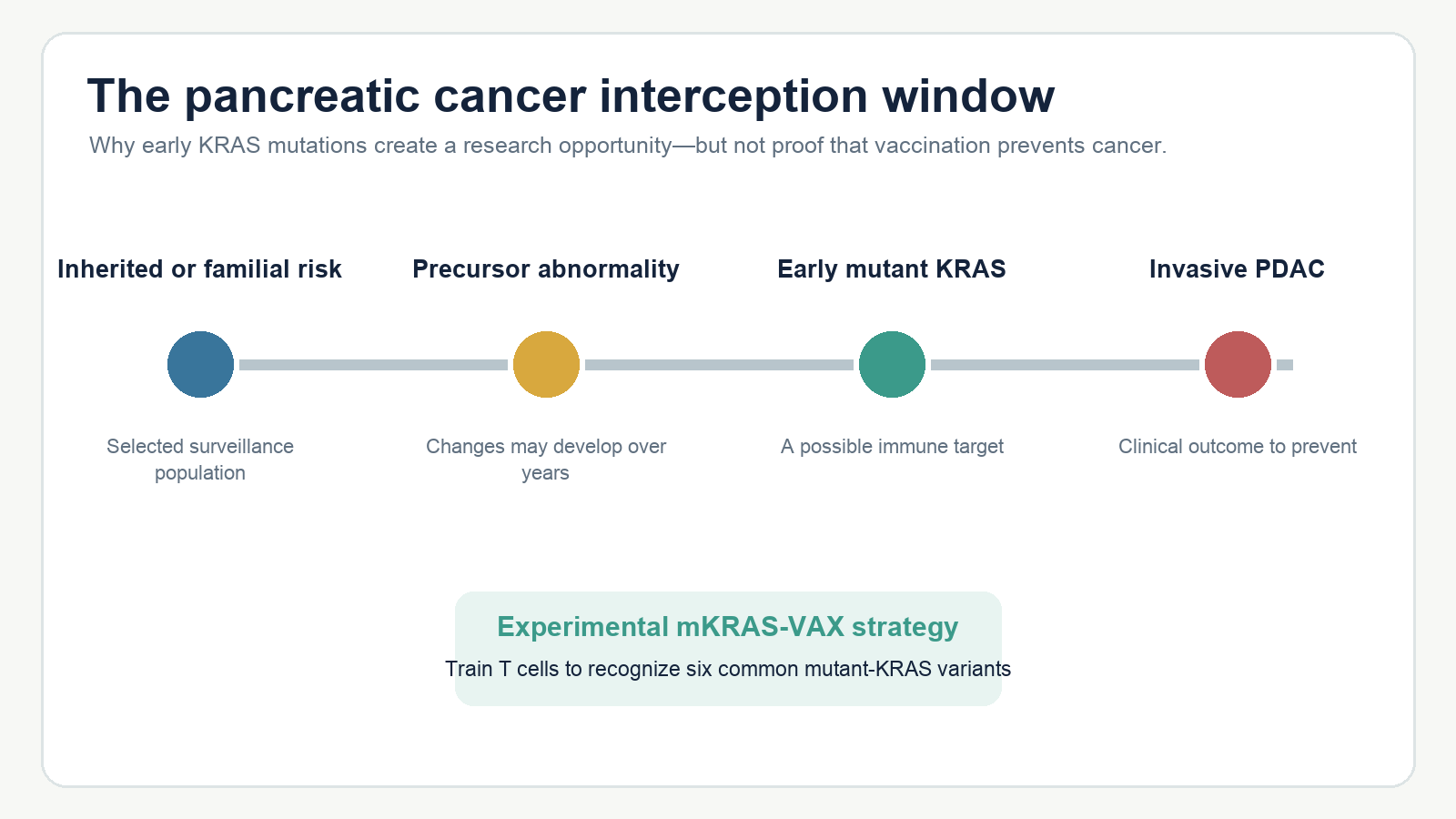
Pancreatic cancer interception aims at a long precursor window, but a plausible window and target do not prove that vaccination changes cancer incidence.
Who was actually studied?
The published phase 1 analysis involved 20 adults with both hereditary pancreatic-cancer predisposition and a pancreatic abnormality visible on imaging. This was not a study of average-risk adults, the general public, or people responding to wellness-peptide advertising.
The participants were already in a specialist surveillance context. Eligibility included defined familial or germline risk categories plus an imaging abnormality, such as a pancreatic cyst or other changes being followed through pancreatic surveillance.
This narrow selection matters for two reasons:
- Their baseline risk and clinical monitoring differ substantially from those of an average-risk person.
- Findings from 20 selected participants cannot be generalized to population-wide vaccination or screening.
The registry identifies the study as phase 1, non-randomized, open-label, and prevention-focused. Its primary endpoints concern safety and mutant-KRAS-specific immune responses—not a statistically powered comparison of pancreatic-cancer incidence.
What did the mKRAS-VAX phase 1 trial find?
The study produced a favorable early safety and immunogenicity signal, with several results worth following.
| Result | What the study reported | What it can support | |---|---:|---| | Participants in the published cohort | 20 | A first human test in a narrow high-risk group | | Adverse events | Grade 1–2 | An encouraging early tolerability signal in this small cohort | | Mutant-KRAS-specific T-cell response | 18 of 20 (90%) | The vaccine often triggered the intended type of immune response | | Vaccine-induced clonotypes | Observed for up to 2 years | Some vaccine-associated T-cell populations persisted | | Pancreatic cancers observed | 0 | A descriptive observation during limited follow-up | | Median follow-up | 16.5 months | Too short and too small to establish prevention |
An immune response in 90% of participants is notable because it shows the vaccine was biologically active in most of the cohort. Longitudinal T-cell receptor sequencing also found vaccine-induced mutant-KRAS-specific clonotypes for up to two years, suggesting that at least some of the induced immune populations did not disappear immediately.
The absence of grade 3 or higher adverse events in the published cohort is also encouraging. But phase 1 safety data from 20 selected people cannot characterize uncommon harms or settle longer-term safety.
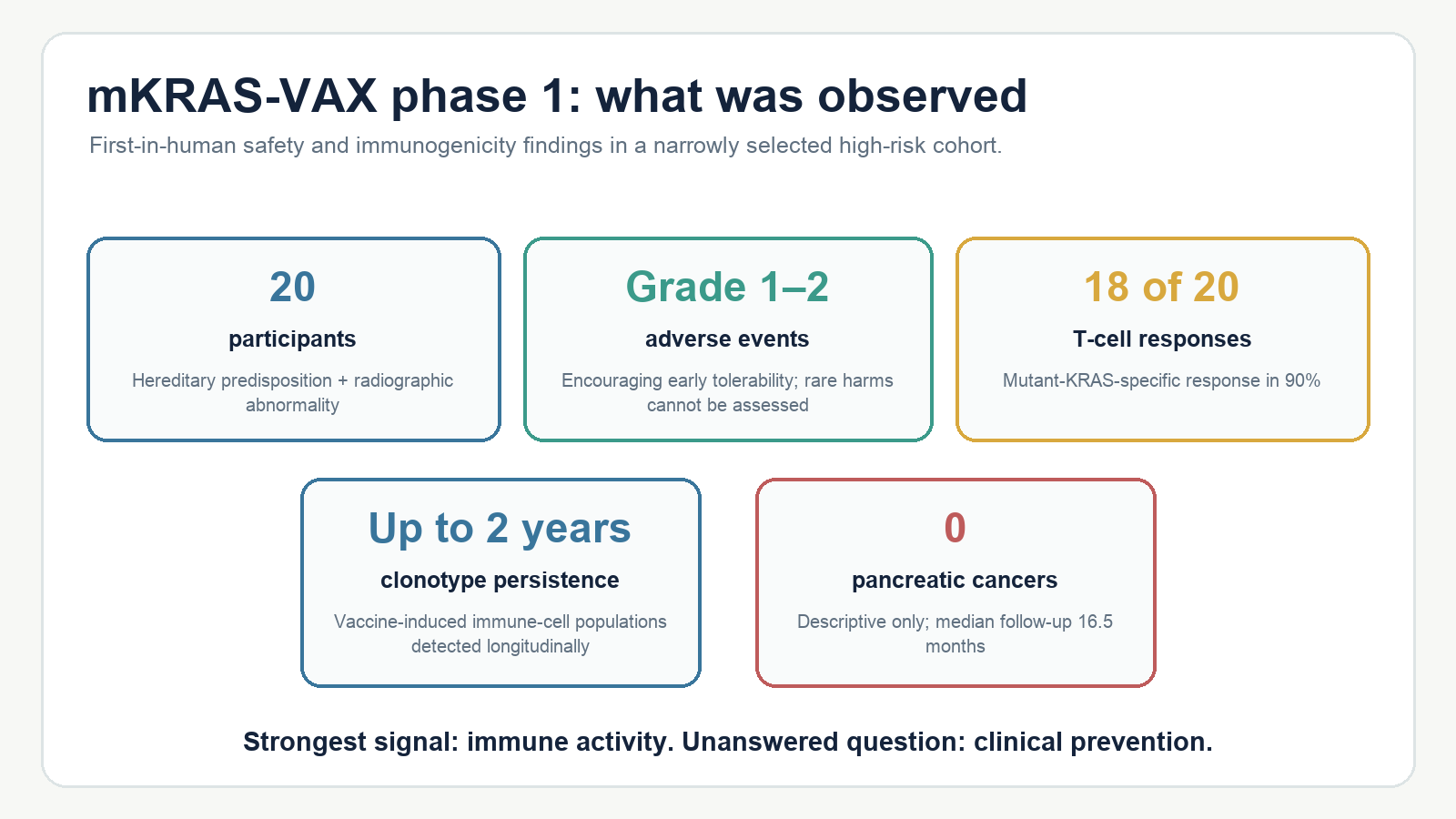
The strongest result is immunogenicity: 18 of 20 participants mounted a mutant-KRAS-specific T-cell response. Cancer prevention was not established.
Why an immune response is not the same as prevention
A vaccine can hit its immune target without yet proving that it changes a person’s clinical outcome. In this study, mutant-KRAS-specific T-cell activity is an immunogenicity endpoint—a biological marker that the immune system responded as intended.
For a prevention claim, the central question is different: do vaccinated people develop fewer pancreatic cancers, later cancers, or fewer clinically important precursor changes than comparable people who are not vaccinated?
This trial cannot answer that question because:
- There was no control group. Without a comparator, the expected number and timing of cancers are unknown.
- The cohort was only 20 people. With an uncommon event and a small sample, zero observed cases can occur by chance.
- Median follow-up was 16.5 months. Cancer interception is based on a process unfolding over years, so prevention needs much longer observation.
- Immune response is a surrogate. It is relevant mechanistically, but it is not itself a diagnosis prevented, a cancer delayed, or a life extended.
- Selection was highly specific. Hereditary-risk adults with radiographic abnormalities under surveillance are not interchangeable with average-risk adults.
The clean interpretation: mKRAS-VAX showed early safety and durable immune activity in a small high-risk cohort. Whether that immune activity prevents pancreatic cancer remains unknown.
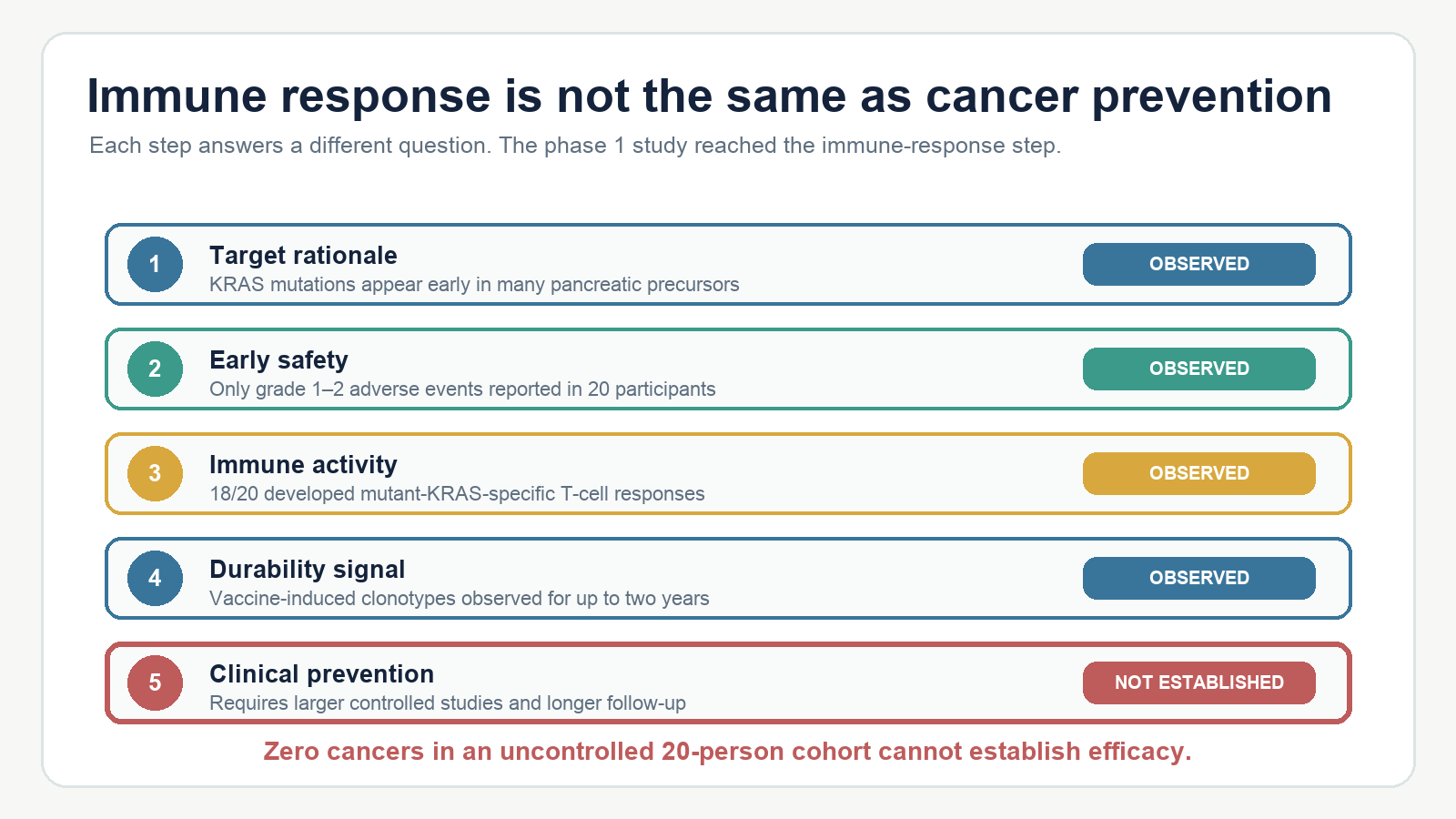
Immune activation is an important step, but only controlled, longer-term clinical outcomes can demonstrate prevention.
What does “no pancreatic cancers” actually mean here?
Zero cancers during follow-up is reassuring as an observation, but it is not an efficacy estimate. A zero in the results column can look decisive while carrying very little inferential weight when the sample is tiny, follow-up is short, and there is no control group.
The participants were high risk, but “high risk” does not mean each person would otherwise have developed cancer within the next 16.5 months. Without a matched or randomized comparison, researchers cannot calculate how many cancers the vaccine prevented—if any.
This is the difference between:
- Descriptive result: none of the 20 participants developed PDAC during the reported follow-up.
- Causal conclusion: vaccination reduced PDAC incidence.
The study supports the first statement, not the second.
How is mKRAS-VAX different from wellness peptides?
mKRAS-VAX is an investigational cancer-interception vaccine studied under a registered clinical protocol; it is not a generic “peptide therapy” or wellness product. The word peptide describes part of its construction, not a shared effect with every product marketed under that label.
The trial had:
- a defined molecular target: six mutant-KRAS variants;
- a specific high-risk population;
- prospectively defined safety and immune endpoints;
- clinical oversight and longitudinal immune testing;
- peer-reviewed reporting and a registered protocol.
Wellness-peptide marketing often jumps from a molecule’s mechanism or animal result to broad claims about recovery, longevity, immunity, or disease prevention. This study illustrates the opposite discipline: even a 90% target-specific immune-response rate in humans does not justify claiming that cancer was prevented.
For a reusable framework, see How to Evaluate Peptide Claims Online and Peptide Research Status Explained.
How does this differ from the PepCan HPV peptide-vaccine trial?
mKRAS-VAX and PepCan are both peptide-vaccine studies, but they target different antigens, diseases, populations, and clinical questions. They should be compared as examples of how to read early trials—not treated as versions of the same vaccine.
| Feature | mKRAS-VAX study | PepCan study | |---|---|---| | Main target | Six common mutant-KRAS variants | HPV16 E6 peptides | | Disease context | Pancreatic-cancer interception in a hereditary high-risk surveillance cohort | Therapeutic vaccination studied in HPV-associated cancer | | Published trial stage | Phase 1, first in humans | Early phase 1/2 | | Central lesson | Immune response does not yet prove cancer prevention | Small early trials cannot settle clinical benefit |
Our article PepCan and HPV Peptide Vaccines: How to Read Early Cancer Vaccine Trials explains that separate study. The shared evidence lesson is useful; collapsing KRAS, HPV, pancreatic precursors, and established cancer into one “peptide vaccine” category is not.
Funding and conflicts belong in the evidence picture
Funding and author disclosures should be read alongside the methods and results, not used as a shortcut to accept or dismiss the study. The trial registry lists the Sidney Kimmel Comprehensive Cancer Center at Johns Hopkins as sponsor, with Stand Up To Cancer and the National Cancer Institute as collaborators. The peer-reviewed paper includes author conflict-of-interest disclosures.
Those relationships do not invalidate the data. They do make independent replication, transparent endpoint reporting, and later controlled trials especially important—exactly as they are for any investigational product.
What research would be needed to show prevention?
Demonstrating pancreatic-cancer prevention would require larger comparative studies with substantially longer follow-up and clinical endpoints. A stronger evidence program would need to determine whether the vaccine meaningfully changes outcomes such as invasive cancer incidence, progression of high-risk precursor lesions, cancer-related surgery, or mortality.
Researchers would also need to clarify:
- which hereditary-risk groups and precursor findings are most relevant;
- how consistently immune responses translate into tissue-level protection;
- whether protection persists;
- uncommon and delayed adverse effects;
- how outcomes compare with appropriate surveillance-based controls;
- whether results reproduce across centers and investigators.
The ongoing registry record has later estimated completion dates, which underscores the basic reality: prevention evidence takes time.
For more context on why early human testing is a beginning rather than a verdict, read When a Peptide Enters Phase 1. To understand what precedes this stage, see What Preclinical Actually Means.
Bottom line
The first human mKRAS-VAX study is encouraging evidence of biological activity, not proof of pancreatic-cancer prevention. In 20 selected high-risk adults, adverse events were grade 1 or 2, 18 developed mutant-KRAS-specific T-cell responses, and vaccine-induced clonotypes were detectable for up to two years. No pancreatic cancers occurred during a median 16.5 months of follow-up.
The honest next sentence matters most: a small uncontrolled phase 1 study cannot tell us whether the vaccine caused that zero, whether the immune response will prevent cancer, or whether the approach applies beyond this narrow surveillance population.
Frequently asked questions
Does the KRAS peptide vaccine prevent pancreatic cancer?
Not yet proven. The phase 1 study established an encouraging early safety and immune-response signal, but it was not designed or powered to demonstrate prevention.
Why target KRAS?
Common KRAS mutations appear early in many pancreatic precursor lesions and are present in most pancreatic ductal adenocarcinomas. That makes mutant KRAS a plausible interception target, though plausibility is not clinical proof.
What does an 18-of-20 T-cell response mean?
It means immune testing detected a mutant-KRAS-specific response in 90% of the published cohort. It does not mean 90% were protected from cancer.
Did anyone in the trial develop pancreatic cancer?
No participant developed PDAC during the reported median follow-up of 16.5 months. Without a control group, a larger sample, and longer follow-up, that observation cannot establish efficacy.
Is mKRAS-VAX intended for average-risk adults?
The published study did not test average-risk adults. It enrolled a narrowly defined group with hereditary predisposition plus a radiographic pancreatic abnormality in a surveillance setting.
Is this the same as the PepCan HPV vaccine?
No. mKRAS-VAX targets mutant KRAS in pancreatic-cancer interception research. PepCan targets HPV16 E6 in a different therapeutic cancer context.
Sources
- Haldar SD, et al. “First-in-human testing of a mutant KRAS vaccine for pancreatic cancer interception in high-risk cohorts.” Cancer Discovery. Published online July 16, 2026. doi:10.1158/2159-8290.CD-25-2245.
- PubMed. PMID 42458705.
- ClinicalTrials.gov. NCT05013216.
- Johns Hopkins Medicine. Experimental KRAS vaccine generates immune response against pancreatic cancer in people at high risk.