Can AI Predict a Good Peptide Drug? What PeptiVerse Can—and Cannot—Prove
AI peptide property prediction can help researchers rank candidates and identify likely liabilities before spending time and money on experiments. It cannot prove that a peptide is safe, effective, manufacturable, clinically useful, or approvable.
That distinction is the most useful lesson from PeptiVerse, a peer-reviewed platform described in Nature Communications in July 2026. The platform accepts an amino-acid sequence or a chemistry-aware SMILES representation and predicts several properties relevant to peptide development. Its breadth is valuable precisely because target binding is only one hurdle in a much longer race.
Quick answer: PeptiVerse is best understood as a computational triage system. It can estimate how a candidate may behave relative to patterns in existing data. A favorable score is a reason to investigate—not evidence that the molecule works as a drug.
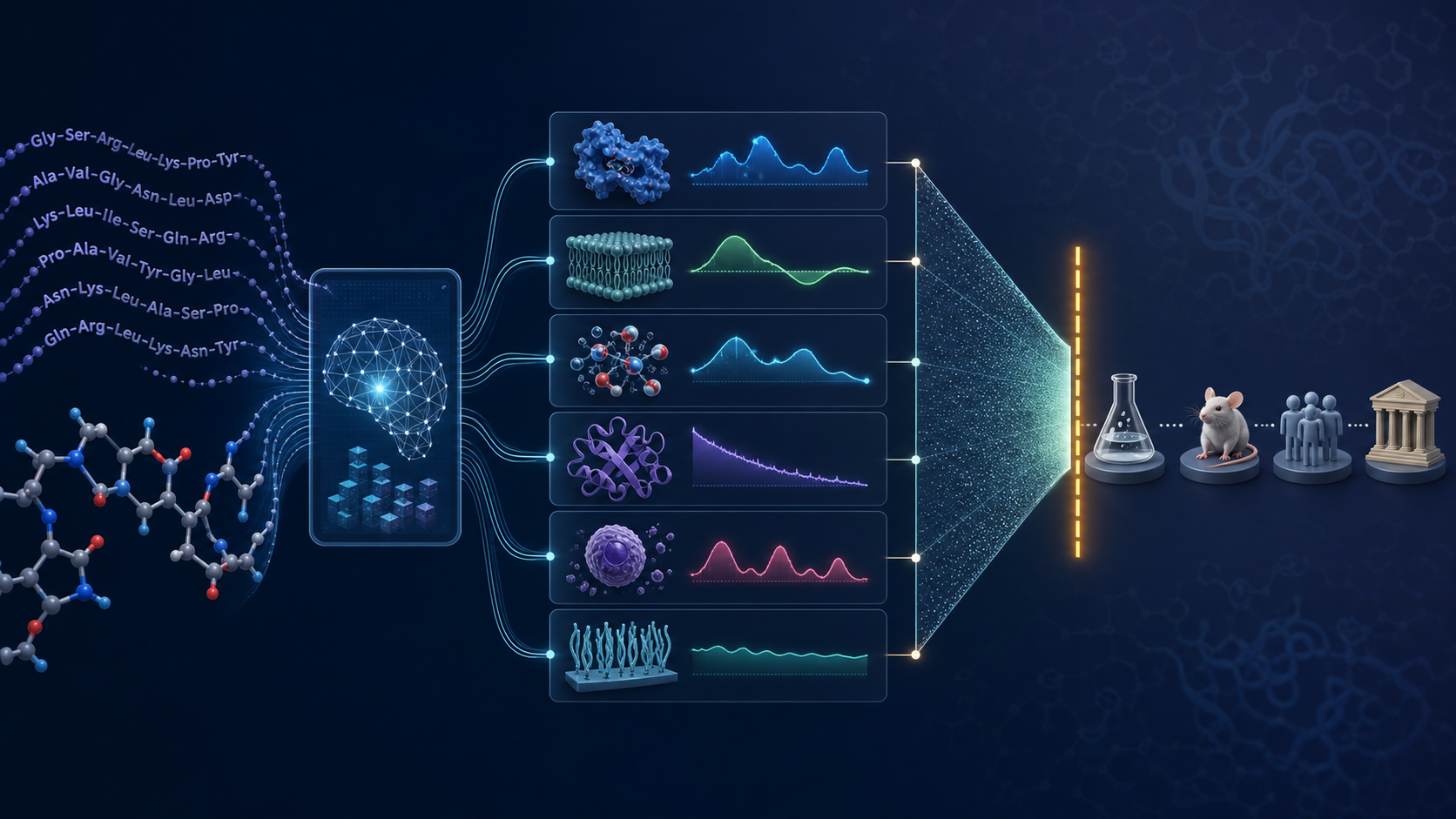
PeptiVerse-style prediction can narrow a candidate list, but experimental, animal, clinical, and regulatory evidence remain separate downstream stages.
Why binding is not enough to make a good peptide drug
A peptide can bind its intended target and still fail for many other reasons. Drug development asks whether the molecule can reach the relevant biology, remain intact long enough to matter, avoid unacceptable harm, be formulated reproducibly, and produce a meaningful effect in a living system.
The major questions include:
- Biological activity: Does binding change the target in the intended way, at relevant concentrations and in an appropriate biological context?
- Permeability and distribution: Can the peptide cross the barriers required to reach its site of action?
- Solubility: Can it remain dissolved under realistic formulation and physiological conditions rather than precipitating or aggregating?
- Stability and half-life: Does it resist chemical and enzymatic degradation long enough for the intended use?
- Toxicity: Does it damage cells, disrupt membranes, cause hemolysis, or produce off-target effects?
- Immunogenicity: Could the molecule or its aggregates provoke an unwanted immune response?
- Manufacturability: Can it be synthesized, purified, characterized, stored, and formulated consistently at an acceptable quality?
These properties interact. A modification that improves stability may reduce activity or solubility. Increasing hydrophobicity may help a peptide cross a membrane but also increase aggregation, nonspecific binding, or membrane toxicity. There is no single “drug-like” score that resolves all of those tradeoffs.
PeptiVerse addresses part of this multi-property problem. The paper reports predictors for binding affinity, hemolysis, non-fouling behavior, permeability, solubility, toxicity, and half-life. That is broader than binding alone, but it still does not directly establish immunogenicity, scalable manufacturing, formulation robustness, animal efficacy, human safety, or clinical benefit.
What PeptiVerse predicts at a high level
PeptiVerse converts a peptide representation into learned numerical features, then applies property-specific prediction models. It does not simulate a complete organism or recreate a clinical trial.
The platform supports two main input forms:
- Amino-acid sequences for peptides represented with conventional residue notation.
- SMILES strings that describe molecular structure and can represent chemically modified or noncanonical peptides more explicitly.
The distinction matters because modern therapeutic peptides often use cyclization, terminal changes, D-amino acids, lipidation, or other noncanonical chemistry. A sequence-only model may not “see” those changes adequately. A SMILES representation can encode more of the actual chemical structure, although representability does not guarantee that the training data contain close, reliable examples.
PeptiVerse uses pretrained protein and chemical language-model embeddings, including ESM-2, PeptideCLM, and ChemBERTa, with different downstream models selected for different tasks. The paper compares methods such as support vector machines, XGBoost, elastic nets, neural networks, convolutional networks, and transformers. One important finding is that no architecture wins everywhere: representation quality and dataset characteristics often matter more than whether the final predictor is fashionable or complex.
Quick answer: PeptiVerse can process sequence or SMILES inputs and produce several property estimates. It does not produce a universal verdict that a peptide is a “good drug.”
What the benchmark results actually show
Benchmark performance shows how well a model predicted held-out labels under the paper’s evaluation setup. It does not show that a newly proposed peptide will succeed prospectively.
For many sequence-based datasets, the authors used MMseqs2 clustering to reduce similarity between training and validation sets. For native SMILES datasets, they used molecular fingerprints and Tanimoto similarity to create cluster-level splits. These are stronger safeguards than a naive random split, which can place near-duplicate molecules on both sides and inflate apparent generalization.
The results also reveal uneven difficulty across properties. Larger classification datasets, such as those for hemolysis or non-fouling behavior, provide more support for model development. Half-life and binding-affinity regression are comparatively limited and heterogeneous. The paper reports, for example, binding-affinity correlations with experimental measurements of about 0.57 for amino-acid inputs and 0.61 for SMILES inputs. Those are useful ranking signals, not near-perfect measurement substitutes.
For permeability, the authors separated PAMPA and Caco-2 data because the assays reflect different processes. That is good scientific hygiene: combining labels that look similar but mean different things can make a model easier to train and harder to interpret.
Still, a benchmark is conditional on its dataset, labels, preprocessing, split, selected metrics, and model-selection procedure. It answers, “How did this system perform here?” It does not automatically answer, “How will this molecule behave in a new laboratory, species, formulation, disease setting, or patient population?”
Why dataset quality sets the ceiling
An AI model cannot learn a cleaner biological truth than its training labels contain. Peptide-property datasets often combine measurements from different laboratories, protocols, concentration ranges, assay formats, species, matrices, and reporting conventions.
Several examples in the PeptiVerse paper make that concrete:
- Binding-affinity data combine readouts such as Kd, Ki, and IC50, which are related but not interchangeable.
- Half-life data are sparse and may use heterogeneous protocols or coarse reporting.
- Permeability can mean passive transport in PAMPA, behavior in Caco-2 cells, or membership in a cell-penetrating-peptide dataset.
- Solubility labels include outcomes derived from protein-expression and structural-genomics pipelines, which are not identical to formulation solubility for a finished therapeutic peptide.
- Toxicity and hemolysis labels depend on the tested system and conditions; absence of one measured liability is not proof of general safety.
Label balance matters too. A model can look strong on an artificial balanced set and behave differently when deployed in a candidate pool where positives are rare. Dataset coverage also matters: predictions are more credible near well-represented chemical and sequence regions than in genuinely novel territory.
Quick answer: Better algorithms cannot rescue missing, inconsistent, or out-of-domain experimental data. For peptide prediction, the dataset is often the bottleneck.
Applicability domain: is the new peptide like the training data?
Every prediction has an applicability domain—the region of sequence, chemistry, length, modification pattern, and assay context where the model has relevant examples.
A candidate may fall outside that domain because it uses unusual residues, a new cyclization pattern, a large conjugate, an uncommon target class, an atypical length, or physicochemical combinations absent from training. SMILES support expands what the software can encode, but encoding a molecule is not the same as having evidence for it.
The PeptiVerse interface reportedly shows underlying training-data distributions, which can help users place a query in context. That is useful, but a one-dimensional distribution does not fully describe distance in a complex learned representation. A responsible interpretation asks:
- Are close chemical or sequence neighbors present in training?
- Were those neighbors measured with assays relevant to the intended question?
- Is the prediction interpolating among familiar examples or extrapolating?
- Does uncertainty increase for unusual inputs?
- Would a different representation or model produce the same ranking?
Predictions outside the applicability domain should be treated as hypotheses with wider error bars, even when the interface returns a precise-looking number.
Leakage and generalization risks do not disappear
Similarity-aware splitting reduces leakage risk, but it does not eliminate every path to optimistic performance.
Peptides can be related through sequence motifs, chemical scaffolds, target families, assay sources, duplicated records, or shared experimental artifacts. The binding-affinity dataset presents a special challenge because targets and binders recur across peptide–protein pairs; the paper used matched affinity-score distributions rather than a clean target- or scaffold-separated split for that task. This supports internal evaluation but leaves important prospective questions open, such as performance on entirely unseen targets or novel chemical families.
Hyperparameter optimization and choosing the best model on a validation framework can also make reported performance specific to that benchmark. The paper uses repeated seeds, bootstrap intervals, cross-validation for limited half-life data, and uncertainty methods, all of which improve transparency. They do not replace an untouched external test set or a prospective experiment designed before predictions are revealed.
A strong next validation step would be blinded prospective testing: rank previously unmeasured peptides, synthesize a prespecified set, measure them under consistent protocols, and report all results—including failures. The cobra-inspired antimicrobial peptide study is a useful example of prospective wet-lab testing in which most computationally prioritized candidates showed limited or no measurable activity. Stronger still would be replication in an independent laboratory and evaluation on truly new targets or chemistry.
What uncertainty estimates can—and cannot—tell you
Uncertainty estimates can flag unstable or ambiguous predictions, but they are not a warranty.
PeptiVerse uses ensembles for some neural models and decision-margin or conformal-style approaches for some classical models. These methods can quantify model disagreement or produce intervals with defined behavior under assumptions such as exchangeability.
But uncertainty can be miscalibrated when deployment data differ from calibration data. Models can also agree confidently for the same wrong reason, especially when all share the same biased labels or representation. A narrow interval describes uncertainty within the model’s setup; it does not include every unknown in biology, formulation, manufacturing, or clinical translation.
Quick answer: A high-confidence prediction means the model is comparatively sure of its estimate under its assumptions. It does not mean the peptide is safe, effective, or clinically validated.
Chemical modifications solve problems—and create new ones
Chemical modifications are central to peptide drug development because native peptides may degrade quickly, cross membranes poorly, or have unsuitable pharmacokinetics. Cyclization, noncanonical residues, terminal modifications, conjugation, and other changes can improve one or more properties.
They also complicate prediction and development. A change may alter conformation, aggregation, protease susceptibility, target selectivity, membrane interactions, impurities, analytical methods, synthesis yield, or immune recognition. Some effects depend on three-dimensional structure and formulation conditions that a sequence or SMILES string alone may not capture.
PeptiVerse’s chemistry-aware input is therefore an important capability, not a universal solution. It allows modified peptides to be represented more faithfully than plain amino-acid text, while the reliability of each prediction still depends on relevant modified-peptide data.
Prediction, experiment, and clinical proof are different evidence levels
The cleanest way to read any AI peptide result is as one rung in an evidence ladder.
| Evidence level | What it can support | What it cannot establish | |---|---|---| | Computational prediction | Candidate ranking, liability flags, experiment planning | Real biological activity or safety | | In vitro assay | Activity or property in a defined experimental system | Whole-organism efficacy or tolerability | | Animal study | Exposure, pharmacology, and toxicity in that model | Human benefit or human safety | | Human clinical trial | Safety and outcomes in the studied population and protocol | Broad benefit beyond the trial evidence | | Regulatory review | A formal benefit–risk and quality assessment for a specific product and use | Automatic approval of related peptides or uses |
This is why prediction is triage, not proof. It can reduce the search space and make experiments more informative. It cannot skip the experiments.
For a deeper guide to reading online claims, see How to Evaluate Peptide Claims Online. The distinctions between laboratory, animal, and human findings are covered in What “Preclinical” Actually Means, while Peptide Research Status Explained helps separate research activity from approval or established medical use.
How should readers evaluate PeptiVerse claims?
The PeptiVerse paper is a useful, peer-reviewed methods contribution with open datasets, model resources, and an accessible interface. Its strongest interpretation is that multi-property prediction across sequence and SMILES inputs can support computational prioritization.
The cautious interpretation should also include five checks:
- Match the claim to the endpoint. A hemolysis prediction is not a complete toxicity assessment; a binding prediction is not proof of functional activity.
- Inspect the data source. Ask how labels were measured, combined, balanced, and cleaned.
- Check domain similarity. Novel chemistry and targets deserve more skepticism than familiar examples.
- Look for external or prospective validation. Internal benchmarks are the beginning of validation, not the end.
- Read disclosures. The paper states that senior author Pranam Chatterjee co-founded several biotechnology companies and advises companies involved in peptide-therapeutics development; the interests are reviewed and managed by the University of Pennsylvania. The remaining authors declared no competing interests. A disclosure does not invalidate the work, but it belongs in a complete evidence assessment.
The bottom line
PeptiVerse shows why AI peptide property prediction is becoming useful: it can combine several developability questions in one framework, accept conventional sequences or chemistry-aware SMILES, and help researchers prioritize what to test.
It also shows why an AI score is not a drug verdict. Benchmark performance remains bounded by dataset quality, assay definitions, split design, applicability domain, uncertainty calibration, and the gap between retrospective prediction and prospective biology. Immunogenicity, manufacturing, formulation, animal performance, human safety, clinical benefit, and regulatory approval remain separate questions.
The right conclusion is neither “AI designed a safe peptide” nor “prediction is useless.” It is simpler: computational screening can make the next experiment smarter. The experiment still has to happen.
Frequently asked questions
Can PeptiVerse prove that a peptide is safe?
No. It can predict selected liabilities such as toxicity or hemolysis within the limits of its training data. It cannot establish complete toxicology, immunogenicity, human safety, or an acceptable clinical benefit–risk profile.
Does a strong binding prediction mean the peptide will work?
No. Binding does not prove the desired functional effect, adequate exposure, selectivity, stability, tolerability, or efficacy in a living system.
Why does PeptiVerse accept both sequences and SMILES?
Amino-acid sequences are convenient for conventional peptides. SMILES can represent molecular details of chemically modified and noncanonical peptides that plain sequence notation may miss.
Is peer review the same as prospective validation?
No. Peer review evaluates the study’s methods, reporting, and contribution. Prospective validation tests new, previously unmeasured candidates—ideally under blinded, prespecified, and independently replicated conditions.
Can a low uncertainty score make a prediction trustworthy?
It can increase confidence within the model’s assumptions and calibration setting. It cannot account for every source of biological, experimental, manufacturing, or clinical uncertainty.
This article is for general education and does not provide medical advice, peptide-design instructions, treatment recommendations, or a basis for judging any product as safe or effective.
Primary source
Zhang Y, Tang S, Chen T, Mahood E, Vincoff S, Chatterjee P. “PeptiVerse: A unified platform for therapeutic peptide property prediction.” Nature Communications. Published July 16, 2026. DOI: 10.1038/s41467-026-74167-w.