AI Picked Cobra-Inspired Peptides. Why Did Most Show Little Antibacterial Activity?
Why AI antimicrobial peptide predictions need experimental validation: CTX-p5 showed modest in-vitro activity, not proof of a working antibiotic.
AI Picked Cobra-Inspired Peptides. Why Did Most Show Little Antibacterial Activity?
Computational screening found cobra-cardiotoxin fragments that looked like antimicrobial peptides, but laboratory testing showed that most had limited or no measurable antibacterial activity under the tested conditions. CTX-p5 was the strongest candidate in this small panel, yet its reported minimum inhibitory concentrations (MICs) were 125–500 micromolar. That makes it an experimental lead, not a clinically potent antibiotic.
The September 16, 2026 study by Mendes and colleagues in npj Drug Discovery is a useful example of why AI antimicrobial peptide predictions need experimental validation. It also shows why a disappointing screen can still be valuable: failed predictions expose where models and discovery assumptions need work.
Quick answer: The software prioritized peptide-like patterns associated with antimicrobial activity. It could not fully predict how short, flexible toxin fragments would behave against different bacterial membranes in a real assay—much less inside an infected animal or person.
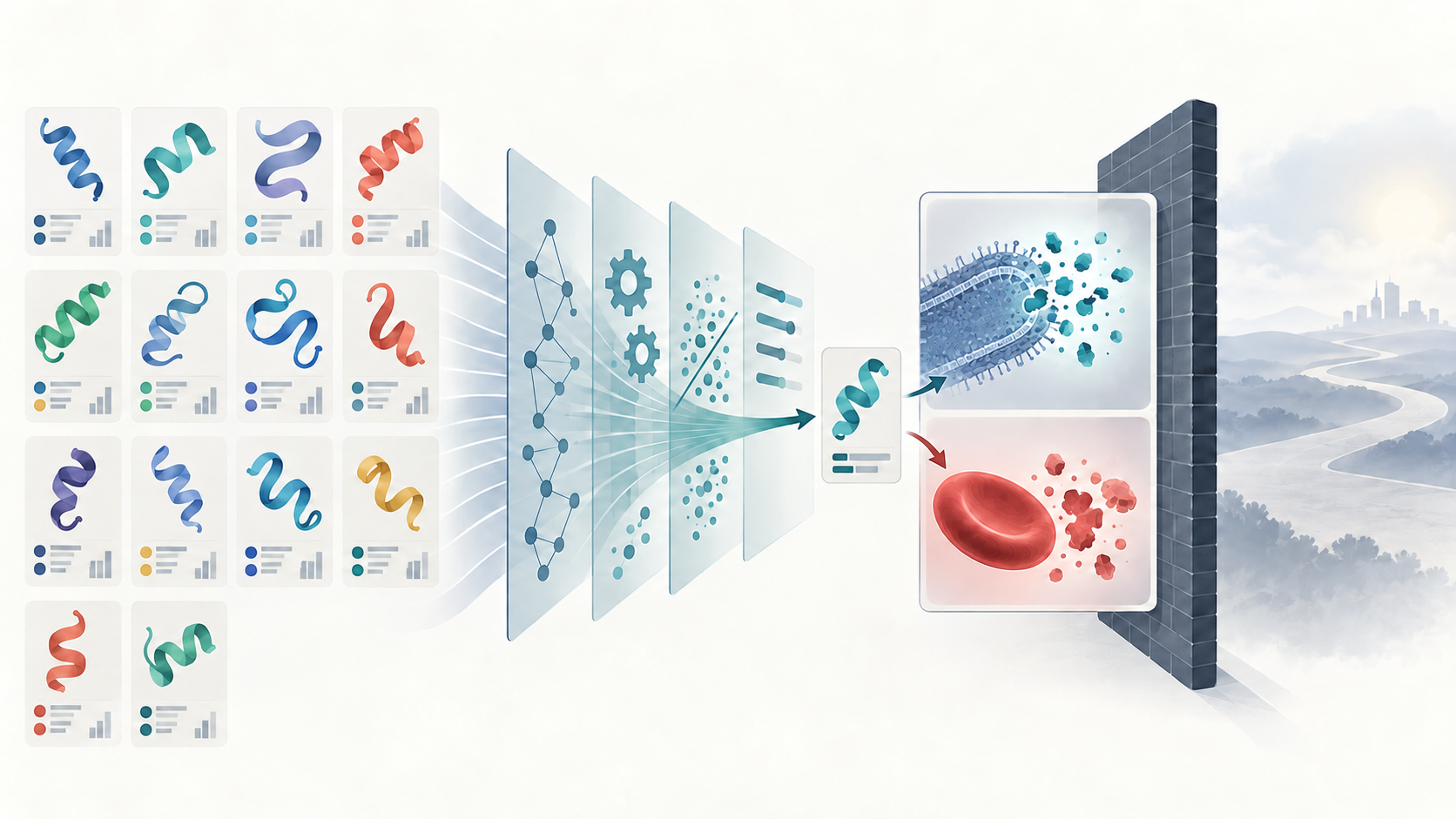
Computational tools narrow a search; they do not erase the evidence boundary. In this study, laboratory activity and red-cell effects were measured, while animal efficacy and clinical benefit remained beyond the wall.
What did the cobra-inspired peptide study actually do?
The researchers computationally selected 14 cardiotoxin-inspired peptides, including two modified derivatives, then tested them in laboratory bacterial and donated-human-red-cell experiments. This was not an animal infection study and not a human treatment trial.
The work began with cardiotoxins from Naja cobras. These larger venom proteins have membrane-interacting features that make them plausible templates for antimicrobial discovery. The team used two distinct candidate-mining strategies:
- AMPA-guided region mining. A deterministic sequence-analysis tool identified physicochemically favorable regions within naturally occurring cardiotoxin sequences. Seven candidate regions came from this route.
- Consensus-sequence construction. Alignment of 92 cardiotoxin entries was used to build a consensus template, from which five additional candidates were designed.
Two derivatives of CTX-p5 were also included: one with amino-acid substitutions and one lipidated version. The researchers then used several machine-learning and deep-learning tools to prioritize predicted antimicrobial potential. In other words, the candidates were not all “generated by AI.” Deterministic mining and consensus construction generated the starting set; ML and deep learning mainly helped score and prioritize it.
Why did the predictions outperform the experiments?
The models recognized antimicrobial-like features, but those features were not sufficient to guarantee useful antibacterial activity. Charge, hydrophobicity and amphipathic patterns can make a sequence resemble known antimicrobial peptides. Actual activity also depends on three-dimensional behavior, aggregation, solubility, bacterial species, membrane composition and assay context.
Several issues can widen the gap between prediction and experiment:
- Training data may not represent the new scaffold well. A model trained largely on established antimicrobial-peptide families can struggle with short fragments cut from a different toxin architecture.
- Favorable features are not a working mechanism. A peptide can look cationic and membrane-seeking on paper but still fail to adopt or maintain a productive conformation.
- Bacterial membranes are not interchangeable. Gram-negative and Gram-positive organisms differ in outer membranes, cell walls and lipid composition. A general antimicrobial score is not necessarily a reliable strain-level forecast.
- Short fragments lose structural context. A cardiotoxin’s native three-finger scaffold positions membrane-interacting residues in space. Extracting a linear fragment may remove that organization.
- Consensus can average away important local patterns. Conserved residues may capture family similarity while diluting the precise arrangement needed for membrane interaction.
This is the same broad lesson described in AI Peptide Design: Why Binding Is Not the Same as Biological Effect: a computational score answers a narrower question than a biological experiment.
Why do several prediction tools not equal independent confirmation?
Agreement among several tools can raise a candidate’s priority, but it does not automatically provide independent biological confirmation. Different tools may use different model architectures while still learning from overlapping peptide databases, similar labels and the same broad sequence-derived properties.
That creates correlated confidence. Four systems can all reward positive charge and hydrophobic patterning, for example, without any of them modeling the full membrane-bound behavior that determines activity. Their scores also may not be directly comparable or calibrated to the same probability scale. The paper itself treated the tool outputs according to each platform’s own scoring system rather than normalizing them into one measurement.
Evidence rule: Model agreement is still prediction agreement. Independent confirmation begins when a different method measures the claimed property in the physical world.
The study did perform that crucial next step by testing the selected panel. The mismatch between rankings and measured potency is therefore information, not an embarrassment to hide.
What did CTX-p5’s MIC of 125–500 micromolar mean?
The MIC range means CTX-p5 inhibited visible bacterial growth in controlled laboratory conditions at the lowest tested concentrations reported for each organism; it is not a patient dose and not proof that an infection was cleared. MIC is an in-vitro growth-inhibition endpoint. It does not establish how a substance distributes through a body, survives enzymes, reaches infected tissue, interacts with proteins or immune cells, or is eliminated.
CTX-p5 showed the most consistent activity across the study’s small panel of Gram-negative and Gram-positive bacteria. Several other candidates—particularly consensus-derived peptides—had no measurable activity within the tested range. The modified CTX-p5-related candidates did not improve antibacterial potency.
Calling CTX-p5 the “best” therefore requires a qualifier: it was the strongest within these 14 candidates under these conditions. The authors characterized the activity as moderate, and the reported concentration range is not evidence of a clinically competitive antibiotic.
For a broader explanation of this evidence stage, see What Preclinical Actually Means.
Did CTX-p5 kill bacteria by disrupting membranes?
The microscopy and fluorescence readouts support bacterial membrane disruption as a mechanism under the tested conditions, but they do not demonstrate clinical benefit or resistance-proof activity. Treated E. coli cells showed altered surface morphology, increased uptake of a membrane-impermeable dye, greater outer-membrane permeability and inner-membrane depolarization.
These findings form a coherent mechanistic package: CTX-p5 exposure was associated with loss of membrane integrity. But a mechanism can be real without being therapeutically useful. Membrane disruption in a laboratory sample does not show selective delivery to an infection, acceptable exposure in a body or freedom from damage to host cells.
It also does not prove bacteria cannot develop resistance. Resistance behavior would require dedicated, longitudinal testing. A plausible membrane mechanism is not a lifetime warranty against evolution; bacteria have been ignoring our press releases for quite some time.
Why did structural predictions not settle the question?
Predicted structure and membrane-mimicking measurements supplied context, not proof of antibacterial performance in a real infection. AlphaFold suggested partial structural tendencies for some candidates, while circular-dichroism measurements showed that several became more ordered in membrane-mimicking environments.
Short linear peptides are flexible, and AlphaFold confidence can be limited for them. The membrane mimics used in structural measurements are also simplified environments. They can stabilize conformations that may not persist in complex bacterial membranes, tissue fluids or an infected organism.
The disconnect matters: some peptides displayed structural features associated with membrane activity yet still showed weak antibacterial results. Structure-like behavior is one link in the chain, not the finished chain.
What did the donated red-cell experiments show?
The red-cell assay measured membrane damage outside the body; it did not establish systemic safety. Human red blood cells came from three healthy volunteers and were exposed to the peptides in vitro. These were three donors, not three treated patients.
Most candidates produced limited red-cell damage at the lower tested concentrations, while effects varied as concentration increased. CTX-p5 showed less hemolytic activity than its lipidated derivative, CTX-p7. The lipidated candidate caused the most red-cell disruption across the tested panel without improving antibacterial potency.
That result is a useful selectivity warning: a modification intended to strengthen membrane interaction can also increase damage to mammalian-cell membranes. Yet red cells represent only one cell type and one toxicity endpoint. Lower hemolysis does not establish organ safety, immune compatibility, tolerability, therapeutic index or safety after systemic exposure.
Measured versus not shown
The cleanest way to read this paper is to separate what was directly measured from what remains untested.
| Measured in this study | Not shown by this study | |---|---| | Computational prioritization of a selected 14-peptide panel | A universal success or failure rate for AI peptide discovery | | In-vitro growth inhibition against a small bacterial panel | Clearance of an infection in an animal or person | | CTX-p5 MIC values of 125–500 micromolar | A patient dose, effective exposure or clinical potency | | Bacterial morphology, permeability and membrane-potential changes | Clinical benefit or resistance-proof activity | | Structural behavior in water and membrane-mimicking environments | Stable structure and function in an infected body | | Hemolysis using donated red cells from three volunteers outside the body | Broader toxicity, systemic safety or tolerability in patients | | Reduced activity of modified CTX-p5-related candidates | A complete optimization map for cardiotoxin-derived peptides |
The paper did not establish animal efficacy, pharmacokinetics, biodistribution, broader toxicity, clinical benefit, human safety or resistance behavior.
Does this mean AI failed at antimicrobial peptide discovery?
No. It means this particular prioritization workflow produced many weak candidates in one small, selected cardiotoxin-inspired library. Fourteen peptides cannot serve as a universal benchmark for the failure rate of AI systems, antimicrobial peptides or venom-derived discovery.
The panel was shaped by specific starting sequences, deterministic mining rules, a consensus strategy and a limited experimental selection. Other AI workflows search far larger and more diverse virtual libraries. Other peptide families may also fit the models’ training data or biological assumptions better.
At the same time, it would be equally misleading to dismiss the negative result. The screen shows that high predicted antimicrobial probability is not enough. It identifies concrete weaknesses—scaffold mismatch, general rather than species-specific prediction, structural uncertainty and feature-based false positives—that future models can address.
Compare this study with Mirror-Peptidizer’s experimentally validated D-peptide workflow, where selected candidates were tested for a different task: target binding. A different discovery strategy using reconstructed ancient lactoferricin peptides also produced in-vitro antimicrobial evidence, but likewise stopped short of therapeutic proof. These are distinct questions, not scorecards in one universal AI contest.
Why are modest and negative findings useful?
A screen that reports weak hits is scientifically useful because it calibrates expectations and improves the next round of discovery. If only successful candidates reach publication, researchers and models learn from a distorted record. Weak and inactive candidates help reveal which predictive features are overvalued and which experimental contexts are missing.
CTX-p5 may be a starting template for further research, but the study’s strongest contribution is epistemic: it demonstrates the gap between being computationally plausible, measurably membrane-active and therapeutically viable.
The bottom line
AI-assisted prioritization helped researchers decide which cobra-inspired peptides to test; it did not produce a ready antibiotic. Most candidates showed limited or no measurable antibacterial activity under the study conditions. CTX-p5 was the strongest of the 14, with MICs of 125–500 micromolar and multiple readouts consistent with bacterial membrane disruption.
The modified candidates did not improve potency, and the lipidated derivative increased red-cell damage. No animal infection model or human treatment study was performed. Pharmacokinetics, broader toxicity, clinical benefit and resistance behavior remain unknown.
That is neither a venom miracle nor proof that AI is useless. It is what honest early discovery often looks like: useful filtering, messy biology and a great deal still to prove.
Frequently asked questions
Were all 14 cobra-inspired peptides AI-generated?
No. The candidates came from deterministic AMPA-guided mining, consensus-sequence construction and two rationally modified CTX-p5 derivatives. Machine-learning and deep-learning tools were used afterward to prioritize antimicrobial potential.
Is CTX-p5 an antibiotic?
CTX-p5 is an experimental peptide candidate with in-vitro antibacterial and membrane-disrupting activity. This study did not establish it as a clinically useful antibiotic.
Does MIC tell us the human dose?
No. MIC is a laboratory growth-inhibition measurement. It does not specify a dose, exposure or treatment effect in animals or people.
Were the three blood donors treated with CTX-p5?
No. Donated red blood cells from three volunteers were tested outside the body. No person received CTX-p5 as a treatment.
Did the study prove CTX-p5 avoids antibiotic resistance?
No. The membrane findings suggest a mode of action, but resistance development was not established.
This article is for general education. It is not medical advice and does not provide peptide sequences, synthesis or optimization instructions, dosing, sourcing, purchasing guidance or treatment recommendations.
Primary source
Mendes B, Almeida JR, Castelletto V, Hamley IW, Barrett G. “Harnessing snake venom cardiotoxins for antimicrobial peptide discovery.” npj Drug Discovery. Published September 16, 2026. DOI: 10.1038/s44386-026-00073-2. The authors declared no competing interests.