Could Astronauts Make Peptide Medicines in Space? What the New Astropharmacy Study Actually Shows
Short answer: Perhaps one day, but the new study did not manufacture a medicine in orbit. It ranked 26 peptide-based medicines to identify which ones might be worth studying first for on-demand production during long missions.
That distinction matters. The July 9, 2026 paper in npj Microgravity is a structured prioritization and feasibility analysis. The researchers reviewed existing literature and scored each candidate against ten predefined criteria. They did not run a space manufacturing experiment, test a flight-ready pharmacy, or show that any listed medicine can yet be produced, purified, verified, stored, and safely administered during a mission.
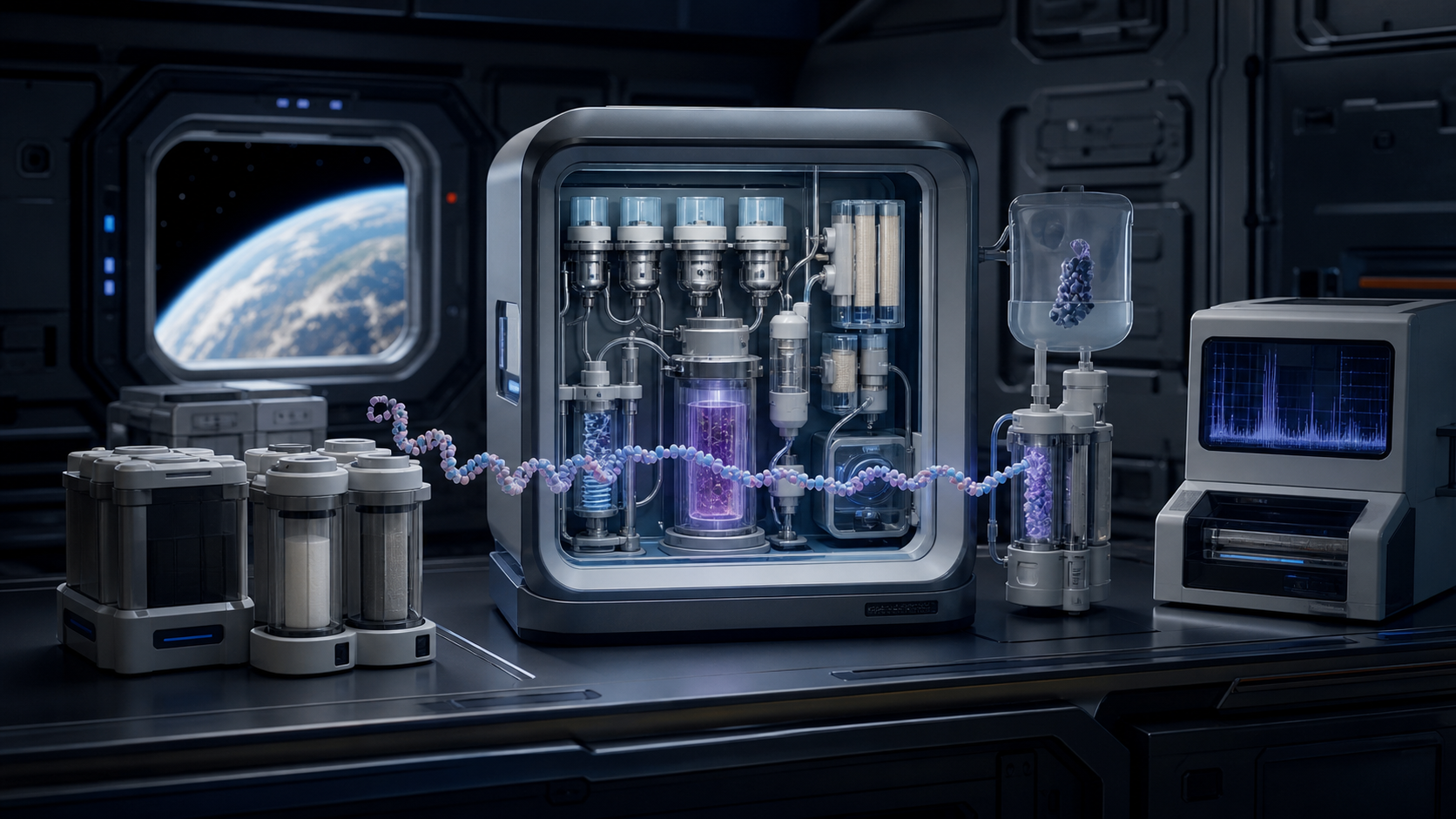
Concept illustration of a closed spacecraft biomanufacturing system. A real system would also need purification, quality-control, sterility, storage, and reliable flight hardware.
Why peptide medicines in space are being considered
Long-duration missions create a pharmacy problem that ordinary resupply cannot solve. A crew traveling far beyond Earth may be away for years, while medicines can lose potency over time because of radiation, storage conditions, and ordinary chemical degradation.
Carrying more stock helps only up to a point. Spacecraft have strict mass and volume limits. Refrigerated or otherwise temperature-controlled products add hardware, power, monitoring, and failure risks. A medicine that expires halfway through a mission is dead weight precisely when replacement may be months or years away.
On-demand manufacturing is one proposed answer: carry compact biological production materials and make selected medicines when needed. Peptides are interesting because many can, in principle, be encoded and expressed in biological systems. But “can be expressed” is nowhere near the same as “can become a safe medicine.”
What is astropharmacy? Astropharmacy is the study of how medicines could be supplied, stored, formulated, tested, or manufactured for space missions where Earth-based supply chains are limited.
What the 2026 study actually did
The researchers identified 26 peptide-based medications relevant to long-duration spaceflight, drawing on established astropharmacy databases and published literature. They then scored each medicine from 0 to 2 on five operational and clinical relevance criteria and five recombinant production feasibility criteria.
That produced a maximum possible score of 20. The scores are a transparent way to compare priorities, not a measurement of whether a medicine is flight-ready.
The two domains asked different questions:
- Operational and clinical relevance (OCR): Would this medicine be useful and practical enough to matter on a mission?
- Recombinant production feasibility (RPF): Does its molecular and manufacturing profile make biological production comparatively plausible?
This approach is useful because the best clinical candidate is not necessarily the easiest molecule to manufacture. Likewise, a peptide that is simple to express may solve no important mission-health problem.
How operational and clinical relevance was scored
The OCR domain covered regulatory status, shelf stability, storage requirements, NASA Human Research Roadmap risk or impact, and purification requirements.
In plain English, this side of the framework rewarded candidates that address credible mission needs without creating impossible storage or processing burdens. Existing regulatory status can also mean that more is known about product identity, clinical use, and testing than for an entirely experimental molecule.
Shelf life and storage matter disproportionately in space. A biologic that requires a dependable cold chain may be practical in a hospital but awkward on a spacecraft. Purification requirements also matter because every added operation demands equipment, consumables, crew time, and another opportunity for failure.
The OCR score did not establish that astronauts will need a given drug, or that it would be appropriate for a particular patient. It was a comparative planning tool.
How recombinant production feasibility was scored
The RPF domain covered amino-acid chain length, evidence of prior recombinant production, availability of a functional assay, dose requirements, and the complexity of post-translational modifications.
These criteria point toward the practical biology:
- Chain length: Shorter, less complex peptides can be easier to express and process, although length alone does not decide manufacturability.
- Prior recombinant production: Existing production evidence reduces uncertainty compared with starting from a purely theoretical construct.
- Functional assay availability: A crew would need a way to test whether a batch performs its intended biological function, not merely whether something resembling the molecule is present.
- Dose requirements: Higher required quantities place more demand on production capacity, purification, storage, and testing.
- Post-translational modifications: Disulfide bonds, amidation, glycosylation, lipidation, and other modifications can be essential to activity while making expression and processing harder.
A high RPF score therefore means “more attractive for further development under these criteria.” It does not mean the molecule has been successfully manufactured aboard a spacecraft.
Why teriparatide, abaloparatide, and amylin ranked highest
Teriparatide received the highest combined score at 17 out of 20. Abaloparatide and amylin followed at 16 out of 20.
Their ranking reflects the framework's balance of mission relevance and comparative production feasibility. Teriparatide and abaloparatide are peptide medicines associated with bone biology, making them relevant to the bone-loss risks of prolonged microgravity. They are also relatively compact peptide molecules compared with many large biologics.
Amylin-related biology is relevant to metabolic regulation, while the peptide's size and existing manufacturing knowledge made it competitive in the feasibility framework. Still, “amylin” in a ranking does not erase the differences among a natural hormone, an engineered analog, and a finished regulated drug product. Molecular identity and formulation remain crucial.
The scores should not be read as a treatment recommendation or a list of medicines astronauts ought to use. They show which candidates rose to the top after the authors applied their chosen criteria and weights.
What other candidates made the list
Several candidates scored 14 out of 20, including angiotensin II, daptomycin, GLP-1 agonists, granulocyte colony-stimulating factor (G-CSF), granulocyte-macrophage colony-stimulating factor (GM-CSF), and salmon calcitonin.
They represent different possible mission needs:
- Angiotensin II is a peptide involved in cardiovascular regulation.
- GLP-1 agonists are a broad medicine class with metabolic applications, but individual products differ substantially in sequence, modifications, formulation, dose, and manufacturing difficulty.
- G-CSF and GM-CSF are larger signaling proteins used in specific medical contexts involving blood-cell production and immune function; their complexity makes quality control especially important.
- Daptomycin is a cyclic lipopeptide antibiotic. Its structure and biosynthesis are considerably more complicated than a simple linear peptide.
- Salmon calcitonin is connected to calcium and bone metabolism, making it potentially relevant to spaceflight health concerns.
Being identified as a “possibility” means these candidates merited further consideration within the study's scoring system. It does not mean they are interchangeable, equally producible, or ready for mission use.
For related context, GLP-1 peptides vs research peptides explains why a peptide category, a specific molecule, and a regulated medicine are not the same thing.
What the study did not prove
The paper did not prove that astronauts can make peptide medicines safely in space. It did not include an orbital production run, a clinical trial, or administration to crew members.
It also did not validate an end-to-end manufacturing system. A functioning space pharmacy would need to solve all of the following:
- Produce the correct peptide consistently.
- Create any required folding or post-translational modifications.
- Separate the target from host-cell proteins, DNA, endotoxins, solvents, aggregates, and closely related impurities.
- Confirm identity, purity, potency, and concentration.
- Maintain sterility or achieve an acceptable sterile finished product.
- Formulate and store it without unacceptable degradation.
- Deliver an accurate dose through reliable hardware.
- Repeat the process under radiation, microgravity, limited power, limited consumables, and limited crew time.
A literature-based score cannot answer all of those questions. It tells researchers where an experimental program might begin.
The hardest bottlenecks are downstream of expression
Recombinant expression gets most of the futuristic attention, but purification and quality control may be the uglier problems. Biology produces mixtures, not pharmacy-ready products.
Expression and molecular processing
The production organism must make enough of the right molecule without degrading it or creating harmful contaminants. Some peptides need precise cleavage, folding, disulfide bonding, amidation, lipidation, or other processing. A host that produces the amino-acid sequence may still fail to produce the active form.
Purification
Purifying a peptide usually takes more than a filter and optimism. The process may need chromatography, specialized membranes, buffers, sterile connections, and single-use components. Those consume payload and generate waste.
Identity and potency testing
A batch can look correct while containing the wrong sequence, chemical variants, aggregates, or insufficient biological activity. Laboratory manufacturing relies on analytical instruments and validated assays. Miniaturizing those capabilities without losing reliability is a major engineering challenge.
Sterility and contamination control
A contaminated injectable product can be dangerous even if the peptide itself is correct. Closed systems reduce risk but do not eliminate it. Sterility assurance, environmental monitoring, endotoxin control, and aseptic transfer are difficult on Earth, where cleanrooms and trained teams are available.
Hardware reliability and regulatory-quality manufacturing
Flight hardware must survive launch, radiation, microgravity, vibration, long storage, and maintenance with limited spare parts. The whole process would need records, controls, acceptance limits, and validation approaching pharmaceutical manufacturing standards. “Made something biologically active” is a research milestone; “made a medicine safe enough to administer” is a much higher bar.
For a closer look at this gap, read Why peptide manufacturing quality is hard.
How to read the ranking without overclaiming it
The right takeaway is that the study created a rational shortlist. It connected mission-health priorities with molecular and manufacturing constraints, using the same 0-to-2 scale across 26 candidates.
The wrong takeaway is that the winning peptides are ready to fly. A score of 17 out of 20 is not a 85% probability of success, a safety rating, or proof of manufacturability. It is the sum of ordinal judgments under one predefined framework. Different criteria, weights, mission profiles, or new experimental data could change the ordering.
This is the same evidence-literacy issue discussed in Peptide research status explained and What preclinical actually means: a useful early-stage result should be described at the stage it has actually reached.
What research needs to happen next
The next step is experimental validation, not clinical deployment. Researchers would need to select production hosts and candidates, demonstrate expression, establish purification methods, validate analytical and functional assays, and test stability under mission-relevant conditions.
After that come integrated hardware trials: autonomous operation, consumable accounting, failure recovery, contamination control, and performance after long storage. Ground systems, parabolic flight, orbital demonstrations, and increasingly realistic mission simulations could gradually reduce uncertainty.
Only much later could an end-to-end platform be assessed as a reliable source of a specific medicine. Each product would need its own process and quality standards; there is no universal “peptide printer” that turns a sequence into a safe dose.
Bottom line
The 2026 npj Microgravity study makes a careful case for prioritizing certain peptide medicines in space research. Teriparatide, abaloparatide, and amylin ranked highest because they combined operational or clinical relevance with comparatively favorable recombinant-production characteristics under the authors' scoring system.
That is valuable groundwork. It is not proof of orbital manufacturing, clinical safety, or mission readiness. The real test will be whether future systems can repeatedly produce the correct molecule, remove contaminants, verify identity and potency, maintain sterility, survive the space environment, and meet pharmaceutical-quality standards with minimal resources.
This article is for general education and evidence literacy. It is not medical advice and does not provide instructions for producing or using medicines.
Primary source
Donovan JJ, Ericson I, Wenthe A, et al. “On-demand peptide therapeutics for multi-year space exploration: analysis of clinical and operational relevance and recombinant production feasibility.” npj Microgravity. Published July 9, 2026. https://doi.org/10.1038/s41526-026-00630-z