One Patient, 26 Months: What an EWSR1–FLI1 Peptide Vaccine Case Report Actually Shows
Short answer: A 2026 case report shows that an experimental EWSR1–FLI1 peptide vaccine in Ewing sarcoma was feasible to make and administer, was followed by durable peptide-specific CD4-positive T-cell responses, and coincided with more than 26 months of disease stability in one patient. It does not show that the vaccine caused that stability or that it is an effective treatment.
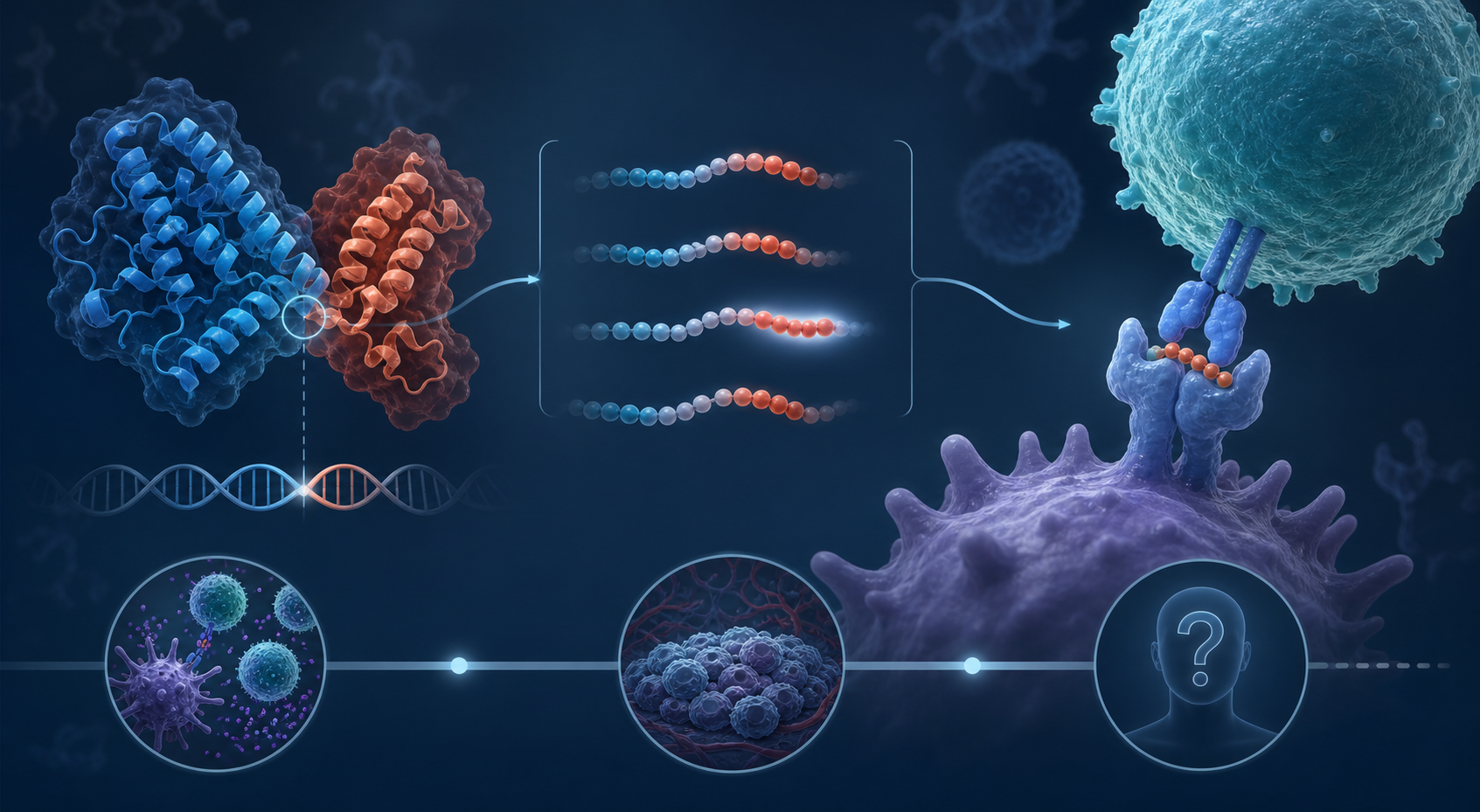
A recurrent fusion breakpoint can provide peptide targets for immune recognition. The immune response, the patient's clinical course, and proof of vaccine efficacy remain three separate questions. Conceptual illustration; not a molecular model or patient result.
What did the EWSR1–FLI1 peptide vaccine case report find?
The report documented feasibility, mild reported vaccine-associated toxicity, a durable immune signal, and prolonged clinical stability in one person. It was published in npj Precision Oncology on August 8, 2026.
The patient was a 30-year-old man with stage IVB Ewing sarcoma involving a large primary tumour in the upper arm and multiple bone metastases. Before vaccination, he had already received intensive multimodal treatment: induction and consolidation chemotherapy, surgery, and radiotherapy to the primary region and known metastatic sites. His disease was radiographically stable before vaccination began.
The experimental vaccine contained four overlapping 17-amino-acid peptides spanning the type 1 EWSR1–FLI1 fusion breakpoint. Vaccination was combined with two immune-stimulating components: sargramostim, a form of GM-CSF, and topical imiquimod.
By the February 2025 data cutoff, the paper reported:
- 23 vaccinations over 26 months, including an initial priming series and later boosters;
- only grade 1 local reactions such as redness, swelling, and induration attributed to vaccination;
- no reported systemic vaccine-associated adverse events or clinically relevant immune-mediated toxicity;
- new polyfunctional CD4-positive T-cell responses beginning around month 7;
- responses that broadened over time and remained measurable beyond two years; and
- disease stability lasting more than 26 months after vaccination started.
Evidence in one sentence: This is a scientifically interesting first-in-human observation, not a clinical trial capable of establishing treatment benefit.
Why can a fusion breakpoint become a peptide target?
A gene fusion can create an abnormal protein junction that is present in tumour cells but absent from normal proteins. That junction may produce short peptide fragments that immune cells can recognize as foreign.
Ewing sarcoma is commonly driven by a rearrangement joining parts of the EWSR1 and FLI1 genes. The resulting fusion protein acts as an abnormal transcription factor that helps drive the cancer. Crucially for vaccine design, the point where the two protein sequences meet creates a tumour-specific sequence.
The researchers used four overlapping peptides spanning that junction. The idea was not that the peptides would directly kill tumour cells. Instead, they were intended to teach or amplify T-cell recognition of the fusion-derived target.
This rationale has two attractive features:
- Tumour specificity: The fusion junction is not part of the corresponding normal proteins.
- Potential repeatability: The type 1 breakpoint recurs across a subset of Ewing sarcomas, making an off-the-shelf design conceivable for patients whose tumours carry that exact fusion.
That is a biological rationale, not proof of clinical efficacy. A target can be logical, a vaccine can generate measurable immune activity, and the treatment can still fail to improve outcomes in larger studies.
What did the immune testing actually show?
The testing found new, durable CD4-positive T-cell activity against the vaccine peptides, but it did not directly prove tumour-cell killing. Blood samples were collected before vaccination and at seven later time points. Researchers expanded peptide-responsive cells in the laboratory and used intracellular cytokine staining to identify T cells expressing at least two functional markers.
The timing matters:
- Before vaccination: No EWSR1–FLI1-specific responses were detected.
- Month 7: Responses appeared against peptides E1 and E4.
- Month 17: Responses were detected against E1, E3, and E4.
- Month 26: Responses were detected against all four peptides, with the strongest response against E4.
The response was dominated by CD4-positive T cells. A CD8-positive response appeared only transiently. Calling the responses polyfunctional means the responding cells expressed at least two of the measured activation or cytokine markers; it does not mean the study proved those cells reached the tumour or destroyed cancer cells.
The authors also noted important assay limits. The test used 12 days of laboratory stimulation with IL-2 and IL-7 to expand rare responsive cells. The report did not include T-cell receptor clonotyping, direct cytotoxicity tests, or functional proof that the measured T cells recognized and killed the patient's tumour cells.
Immune response, disease stability, and efficacy are different claims
These three claims sit on different evidence levels and should not be collapsed into one story.
| Claim | What the report supports | What remains unproven | |---|---|---| | Durable immune response | Peptide-responsive, polyfunctional CD4-positive T cells appeared after vaccination and persisted beyond two years | Whether those cells attacked tumour cells effectively in the body | | Clinical stability | This patient remained without disease progression for more than 26 months after vaccination began | How much of that course resulted from chemotherapy, surgery, radiotherapy, vaccination, patient biology, or their combination | | Causal efficacy | A hypothesis that vaccine-induced immunity may have contributed | That the vaccine caused stability, improves outcomes, or benefits a defined proportion of patients |
An immune signal answers, "Did the immune system respond to the peptides in a measurable assay?" Disease stability answers, "What happened clinically during follow-up?" Efficacy asks the harder question: "Did the intervention cause a better outcome than would otherwise have occurred?"
A single case can answer the first two descriptively. It cannot reliably answer the third.
The same evidence-literacy rule appears in a different setting in our review of an IL-17A peptide-vaccine phase 1 trial: a measurable immune response is not automatically a demonstrated clinical benefit.
Why can't 26 months of stability prove the vaccine worked?
The clinical course is notable, but the study design cannot isolate the vaccine's contribution. Several causal problems overlap.
First, there was only one patient and no comparison group. Without comparable patients who did not receive the vaccine, there is no counterfactual showing what would have happened otherwise.
Second, the patient had undergone extensive treatment before vaccination. Chemotherapy, surgery, and radiotherapy can all affect later disease control. The disease was already stable when vaccination started, only 15 days after radiotherapy ended.
Third, the vaccine was not given alone. Most vaccinations were accompanied by GM-CSF and topical imiquimod. Those components were intended to stimulate immune activity, so the observed immune response cannot be assigned cleanly to the four peptides in isolation.
Fourth, Ewing sarcoma outcomes vary between individuals. An unusually durable course can be clinically important without revealing which component caused it.
This is why the wording matters: disease stability coincided with the immune response. The report supports a possible contribution worth testing, not a causal conclusion.
For a broader guide to this distinction, see Peptide research status explained and How to evaluate peptide claims online.
What does the safety observation mean?
The reported vaccine-associated toxicity was mild in this patient, but one person's experience cannot define a safety profile. Grade 1 local reactions were reported, with no systemic vaccine-associated adverse events or clinically relevant immune-mediated toxicities during follow-up.
That is reassuring as a feasibility observation. It is not evidence that the approach is generally safe, that uncommon harms do not occur, or that risks would remain the same across different patients, schedules, disease states, or combinations. Larger studies are needed to estimate both common and rare adverse effects.
The same rule applies to small early studies discussed in When a peptide enters phase 1: an absence of serious events in a tiny sample is not the same as a well-characterized risk profile.
What kind of study is needed next?
Larger prospective studies are required to test reproducibility, safety, tumour recognition, and clinical benefit. A useful next step would enroll patients under a predefined protocol, specify clinical and immune endpoints in advance, and track outcomes consistently.
Future research would need to ask:
- Can the vaccine reliably induce fusion-specific responses in more than one patient?
- Which HLA types and immune contexts support useful responses?
- Do vaccine-induced T cells directly recognize and damage tumour cells?
- How often do adverse effects occur?
- How do outcomes compare with an appropriate control or benchmark?
- Does adding the vaccine improve progression-free survival, overall survival, quality of life, or another meaningful clinical endpoint?
Only larger controlled evidence can estimate response rates or compare efficacy. One case report cannot supply those numbers, no matter how striking the timeline looks.
The bottom line
The EWSR1–FLI1 peptide vaccine case report shows that a recurrent fusion breakpoint can be turned into an off-the-shelf peptide-vaccine concept that generated durable CD4-positive immune responses in one patient. It also reports mild local reactions and more than 26 months of disease stability.
The central limit is just as important: the patient had already received multimodal cancer treatment, the vaccine was combined with GM-CSF and imiquimod, the disease was stable before vaccination, and there was no control group. The report demonstrates feasibility and an immune signal. It does not establish that the vaccine caused the clinical course or provides a proven treatment benefit.
Frequently asked questions
Is the EWSR1–FLI1 peptide vaccine a proven treatment for Ewing sarcoma?
No. The publication is a single-patient case report, not an efficacy trial.
Did all four peptide responses appear at month 7?
No. Responses to E1 and E4 appeared by month 7, broadened to E1, E3, and E4 by month 17, and included all four peptides by month 26.
Does a polyfunctional CD4-positive T-cell response prove tumour killing?
No. It shows multiple measured immune functions after peptide stimulation. The report did not directly demonstrate tumour-cell killing.
Does 26 months of stability prove the vaccine caused the outcome?
No. Prior chemotherapy, surgery, radiotherapy, the concomitant immune adjuvants, and individual disease biology prevent that causal conclusion.
Where was the case report published?
Calukovic and colleagues published it in npj Precision Oncology on August 8, 2026: doi:10.1038/s41698-026-01642-4.
This article is for general education and evidence literacy. It does not provide individualized cancer advice or recommend a treatment, dose, protocol, source, or product.