Can a Peptide Vaccine Target IL-17A? What a 20-Person Phase 1 Trial Does—and Does Not—Show
What the 20-person FPP003 phase 1 trial shows about IL-17A peptide-vaccine safety and antibody responses—and why it does not prove neutralization or disease benefit.
Can a Peptide Vaccine Target IL-17A? What a 20-Person Phase 1 Trial Does—and Does Not—Show
Short answer: An experimental IL-17A peptide vaccine called FPP003 prompted most evaluable vaccine recipients in a small phase 1 trial to produce more anti-IL-17A antibodies. That is an immunogenicity result—not evidence that the antibodies neutralized IL-17A, improved inflammatory disease, or made the vaccine clinically effective.
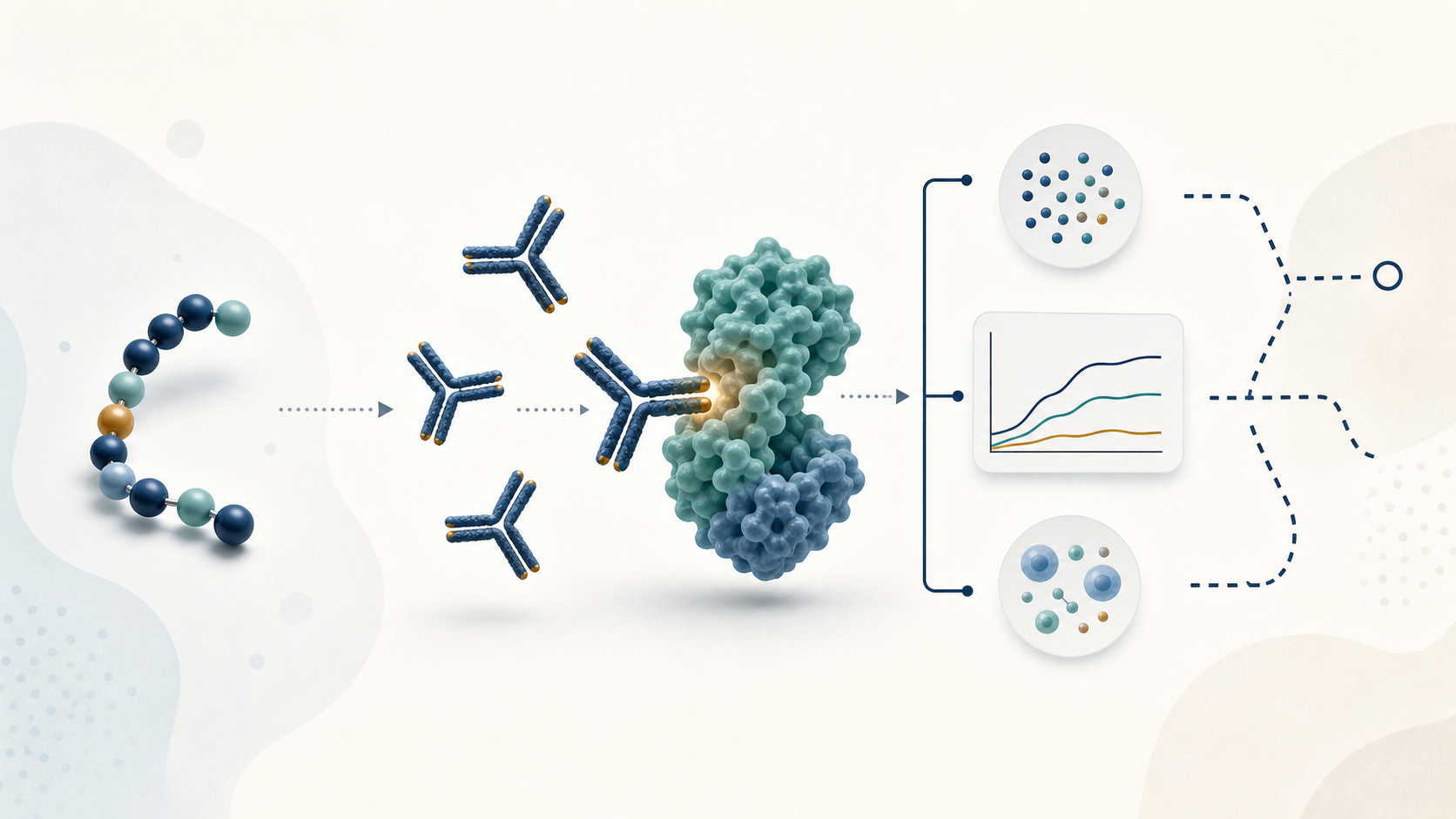
FPP003 generated measurable immune responses, but the path from antibody production to neutralization and clinical benefit remains unproven. Conceptual illustration; not a molecular model or trial result.
Quick facts about the FPP003 phase 1 trial
- Design: Single-center, randomized, double-blind, placebo-controlled, dose-escalation phase 1 trial
- Participants: 20 healthy Japanese adults
- Groups: Eight received low-dose FPP003, eight received high-dose FPP003, and four received placebo—two within each dose cohort
- Schedule: Three administrations, 28 days apart
- Follow-up: Through day 141; one high-dose participant withdrew consent before the second administration
- Main purpose: Safety, tolerability, and immunogenicity—not disease treatment
- Antibody result: 14 of 15 evaluable FPP003 recipients met the study's definition of seroconversion, a fourfold or greater rise in antibody titer
- Crucial negative finding: Neutralizing activity was not detected in the study's purified-IgG assay
The trial was published electronically in iScience on July 21, 2026. Its registration number was jRCT2071230039.
What is the IL-17A peptide vaccine FPP003?
FPP003 is an experimental therapeutic vaccine designed to make the body generate antibodies against the inflammatory signaling protein IL-17A. It is not an approved treatment, and this phase 1 study did not test whether it improves any disease.
The construct combines two functional pieces:
- An IL-17A B-cell epitope, intended to focus antibody production on part of the IL-17A target.
- AJP001, described by the researchers as a helper T-cell epitope that also activates innate immune responses.
The authors call FPP003 “adjuvant-free” because it was administered without a separate conventional vaccine adjuvant. That does not mean it lacks immune-stimulating design. AJP001 is part of the peptide construct and is intended to supply T-cell help and innate-immune activation.
Quick answer: What does “adjuvant-free” mean here? It means no separate adjuvant was added. It does not mean the formulation was immunologically inactive beyond the IL-17A epitope; AJP001 was included specifically to support the immune response.
How was the 20-person study designed?
The study was built to look for early safety and immune-response signals, not clinical efficacy. Researchers enrolled 20 healthy adults at one hospital in Osaka, Japan, and used two sequential dose cohorts.
Within each cohort, participants were randomized four to one: eight to FPP003 and two to placebo. The low-dose cohort started first, followed by the high-dose cohort after a safety review. Participants were scheduled for three administrations at four-week intervals and observation through day 141.
One person in the high-dose group withdrew consent after the first administration and did not receive the second or third. This left 15 vaccine recipients evaluable for the reported seroconversion analysis.
Randomization and blinding reduce some forms of bias. But they cannot compensate for a sample this small. With only four placebo recipients total—and two per cohort—the study has little ability to compare event rates reliably or detect uncommon harms.
For context, see what entering phase 1 actually means and how to evaluate peptide claims online.
What did the trial find about safety?
No severe or serious adverse events were reported, but mild-to-moderate events were common and the sample was far too small to establish broad safety. All FPP003 recipients had at least one reported adverse event, compared with half of the four placebo recipients.
Injection-site reactions were prominent in both active-dose groups. The paper reported injection-site pain, redness, induration, and swelling at high frequency, while fatigue was the main systemic event. Headache and fever also occurred in the low-dose group. No adverse event led to discontinuation; the one withdrawal was by consent.
This is useful early tolerability information. It is not proof that the product is safe across larger, older, medically diverse, or chronically ill populations. A trial of 20 people is structurally incapable of ruling out uncommon adverse effects.
Quick answer: Was FPP003 shown to be safe? The careful conclusion is narrower: no severe or serious events appeared in this very small, short phase 1 study. Larger and longer trials would be needed to characterize safety.
What did the antibody results show?
FPP003 was immunogenic by the study's laboratory definition. Anti-IL-17A antibody titers rose after vaccination, peaked around day 71 or day 85 depending on the analysis, and remained above baseline through the final day-141 measurement.
Fourteen of 15 evaluable vaccine recipients achieved “seroconversion,” which the paper defined as at least a fourfold increase in anti-IL-17A antibody titer. The study also reported changes in immune-cell assays, including IL-4 and IFN-γ ELISpot responses and an increase in circulating follicular helper T cells in the high-dose group.
Those findings support the claim that the platform engaged the immune system. They do not establish what the antibodies did to IL-17A signaling in a person.
Why are antibodies not the same as neutralization?
An antibody can bind a target without blocking its biological function. Antibody quantity, binding strength, target location, persistence, and functional activity are different questions.
The evidence ladder in this trial is:
- Antibody detected: The assay found antibodies that recognized IL-17A.
- Fourfold titer rise: Most evaluable recipients crossed the study's seroconversion threshold.
- Functional neutralization: Not demonstrated. The researchers did not detect neutralizing activity using purified IgG collected on days 71 and 85.
- Clinical benefit: Not tested. Participants were healthy, and the trial measured no psoriasis, rheumatoid arthritis, or other inflammatory-disease outcome.
The authors suggested that the IgG purification method might have affected the neutralization assay and contrasted it with a method used in earlier monkey work. That is a hypothesis about the negative result, not proof that neutralizing activity existed. Until a suitable validated assay detects functional inhibition, neutralization remains unshown.
Quick answer: Did FPP003 neutralize IL-17A? Not in the purified-IgG assay reported in this study. The trial demonstrated antibody binding responses, not confirmed functional blockade.
Did the IL-17A peptide vaccine improve psoriasis or rheumatoid arthritis?
No. The trial cannot answer that question because it enrolled healthy volunteers and measured no disease outcomes. References to psoriasis, rheumatoid arthritis, or other inflammatory conditions explain why researchers are interested in IL-17A; they are not efficacy results for FPP003.
Clinical benefit would require disease-specific trials that measure outcomes meaningful to patients, compare them against an appropriate control, and follow participants long enough to assess durability and harms. Even confirmed IL-17A neutralization would remain a mechanistic result until linked to better clinical outcomes.
This distinction is central to reading early peptide studies: a biomarker may show that a platform did something biologically measurable without showing that it helped anyone feel or function better. Our guide to what preclinical evidence actually means explains the same gap at an earlier research stage.
How is a therapeutic peptide vaccine different from other vaccines and biologics?
FPP003 aims to induce the recipient's own antibodies against a human signaling protein, which makes it different from both infectious-disease vaccination and direct antibody treatment.
| Approach | What is given | Intended immune effect | What the FPP003 trial establishes | |---|---|---|---| | Therapeutic peptide vaccine such as FPP003 | Selected peptide epitopes | Encourage the body to make antibodies against a disease-relevant target | Antibody generation in healthy volunteers; no demonstrated neutralization or clinical benefit | | Infectious-disease vaccine | Antigen(s) from or modeled on a pathogen | Build immune memory to reduce infection or disease risk | Not the purpose tested here | | Direct anti-IL-17 biologic | Manufactured monoclonal antibody | Bind and inhibit a specified IL-17 pathway target with a controlled drug dose | A different therapeutic modality with its own evidence, dosing, duration, and safety profile |
A therapeutic vaccine could, in theory, produce a longer-lasting endogenous antibody response. That possibility also makes control and reversibility important research questions: vaccine-induced antibody production is not adjusted in the same way as the concentration of a directly administered biologic. This phase 1 paper does not establish comparative efficacy, cost, convenience, or safety versus anti-IL-17 medicines.
What are the study's main limitations?
The strongest interpretation is constrained by five major limitations.
- Only 20 healthy adults participated, with 16 assigned to FPP003 and four to placebo.
- One high-dose participant withdrew, leaving 15 evaluable vaccine recipients for seroconversion.
- Follow-up ended at day 141, so longer-term antibody persistence and safety are unknown.
- The study did not detect neutralizing activity in its purified-IgG assay.
- No participant had an inflammatory disease being treated, so clinical benefit was not tested.
There was also no meaningful power to compare the low and high doses, evaluate subgroups, or detect uncommon adverse events. The randomized, double-blind design is a genuine strength, but design quality and sample size answer different questions.
Who developed the study, and what conflicts were disclosed?
The paper reports substantial connections between several authors, their university departments, and FPP003's developer, FunPep. Five authors were FunPep employees. Two authors were FunPep stockholders and scientific advisers.
The disclosure also states that the University of Osaka's Department of Health Development and Medicine was endowed by AnGes, Daicel, and FunPep, while its Department of Clinical Gene Therapy was endowed by several companies and organizations, including FunPep.
These affiliations do not invalidate the data. They do increase the importance of independent replication, transparent methods, complete adverse-event reporting, and cautious interpretation—especially when the study is small and the main functional assay was negative.
Bottom line
The FPP003 phase 1 trial shows that an adjuvant-free IL-17A peptide vaccine can generate anti-IL-17A antibodies in most evaluable healthy volunteers over 141 days, with no severe or serious adverse events observed in this tiny sample. It does not show that those antibodies neutralize IL-17A, treat inflammatory disease, outperform biologics, or have a well-characterized safety profile.
The next informative evidence would need to demonstrate functional activity reproducibly, clarify durability and safety in larger groups, and eventually test clinical outcomes in an appropriate patient population. Until then, FPP003 is an experimental platform with an immunogenicity signal—not a demonstrated therapy.
Frequently asked questions
Is FPP003 an approved IL-17A treatment?
No. FPP003 is an experimental therapeutic peptide vaccine evaluated in an early phase 1 trial.
Did 14 of 15 participants benefit from FPP003?
No. Fourteen of 15 evaluable vaccine recipients met a laboratory definition of seroconversion. That figure describes an antibody-titer increase, not symptom improvement or clinical benefit.
Why were only 15 vaccine recipients evaluable?
Sixteen participants were assigned to FPP003, but one high-dose participant withdrew consent after the first administration and did not complete the series.
Does “no serious adverse events” prove the vaccine is safe?
No. It describes what occurred in this 20-person study through day 141. Rare, delayed, or population-specific harms require much larger and longer studies.
Where can I read the study?
The paper is open access in iScience: Kasahara et al., 2026. The PubMed record is PMID 42495520.
This article is for general education and evidence literacy. It is not medical advice and does not recommend FPP003, any vaccine, or any treatment decision.