AI Peptide Design: Why Binding Is Not the Same as Biological Effect
AI peptide design has a basic problem: predicting that a peptide will bind a receptor does not tell you what the peptide will make that receptor do. A binder might activate the receptor, block it, produce only a weak response, favor one signaling pathway over another, or have no useful effect in a living system.
That distinction is the focus of TD3B, a computational peptide-design framework from researchers at the University of Pennsylvania and the Chinese University of Hong Kong. Presented as a Spotlight at ICML 2026, the model was designed to generate peptide candidates predicted both to bind selected G protein-coupled receptors (GPCRs) and to push those receptors toward a requested functional direction: agonism or antagonism.
The work is an interesting advance in computational design. It is not evidence that the generated peptides are safe or effective medicines. At the time of the researchers' July 2026 description, synthesis and laboratory validation were still underway.
Quick answer: Binding answers, “Does the molecule make contact with the target?” Function asks, “What happens after contact?” Drug discovery needs both answers, followed by experimental testing.
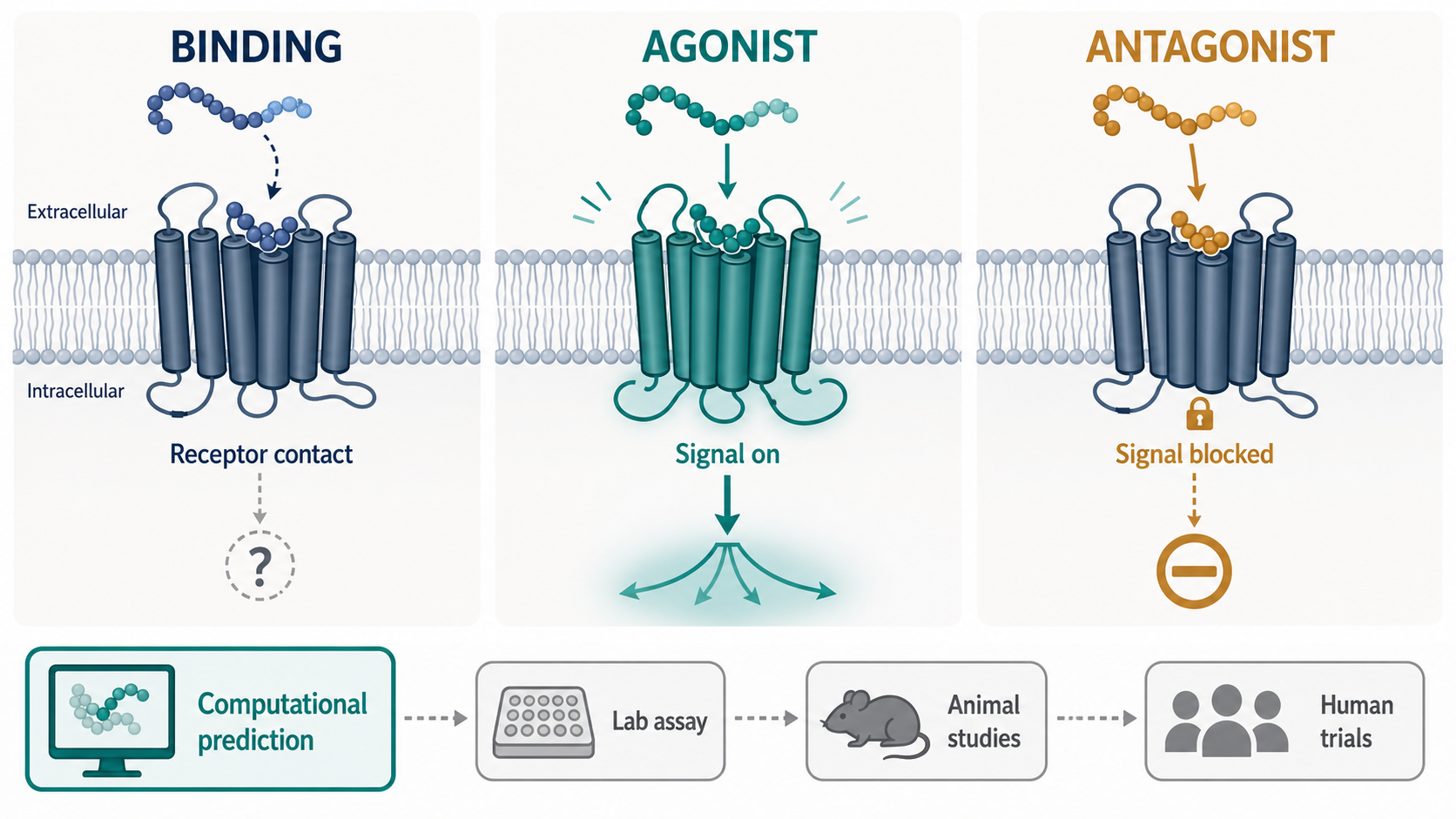
Binding is only the first question. Agonists and antagonists can contact the same receptor while producing opposite functional outcomes, and computational predictions still sit at the beginning of the validation ladder.
In This Guide
- Why binding is not enough
- How GPCR signaling works
- Agonists versus antagonists
- Why GLP-1 is a useful example
- What TD3B reportedly did
- What the study does not prove
- How to read future AI peptide claims
Why Is Binding Not Enough in AI Peptide Design?
Binding is necessary for many receptor-targeting drugs, but it is not a complete description of biological activity. A peptide can fit a receptor well without producing the desired change in receptor shape or cellular signaling.
Traditional structure-based design often works from a relatively static picture: a target structure, a candidate molecule, and an estimate of whether the two fit together favorably. That can help researchers rank candidates, but proteins are not rigid locks. They move among conformations, interact with cellular machinery, and can pass different messages depending on how a ligand changes their state.
This creates several separate questions:
- Affinity: How strongly is the peptide predicted or measured to bind?
- Efficacy: How strongly does the bound peptide change receptor activity?
- Direction: Does it activate, inhibit, or otherwise modulate the receptor?
- Pathway: Which downstream signals are favored?
- Biological relevance: Does the effect survive in cells, animals, and eventually humans?
A high predicted affinity cannot answer the other four. Treating “binds the target” as shorthand for “will work” is one of the easiest ways to inflate an early computational result.
Evidence check: A docking score or predicted binding affinity is a model output. It is not a cell response, an animal outcome, a human benefit, or a safety finding.
How Do GPCRs Turn Binding Into a Biological Signal?
GPCRs translate an outside binding event into signaling inside the cell by shifting between functional conformations. They are membrane-spanning proteins that respond to hormones, neurotransmitters, peptides, and other ligands.
When a suitable agonist binds, the receptor can favor an active state and engage intracellular partners such as G proteins or arrestins. Those partners then influence second messengers and downstream pathways. An antagonist can bind without triggering the same activation and prevent an agonist from producing its signal.
The common “lock and key” analogy is therefore incomplete. A better analogy is a control switch with multiple positions. A ligand does not merely need to fit the control; it needs to move or stabilize it in the intended position.
GPCR behavior can be more complicated than a clean on/off switch. Some ligands are partial agonists, some reduce constitutive receptor activity as inverse agonists, and some favor certain signaling pathways over others. TD3B focuses on the broader directional distinction between agonist-like and antagonist-like behavior, but real pharmacology can contain more shades than those two labels imply.
What Is the Difference Between an Agonist and an Antagonist?
An agonist activates a receptor response; an antagonist blocks activation by another ligand without producing that response itself. Both may bind the same receptor, yet their functional effects can point in opposite directions.
| Question | Agonist | Antagonist |
|---|---|---|
| Does it bind the receptor? | Yes | Yes |
| Does it favor receptor activation? | Generally yes | Generally no |
| What happens to signaling? | Initiated or increased | Activation by an agonist is blocked or reduced |
| Is binding alone enough to identify it? | No | No |
The distinction matters because target identity does not determine therapeutic direction. If the scientific goal is to increase a receptor-mediated signal, generating a strong antagonist would be a design failure even if it bound beautifully. The reverse is true when the goal is blockade.
This is what the TD3B researchers mean by functional directionality: the design objective includes the direction of the state transition, not merely stable contact with a target structure.
Why Does the GLP-1 Receptor Make the Distinction Clear?
The GLP-1 receptor is a useful example because clinically used GLP-1 medicines depend on agonism, not simply receptor binding. Their pharmacology comes from activating GLP-1 receptor signaling in relevant tissues.
A hypothetical peptide that bound the GLP-1 receptor but blocked activation would not reproduce the action of a GLP-1 receptor agonist. Same target, different instruction.
That does not mean every agonist has the same effect. Potency, duration, exposure, tissue distribution, pathway bias, off-target activity, formulation, and dose all matter. The example simply makes the first functional split easy to see: a GLP-1 receptor agonist and antagonist can bind the same receptor yet are not interchangeable.
Readers who want the clinical-versus-research distinction can start with GLP-1 peptides versus research peptides. The existence of validated peptide medicines does not validate every new peptide sequence or every computational design method.
GLP-1 answer: Receptor binding is part of the mechanism, but activation is the relevant direction. A binder predicted to block the GLP-1 receptor is not a substitute for a validated GLP-1 receptor agonist.
What Did TD3B Reportedly Do?
TD3B generated peptide candidates under a combined objective: predicted target binding plus predicted agonist or antagonist direction. The framework's name stands for Transition-Directed Discrete Diffusion for Allosteric Binder Design.
According to the ICML abstract, arXiv paper summary, and Penn Engineering release, the system combines:
- a target-aware Direction Oracle that predicts agonist-like versus antagonist-like interactions;
- a soft binding-affinity gate so direction is not rewarded without predicted binding; and
- fine-tuning of a pretrained discrete diffusion model to generate candidate peptide sequences toward the requested behavior.
The Penn release reported 93% accuracy for the Direction Oracle in distinguishing agonist- and antagonist-like interactions. That number describes performance of a computational classifier in the study's evaluation; it is not a 93% success rate for making drugs.
The researchers also performed computational structural analyses involving two GPCRs:
- GLP-1 receptor: predicted agonists contacted activation-associated sites used by known GLP-1 ligands, while predicted antagonists avoided those activation-related interactions.
- Orexin 1 receptor (OX1R): analyses reportedly showed a similar separation of predicted functional direction.
These results suggest that the model learned patterns connected to directional receptor behavior rather than optimizing only for generic target contact. That is the legitimate computational claim. The structural patterns remain predictions and analyses until experiments show that synthesized peptides actually bind and produce the intended cellular effects.
What Does TD3B Not Prove?
TD3B does not yet prove that its generated candidates work in the laboratory, in animals, or in people. The paper and institutional release describe a computational framework and computational evaluations, while noting that peptide synthesis and experimental testing were next.
The reported work does not establish:
- experimentally measured binding affinity for each generated candidate;
- agonist or antagonist activity in a functional cell assay;
- selectivity against related receptors;
- stability, bioavailability, pharmacokinetics, or tissue exposure;
- toxicity, immunogenicity, or broader safety;
- efficacy in animals or humans;
- a clinically usable formulation; or
- approval by any regulator.
Even successful cell testing would remain an early step. A peptide may show the intended receptor response in an engineered assay and still fail because it degrades rapidly, reaches the wrong tissue, activates unintended targets, triggers immune reactions, or lacks an acceptable therapeutic window.
For the broader hierarchy, see what preclinical actually means in peptide research. TD3B-generated candidates were described even earlier in that ladder: computationally proposed and awaiting laboratory validation.
Bottom-line evidence statement: TD3B supports the idea that AI generation can be conditioned on predicted functional direction. It does not validate any generated peptide as a medicine.
Why Computational Structure Still Helps
Computational evidence is useful for prioritizing experiments, not replacing them. The possible value of a model such as TD3B is that it may shrink an enormous sequence space into a more focused set of candidates.
If researchers can enrich a candidate list for both binding and desired direction, they may waste fewer synthesis and assay cycles on peptides that contact the right target but send the wrong message. That could make discovery more efficient even if many generated sequences still fail.
The practical benchmark is therefore not whether every design works. It is whether TD3B prospectively produces a better experimental hit rate, functional accuracy, selectivity profile, or development starting point than appropriate baselines. Those comparisons need blind or prospective laboratory testing, not only retrospective computational agreement. A later Mirror-Peptidizer proof-of-concept shows what prospective synthesis, binding assays, and cell-based follow-up can add—while still stopping short of therapeutic validation.
How Should You Evaluate an AI-Designed Peptide?
Ask what was measured, not what the model was intended to achieve. AI peptide claims become much easier to read when each validation stage is kept separate.
- Was the sequence merely generated? A plausible sequence is a hypothesis.
- Was binding predicted or experimentally measured? Docking and affinity models are not binding assays.
- Was function measured? Look for receptor activation or inhibition in a relevant assay, not target contact alone.
- Was direction confirmed? The candidate should produce the requested agonist, antagonist, or other defined response.
- Was selectivity tested? Activity at related receptors can change both usefulness and risk.
- Was the result replicated? Prospective testing and independent replication are stronger than evaluation on familiar data.
- How far did development proceed? Cell, animal, and human evidence answer different questions.
- What remains unknown? Safety, exposure, manufacturing, and clinical benefit do not emerge automatically from a successful receptor assay.
Our guide to evaluating peptide claims online provides a broader version of the same filter. A model name and a structural rendering can make a result look finished long before biology has had its say.
The Bottom Line
AI peptide design improves when it treats biological function as part of the target, but predicted directionality is still a prediction. TD3B addresses a real limitation of binding-first design by generating candidates toward both target contact and agonist- or antagonist-like behavior.
Its GLP-1 receptor and OX1R analyses are evidence that the computational strategy is worth testing. They are not evidence of human efficacy, safety, or a market-ready peptide. The decisive next steps are experimental: synthesize the candidates, measure binding, test receptor function and selectivity, examine biological behavior, and only then consider later development stages.
Binding tells researchers that a candidate may have reached the door. Biology decides whether it rings the bell, blocks it, or does something nobody intended.
FAQ
What is AI peptide design?
AI peptide design uses computational models to generate or rank amino-acid sequences for selected properties, such as target binding, stability, or biological function. The outputs are candidates for testing, not automatically validated molecules.
Is binding affinity the same as biological activity?
No. Affinity describes the strength of a binding interaction. Biological activity describes the functional response that follows, which can include activation, blockade, pathway bias, or no useful response.
Can an agonist and antagonist bind the same receptor?
Yes. They can bind the same receptor while favoring different receptor states. An agonist activates signaling; an antagonist blocks activation by an agonist.
What did TD3B show for the GLP-1 receptor?
In computational structural analyses, predicted agonists contacted activation-associated GLP-1 receptor sites, while predicted antagonists avoided those interactions. Laboratory confirmation of generated candidates was still pending in the July 2026 report.
Did TD3B create a new approved peptide drug?
No. It generated computational candidates. The reported work did not establish human efficacy, clinical safety, regulatory approval, or a consumer product.
Should consumers use TD3B-designed peptides?
No consumer use follows from this research. The generated candidates were investigational computational outputs awaiting experimental validation, and this article does not recommend peptide use or self-experimentation.