BPC-157 Use Is Rising—Why 1,039 Clinical Notes Still Do Not Prove It Works
A 2026 preprint found 1,039 documented BPC-157 users and sharply rising use, but incomplete notes, co-treatments and an uncontrolled design cannot prove efficacy or safety.
BPC-157 Use Is Rising—Why 1,039 Clinical Notes Still Do Not Prove It Works
Short answer: A large clinical-note study found that documented BPC-157 use rose sharply inside a U.S. health-record network. It did not show that BPC-157 caused recovery, works better than placebo, or is safe.
The key source for this BPC-157 clinical evidence on real-world use is Venkatakrishnan and colleagues’ version 1 preprint, posted September 7, 2026. It is a non-peer-reviewed preprint, so its methods and conclusions have not completed journal peer review. A September 15 Reuters report accurately framed the work as evidence about rising real-world use—not proof of treatment benefit.
This is the central evidence-literacy point: utilization evidence answers “Is this showing up in clinical practice?” Treatment evidence answers “Does this intervention cause better outcomes than a credible comparison?” The study addresses the first question.
Quick answer: The paper is useful for documenting BPC-157 mentions, confirmed use, co-treatments and what clinicians recorded. It cannot determine efficacy or establish a safety profile because it is retrospective, uncontrolled, dependent on incomplete notes and vulnerable to multiple biases.

Clinical-note curation can turn scattered documentation into a measurable cohort. It does not, by itself, balance the evidence for cause and effect.
What did the BPC-157 clinical evidence on real-world use actually measure?
The study measured documented BPC-157 use and documented patient-reported outcomes in retrospective clinical notes from 2020 through 2026.
BPC-157 is unapproved in the United States and lacks a National Drug Code, so a conventional prescription or claims-code search would miss much of its use. The researchers instead searched de-identified free-text clinical notes across a federated U.S. network and used a large language model to curate relevant information. Physicians then adjudicated samples of the extraction tasks.
The study’s main cohort flow was:
- 1,536 patients had at least one clinical note mentioning BPC-157.
- 1,039 patients were classified as having documented use, or 67.6% of those with a mention.
- Quarterly newly confirmed users increased 33-fold from 2020 to 2026.
That last figure describes growth in newly documented cases within this network. It is not a U.S. prevalence estimate, a market-share estimate or proof that use grew 33-fold in the general population. People outside participating records, people whose clinicians never asked, and people whose use was never written into a note are invisible to the analysis.
What can the study establish—and what remains unproven?
It can establish patterns in what the network’s notes documented; it cannot establish what BPC-157 caused.
| Measured or described | Not proven |
|---|---|
| BPC-157 mentions and confirmed documented use in the network | How many people use BPC-157 nationally |
| A 33-fold increase in quarterly newly confirmed users from 2020 to 2026 | A 33-fold rise in population prevalence |
| What clinicians recorded about reasons, co-use, sources and responses | That every relevant exposure or outcome was captured accurately |
| Patient-reported improvement when a directional response appeared in the note | That BPC-157 caused the improvement |
| Infrequently documented adverse events during use | That BPC-157 is safe or that a reported event was caused by it |
| How accurately the LLM extracted selected note fields | Whether the underlying clinical statement was true or causal |
This distinction keeps the new BPC-157 clinical evidence in its proper lane. The paper expands knowledge about use in practice. It does not replace prospective trials.
Why does the “79% improved” figure need a denominator?
The 79% figure applies only to the 354 users whose notes contained an interpretable directional response—not to all 1,039 confirmed users.
Response direction was unavailable for 685 of 1,039 users, or 65.9%. That leaves 354 people with documentation that the model could classify as improvement, worsening or another direction. Within that selected subset, 79% had documented symptomatic improvement and 5% had documented worsening.
The denominator changes the meaning. “Seventy-nine percent improved” sounds like a cohort-wide response rate. The defensible statement is: among roughly one-third of confirmed users with a directional response documented, 79% had an improvement recorded.
Several biases can inflate that selected proportion:
- Documentation bias: clinicians may record a striking improvement or complaint but omit a neutral outcome.
- Selection bias: the 354 people with interpretable follow-up may differ from the 685 without it.
- Confirmation bias: patients and clinicians who expect benefit may interpret ambiguous change favorably.
- Placebo and context effects: expectations, attention and treatment rituals can influence reported symptoms.
- Natural recovery: many injuries and symptom flares improve over time without the studied exposure causing the change.
- Reporting bias: disappointing outcomes may be less likely to reach the note or the treating clinician.
There was no randomized assignment, untreated control group, placebo group or standardized outcome schedule to separate those explanations.
Why can’t the notes attribute improvement to BPC-157?
Attribution is impossible because many users received other drugs and interventions at the same time.
The preprint reports that 525 of 1,039 users (50.5%) had documented co-use of other therapeutic agents. The most commonly recorded were testosterone (17.0% of all confirmed users), NSAIDs (14.7%), TB-500 (12.9%) and corticosteroids (11.7%). Non-drug interventions were also documented, including physical therapy (15.3%), surgery (12.6%), exercise counseling (8.3%) and diet counseling (6.3%).
Those are not side details. NSAIDs can change pain, physical therapy can change function, surgery can change healing trajectories, and time can change all three. When exposures overlap, a retrospective note cannot isolate the contribution of BPC-157.
The study also lacked standardized indication, formulation, dose, route, duration and outcome assessment. Two patients counted as confirmed users may therefore represent very different exposures and clinical situations.
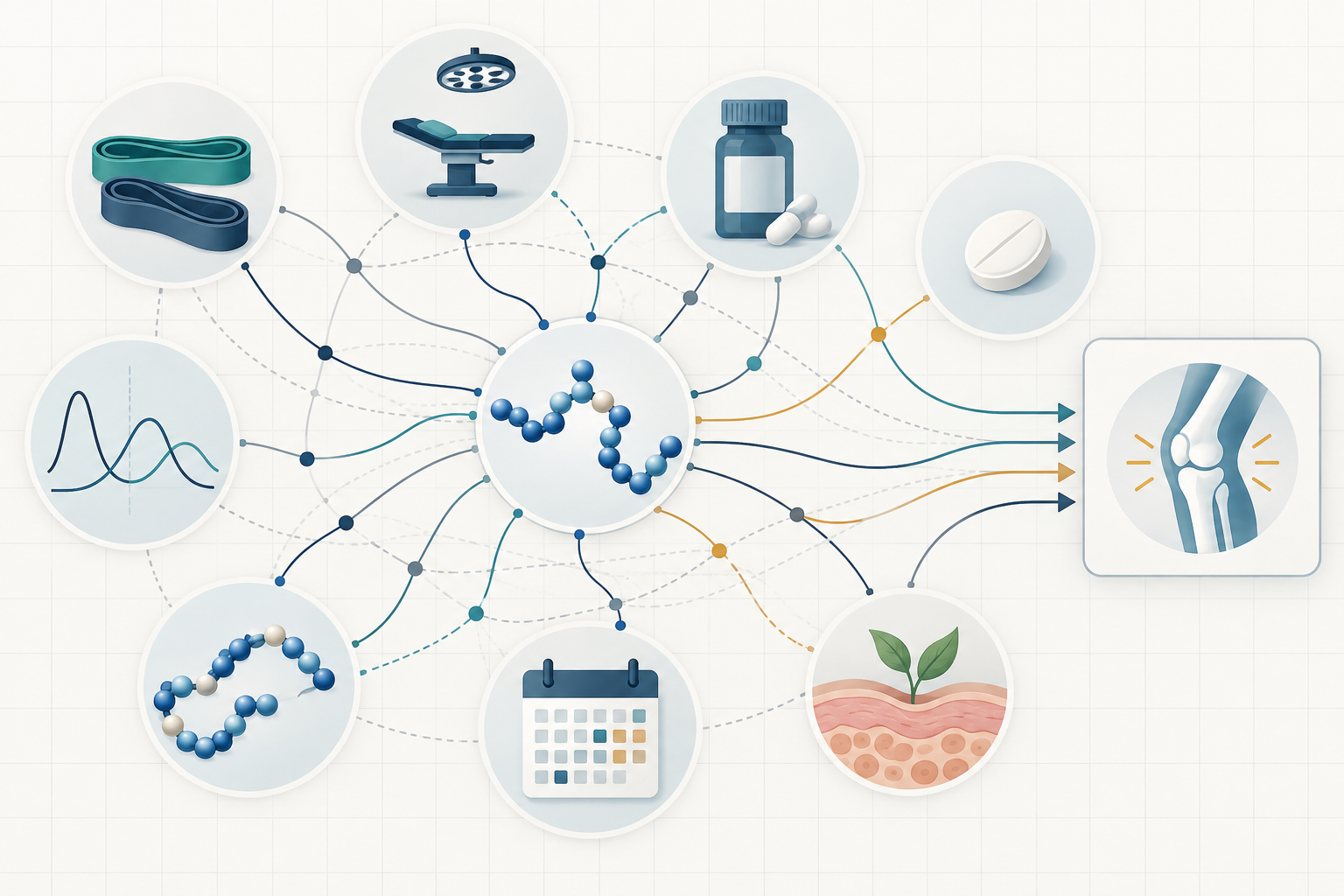
A reported outcome can reflect BPC-157, another agent, rehabilitation, surgery, time, expectations or some combination. An uncontrolled note review cannot separate those paths.
For a broader explanation of why anecdotes and uncontrolled observations are easy to overread, see How to Evaluate Peptide Claims Online.
Does physician validation make the outcomes clinically true?
No. Physician adjudication tested extraction accuracy, not treatment causality.
The researchers checked whether the LLM correctly pulled information from the notes. Reported adjudicated accuracy varied by task: 96.0% for co-therapies, 74.4% for non-drug interventions, 83.9% for reasons for use and 78.4% for response direction.
That is valuable method validation. It helps answer: “Did the model extract what the note said?” It does not answer:
- Was the patient’s report objectively verified?
- Was the improvement clinically meaningful?
- Would the same change have happened without BPC-157?
- Was another therapy responsible?
- Were negative outcomes missing from the note?
An accurate transcription of an uncertain observation remains an uncertain observation. Artificial intelligence can organize evidence; it cannot upgrade the evidence design.
What do the source and demographic findings really say?
They describe documented subgroups, not a universal BPC-157 consumer profile.
Consumer source was documented for only 205 of 1,039 confirmed users (19.7%). Within those 205, 36% were documented as obtaining BPC-157 from compounding pharmacies and 35% from gray-market peptide vendors. Those percentages should not be applied to the 834 users without a documented source.
Race was recorded for 972 confirmed users; 95.9% of that subgroup was White. The preprint also reports shifts in sex and mean age among newly documented users over time, but those network-specific patterns should not be generalized to all BPC-157 users. Clinical-network composition, access, documentation habits and who tells a clinician about use can all shape the observed profile.
The same denominator discipline applies to reasons for use. Reasons were documented for 644 users, while percentages for pain, gastrointestinal conditions, prior injury and post-surgical healing were reported against the full 1,039-person cohort. These figures map what appeared in notes; they do not validate BPC-157 for any of those purposes.
Do infrequently documented adverse events show BPC-157 is safe?
No. Sparse adverse-event documentation cannot establish safety.
The preprint reports infrequently noted neuropsychiatric, injection-site hypersensitivity and gastrointestinal events during BPC-157 use. But clinical notes are not a prospective safety-surveillance system. Patients may not report an event, clinicians may not ask, the event may occur outside the network, follow-up may be missing, or symptoms may be recorded without linking them to the exposure.
Spontaneous adverse-event databases have similar limits. As Reuters noted, an FDA adverse-event report does not prove causation; submissions can come from consumers, clinicians or companies and may be incomplete or unverified. The reverse is also true: a small number of reports does not prove safety because underreporting is common and the number of exposed users is unknown.
The FDA’s compounding-risk page has used cautious language for peptide substances around limited safety information, peptide-related impurities, active-pharmaceutical-ingredient characterization and potential immunogenicity. These are risk concerns and evidence gaps—not proof that a particular reported event was caused by BPC-157.
For the broader safety evidence, see BPC-157 Side Effects and Unknowns.
What evidence would be needed to show that BPC-157 works?
Efficacy requires prospective comparison, standardized exposure and outcomes, and enough follow-up to detect both benefit and harm.
A credible treatment study would predefine who qualifies, what formulation and route are used, what comparison group receives, which outcomes matter, when they are measured and how missing data are handled. Randomization and blinding would reduce selection, expectation and confirmation bias. Adequate sample size and follow-up would improve the chance of detecting uncommon or delayed harms.
The 2026 preprint can help design such research by identifying commonly documented use cases and co-interventions. It cannot substitute for it.
If you need the general background rather than this specific methods question, read What Is BPC-157?. For why “research use” and clinical evidence are different categories, see Peptide Research Status Explained.
Bottom line
The study is evidence that BPC-157 is increasingly documented in one large U.S. clinical network. It is not evidence that BPC-157 is effective or safe.
The useful findings are the 1,536 mentions, 1,039 confirmed users, 33-fold increase in newly documented quarterly users, limited response documentation, substantial co-treatment and network-specific source and demographic patterns. The limits are equally important: no control group, no standardized exposure, incomplete outcomes, uncontrolled co-interventions, retrospective notes and strong opportunities for selection, documentation, placebo, confirmation and natural-recovery bias.
That is not a reason to dismiss the paper. It is a reason to read it for the question it can answer.
Educational note: This article is for general information and evidence literacy. It is not medical advice, treatment guidance or a recommendation to use BPC-157. It provides no dosing, stacking, sourcing or purchasing instructions.
Frequently asked questions
Did the study prove BPC-157 works?
No. It documented real-world use and reports recorded in clinical notes. Without a controlled comparison, it cannot determine whether BPC-157 caused improvement.
Were there 1,039 trial participants?
No. The 1,039 people were confirmed documented users identified retrospectively in a health-record network. They were not enrolled in a randomized treatment trial.
Does the 33-fold increase mean national use rose 33-fold?
No. It means quarterly newly confirmed users in the studied network increased 33-fold from 2020 to 2026. The national denominator is unknown.
Did 79% of all users improve?
No. The 79% figure applies to 354 users with a directional response in their notes. Response direction was unavailable for 685 of the 1,039 confirmed users.
Was the paper peer reviewed?
No. The cited paper is version 1 of a preprint posted September 7, 2026. It had not completed peer review when this article was prepared.