When a Peptide Cancer Study Is Retracted: What Retraction Does—and Does Not—Mean
What a peptide study retraction means, why ethics and provenance concerns can undermine confidence, and how readers can verify a paper's current status.
When a Peptide Cancer Study Is Retracted: What Retraction Does—and Does Not—Mean
A peptide study retraction means the journal no longer considers the paper reliable enough to remain part of the active scientific record. It does not automatically prove that every chart, measurement, or conclusion was false. But it does mean readers should stop using the paper as positive evidence for a scientific or medical claim.
That distinction is central to a July 20, 2026 retraction in the Journal of Translational Medicine. The journal retracted a 2025 animal study involving a peptide hydrogel and nanoparticle-mimicking nanovaccine approach for gastric cancer after concerns arose about the stated animal-ethics approval.
The notice is narrow and specific. It does not allege fabrication, identify a particular person as responsible, or announce a point-by-point reanalysis of every experiment. It says the editor lost confidence in the article's provenance and reliability because the reported ethics approval could not be reconciled with the listed author affiliations.
Quick answer: A retraction changes a paper's status from usable evidence to an unreliable record that should be clearly identified as retracted. It is a correction to the literature, not a verdict on every other study in the field.
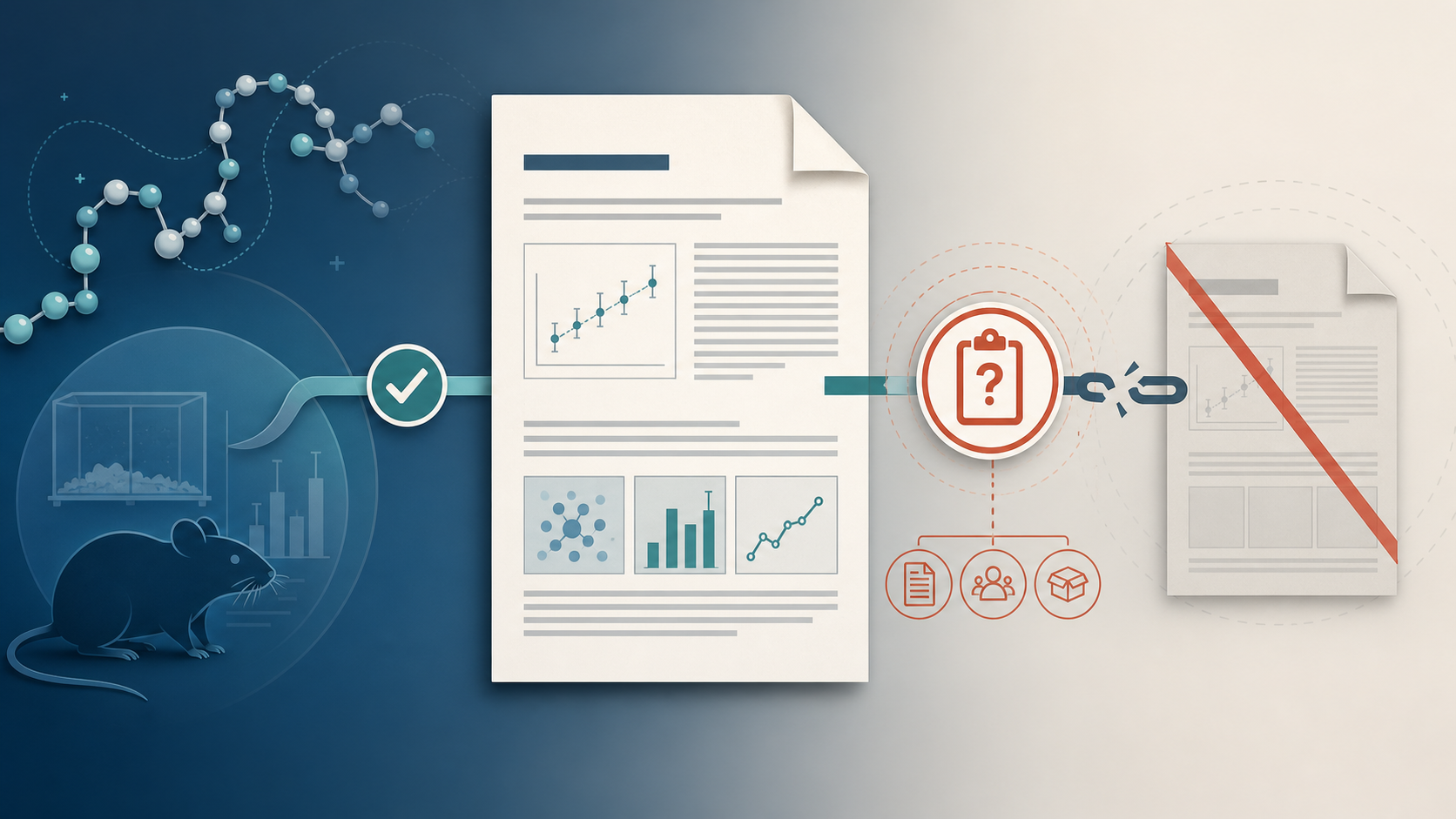 A retraction removes a paper from the usable evidence chain. It does not, by itself, show that every related research question or every other peptide study is invalid.
Why was this peptide cancer paper retracted?
The documented reason was concern about the animal-ethics approval stated in the original article. According to the retraction notice, the paper said all animal experiments had been approved by Huazhong Agricultural University under approval number HZAUMO-2024-0078.
The notice then states that none of the listed authors appeared to be affiliated with Huazhong Agricultural University. Because of that discrepancy, the editor-in-chief said they no longer had confidence in the provenance and reliability of the article.
The notice also says the authors did not respond to correspondence regarding the retraction notice.
Those are the facts the journal documented. Going further would be speculation. The notice does not say that the experiments were fabricated, that the approval number was necessarily false, or that every reported result was disproved. It says the unresolved ethics and affiliation problem was serious enough that the editor could no longer stand behind the paper's reliability.
The retraction notice is linked to the original article through DOI records. The original paper now carries a retracted-article label and a change-history entry dated July 20, 2026.
What is a scientific retraction?
A retraction is a formal notice that a published paper should no longer be treated as a dependable contribution to the research literature. Journals use retractions when problems are serious enough that a normal correction cannot restore confidence in the work.
A retraction may follow problems involving data, methods, duplicate publication, authorship, ethics oversight, provenance, peer review, or other failures. The reason matters, which is why readers should open the notice instead of treating the word “retracted” as a complete explanation.
Retraction is also different from several other journal actions:
| Journal action | What it usually means | |---|---| | Correction or erratum | A limited error is fixed while the paper remains usable | | Expression of concern | The journal warns readers while an investigation is unresolved | | Retraction | The journal withdraws confidence in the paper as reliable evidence | | Withdrawal before publication | A manuscript is removed before becoming a normal published record |
Publishers generally leave retracted papers online with prominent labels so the record remains transparent. Erasing a paper would make it harder to understand what happened, trace later citations, or prevent the same unreliable claims from quietly circulating.
Why ethics and provenance affect scientific reliability
Animal-ethics approval is part of the evidence chain, not decorative paperwork. It is meant to show that a defined institution reviewed a defined protocol, assessed animal welfare, and authorized the work under accountable oversight.
Provenance means knowing where the work came from and being able to trace the people, institutions, materials, approvals, and records behind it. If a paper says one institution approved animal experiments but the listed affiliations provide no clear connection to that institution, basic questions become difficult to verify:
- Who submitted the protocol?
- Which laboratory conducted the work?
- Which institution supervised animal welfare?
- Does the approval cover the experiments described?
- Where are the underlying records held?
- Who is accountable for answering questions about the study?
An unresolved break in that chain can undermine confidence in the entire report. Scientific reliability depends not only on whether a graph looks plausible, but also on whether the work can be traced, audited, and connected to valid oversight.
This is why an editor can reasonably lose confidence without first proving that every individual result is false. If the foundation cannot be verified, a journal cannot safely ask readers to keep building on it.
Does retraction mean every experimental result was false?
No. Retraction is not automatically a finding that every result was false—but it removes the paper's value as affirmative evidence. Both parts matter.
A journal may retract a paper because it cannot establish confidence in the work as a whole. That is different from publishing a forensic report on every image, data point, and calculation. Some results might later be reproduced independently. Others might not. The retracted paper itself cannot settle that question.
The right interpretation is:
- Do not say the notice proved fabrication when it did not.
- Do not cite the retracted paper as support for effectiveness, mechanism, or safety.
- Do look for independent studies that answer the same question with traceable methods and intact research status.
- Do identify the paper as retracted if discussing its history.
This is a deliberately conservative rule. Once provenance and reliability are no longer trusted, selective reuse of the paper's favorable findings turns uncertainty into evidence by wishful thinking.
Why the original study was never clinical proof
Even before retraction, this was a preclinical animal study—not proof that a peptide platform prevents or treats gastric cancer in people. Retraction makes the paper unusable as positive evidence, but it does not change the evidence tier the paper originally occupied.
The 2025 article described a nanomedicine platform tested through laboratory and animal experiments. Work at that stage can explore biological mechanisms, delivery systems, immune responses, toxicity signals, or tumor-related outcomes in a model. It can help researchers decide whether further study is warranted.
It cannot establish:
- that the intervention prevents gastric cancer in humans
- that it treats cancer in patients
- what a safe human dose would be
- how it compares with standard cancer care
- whether benefits outweigh harms in clinical practice
Our guide to what preclinical actually means explains why promising animal findings frequently fail to translate into useful human treatments. When a peptide enters Phase 1, researchers are only beginning formal human testing; even that is not proof of effectiveness.
The lesson is broader than this one paper: evidence tier and publication status are separate checks. A valid animal paper remains preclinical. A retracted animal paper is both preclinical and no longer reliable evidence.
Should a retracted paper still be cited?
A retracted paper should not be cited as positive support for a claim. It may still be cited when the subject is the retraction itself, publication history, or research-integrity analysis—but the citation must make its status unmistakable.
Common citation failures include:
- copying a citation from an older review without checking its current status
- citing the original DOI while omitting the linked retraction notice
- describing the paper's conclusions in the present tense
- counting a retracted paper in a list of “supporting studies”
- repeating a claim from an AI summary or social post without opening the source
Later reviews are not automatically updated when one of their sources is retracted. A review published before July 20, 2026 may accurately reflect the literature as it stood at the time yet now contain a citation that should no longer carry evidentiary weight. A review published later may also miss the status change if its authors or databases did not catch it.
For a broader checklist, see how to evaluate peptide claims online and our guide to peptide research status.
How to check whether a peptide paper has been retracted
Start with the DOI, then verify the status across the publisher and an independent database. A five-minute check can prevent years-old claims from being recycled after the evidence changed.
1. Open the DOI
Paste the DOI into https://doi.org/. For this case:
- Retraction notice: 10.1186/s12967-026-08656-3
- Original article: 10.1186/s12967-025-06088-z
The original article page should display a retraction label and link to the notice.
2. Read the notice, not just the banner
The notice gives the documented reason and often says whether authors agreed or responded. Read its exact wording. “The editor no longer has confidence” is not interchangeable with “the journal proved all data were fabricated.”
3. Check PubMed or another literature index
The PubMed record for the notice identifies it as a retraction notice. Database status labels are useful because copied PDFs and citation exports may omit the publisher's warning.
4. Review the correction history
Look for tabs or sections labeled “updates,” “corrections,” “change history,” “related content,” or “Crossmark.” A paper can accumulate corrections or expressions of concern before a final retraction.
5. Compare ethics statements and affiliations
Find the ethics section, approval institution, protocol number, author affiliations, animal facility, and corresponding authors. A mismatch does not let a casual reader diagnose what happened, but it is a reason to check whether the journal investigated and issued a notice.
6. Check later reviews and citations
Use PubMed, Crossref, Google Scholar, or another citation index to see who cited the paper. Then check whether later reviews:
- were published before or after the retraction
- identify the paper as retracted
- rely materially on its findings
- still reach the same conclusion without it
Do not assume a claim remains supported merely because a review contains several citations. One retracted reference may be peripheral—or it may be the only direct experiment behind the sentence.
What this retraction does not show
One peptide study retraction does not invalidate all peptide cancer research. It changes the status of one article.
It does not establish that:
- all peptide hydrogels are ineffective
- all nanovaccine research is unreliable
- peptide-based cancer vaccines cannot work
- every author or institution in adjacent research acted improperly
- a different study with independent data shares the same problem
Each paper needs its own evidence-tier, methods, ethics, provenance, and current-status check. Early human peptide-vaccine research, for example, must be judged on its own record; our PEPcan early-trial explainer shows how to discuss a different cancer-vaccine program without turning early findings into clinical certainty.
The practical takeaway
A retraction is a stop sign for using that paper as evidence, not permission to invent allegations beyond the notice. In this case, the journal documented concerns about the stated animal-ethics approval, noted that none of the authors appeared affiliated with the named approving institution, and said the editor no longer had confidence in the article's provenance and reliability. The authors did not respond to correspondence regarding the notice.
That is enough to remove the article from the usable evidence base. It is not enough to claim that every result was proven false or to dismiss all peptide cancer research.
Good evidence literacy holds both boundaries at once.
Frequently asked questions
What does a peptide study retraction mean?
It means the journal no longer considers the paper reliable enough to remain usable evidence. The original record usually stays online but is marked and linked to a formal notice.
Does retraction prove every result in the paper was false?
No. A retraction may reflect a failure serious enough to undermine confidence in the paper as a whole without a separate finding about every data point. Readers still should not use the paper as positive evidence.
Can a retracted study be cited?
It can be cited when discussing the retraction, publication history, or research integrity, provided its status is explicit. It should not be cited as support for effectiveness, safety, or mechanism claims.
Why does animal-ethics approval matter to evidence quality?
Ethics approval helps establish accountable institutional oversight and links the reported experiments to an authorized protocol. If that chain cannot be verified, confidence in where and how the work was conducted can fail.
Was the retracted gastric-cancer paper clinical evidence?
No. It reported preclinical laboratory and animal research. Even before retraction, it was not proof of cancer prevention or treatment in people.
This article is for general education and evidence literacy only. It is not medical advice or cancer treatment guidance.