Is Orforglipron a Peptide? The New Oral GLP-1 Pill Explained
No. Orforglipron is not a peptide. It is an oral, non-peptide small-molecule GLP-1 receptor agonist, sold under the brand name Foundayo in the United States. The confusion comes from the target: orforglipron acts on the GLP-1 receptor, the same broad receptor family discussed around peptide-based GLP-1 drugs.
That distinction matters. “GLP-1” is the biological pathway. “Peptide” describes a type of molecule. Orforglipron belongs in the GLP-1 receptor agonist conversation, but it should not be grouped with research peptides or injectable peptide products as if they all have the same chemistry, evidence standard, or regulatory status.
Our guide to GLP-1 medicines versus “research peptides” explains why a shared pathway label does not make products equivalent in identity, evidence, or oversight.
Educational note: This article explains classification and evidence boundaries. It does not give treatment advice, dosing instructions, purchasing guidance, or switching guidance.
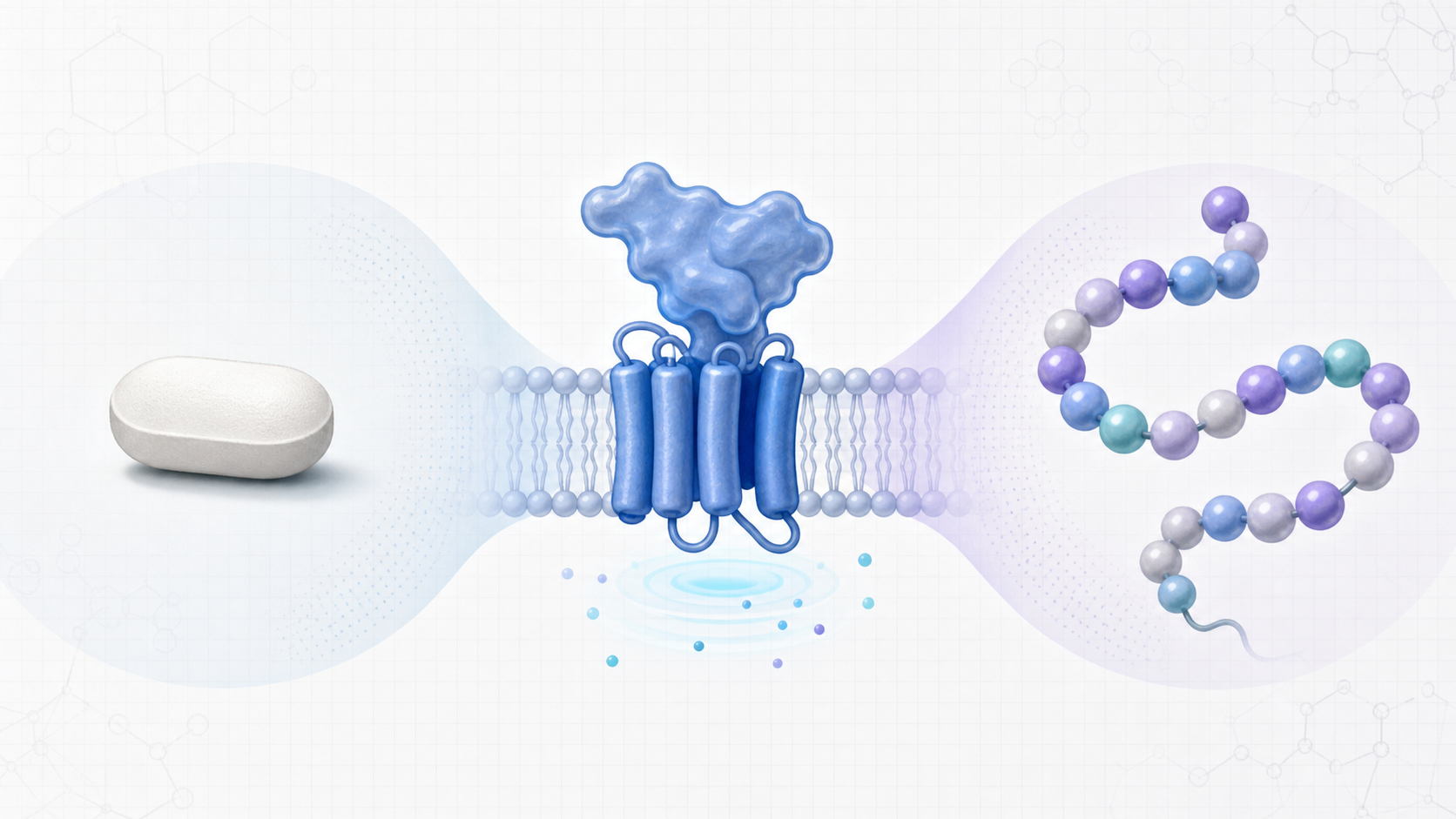
Orforglipron is easy to misclassify because it targets a peptide-related hormone pathway, but its molecule type is small-molecule and non-peptide.
Quick Answer: Is Orforglipron a Peptide?
Orforglipron is not a peptide. It is a synthetic, orally available, non-peptide small molecule that activates the human GLP-1 receptor.
The short version:
| Question | Answer | |---|---| | Is orforglipron a peptide? | No. It is a non-peptide small molecule. | | Is it related to GLP-1 biology? | Yes. It is a GLP-1 receptor agonist. | | Is Foundayo approved in the U.S.? | Yes. FDA records list Foundayo, active ingredient orforglipron, approved on April 1, 2026. | | Is this the same category as research peptides? | No. An FDA-approved drug is not the same evidence or regulatory category as a research peptide sold online. |
The cleanest classification is: orforglipron is an approved oral non-peptide GLP-1 receptor agonist, not a peptide supplement, injectable research peptide, or gray-market GLP-1 product.
Why People Confuse Orforglipron With Peptides
People confuse orforglipron with peptides because the name GLP-1 literally stands for glucagon-like peptide-1. Native GLP-1 is a peptide hormone, and several well-known GLP-1 medicines are peptide-based or peptide-like drugs.
That creates a sloppy shortcut online: if a drug acts on the GLP-1 receptor, people assume it must be a peptide. Orforglipron breaks that shortcut. It is designed as a small molecule that can be taken orally while still activating the GLP-1 receptor.
The difference is less about the marketing label and more about molecular design:
- Peptides are chains of amino acids. Many are fragile in the digestive system and often need injection or special delivery approaches.
- Small molecules are usually much smaller chemical compounds. Some can be formulated as conventional oral tablets.
- GLP-1 receptor agonist describes receptor activity, not whether the compound is a peptide.
So the phrase “oral GLP-1 pill” does not automatically mean “oral peptide.” It means the drug is taken by mouth and acts on the GLP-1 receptor.
What Foundayo Approval Does and Does Not Mean
Foundayo’s FDA approval means orforglipron went through the drug-review pathway for a specific labeled use. FDA’s 2026 novel drug approvals list shows Foundayo, active ingredient orforglipron, approved on April 1, 2026. FDA’s announcement describes it as approved for use with diet and physical activity to reduce excess body weight and maintain weight reduction long term in adults with obesity or adults with overweight and at least one weight-related comorbid condition.
That is very different from a research peptide listing on a vendor site. Research peptides are often sold with disclaimers, limited public clinical evidence for consumer claims, unclear quality controls, and no FDA approval for the promoted use.
Approval does not mean a drug is risk-free, appropriate for everyone, or interchangeable with other GLP-1 medicines. It means regulators reviewed a specific product, evidence package, labeling, manufacturing controls, warnings, and intended use. That is a much higher and more specific standard than “people are discussing it online.”
Orforglipron vs Peptide GLP-1 Drugs
Orforglipron and peptide GLP-1 drugs can share a receptor target while being chemically different. That is the piece most articles blur.
Semaglutide and liraglutide are peptide-based GLP-1 receptor agonists. Tirzepatide is also peptide-based, although it targets both GIP and GLP-1 receptors. Orforglipron is different because it is a non-peptide small molecule.
| Category | Example | Peptide? | Main point | |---|---:|---:|---| | Native hormone | GLP-1 | Yes | A peptide hormone involved in glucose and appetite signaling. | | Peptide-based GLP-1 drug | Semaglutide | Yes | Modified peptide drug acting at the GLP-1 receptor. | | Dual incretin peptide drug | Tirzepatide | Yes | Peptide-based GIP/GLP-1 receptor agonist. | | Oral small-molecule GLP-1 drug | Orforglipron | No | Non-peptide molecule that activates the GLP-1 receptor. | | Research peptide | BPC-157, TB-500 discussions | Usually yes | Not comparable to an FDA-approved GLP-1 medicine by default. |
The practical takeaway for classification is simple: same receptor family does not mean same molecule class. A key does not have to be made from the same material as the original key to fit a lock. Biology loves making the naming system just annoying enough to keep everyone employed.
How Orforglipron Works at a High Level
At a high level, Foundayo labeling describes orforglipron as a GLP-1 receptor agonist that binds to and activates the human GLP-1 receptor. GLP-1 receptors are involved in appetite and caloric intake regulation, including brain regions that influence appetite.
That mechanism explains why it sits in the GLP-1 drug category. It does not make the molecule a peptide.
For a peptide education site, the useful distinction is:
- Pathway: GLP-1 signaling.
- Receptor target: GLP-1 receptor.
- Molecule class: non-peptide small molecule.
- Regulatory lane: FDA-approved drug product, not a research peptide.
This is also why orforglipron is a good example for readers learning how to evaluate peptide-adjacent claims. A compound can be biologically connected to a peptide hormone pathway without being a peptide itself.
Why Approval Status Differs From Research Peptides
The biggest mistake is treating “approved GLP-1 medicine,” “compounded GLP-1 product,” and “research peptide” as one marketplace category. They are not the same thing.
An FDA-approved drug has a specific active ingredient, product label, manufacturing framework, safety warnings, and approved indication. A research peptide may be discussed in animal studies, cell studies, preclinical work, or uncontrolled anecdotes without being approved for consumer use. Some online products also use peptide language loosely to make a compound sound more established than it is.
This is why PeptideBase separates classification from hype:
- Read peptide therapy explained for the difference between approved medicines, clinic marketing, and research compounds.
- Read peptide side effects for why side-effect claims vary by exact compound and product status.
- Read how to evaluate peptide claims online before trusting vendor-style mechanism claims.
- Read peptide research status explained for the gap between preclinical interest and approved medical use.
The classification question is not a trivia point. It changes how carefully you should read claims, what evidence standard applies, and whether the product belongs in a regulated-drug discussion or a research-peptide discussion.
What Not to Infer From “Oral GLP-1”
“Oral GLP-1” is useful shorthand, but it can mislead readers if it gets stretched too far.
Do not infer that:
- orforglipron is a peptide because GLP-1 is a peptide hormone;
- every oral GLP-1 product has the same chemistry;
- approval for one product validates research peptides or gray-market products;
- an oral GLP-1 pill is appropriate for every person interested in weight loss;
- online access, clinic marketing, or social media attention proves safety or legality.
Those are separate questions. Chemistry, receptor activity, approval status, personal medical appropriateness, and product quality all need their own evidence.
Bottom Line
Orforglipron is best understood as an oral non-peptide small-molecule GLP-1 receptor agonist. It is peptide-adjacent because it acts on a receptor named after a peptide hormone, and because many GLP-1 drugs are peptide-based. But orforglipron itself is not a peptide.
The FDA-approved Foundayo product also should not be lumped together with research peptides. Approval status, labeling, evidence review, and manufacturing controls put it in a different category from compounds marketed online for “research” or wellness use.
For readers, the safest classification habit is to ask four questions every time: What is the exact molecule? What receptor or pathway does it affect? What evidence supports the claim? And what is its actual regulatory status?
FAQ
Is Foundayo the same thing as orforglipron?
Foundayo is the U.S. brand name for tablets containing orforglipron as the active ingredient.
Is orforglipron a GLP-1?
Orforglipron is a GLP-1 receptor agonist. It is not the native GLP-1 hormone itself.
Is orforglipron a research peptide?
No. Foundayo/orforglipron is listed by FDA as an approved drug product. That is different from a research peptide sold without FDA approval for a consumer medical use.
Why is orforglipron oral if many peptide GLP-1 drugs are injectable?
A major reason is molecule class. Orforglipron is a small molecule rather than a peptide chain, which helps explain why it can be developed as an oral tablet. That does not mean all oral GLP-1 drugs work the same way.
Does this article explain how to take or switch to orforglipron?
No. This article is only about classification, evidence boundaries, and regulatory status. Personal treatment decisions belong with a qualified healthcare professional.