What Is GHK-Cu? Copper Peptide Benefits, Skin Claims, Hair Growth, and Evidence
GHK-Cu is a copper-binding form of the naturally occurring tripeptide GHK: glycyl-L-histidyl-L-lysine. In plain English, it is a very small peptide that can bind copper ions, which is why it shows up in skin-care marketing as "copper peptide." The legitimate science is interesting. The internet version is, as usual, wearing a lab coat it bought on Amazon.
Quick answer: GHK-Cu has a plausible biological basis for skin-related claims because it has been studied in wound-healing, extracellular-matrix, collagen, and skin-permeation contexts. The strongest consumer-facing use case is topical cosmetic skin care, where the claim is usually support for appearance, firmness, texture, or aging-related skin changes. Hair-growth claims exist, but the evidence is thinner and easier to overstate. Injection claims are the least appropriate place to get casual advice from the internet: they raise sterility, route, safety, and regulatory questions this article will not turn into a protocol.
This is an educational evidence guide, not medical advice, not a treatment recommendation, and not a usage guide. It does not provide dosing, injection instructions, sourcing advice, or product recommendations.
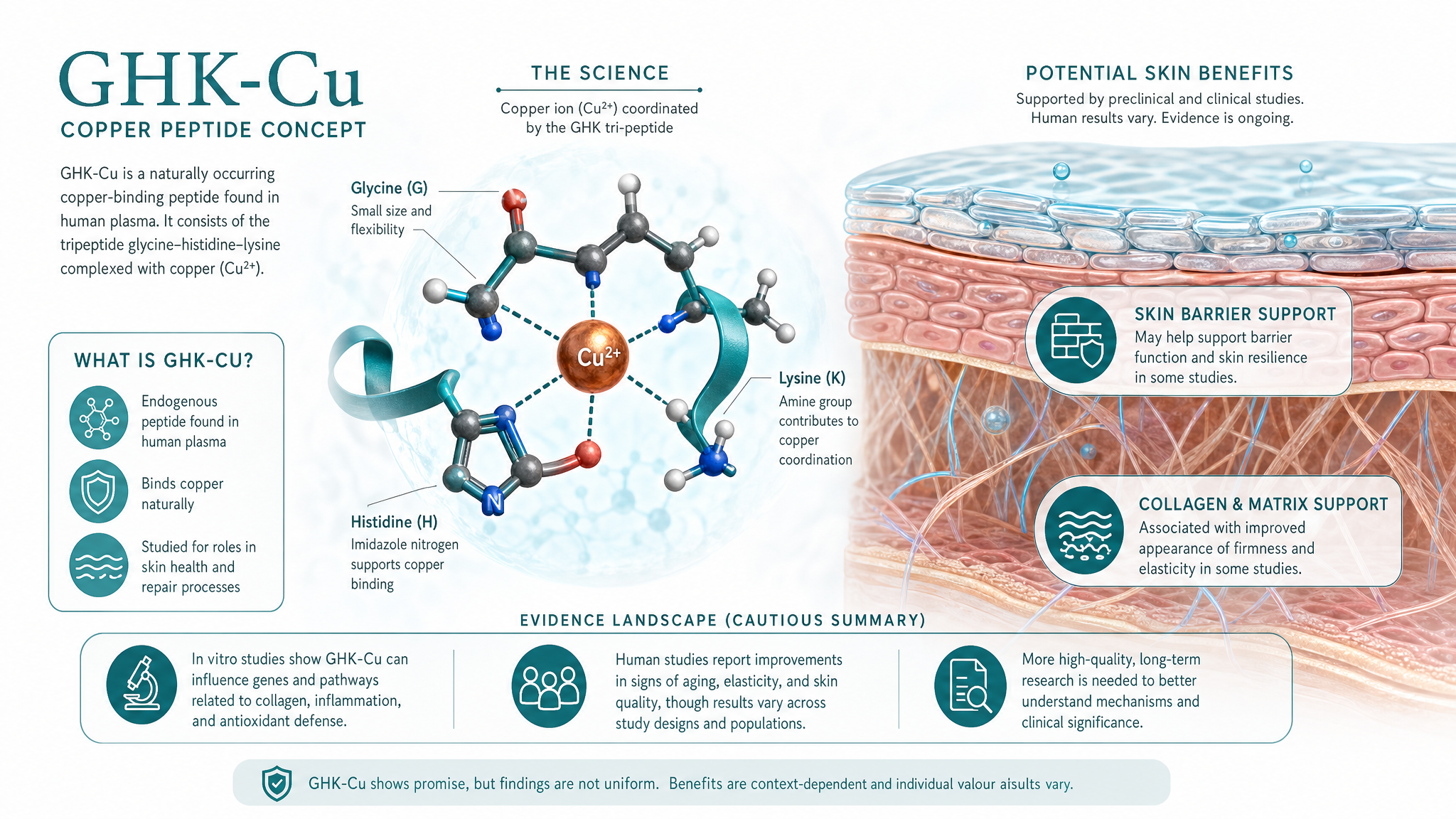 GHK-Cu has a real scientific backstory, but the confidence level changes depending on whether the claim is topical skin appearance, wound biology, hair growth, or broader systemic speculation.
What is GHK-Cu?
GHK-Cu refers to a complex formed when the tripeptide GHK binds copper. GHK itself is made from three amino acids: glycine, histidine, and lysine. The "Cu" part refers to copper, usually discussed as copper(II) in the scientific literature.
The reason GHK-Cu became famous is that it sits at a convenient crossroads: small peptide chemistry, copper biology, wound repair research, cosmetic skin-care claims, and anti-aging marketing. That combination is catnip for supplement forums and skin-care companies. Add the word "peptide" and suddenly everyone is speaking fluent PubMed with a TikTok accent.
The more sober view is this: GHK-Cu is a biologically active copper-peptide complex with evidence suggesting effects on wound-related extracellular matrix accumulation, collagen-related processes, dermal fibroblast biology, and skin-barrier/permeation questions. That does not automatically mean every serum, cream, before-and-after photo, or injection story is proven.
What is GHK-Cu usually claimed to do?
GHK-Cu is usually discussed around four buckets of claims:
- topical skin appearance claims, including firmness, wrinkles, texture, elasticity, and barrier support
- wound-healing and extracellular-matrix biology
- hair-growth or hair-thickness claims
- broader systemic, anti-aging, anti-inflammatory, or regenerative claims
The first two buckets have the most coherent scientific basis. The third bucket is plausible but less settled. The fourth bucket is where people often leap from mechanism to miracle. Mechanisms are not outcomes. Cells doing something interesting in a lab are not the same thing as a predictable benefit in a person.
For PeptideBase purposes, the cleanest classification is: GHK-Cu is a copper-binding peptide with cosmetic and wound-biology relevance, but many consumer claims run ahead of human outcome evidence.
How strong is the evidence for skin benefits?
The skin evidence is the most defensible part of the GHK-Cu conversation, but it still needs careful wording. GHK-Cu is widely discussed in relation to collagen, elastin, glycosaminoglycans, dermal fibroblast function, skin-barrier proteins, and appearance-related outcomes such as firmness and fine lines.
A frequently cited animal wound model found that GHK-Cu increased extracellular matrix accumulation in rat wound chambers, including increases in dry weight, DNA, total protein, collagen, and glycosaminoglycans. That is meaningful wound-biology evidence, but it is not the same thing as proving that a consumer serum will reverse aging skin in a predictable way.
Our review of a frog-peptide wound study provides another example of why promising repair biology in experimental models should not be translated directly into human treatment claims.
Review literature also describes GHK-Cu as supporting collagen, elastin, glycosaminoglycan synthesis, dermal fibroblast function, and tissue repair pathways. Those claims are mechanistically coherent, and they explain why GHK-Cu became popular in cosmetic products. The evidence is not nothing. It is just not a permission slip to write "clinically proven miracle molecule" on every blue bottle with a dropper.
Topical delivery is another issue. A 2025 review on liposomal GHK-Cu emphasized that GHK-Cu is fairly hydrophilic and has limited permeation through the lipophilic stratum corneum, while liposomal delivery may improve permeation potential. Translation: even when the ingredient is plausible, formulation matters. A molecule being interesting does not mean it automatically gets where marketing copy says it goes.
What about GHK-Cu and hair growth?
GHK-Cu hair-growth claims should be treated as plausible but not settled. You will see claims about hair follicle size, thickness, and growth support, and some review-level discussions include hair-related effects among the broader actions attributed to GHK-Cu.
The problem is confidence. Hair growth is a high-noise category. Genetics, hormones, inflammation, scalp health, medications, cosmetic practices, stress, nutrition, and baseline hair-loss pattern all change what "worked" appears to mean. Before-and-after photos are especially easy to abuse because lighting, hair length, wetness, angle, styling, and selection bias can do Olympic-level gymnastics.
So the fair answer is: GHK-Cu may have mechanistic and early evidence reasons to be studied for hair, and topical scalp products may market around that possibility. But hair-growth claims should not be treated as proven in the same way people talk about established medical treatments. If an article or product page jumps straight from "peptide involved in tissue repair pathways" to "regrows hair," your skepticism should clock in for work.
Topical GHK-Cu vs injection claims
Topical GHK-Cu and injectable GHK-Cu should not be treated as the same conversation.
Topical GHK-Cu belongs mostly in the cosmetic and dermatology-adjacent skin-care category. The practical questions are formulation, concentration transparency, irritation, compatibility with other actives, stability, and whether the product can deliver enough compound to relevant skin layers to matter.
Injection claims are different. Injection changes the safety conversation because it introduces sterility, route, systemic exposure, adverse event monitoring, product quality, and regulatory issues. This article does not provide injection instructions, injection schedules, dosing, sourcing guidance, or "how to use" advice. That is not a coy omission. It is the line between education and doing something dumb with confidence.
The evidence base people cite for GHK-Cu does not automatically validate casual self-injection. Animal wound models, cell studies, cosmetic formulation research, and review articles are not a personal protocol.
What are the possible side effects?
For topical GHK-Cu products, the most plausible side effects are local skin reactions: irritation, stinging, redness, dryness, itching, breakouts, or sensitivity when combined with other active ingredients. Any topical ingredient can bother some people, and copper-peptide products are no exception.
More serious concerns depend on context: compromised skin barrier, allergies, sensitive skin, aggressive stacking with acids/retinoids, contaminated products, or non-topical use. Injection use carries a different risk profile and should not be inferred from cosmetic topical experience.
A cautious side-effects summary looks like this:
- topical products may cause irritation or sensitivity in some users
- product formulation and other actives matter
- injection claims involve risks that topical skin-care discussions do not answer
- long-term safety claims should not be stronger than the evidence behind the exact route and formulation
- "natural peptide" does not mean "risk-free"
For a broader framework, see the PeptideBase side-effects pillar rather than treating any one peptide's marketing page as a safety review.
What evidence is stronger, weaker, or speculative?
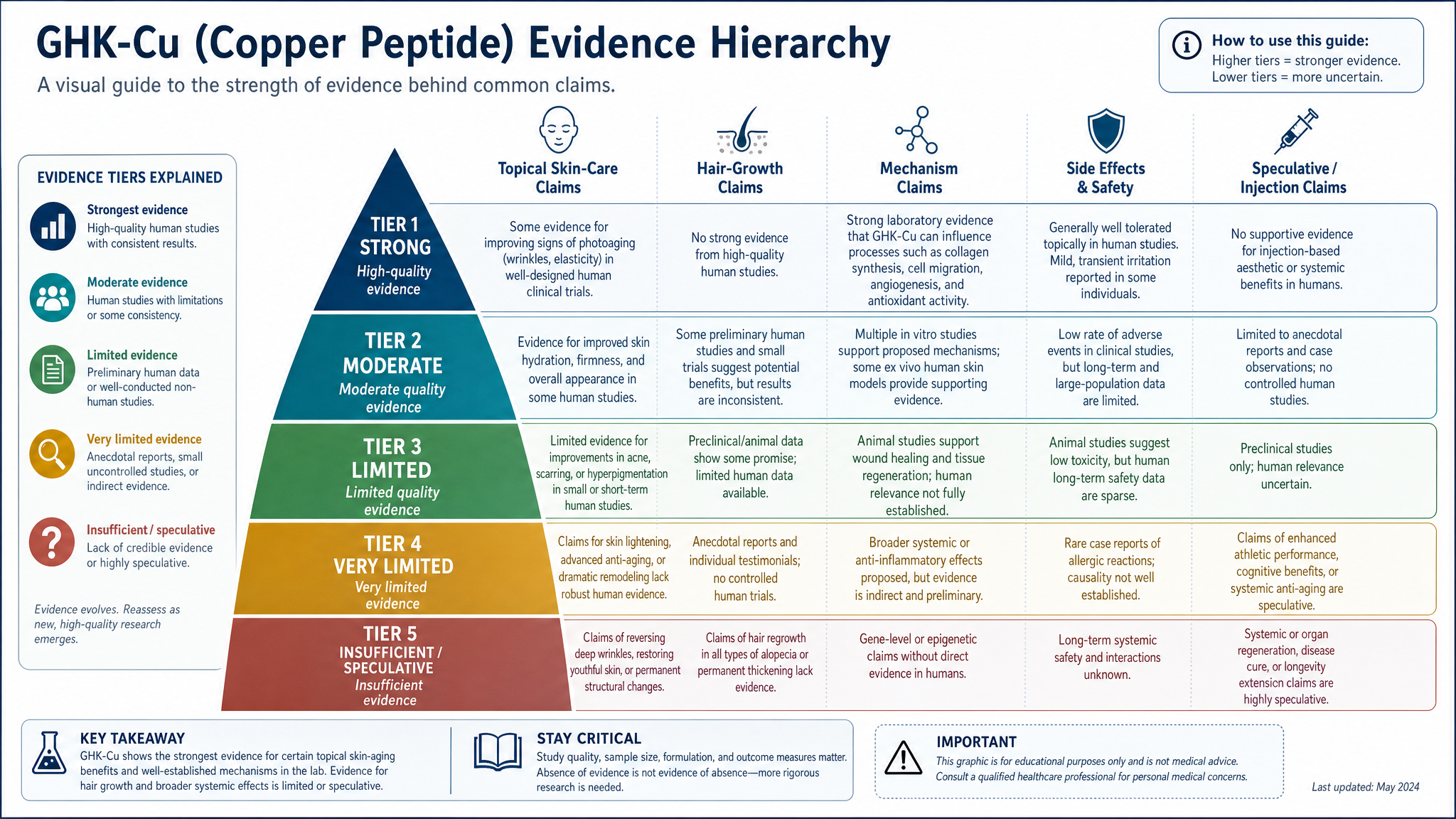 The confidence level changes by claim type: wound biology and skin mechanisms are stronger than broad anti-aging, hair-growth, or injection-based claims.
The strongest GHK-Cu evidence is not "everything works." It is narrower: GHK-Cu has credible biological activity and has been studied in wound and skin-related contexts.
Stronger evidence areas: wound-biology models, extracellular matrix accumulation, collagen-related pathways, skin-repair mechanisms, and formulation/permeation questions.
Moderate or cautious areas: cosmetic skin appearance claims, especially when tied to topical formulations. These are plausible, but the strength depends on product formulation, study quality, endpoints, and whether the claim is appearance-based rather than medical.
Weaker or more easily overstated areas: hair growth, dramatic before-and-after transformations, broad anti-aging language, and systemic "regeneration" claims.
Speculative or inappropriate for casual advice: injection protocols, disease treatment claims, systemic therapeutic use, and claims that GHK-Cu can diagnose, treat, cure, or prevent a medical condition.
That distinction matters because GHK-Cu is not fake science. It is real science surrounded by a lot of overconfident retail fog.
How should you interpret GHK-Cu before-and-after photos?
GHK-Cu before-and-after photos should be treated as anecdotes unless they come from a controlled, transparent study design. Skin and hair photos are especially easy to manipulate accidentally or intentionally.
For skin, lighting, hydration, makeup, camera angle, skin-care routine changes, retinoids, acids, sunscreen, sleep, and time of day can all change the result. For hair, styling, length, wetness, lighting, angle, scalp visibility, and selective posting can make weak results look dramatic.
A useful photo set should tell you:
- what exact product or intervention was used
- what else changed in the routine
- how long the observation lasted
- whether lighting and angles were standardized
- whether the person had a relevant baseline condition
- whether there were side effects or dropouts
- whether the outcome was independently measured
Most consumer before-and-after content does not meet that bar. It may be interesting. It is not proof.
Is GHK-Cu legal or approved?
GHK-Cu appears in cosmetic skin-care products, but that does not mean every GHK-Cu claim or route is approved. Cosmetic ingredients, research chemicals, compounded products, and injectable claims can fall into very different regulatory buckets depending on jurisdiction, route, intended use, labeling, and seller behavior.
A topical cosmetic product claiming to improve the appearance of skin is a different regulatory posture from a product marketed to treat disease, reverse hair loss medically, or produce systemic effects. Injection use changes the safety and regulatory questions again.
The safest educational framing is simple: evaluate GHK-Cu claims by product type, route, evidence, and jurisdiction. Do not assume that because one form appears in skin care, every form and claim is legitimate.
Who should be especially cautious?
Anyone with sensitive skin, active skin disease, a damaged skin barrier, allergy history, pregnancy or breastfeeding considerations, complex medical conditions, or current prescription skin treatments should be cautious and get qualified guidance before adding active products. That is not because GHK-Cu is uniquely scary. It is because biology does not care that a product has nice packaging.
People considering non-topical routes should be even more cautious. This article does not endorse that use or provide instructions. The evidence and safety questions are not answered by cosmetic serum marketing.
Bottom line
GHK-Cu is one of the more interesting cosmetic-adjacent peptides because it has a real biological story: copper binding, wound-biology research, extracellular matrix effects, collagen-related mechanisms, and skin formulation questions. Topical skin-care claims are the most reasonable consumer-facing area to discuss, provided the wording stays modest.
Hair-growth claims are more uncertain. Broad anti-aging and systemic regeneration claims should be treated carefully. Injection claims should not be converted into casual internet protocols.
The best way to understand GHK-Cu is not "miracle peptide" or "total hype." It is a biologically plausible copper peptide with meaningful skin and wound-repair research, limited certainty for many consumer claims, and a marketing ecosystem that often rounds uncertainty up to whatever sells best.
For more on evaluating peptide claims in general, see How to Evaluate Peptide Claims Online and What Preclinical Actually Means.
FAQ
What is GHK-Cu peptide?
GHK-Cu is a copper-binding complex of the tripeptide glycyl-L-histidyl-L-lysine. It is discussed in skin care, wound-biology research, collagen-related mechanisms, and some hair-growth claims.
Is GHK-Cu the same as copper peptide?
GHK-Cu is one of the best-known copper peptides. In consumer skin care, "copper peptide" often refers to GHK-Cu or related copper-binding peptide ingredients, but product labels should be checked carefully.
Does GHK-Cu help skin?
GHK-Cu has plausible and researched skin-related mechanisms, including extracellular matrix and collagen-related biology. Topical cosmetic benefits depend on formulation, delivery, study quality, and realistic appearance-based endpoints.
Does GHK-Cu regrow hair?
GHK-Cu hair-growth claims are less certain than many marketing pages imply. There are mechanistic reasons for interest, but strong consumer claims about regrowing hair should be treated cautiously unless backed by controlled human evidence.
Is topical GHK-Cu safer than injectable GHK-Cu?
Topical and injectable use are different safety conversations. Topical products mainly raise skin irritation and formulation questions. Injection claims raise sterility, route, systemic exposure, and regulatory concerns that this article does not convert into guidance.
What are GHK-Cu side effects?
Topical GHK-Cu products may cause irritation, redness, itching, dryness, breakouts, or sensitivity in some people. Non-topical use may carry different risks and should not be inferred from cosmetic skin-care experience.
Is GHK-Cu proven?
GHK-Cu is supported by real biological research, especially around wound and skin-related mechanisms, but not every consumer claim is proven. Confidence varies by claim, route, formulation, and outcome.