Did Semaglutide Extend Lifespan? What the Female-Mouse Ageing Study Actually Shows
Yes—in one experiment, semaglutide extended median lifespan in older female mice. It did not show that semaglutide extends human life. The September 2026 Nature study followed 39 control mice and 40 semaglutide-treated mice after treatment began at 20 months of age. Median lifespan was 742 days in controls and 834 days with semaglutide, a 92-day difference, and the survival curves differed by log-rank test (P = 5.7 × 10⁻⁶).
That is a meaningful animal result. It is also much narrower than “semaglutide is an anti-ageing drug.” The paper used only female mice from one inbred strain, treatment continued late in life, food intake fell by about 24%, and the calorie-restriction comparison was a separate five-month experiment that did not test lifespan.
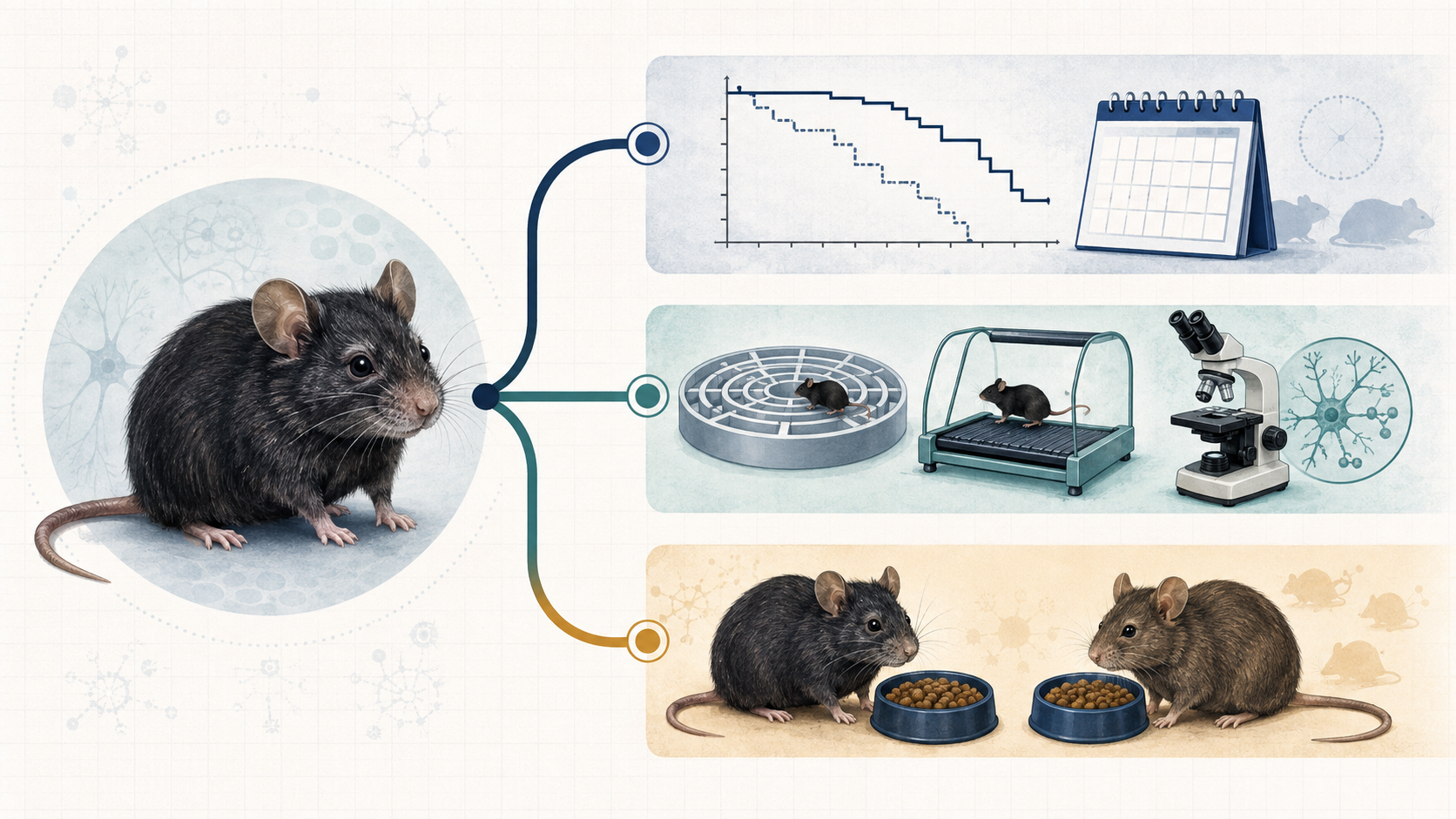
The paper combined three distinct experimental questions: survival until death, three-month physiological and molecular testing, and a five-month comparison with matched calorie restriction. Keeping those cohorts separate is essential.
Evidence boundary: This article explains an animal study. It does not provide medical, dosing, prescribing, weight-loss, longevity-treatment, purchasing, or self-experimentation advice.
Semaglutide lifespan mouse study: the short answer
The semaglutide lifespan mouse study found longer survival in treated aged female C57BL/6 mice, but it provides no direct evidence of lifespan extension in people.
The cleanest reading is:
- What was directly shown: median lifespan was 834 days in 40 treated mice versus 742 days in 39 controls.
- What else was measured: separate mice performed better on selected movement, memory, motor, muscle-endurance and glucose tests after three months.
- What may explain part of the result: treated mice ate roughly 24% less and lost mainly fat mass.
- What the paper did not show: that semaglutide slows human ageing, extends human lifespan, or works through a calorie-independent longevity mechanism.
The 92-day median difference is about 12.4% relative to the control median. That percentage describes these two mouse groups; it is not a forecast for people.
What did Feng and colleagues actually study?
Feng et al. used three related but separate experiments in naturally aged female mice. Treatment began when the mice were 20 months old, and the experiments answered different questions.
| Experiment | Groups and sample size | Duration | What it could show | |---|---:|---|---| | Lifespan cohort | Control: 39; semaglutide: 40 | Continued for the remaining lifespan | Whether survival distributions differed | | Physiological and molecular cohort | Functional tests generally used 10 controls and 10 treated mice; liver RNA sequencing used 5 per group | 3 months | Whether selected functions, tissues and molecular markers differed after treatment | | Calorie-restriction comparison | Control: 10; semaglutide: 10; 24% calorie restriction: 10 | 5 months, with assessments at baseline and after 2 and 4 months | How functional trajectories compared under matched food reduction—not lifespan |
All animals were female C57BL/6 mice. The authors said females were chosen to reduce the confounding effects of male aggression and injury. That design choice may improve consistency within the experiment, but it also means the result cannot tell us whether males would respond similarly.
The study reported random allocation and blinded collection and analysis except for the calorie-restricted group, whose feeding pattern made blinding impractical. Most experiments were repeated twice; the liver RNA-sequencing experiment was not, although the authors pointed to other assays as biological validation.
How strong was the lifespan result?
Within this mouse cohort, the survival difference was statistically strong. Translation beyond the cohort remains uncertain.
The survival analysis used a Kaplan–Meier curve and a log-rank test:
- control median lifespan: 742 days
- semaglutide median lifespan: 834 days
- absolute difference in medians: 92 days
- relative difference versus the control median: about 12.4%
- log-rank test: P = 5.7 × 10⁻⁶
- sample sizes: 39 controls and 40 treated mice
A small P value means the observed separation would be unlikely under the test's no-difference model. It does not measure how likely the finding is to reproduce in another strain, in males, under another feeding pattern, or in humans. Nor does it identify the biological cause of the survival difference.
The researchers also classified end-of-life findings. The distribution of endpoint categories did not significantly differ between groups. Age at death appeared delayed across several non-tumour categories, but those category-level observations were secondary and should not be mistaken for proof that one disease mechanism was prevented.
For a broader guide to this translation gap, see What Preclinical Actually Means in Peptide Research.
What improved in the separate three-month cohort?
After three months, treated mice performed better on several selected tests, but these were not measurements from the lifespan cohort. Most headline functional comparisons involved 10 mice per group.
Examples from Figure 1 include:
- more movement in the open-field test (P = 0.0028)
- more time in the target quadrant of the Barnes maze (P = 0.0052)
- shorter latency to find the escape hole (P = 0.0102)
- longer latency to fall on the rotarod (P = 0.0047)
- longer latency to fall from an inverted screen (P = 2.5 × 10⁻⁵)
- longer treadmill time and distance to exhaustion (both P = 0.0019)
- lower glucose-tolerance-test area under the curve (P = 6.3 × 10⁻⁶)
These tests probe different domains, including exploratory behaviour, spatial memory, motor coordination, grip-related performance, endurance and glucose handling. They do not combine into a validated single measure of “biological age.” Lower body weight can also affect physical testing, so the authors used analysis of covariance for the rotarod and inverted-screen results; both remained significant after adjustment for body weight.
The molecular work reported changes consistent with attenuation of several measured hallmarks of ageing: stem-cell dysfunction, inflammatory signalling, cellular senescence markers, DNA-damage markers, mitochondrial stress and loss of protein homeostasis. Liver RNA sequencing used five mice per group and defined differentially expressed genes with a Benjamini–Hochberg-adjusted P below 0.1. Those molecular results are mechanistic clues, not proof of whole-organism rejuvenation.
How much of the effect could be calorie restriction?
Reduced food intake is a major alternative explanation and cannot be cleanly separated from semaglutide in the lifespan experiment. Treated mice ate about 24% less than controls, lost weight and lost proportionally more fat.
A separate female-mouse study of GLP-1 weight loss and AgRP neurons examines one possible feeding-related mechanism, but it does not resolve what caused the lifespan difference in this experiment.
Calorie restriction can extend lifespan in some mouse studies, although its effects vary by sex, strain, age, diet and protocol. Because the lifespan cohort did not include a pair-fed or calorie-restricted survival group, this paper cannot determine how much of the 92-day median difference came from reduced intake and how much came from other GLP-1 receptor effects.
The paper's five-month comparison helps with function, not survival. Thirty different mice—10 per group—received control feeding, semaglutide or a 24% calorie-restricted diet. Both interventions produced comparable weight and fat loss, and both generally slowed decline on several tests.
The semaglutide and calorie-restricted groups also ate differently. Calorie-restricted mice consumed their allotment quickly and then fasted, whereas treated mice ate less without the same feeding rhythm. Equal calories do not necessarily create equal metabolic exposure.
Did semaglutide outperform calorie restriction?
On some exploratory, spatial-memory and glucose-control trajectories, yes; on many other measures, the two interventions were similar. This does not establish a distinct human anti-ageing mechanism.
In the five-month longitudinal comparison, semaglutide and calorie restriction had similar trajectories for total movement, rotarod performance, inverted-screen performance and treadmill endurance. Semaglutide showed more favourable trajectories than calorie restriction for:
- open-field centre time, an exploratory-behaviour measure (semaglutide versus calorie-restriction slope comparison, P = 0.0172)
- Barnes-maze target-quadrant time, a spatial-memory measure (P = 0.0298)
- glucose-tolerance-test area under the curve (P = 0.0116)
The analysis used mixed-effects models for longitudinal trajectories, with adjusted pairwise comparisons of slopes. Each arm contained only 10 mice, many outcomes were examined, and the measures are not interchangeable with disease prevention, independence, quality of life or lifespan.
So the defensible conclusion is modest: semaglutide appeared to do more than reproduce every consequence of eating 24% less in this particular model. The experiment does not establish which additional pathway mattered, whether the same pattern would repeat elsewhere, or whether it has any longevity relevance in humans.
What do the “hallmarks of ageing” findings mean?
They show that treatment shifted multiple measured markers in a direction the authors interpreted as more youthful; they do not prove that ageing was globally reversed.
The paper connected semaglutide with changes in NAD⁺, sirtuins, IGF-1, mTORC1-related signalling, AMPK-related signalling, inflammatory pathways, mitochondrial function and protein-stress responses. It also reported changes in blood-forming stem cells and hippocampal neurogenesis markers.
This breadth is scientifically interesting, but it creates an interpretation problem. When many tissues, markers and behavioural outcomes are tested, some findings may be sensitive to analysis choices or fail to reproduce. Several measures are also biologically related, so they should not be counted as dozens of independent confirmations.
Mechanism can explain why a result is plausible. It cannot turn an animal outcome into a human one. Our guide to How to Evaluate Peptide Claims Online explains why evidence tier matters more than mechanistic vocabulary.
Why this study does not prove semaglutide extends human lifespan
The human-longevity claim remains untested. Six limits should stay attached to every summary of this paper:
- It was an animal experiment. Mouse survival results often fail to translate quantitatively—or at all—to people.
- It used one inbred strain. C57BL/6 mice reduce genetic variability but do not represent the diversity of mice, much less humans.
- Only females were studied. The experiment provides no direct result for male mice.
- Treatment began late and continued. The survival cohort received ongoing intervention from 20 months of age until death; it did not test brief exposure or durability after stopping.
- Food intake changed substantially. The lifespan design cannot isolate reduced calories from other drug effects.
- Many outcomes were exploratory. Selected functional and molecular signals need independent replication across sex, strain, laboratory and design.
There is also a disclosed competing interest: The Regents of the University of California filed patent application 64/113,481 on GLP-1 receptor agonists for healthy ageing. A patent disclosure does not invalidate the data. It does matter when assessing incentives and why independent replication is valuable.
Semaglutide already has substantial human evidence for specific approved medical uses and outcomes, but that evidence is not a human lifespan trial. GLP-1 Peptides vs “Research Peptides” explains why a regulated medicine's established uses should not be blurred with new, unproven longevity claims.
What evidence would move the claim forward?
Replication should come before broad anti-ageing conclusions. Useful next steps would include:
- repeating the lifespan experiment in male mice and genetically diverse mice
- including a pair-fed or matched calorie-restriction lifespan arm
- preregistering primary outcomes and analysis plans
- reproducing the work in independent laboratories
- testing whether benefits persist after treatment ends
- establishing which effects depend on weight loss, food intake or GLP-1 receptor signalling in specific tissues
- conducting long-term human studies designed around ageing-related outcomes rather than borrowing conclusions from trials built for other purposes
Even human biomarker improvement would not equal proof of longer life. A human lifespan claim needs human outcome evidence.
Frequently asked questions
Did semaglutide make mice live 12% longer?
The treated group's median lifespan was about 12.4% longer than the control median: 834 versus 742 days. That describes a relative difference between two groups of older female C57BL/6 mice. It is not a human estimate.
Did calorie restriction produce the same lifespan result?
No calorie-restriction lifespan arm was included. The matched 24% calorie-restriction group was part of a separate five-month experiment comparing functional trajectories in 10 mice per group.
Did the study show that semaglutide reverses ageing?
No. It found longer survival and favourable changes in selected functions and ageing-related markers in mice. “Reverses ageing” is broader than the evidence.
Were the lifespan and memory results measured in the same mice?
No. The 79-mouse lifespan cohort was separate from the three-month physiological and molecular cohort.
Does this paper support using semaglutide for longevity?
No. It is preclinical evidence from one female mouse strain, not a human longevity trial or treatment recommendation.
Bottom line
Feng et al. reported a real and statistically strong lifespan extension in one cohort of older female mice: 834 versus 742 median days. The same paper also found better selected functional and molecular outcomes in separate cohorts. But semaglutide reduced food intake by about 24%, the matched calorie-restriction experiment did not measure lifespan, and no human longevity effect was tested.
The study earns scientific attention. It does not earn a human anti-ageing claim.
Primary source
Feng Y, Barthez M, Wang Y, et al. Late-life semaglutide treatment slows ageing and extends lifespan in female mice. Nature. Published September 2, 2026. Open access under CC BY 4.0.
This article is for general education and evidence literacy. It is not medical advice and does not recommend semaglutide or any longevity intervention.