How Might Semaglutide Protect the Kidney? What the REMODEL Trial Found—and Missed
The REMODEL trial did not find significant differences in its coprimary kidney MRI outcomes: oxygenation, global perfusion, or T1-mapped tissue changes. It did find several favorable secondary and exploratory signals with semaglutide—including lower renal vascular resistance, a more stable cortical diffusion measure, lower albuminuria, less fat around and within the kidney, and altered gene expression in glomerular endothelial cells. Those results suggest several possible pathways. They do not prove that any one pathway causes kidney protection.
That distinction is the key to reading REMODEL. The 52-week randomized, quadruple-masked, placebo-controlled trial enrolled 106 adults with type 2 diabetes and chronic kidney disease. It was built to investigate how semaglutide might affect the kidney, not to establish whether it prevents kidney failure. The larger FLOW trial addressed clinical outcomes; REMODEL examined imaging, urine, biopsy, and molecular clues.
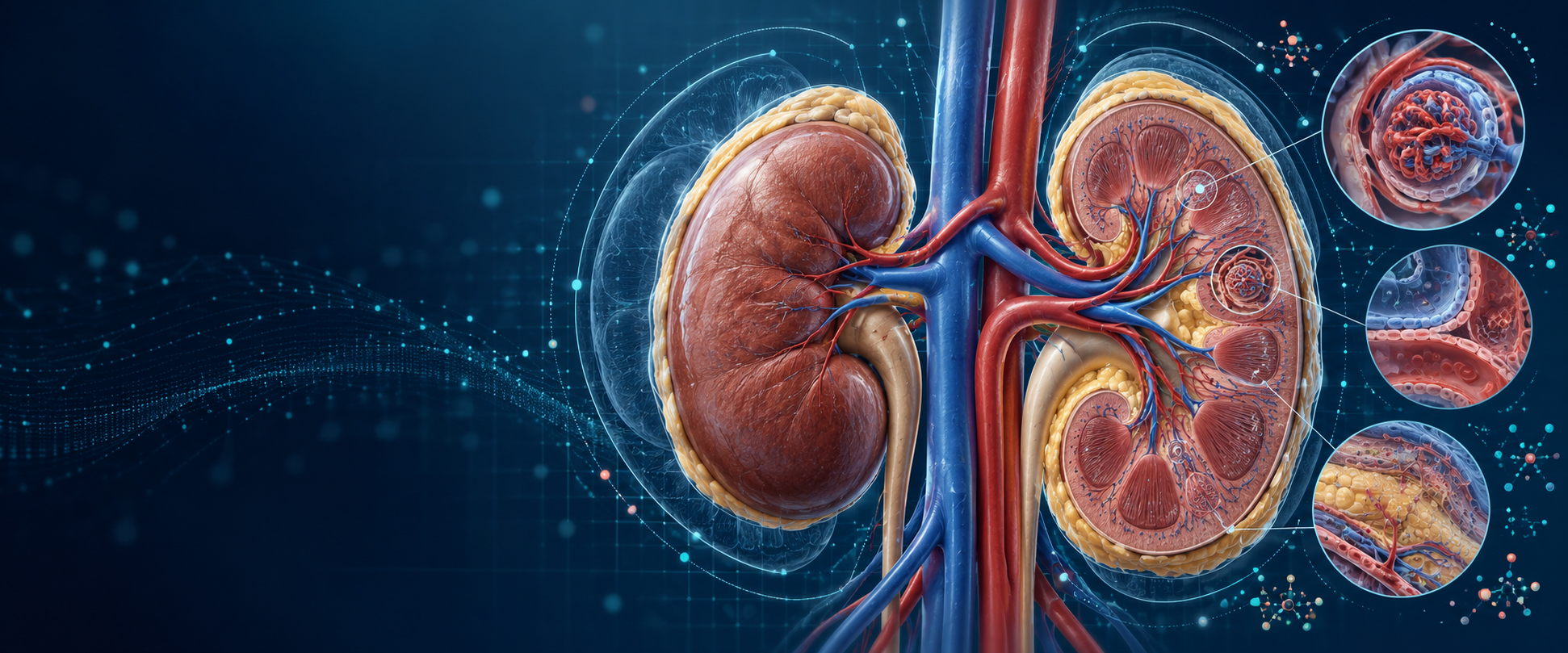
REMODEL measured several possible pieces of kidney protection—vascular resistance, tissue diffusion, albumin leakage, kidney fat, and cellular gene expression. Agreement among clues can strengthen a hypothesis, but it is not the same as proving a causal chain.
Evidence boundary: This article explains a clinical trial and its limits. It does not provide dosing, treatment selection, start/stop instructions, sourcing, purchasing, or individualized kidney-care advice.
Semaglutide kidney protection mechanism: the short answer
REMODEL supports a multi-pathway hypothesis, not a settled semaglutide kidney protection mechanism. The most defensible summary is:
- The prespecified MRI targets were null. Five coprimary comparisons—cortical and medullary oxygenation, global kidney perfusion, and cortical and medullary T1 mapping—were not significantly different at 52 weeks.
- Several secondary measures favored semaglutide. Renal artery resistive index fell and cortical apparent diffusion coefficient was higher, a pattern compatible with lower vascular resistance and stabilization of diffusion changes associated with fibrosis.
- Several exploratory findings pointed the same way. Albuminuria and perirenal and sinus fat were lower, while tissue analyses suggested endothelial and immune-cell changes.
- Causation remains unresolved. The trial did not formally test mediation, directly measure GFR with a filtration tracer, or have large tissue subsets capable of validating one pathway.
The trial is valuable precisely because it narrows the search. It would be less valuable if its secondary findings were inflated into a mechanism the coprimary outcomes did not establish.
What did REMODEL test?
REMODEL was a small mechanistic trial with deep measurements, not a kidney-outcome trial. Between April 2021 and October 2023, investigators randomized 71 participants to semaglutide and 35 to placebo at 28 sites in eight countries. Participants were followed through 52 weeks of treatment plus follow-up.
At baseline, the mean age was 65.3 years, 25 of 106 participants (23.6%) were women, mean creatinine-based estimated GFR was 51.1 mL/min/1.73 m², and median urinary albumin-to-creatinine ratio (UACR) was 187.3 mg/g. Nearly everyone used renin–angiotensin-system inhibition (105/106), and 42/106 used an SGLT2 inhibitor.
The design combined:
- multiparametric MRI to assess oxygenation, perfusion, tissue characteristics, vascular resistance, diffusion, and kidney fat;
- standard and estimated kidney measures, including UACR, creatinine clearance, and eGFR;
- paired kidney biopsies in a voluntary 33-person subgroup; and
- single-nucleus RNA sequencing and spatial transcriptomics in smaller usable subsets.
That breadth is a strength. It also creates many chances to find nominally positive results, especially when the primary readouts are negative and no multiplicity adjustment is applied.
What happened to the coprimary MRI outcomes?
None of the five coprimary MRI comparisons reached statistical significance. The registry supplies the clearest numerical view of these treatment ratios and 95% confidence intervals:
| Coprimary comparison | Semaglutide vs placebo at week 52 | Interpretation | |---|---:|---| | Cortical oxygenation, BOLD MRI R2* | 0.98 (95% CI 0.96–1.01); P = 0.1333 | Numerically consistent with higher oxygenation, but compatible with no difference | | Medullary oxygenation, BOLD MRI R2* | 0.99 (0.94–1.03); P = 0.5619 | No significant difference | | Global kidney perfusion | 1.10 (0.98–1.24); P = 0.0958 | Numerically higher, but the interval crossed no difference | | Cortical T1 mapping | 1.00 (0.98–1.02); P = 0.8651 | No significant difference | | Medullary T1 mapping | 1.00 (0.98–1.02); P = 0.9335 | No significant difference |
R2* is an indirect marker influenced by deoxyhemoglobin and other physiological and technical factors. T1 mapping is also composite: inflammation, perfusion, and fibrosis can all affect it. A null result could mean no relevant effect, a modest effect the trial could not detect, competing signals inside the measure, or too much measurement variability. It cannot simply be relabeled as success because other outcomes looked favorable.
Which secondary and exploratory findings favored semaglutide?
The strongest mechanistic clues came from outcomes below the coprimary tier. These results deserve attention with their hierarchy attached.
Renal vascular resistance
The renal artery resistive index was lower with semaglutide: estimated treatment ratio 0.96 (95% CI 0.93–0.99; P = 0.008). The paper's figure reports 71 semaglutide and 34 placebo participants contributing to this analysis. A lower value is compatible with reduced resistance to blood flow within the renal arteries.
This is evidence of a hemodynamic signal. It does not show that the change mediated later kidney outcomes.
Cortical diffusion
Cortical apparent diffusion coefficient (ADC) was higher: ratio 1.05 (95% CI 1.01–1.09; P = 0.005), with 66 semaglutide and 32 placebo participants in the figure. Delta ADC also favored semaglutide, with an estimated difference of 61.49 (95% CI 11.40–111.58; P = 0.016).
Because fibrosis restricts water movement, the authors interpreted the pattern as stabilization or less progression of fibrotic architecture. “Compatible with” matters here: ADC is an imaging surrogate, not a direct measurement of collagen deposition or a clinical kidney event.
Albuminuria and estimated kidney function
UACR was 40% lower relative to placebo: ratio 0.60 (95% CI 0.41–0.88; P = 0.008). The paper reports 71 semaglutide and 35 placebo participants contributing to that modeled analysis.
Estimated GFR differences favored semaglutide numerically but crossed no difference: 3.4 mL/min/1.73 m² by creatinine (95% CI −0.2 to 6.9), 2.9 by creatinine–cystatin C (−0.2 to 6.1), and 2.3 by cystatin C (−0.4 to 5.0). Twenty-four-hour creatinine clearance, a secondary outcome, was 12 mL/min higher (95% CI 0.7–23.3; P = 0.038; figure denominator 67/34).
These are encouraging markers, but REMODEL did not directly measure GFR with iohexol or renal plasma flow with para-aminohippuric acid. It therefore cannot turn estimated or clearance-based differences into proof of a specific physiological mechanism.
Fat around and within the kidney
In a much smaller MRI subset, perirenal fat was 25% lower (ratio 0.75, 95% CI 0.58–0.97; P = 0.027) and renal sinus fat was 13% lower (0.87, 0.78–0.97; P = 0.012). The figure reports 22 semaglutide and 12 placebo participants.
Less local fat might reduce mechanical compression or adipose signaling around renal vessels. It might also reflect broader weight change. Because no mediation analysis tested whether kidney-fat change carried the effect on albuminuria, vascular resistance, or another outcome, it remains a plausible link rather than a demonstrated one.
What did the kidney biopsies and transcriptomics add?
The tissue work points most strongly toward glomerular endothelial remodeling, but its effective sample size was small. Thirty-three participants entered the biopsy subgroup: 22 assigned semaglutide and 11 placebo.
The paper reports 53 biopsy samples passing single-nucleus RNA-sequencing quality control, but treatment-response analysis depended on 22 paired participants—14 semaglutide and 8 placebo. Glomerular endothelial-cell populations were among the most responsive, with changes in genes related to metabolic stress, inflammation, fibrosis, cell adhesion, mitochondrial function, and related signaling networks. Importantly, pathway-enrichment analyses did not produce pathways meeting the prespecified multiple-testing threshold.
Spatial transcriptomics had 17 paired samples overall. The glomerular endothelial neighborhood analysis was a post hoc subset of 13 paired participants—8 semaglutide and 5 placebo—whose tissue sections contained glomeruli. It found fewer natural-killer/natural-killer-T cells near glomerular endothelial cells and changes in cell-interaction signals consistent with altered endothelial–immune communication.
These results make endothelial repair and reduced fibroinflammatory stress biologically plausible. They do not prove that endothelial transcriptional change caused lower albuminuria or any FLOW outcome. Small paired subsets, post hoc analyses, tissue-selection requirements, and multiple molecular comparisons all limit causal confidence.
Why missingness and differential completion matter
All 106 randomized participants entered the full analysis set, but not all outcomes had complete observed week-52 data. The registry reports that 58/71 semaglutide participants and 34/35 placebo participants completed the overall study—81.7% versus 97.1%. Thirteen semaglutide participants and one placebo participant did not complete it.
The paper's model-based figure denominators were 70/35 for cortical oxygenation, 65/33 for global perfusion, and 68/35 for T1 mapping. The registry's observed bilateral week-52 denominators were smaller: 58/33, 49/30, and 56/32, respectively. The analysis used multiple imputation under a missing-at-random assumption within actual treatment groups.
That approach is standard, but the assumption is still an assumption. When completion differs between groups and observed outcome counts shrink, the distinction between modeled estimates and directly observed measurements should be visible—not buried under a single “n = 106” headline.
What did the safety data show?
Serious adverse events occurred at similar rates, but permanent discontinuation because of adverse events was more frequent with semaglutide. Nine of 71 semaglutide participants (12.7%) permanently discontinued for an adverse event, compared with 1 of 35 placebo participants (2.9%).
In the biopsy subgroup, the corresponding counts were 3/22 (13.6%) and 0/11. The investigators reported no biopsy-related serious adverse events.
These data belong in the interpretation because tolerability can affect completion, missingness, and how closely trial estimates reflect continued treatment. They are not a basis for individual treatment decisions.
REMODEL is not FLOW
FLOW established clinical kidney-outcome evidence; REMODEL explored mechanisms. FLOW randomized 3,533 people with type 2 diabetes and chronic kidney disease and found a 24% relative reduction in its primary composite of major kidney events and cardiovascular or kidney death (hazard ratio 0.76, 95% CI 0.66–0.88).
REMODEL randomized 106 people and was not powered to retest that clinical endpoint. Its job was to ask which biological changes might sit between treatment and outcome. A mechanism trial cannot inherit causal certainty from a larger outcome trial for every pathway it measures.
The distinction also separates REMODEL from PeptideBase's analysis of SELECT and semaglutide's cardiovascular benefit. SELECT's later analysis statistically modeled possible mediators of a cardiovascular outcome. REMODEL prospectively randomized treatment and directly collected kidney imaging and tissue, but it still did not randomize the proposed pathways or formally test mediation. Different design, same warning: a plausible intermediate signal is not automatically the cause of the clinical benefit.
For a broader framework, see Peptide Research Status Explained and the Semaglutide database page.
Why REMODEL did not prove one kidney-protection pathway
Several limitations prevent a one-mechanism conclusion. The major ones are:
- The coprimary outcomes were null. The prespecified MRI targets did not distinguish semaglutide from placebo.
- Many later findings were secondary, exploratory, or post hoc. Nominal P values were reported without a single multiplicity-adjusted hierarchy across the clinical and imaging results.
- The biopsy subsets were small. Only 22 paired participants supported cell-type RNA treatment-response analysis, and the post hoc glomerular spatial analysis used 13 paired participants.
- No formal mediation analysis was performed. The trial did not test whether vascular resistance, kidney fat, ADC, albuminuria, or endothelial gene expression carried the treatment effect.
- GFR was not directly measured. eGFR and creatinine clearance are informative but do not replace tracer-measured filtration for this mechanistic question.
- Completion and observed-data availability differed. More semaglutide participants discontinued, and observed week-52 MRI denominators were lower than enrollment.
- The population was narrow. All participants had type 2 diabetes and CKD, and women were underrepresented.
The honest conclusion is not “nothing happened.” It is that several mutually compatible signals emerged without identifying which are causal, which are downstream consequences, which reflect weight or glycemic change, and which may be chance findings.
How should funding and conflicts be interpreted?
Industry funding does not erase the data, but it raises the value of transparent methods and independent replication. Novo Nordisk funded REMODEL. Multiple authors were current or former Novo Nordisk employees and shareholders, sponsor-affiliated authors participated in analysis and manuscript revision, and several academic authors reported consultancy, speaking, grant, or trial relationships with Novo Nordisk and other pharmaceutical companies.
The appropriate response is neither automatic dismissal nor automatic trust. It is to keep the prespecified null outcomes, nominal secondary analyses, missingness, and small molecular subsets in full view.
Bottom line
REMODEL suggests that semaglutide may affect several kidney systems at once—vascular resistance, tissue diffusion, albumin leakage, local fat, and glomerular endothelial biology. It did not prove a single semaglutide kidney protection mechanism.
FLOW provides the stronger clinical-outcome evidence. REMODEL adds a layered map of plausible pathways, with the important complication that its coprimary MRI outcomes were null and its most detailed tissue findings came from small subsets. The map is useful. It is not the territory.
Frequently asked questions
Did REMODEL prove that semaglutide improves kidney oxygenation?
No. Cortical and medullary BOLD MRI oxygenation comparisons were not statistically significant at 52 weeks.
Did REMODEL find better kidney perfusion?
Global kidney perfusion was numerically higher, but the treatment ratio of 1.10 had a 95% confidence interval of 0.98–1.24 and was not statistically significant.
What was the clearest favorable clinical marker?
Albuminuria was 40% lower relative to placebo, with a treatment ratio of 0.60 (95% CI 0.41–0.88). In REMODEL it was exploratory, so it should support—not replace—the larger clinical-outcome evidence.
Did the biopsy prove a direct endothelial effect?
No. Endothelial-cell gene-expression and neighborhood changes support that hypothesis, but the paired subsets were small and no mediation analysis connected them causally to clinical outcomes.
Was kidney function measured directly?
No. The trial used estimated GFR and 24-hour creatinine clearance, but it did not measure GFR with iohexol or renal plasma flow with para-aminohippuric acid.
Should REMODEL guide an individual's kidney treatment?
No. It is a mechanistic research study in a defined trial population. This article provides evidence literacy, not individualized medical advice.
Sources
- Tuttle KR, Bjornstad P, Smith C, et al. Effects of semaglutide on kidney disease in type 2 diabetes: a randomized placebo-controlled trial. Nature Medicine. Published October 1, 2026. Open access under CC BY-NC-ND 4.0.
- ClinicalTrials.gov record and posted results for REMODEL (NCT04865770). Results first posted January 14, 2026; last update posted February 10, 2026.
- Perkovic V, Tuttle KR, Rossing P, et al. Effects of Semaglutide on Chronic Kidney Disease in Patients with Type 2 Diabetes. New England Journal of Medicine. 2024;391:109–121.
This article is for general education and evidence literacy. It is not medical advice and does not recommend starting, stopping, changing, or selecting any treatment.