Peptides in Real Medicine: PRRT, Edotreotide, and Neuroendocrine Tumor Evidence
Peptide receptor radionuclide therapy is one of the clearest examples of peptides being used as serious medicine, not wellness marketing. In PRRT, a peptide-like targeting molecule binds receptors on certain tumors and carries a radioactive payload to cells that express those receptors.
That does not mean consumer peptide therapy claims should borrow oncology credibility. The COMPETE trial of [177Lu]Lu-edotreotide versus everolimus studied a narrow, disease-specific population: adults with advanced, unresectable, progressive, somatostatin receptor-positive gastroenteropancreatic neuroendocrine tumors, or GEP-NETs. It was a regulated phase 3 oncology trial, not evidence that peptide clinics, research-peptide vendors, or general wellness protocols work.
This article is educational only. It is not medical advice, treatment guidance, dosing guidance, sourcing advice, or a recommendation to use any medicine.
Quick answer: what does COMPETE show about peptide receptor radionuclide therapy?
The phase 3 COMPETE trial reported that [177Lu]Lu-edotreotide, an investigational peptide receptor radionuclide therapy, improved median progression-free survival compared with everolimus in advanced, progressive, grade 1 or grade 2 SSTR-positive GEP-NETs: 23.9 months versus 14.1 months. The reported hazard ratio was 0.67 with a 95% confidence interval of 0.48 to 0.95 and p=0.022.
The same trial also reported a higher centrally reviewed objective response rate with [177Lu]Lu-edotreotide: 22% versus 4%. Grade 3 or 4 treatment-related adverse events were reported less often in the [177Lu]Lu-edotreotide group than in the everolimus group: 18% versus 40%.
Those numbers matter because COMPETE was a randomized, multicenter, phase 3 comparison against an active therapy. They should still be read in context: the trial was open-label, the medicine was investigational at the time of publication, and the results apply to a specific oncology population.
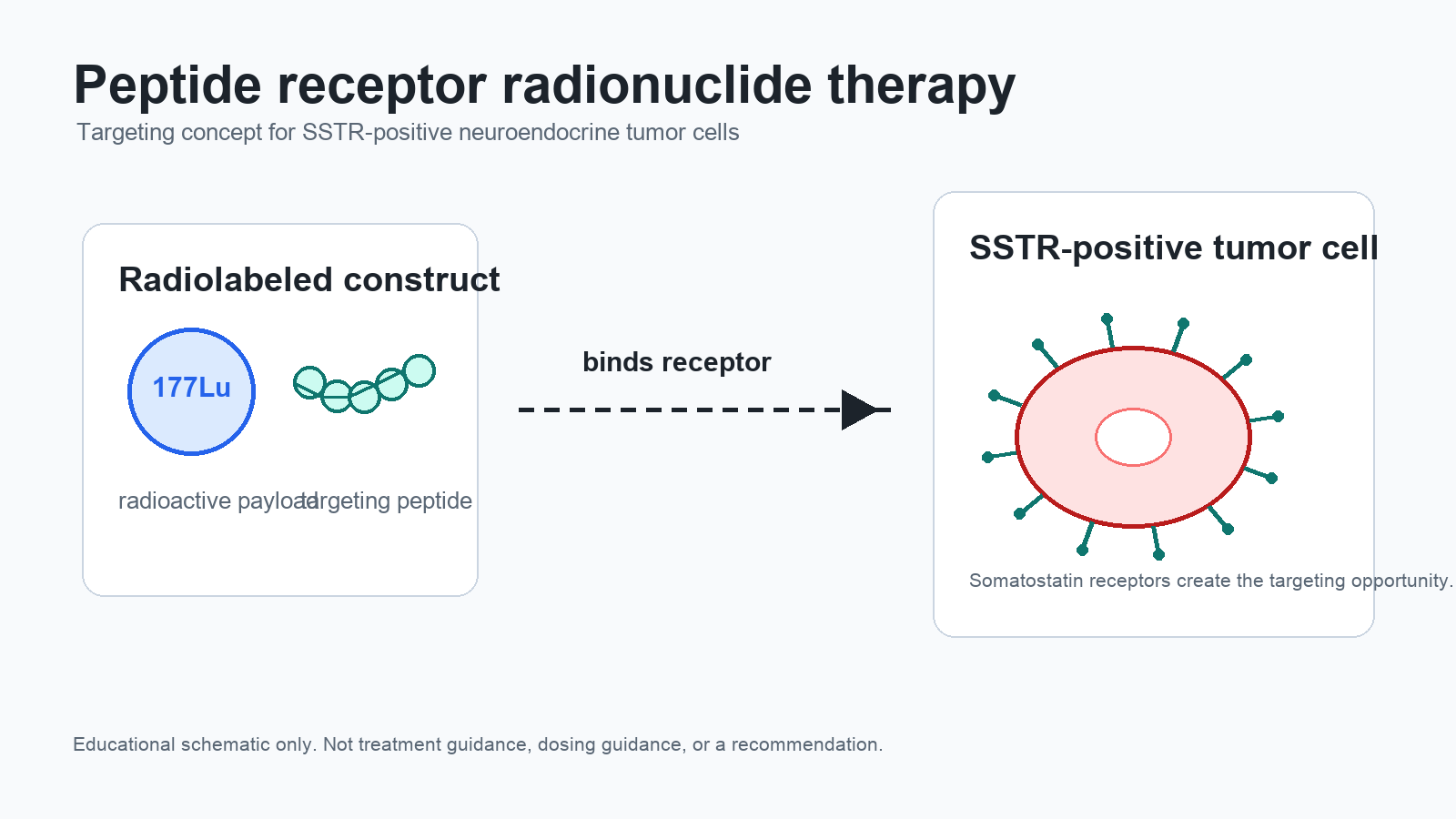
PRRT is a targeting strategy: the peptide component helps deliver the radioactive payload to cells expressing the relevant receptor.
What is peptide receptor radionuclide therapy?
Peptide receptor radionuclide therapy, or PRRT, is a form of targeted radiopharmaceutical treatment. It pairs a receptor-binding peptide or peptide-like molecule with a radioactive isotope. The targeting molecule is designed to bind receptors that are commonly expressed on certain tumor cells.
In neuroendocrine tumor care, the relevant target is often the somatostatin receptor, especially subtype 2. Many well-differentiated neuroendocrine tumors express somatostatin receptors, which is why somatostatin receptor imaging and PRRT can be clinically relevant in selected patients.
The phrase "peptide" is doing real work here, but not in the vague way it is often used online. In PRRT, the peptide is part of a regulated drug construct with a defined target, isotope, manufacturing process, clinical trial program, safety monitoring, and disease context.
What is edotreotide?
Edotreotide is a somatostatin analog used as the targeting component in certain radiopharmaceutical approaches. In [177Lu]Lu-edotreotide, edotreotide is linked to lutetium-177, a beta-emitting radioisotope.
The simplified idea is:
- edotreotide helps bind somatostatin receptors on eligible tumor cells
- lutetium-177 delivers localized radiation
- the therapeutic goal is to damage receptor-positive tumor cells while limiting broader exposure
That is still a high-risk oncology treatment concept, not a general wellness intervention. The same word "peptide" can describe a hormone drug, a diagnostic tracer, a targeted cancer therapy component, a cosmetic ingredient, or an unsupported research-chemical pitch. The category is too broad to carry evidence by association.
For the broader distinction, see Peptide Therapy Explained.
The COMPETE trial in plain English
COMPETE was a phase 3, multicenter, randomized, open-label superiority trial published in The Lancet in 2026. It compared [177Lu]Lu-edotreotide with everolimus in patients with advanced, unresectable, progressive, somatostatin receptor-positive GEP-NETs.
The trial enrolled 309 patients across 49 sites. Participants had grade 1 or grade 2 disease. A substantial share had pancreatic neuroendocrine tumors: 178 patients, or 57.6% of the enrolled population.
Patients were randomized 2:1. The [177Lu]Lu-edotreotide arm received treatment every three months for up to four cycles. The everolimus arm received daily therapy for up to 30 months. Somatostatin analogs were not mandatory, but investigators could use them for symptom control; about 21% of patients received concomitant SSA treatment during the study.
The primary endpoint was progression-free survival, meaning the time before the disease progressed or the patient died. This endpoint is common in oncology trials, but it should not be confused with cure, overall survival, or proof that every patient personally benefits.
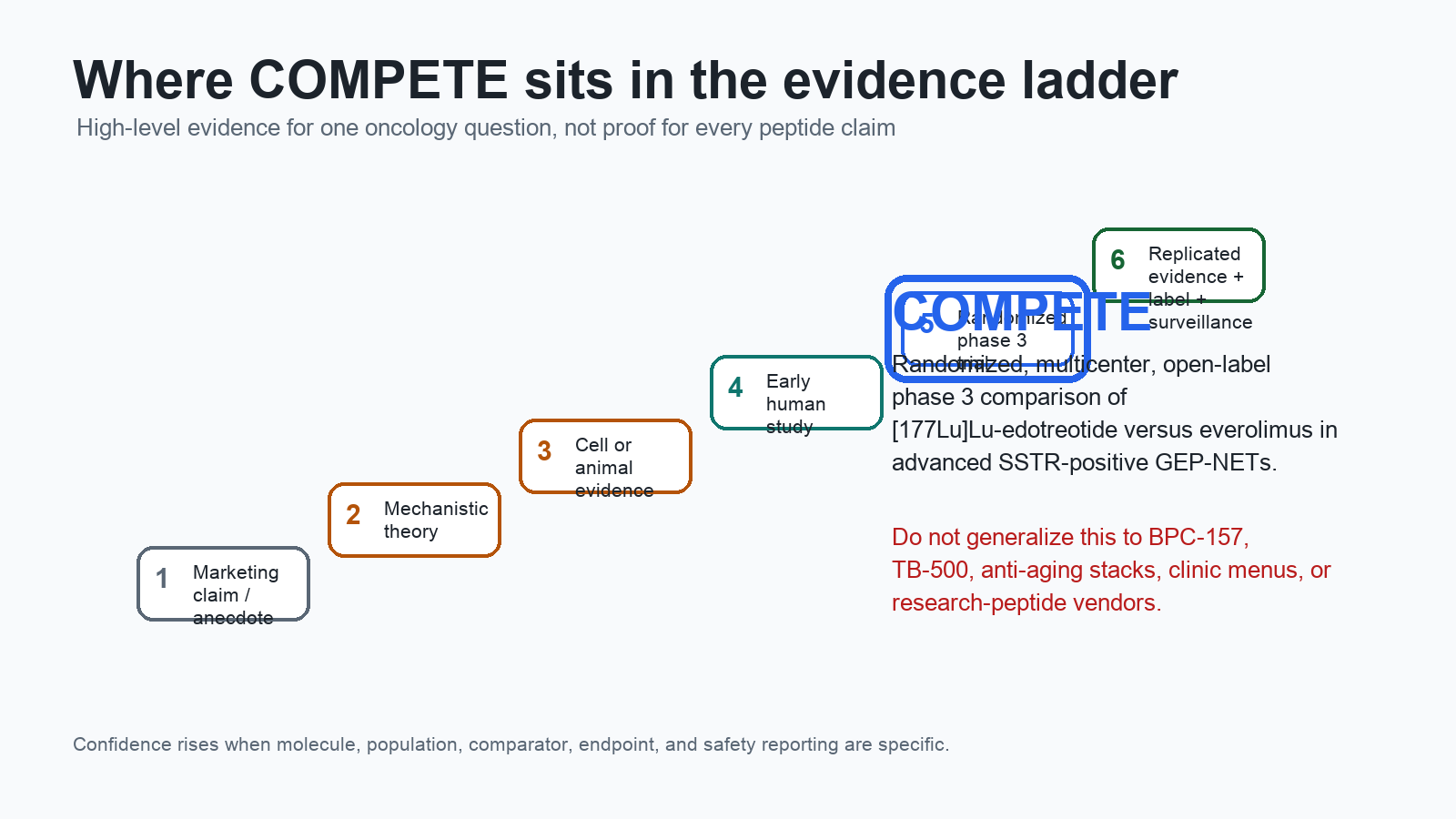
A phase 3 oncology trial can raise confidence for one defined clinical question without validating unrelated peptide marketing claims.
What the trial found
COMPETE reported a statistically significant improvement in progression-free survival for [177Lu]Lu-edotreotide compared with everolimus.
| Outcome | [177Lu]Lu-edotreotide | Everolimus | What it means |
|---|---|---|---|
| Median progression-free survival | 23.9 months | 14.1 months | Longer median time before progression or death in this trial population |
| Hazard ratio for PFS | 0.67 | Reference | Lower relative risk of progression or death during the study period |
| 95% confidence interval | 0.48 to 0.95 | Reference | The estimate favored [177Lu]Lu-edotreotide, but with uncertainty around the exact effect size |
| p-value | 0.022 | Reference | Statistically significant under conventional thresholds |
| Objective response rate | 22% | 4% | More patients had measurable tumor response by central review |
| Grade 3/4 treatment-related adverse events | 18% | 40% | Severe or medically significant treatment-related events were reported less often in the PRRT arm |
The most common treatment-related adverse events reported with [177Lu]Lu-edotreotide were diarrhea and nausea, both 36%, and asthenia, 33%. In the everolimus arm, common treatment-related adverse events included diarrhea, 45%, asthenia, 36%, and anemia, 27%.
These are sober trial findings. They are not a green light for casual peptide use, self-treatment, protocol copying, or vendor claims. A trial can support a medicine in a defined disease setting while telling us nothing about most peptide products sold into wellness markets.
Why the open-label design matters
Open-label means patients and investigators knew which treatment was assigned. That does not automatically invalidate a trial, especially when endpoints are reviewed centrally and objective imaging outcomes are involved. But it does matter.
Open-label designs can influence symptom reporting, adverse-event attribution, discontinuation behavior, expectations, and clinical decision-making. In oncology, blinding can also be difficult or impractical when treatments differ substantially in administration, monitoring, and side-effect profile.
The right interpretation is balanced: COMPETE provides important randomized phase 3 evidence, but readers should still notice the open-label design, endpoint selection, comparator choice, follow-up duration, and whether overall survival data are mature.
For a broader framework on trial stages and evidence strength, see Peptide Research Status Explained.
Why this is real peptide medicine, not wellness peptide marketing
The COMPETE trial is useful partly because it shows what serious evidence looks like. It had a named drug construct, a defined patient population, an active comparator, trial registration, prespecified outcomes, adverse-event reporting, and publication in a major peer-reviewed journal.
Most wellness peptide claims do not look like that. They often rely on:
- mechanistic theory presented as outcome proof
- animal or cell studies stretched into human claims
- testimonials
- clinic blog posts
- vendor pages
- broad claims like "recovery," "anti-aging," or "optimization" without disease-specific evidence
That contrast is the whole lesson. Regulated peptide-based medicines can be real, powerful, and clinically important. Unsupported peptide marketing can still be weak, exaggerated, or unsafe.
The evidence belongs to the exact compound, route, population, comparator, endpoint, and clinical context studied. It does not float around the entire peptide category like free Wi-Fi.
What PRRT evidence does and does not generalize to
PRRT evidence can generalize cautiously within related medical questions: somatostatin receptor-positive neuroendocrine tumors, radiopharmaceutical targeting, sequencing against other systemic therapies, safety monitoring, and oncology trial design.
It does not generalize to:
- BPC-157 recovery claims
- TB-500 injury claims
- cosmetic peptide products
- research-only peptides sold online
- clinic "peptide therapy" menus
- anti-aging peptide stacks
- dosing protocols shared in forums
- claims that peptides diagnose, treat, cure, or prevent disease outside their studied indication
That boundary is not nitpicking. It is the difference between evidence literacy and category laundering.
How readers should evaluate peptide medicine claims after COMPETE
The COMPETE trial gives readers a practical checklist for peptide claims:
- What exact molecule was studied? A peptide name alone is not enough; formulation, isotope, route, and product quality matter.
- Who was studied? Advanced SSTR-positive GEP-NETs are not the same as healthy adults seeking wellness optimization.
- What was the comparator? COMPETE compared against everolimus, an active systemic therapy, not placebo or anecdote.
- What endpoint changed? Progression-free survival and objective response are oncology endpoints, not general vitality outcomes.
- What harms were tracked? Serious evidence includes adverse-event reporting, not just benefit claims.
- What are the limitations? Open-label design, immature long-term outcomes, and investigational status still matter.
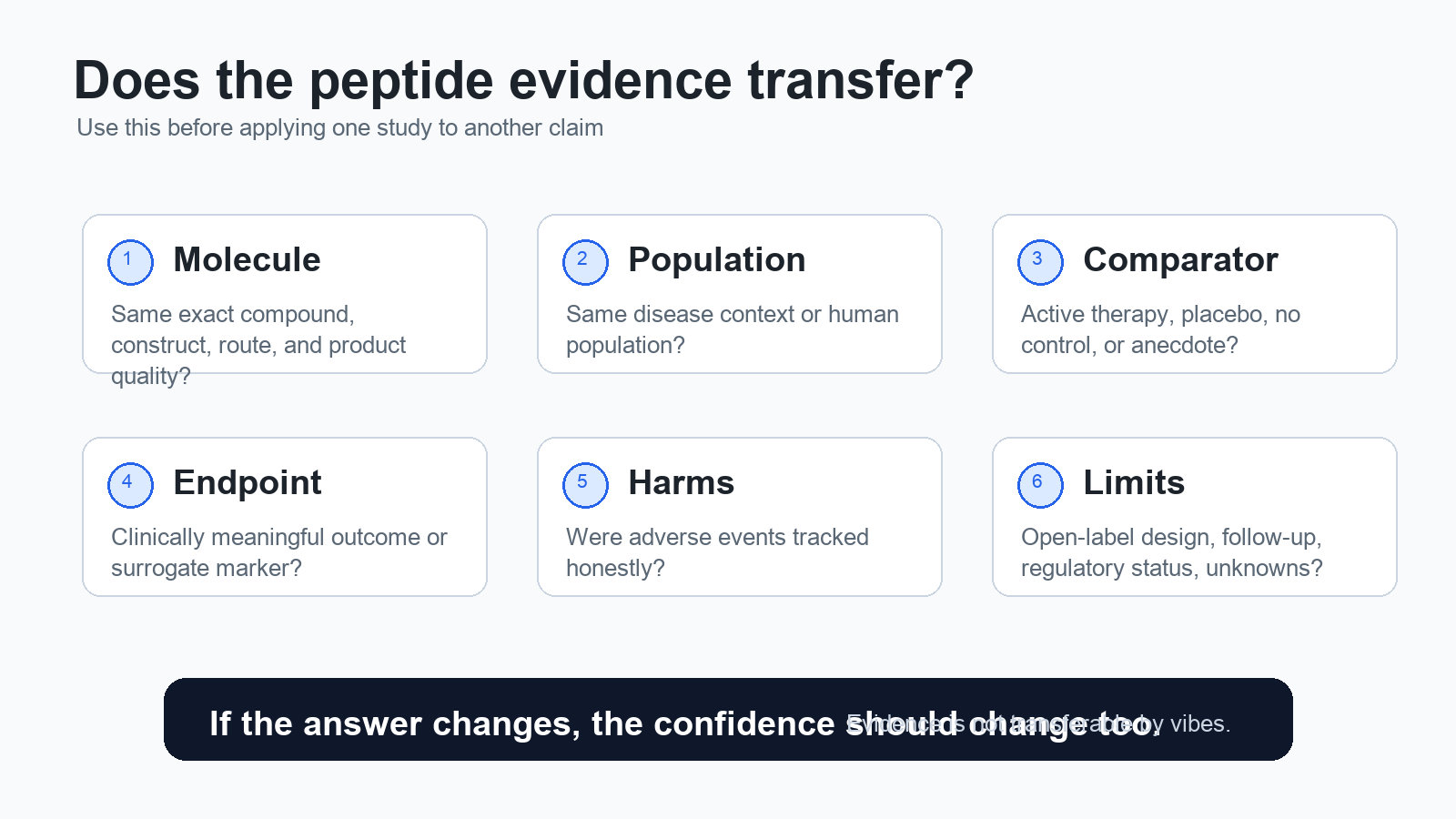
Evidence should transfer only when the claim matches the molecule, population, comparator, endpoint, and risk context.
This same discipline is useful when reading any peptide page. Start with the exact claim. Then ask whether the cited evidence actually supports that claim in humans. For a deeper checklist, read How to Evaluate Peptide Claims Online.
What this means for PeptideBase readers
The main takeaway is not "peptides work" or "peptides are hype." Both are lazy.
The better takeaway is that peptides are a broad biomedical category. Some peptide-based medicines are approved, regulated, and supported by serious human evidence in specific settings. Some peptide-related claims are preliminary but scientifically interesting. Some are marketing dressed up as biochemistry.
PRRT and [177Lu]Lu-edotreotide sit in the serious-medicine category because the evidence is disease-specific and trial-based. Afamelanotide for EPP offers another product-specific example of how trials, regulatory review, a narrow indication, and safety monitoring distinguish medicine from category-wide marketing. Wellness peptide claims have to earn their own evidence. They do not get to borrow credibility from oncology.
FAQ
Is [177Lu]Lu-edotreotide proof that peptide therapy works?
No. It is evidence about an investigational radiopharmaceutical therapy in a specific group of patients with advanced, progressive, SSTR-positive GEP-NETs. It does not prove broad claims about peptide therapy, recovery peptides, anti-aging peptides, or research peptides.
What is the peptide part of PRRT doing?
In PRRT, the peptide or peptide-like targeting molecule helps bind receptors on eligible tumor cells. The radioactive isotope supplies the therapeutic radiation payload. The peptide is a targeting component, not a vague wellness ingredient.
Why compare [177Lu]Lu-edotreotide with everolimus?
Everolimus is a targeted systemic therapy used in neuroendocrine tumor care. Comparing PRRT with an active therapy helps answer a clinically meaningful sequencing question more directly than comparing against no active treatment.
Does progression-free survival mean patients lived longer?
Not necessarily. Progression-free survival measures time before disease progression or death. It is important in oncology trials, but it is different from overall survival. Long-term follow-up is still needed to understand durability and survival effects.
Was COMPETE blinded?
No. COMPETE was open-label. That is an important caveat because treatment expectations and clinical management can influence some outcomes. The trial still provides meaningful randomized phase 3 evidence, especially because imaging-based endpoints can be centrally reviewed.
Can consumers apply PRRT evidence to research peptides?
No. PRRT evidence should not be used to validate unrelated consumer peptide products, self-directed protocols, or wellness claims. Evidence applies to the specific treatment, disease, population, comparator, and endpoint studied.
Sources
- Walter T, Jann H, Ansquer C, et al. [177Lu]Lu-edotreotide versus everolimus for gastroenteropancreatic neuroendocrine tumours (COMPETE): a phase 3, multicentre, randomised, open-label, superiority trial. The Lancet. Published online July 2, 2026. DOI: 10.1016/S0140-6736(26)00604-5.
- ITM Isotope Technologies Munich. ITM Announces Primary Results from the Phase 3 COMPETE Trial Published in The Lancet Comparing 177Lu-edotreotide (ITM-11) vs. Everolimus in Advanced GEP-NETs. Published July 7, 2026.