Pegtarazimod for Steroid-Refractory GVHD: What 7 Patients and Mouse Studies Actually Show
Short answer: Pegtarazimod (RLS-0071) reduced mortality and several signs of acute graft-versus-host disease in multiple mouse models. Intestinal organoid experiments also suggested protection from inflammatory and oxidative injury. But the human evidence reported so far consists of only seven treated patients in an open-label, non-randomized phase 2 program. Four met the study's day-28 overall-response endpoint. That result is interesting, but it cannot establish efficacy.
The August 4, 2026 Journal of Clinical Investigation paper is best read as an evidence ladder. The mouse work asks whether the experimental peptide changes disease in controlled models. The organoids probe possible tissue-protection mechanisms. The seven-patient report offers an early tolerability and response signal. None of those layers can substitute for a sufficiently large controlled human trial.
Evidence in one sentence: Pegtarazimod has coherent preclinical support and a tiny early human signal, but no reliable estimate yet of clinical benefit, uncommon harms, or superiority to standard care.
What is pegtarazimod?
Pegtarazimod is an experimental synthetic peptide derived from a sequence in the capsid protein of human astrovirus serotype 1. It is also called RLS-0071.
Researchers are studying it as a modulator of inflammatory processes involving neutrophils, reactive oxygen species (ROS), and related tissue injury. That description does not mean the drug's mechanism has been settled in people. It describes a model supported by laboratory and animal experiments.
The clinical setting in the JCI paper is acute graft-versus-host disease (aGVHD) after allogeneic hematopoietic cell transplantation. In aGVHD, donor immune cells attack recipient tissues; the gastrointestinal tract, skin, and liver can be affected. “Steroid-refractory” means the disease has not responded adequately to corticosteroid treatment. It is a serious, medically complex setting in which a biological signal needs rigorous testing before it can guide care.
What did the pegtarazimod acute graft-versus-host disease paper study?
The paper combined three distinct evidence layers: mouse aGVHD models, intestinal organoids, and observations from seven patients in the ongoing AURORA phase 2 study. Keeping those layers separate is the key to reading it accurately.
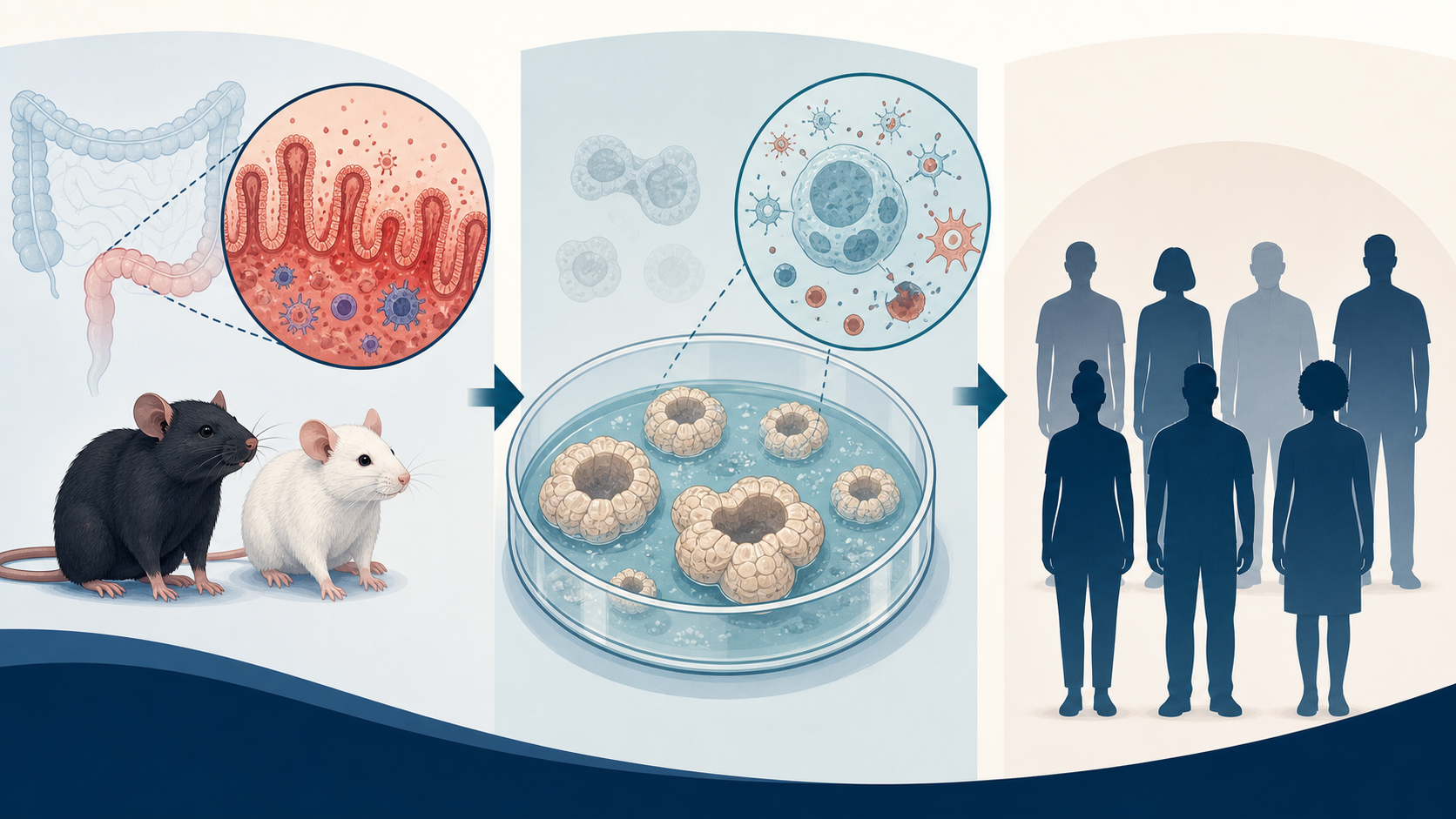
Mouse models, organoids, and seven treated patients answer different questions. Agreement across layers can justify more research, but it does not turn preclinical findings into proven patient benefit.
| Evidence layer | What it can show | What it cannot show | |---|---|---| | Multiple mouse aGVHD models | Whether treatment changes survival, tissue injury, inflammation, and selected mechanisms under controlled conditions | Whether patients will benefit or experience the same risks | | Intestinal organoids | Whether pegtarazimod changes selected injury responses in a simplified human-tissue model | Whole-body effectiveness, survival, uncommon harms, or clinical management effects | | Seven treated patients | Early tolerability observations and whether prespecified responses occurred | Efficacy, comparative benefit, uncommon harms, or superiority to standard care |
What did the mouse studies show?
Across multiple mouse aGVHD models, pegtarazimod was associated with lower mortality, less histologic disease severity, lower pro-inflammatory cytokines, and less neutrophil-related oxidative injury. These are meaningful preclinical findings because they appeared across more than one model and included both outcomes and mechanistic measurements.
Histologic severity refers to tissue damage assessed under a microscope. Cytokines are signaling proteins involved in inflammation. The study also examined oxidative injury connected to neutrophil activity, including ROS production.
The mouse results strengthen the case for continued investigation. They do not provide a human response rate, prove safety in transplant recipients, or identify which patients might benefit. Animal transplantation models reproduce selected features of aGVHD, not the full variation in human disease, prior treatments, infections, organ dysfunction, and supportive care.
Quick answer: The mouse data support biological activity against aGVHD-like disease. They are not clinical efficacy data.
Why do NOX2, neutrophils, and ROS matter?
The paper supports a model in which pegtarazimod reduces inflammatory damage partly by limiting neutrophil-associated ROS production, with NOX2 as an important part of that pathway. This should be described as a model-supported hypothesis, not a settled human mechanism.
Neutrophils are immune cells that can help control infection but can also amplify tissue injury. NOX2 is an enzyme complex that produces reactive oxygen species. ROS participate in normal antimicrobial defense and signaling, yet excessive or poorly controlled ROS can damage lipids, proteins, and DNA.
The researchers used allogeneic transplant recipient mice with genetic inactivation of NOX2 in bone-marrow-derived cells to probe the pathway. That kind of perturbation is more informative than simply observing that ROS levels changed: it asks whether altering a suspected component changes the experimental relationship.
Even so, a mouse genetic experiment cannot prove that pegtarazimod works through the same dominant mechanism in patients. Human aGVHD involves interacting donor and recipient cells, conditioning injury, infections, medications, and organ-specific biology. The proposed neutrophil–NOX2–ROS pathway is scientifically plausible and experimentally supported, but its clinical importance remains to be established.
What did the intestinal organoids add?
Intestinal organoids suggested that pegtarazimod may protect epithelial tissue from TNF-related toxicity and oxidative DNA damage. Organoids are three-dimensional cell systems that reproduce selected features of an organ more realistically than a flat cell layer.
This matters because the intestinal lining is a major target in aGVHD. Tumor necrosis factor (TNF) is an inflammatory signal, while oxidative DNA damage is one measure of cellular injury. A protective effect in organoids offers a second possible dimension beyond suppressing inflammatory-cell activity: preserving tissue integrity.
But organoids are deliberately simplified. They do not reproduce blood flow, drug distribution, the complete immune system, infection risk, or whole-patient outcomes. They make a mechanism more plausible; they do not show that a patient will recover.
What happened in the seven patients?
The JCI paper reports that pegtarazimod was tolerated in seven patients with corticosteroid-refractory aGVHD, and four of seven met the day-28 overall-response endpoint. That is an early clinical observation, not a reliable efficacy estimate.
The AURORA study is open-label, meaning investigators and participants know the treatment being given. It is also non-randomized. With only seven reported patients and no randomized control group, several alternative explanations remain possible: natural variation in disease course, effects of concurrent or prior care, differences in baseline severity, assessment variability, and chance.
“Four of seven responded” also does not mean the treatment has a stable 57% response rate. In a sample this small, one person's outcome moves the percentage by more than 14 points. The estimate is therefore extremely imprecise. Our three-case regenerative-peptide evidence guide explains the related problem of drawing causal conclusions from tiny uncontrolled clinical observations.
The phrase “well tolerated” needs similar restraint. Seven people can reveal obvious short-term problems in those seven people. They cannot estimate uncommon adverse events, characterize risk across diverse transplant populations, or establish long-term safety.
Clinical boundary: Seven uncontrolled cases can identify a signal worth testing. They cannot establish that pegtarazimod caused the responses or works better than existing care.
What does the recruiting AURORA study need to answer?
The registered AURORA phase 2 study remains recruiting and lists an estimated enrollment of 66, with estimated primary and study completion in December 2026. ClinicalTrials.gov identifies it as an open-label, non-randomized, sequential study evaluating safety, tolerability, pharmacology, and efficacy-related outcomes in hospitalized patients with steroid-refractory aGVHD.
Even the planned 66-person study will need to be interpreted according to its design. A larger cohort should improve the description of observed responses and common adverse events, but a non-randomized trial still has limited ability to determine what would have happened without pegtarazimod or whether it is superior to standard care.
Useful future evidence would include transparent baseline characteristics, treatment context, response durability, organ-specific responses, survival and non-relapse mortality, adverse events, infections, relapse outcomes, and clear accounting for missing data. Ultimately, controlled comparative studies may be needed to estimate causal benefit.
Registry status and dates can change. The statements above reflect the ClinicalTrials.gov record checked for this article.
Why was preserved anti-leukemia activity tested in mice?
Preserving anti-leukemia activity matters because donor immune effects can help control residual malignant cells after transplantation. A treatment that reduces graft-versus-host injury but also erases graft-versus-leukemia activity could create a serious tradeoff.
The paper reports that pegtarazimod maintained anti-leukemia effects in mouse models while reducing aGVHD-related injury. Scientifically, that is an important reason to keep developing the hypothesis: the model did not show an obvious loss of the desired anti-tumor effect under the tested conditions.
It is not proof that graft-versus-leukemia effects are preserved in patients. Mouse tumor models, immune systems, disease burdens, and follow-up cannot reproduce the diversity of human cancers after transplant. Human relapse outcomes require adequate patient numbers, relevant follow-up, and careful comparison.
What can and cannot be concluded today?
The defensible conclusion is that pegtarazimod has promising translational evidence, while human efficacy and safety remain uncertain.
What the paper supports:
- pegtarazimod showed activity in multiple mouse aGVHD models;
- the animal data connect that activity to reduced inflammatory and oxidative injury;
- organoid experiments support a possible intestinal tissue-protection effect;
- seven treated patients provide an early tolerability and response signal;
- the findings justify continued clinical investigation.
What it does not establish:
- that pegtarazimod is effective for steroid-refractory aGVHD;
- a dependable response rate;
- superiority or equivalence to standard care;
- uncommon or long-term harms;
- preservation of graft-versus-leukemia activity in patients;
- a settled human neutrophil/NOX2/ROS mechanism;
- who should receive treatment or how transplant care should be managed.
This is the difference between a strong translational story and a proven therapy. The former can be scientifically exciting. The latter requires evidence the current seven-patient report cannot provide.
For help reading the layers, see What Preclinical Actually Means, When a Peptide Enters Phase 1: What It Means, and How to Evaluate Peptide Claims Online.
Frequently asked questions
Is pegtarazimod proven to treat acute graft-versus-host disease?
No. Mouse models and organoids support further study, while the reported human experience includes only seven patients in an uncontrolled phase 2 program. That cannot establish efficacy.
What does four responses among seven patients mean?
It means four patients met the study's day-28 overall-response endpoint. It does not prove pegtarazimod caused those responses or establish a reliable response percentage.
Did pegtarazimod preserve anti-leukemia effects?
The paper reports preserved anti-leukemia activity in mouse models. Whether graft-versus-leukemia effects are preserved in patients remains unknown.
Is the NOX2/ROS mechanism proven in humans?
No. Genetic and mechanistic mouse experiments support the proposed pathway, but its importance in human aGVHD and human response to pegtarazimod has not been established.
Is the AURORA study complete?
No. The ClinicalTrials.gov record lists AURORA as recruiting, with estimated enrollment of 66 and estimated completion in December 2026.
Sources
- Holzmüller V, et al. “Pegtarazimod limits acute graft-versus-host disease mortality and severity in mice and is tolerated in patients.” Journal of Clinical Investigation. Published August 4, 2026. doi:10.1172/JCI205864
- ClinicalTrials.gov. NCT06343792: AURORA
This article is for evidence education only. It does not provide treatment selection, transplant-management, dosing, sourcing, purchasing, prognosis, or individualized medical advice.