Can a Peptide Vaccine Lower Cholesterol? What the PCSK9 Animal Study Actually Shows
A plain-English review of the 2026 PCSK9 peptide vaccine animal study, including its design, findings, limitations, and differences from PCSK9 antibodies and oral inhibitors.
Can a Peptide Vaccine Lower Cholesterol? What the PCSK9 Animal Study Actually Shows
A PCSK9 peptide vaccine lowered LDL cholesterol and reduced several signs of atherosclerosis in mouse models in a 2026 study. It also produced durable anti-PCSK9 antibodies in mice, guinea pigs, and rhesus macaques. That is meaningful preclinical evidence—but it is not evidence that the vaccine safely prevents heart attacks or strokes in people.
The distinction matters. The study tested a promising way to generate longer-lasting antibodies against PCSK9, but it did not test the vaccine in a human trial. Even within the animal work, healthy rhesus macaques developed antibodies without a significant change in measured blood lipids.
Quick answer: The study supports further research on a structure-guided PCSK9 vaccine. It does not establish human effectiveness, long-term human safety, a clinical dosing schedule, or regulatory approval.
Why PCSK9 affects LDL cholesterol
PCSK9 helps determine how many LDL receptors remain available on liver cells to clear LDL particles from the blood.
An LDL receptor can bind an LDL particle, carry it into a liver cell, release it, and then return to the cell surface for another round. PCSK9 can bind the receptor and steer it toward breakdown instead of recycling. Fewer working receptors at the liver-cell surface generally means less LDL is removed from circulation.
Blocking the PCSK9–LDL receptor interaction can preserve receptor recycling. This is why PCSK9 is already a validated drug target, even though the vaccine approach described here remains experimental.
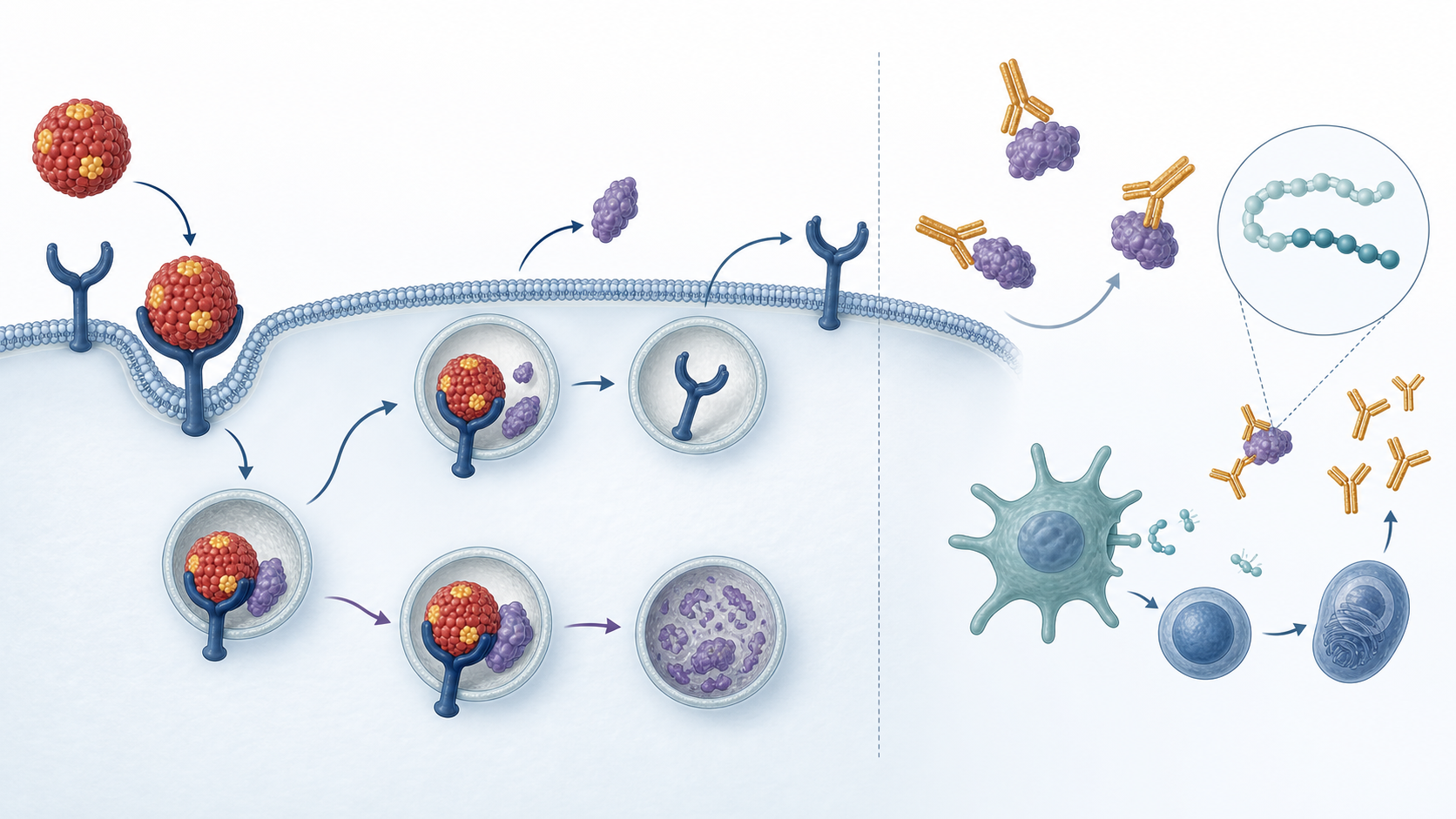
PCSK9 can promote LDL-receptor breakdown. The vaccine concept is to train the immune system to make antibodies that bind PCSK9, potentially preserving more receptor recycling. This illustration explains the concept; it does not depict a proven human outcome.
What researchers built in the 2026 study
The researchers used structural information to choose short PCSK9 regions that antibodies might recognize effectively.
They examined PCSK9–antibody complex structures in the Protein Data Bank and used AlphaFold3-guided modeling to identify conserved, antibody-facing B-cell epitopes. These are short regions intended to become targets for antibody binding.
Each candidate PCSK9 epitope was joined to a heterologous T-helper epitope. In plain English, the construct paired the PCSK9 target with a separate immune-system helper signal intended to support antibody production without deliberately teaching T cells to attack PCSK9-bearing tissue.
The candidates were formulated with CpG plus alum, two immune-stimulating adjuvant components. Of the three constructs assessed, the candidate called PVC3 generated the strongest PCSK9-specific antibody response and became the main focus of the animal experiments.
This is a peptide vaccine because a selected peptide epitope—not the entire PCSK9 protein—was used as the immune target. “Structure-guided” describes how that epitope was chosen.
What the animal experiments actually found
The findings fall into three different buckets: antibody production, lipid and plaque outcomes in mice, and limited safety observations.
Durable antibodies appeared across three animal species
PVC3 generated anti-PCSK9 antibodies in mice, guinea pigs, and rhesus macaques. In mice, reported antibody titers remained detectable for up to 24 weeks.
That cross-species immune response is useful for development because it suggests the construct was not immunogenic in only one mouse strain. It does not show that the antibodies will have the same potency, duration, or clinical consequences in humans.
Cholesterol and liver-fat findings came from mouse models
Researchers tested functional effects in two hypercholesterolemia models.
In mice given an AAV vector expressing the human PCSK9 D374Y variant, vaccination inhibited rises in LDL cholesterol and total cholesterol after the challenge and reduced hepatic lipid accumulation.
In ApoE-deficient mice, which are prone to high cholesterol and atherosclerotic lesions, PVC3 attenuated LDL-cholesterol elevation relative to controls. The reported difference was 29% at week 4 and 20% at week 14.
Those are model-specific comparisons, not expected reductions for people.
Plaque progression was reduced in mice
In the ApoE-deficient model, vaccination reduced aortic lesion area and the necrotic-core fraction in aortic-root plaques. These findings suggest less atherosclerotic burden in that model.
They do not demonstrate fewer heart attacks, strokes, or cardiovascular deaths. Animal plaque measures can help justify human research, but clinical events in people require human outcome trials.
The rhesus macaque result was narrower
Healthy rhesus macaques generated robust anti-PCSK9 antibodies, but the study did not find significant changes in LDL cholesterol, total cholesterol, HDL cholesterol, or triglycerides compared with controls.
That result is not a trivial footnote. It suggests that an antibody response alone does not guarantee a measurable lipid effect in every species or metabolic setting. The authors identified testing in dyslipidemic larger-animal models as an important next step.
What “no detected toxicity or autoimmunity” means here
The study did not detect overt systemic toxicity, major organ abnormalities, or the measured autoimmune safety signals in the studied animals. That is reassuring within the experiment, but it is not the same as proving the vaccine safe.
In mice, investigators reported no major histopathological changes in the organs examined and no detectable T-cell response to the PCSK9 B-cell epitope alone. In healthy rhesus macaques, the reported assays did not show apparent liver, kidney, or autoimmune safety signals.
These observations are bounded by the species, sample sizes, follow-up periods, doses, assays, and endpoints used. Rare immune reactions, delayed effects, interactions with human disease, and consequences of repeated or sustained antibody production cannot be ruled out by a preclinical study.
For a broader guide to this evidence boundary, see what preclinical actually means and how peptide research status should be interpreted.
Why active vaccination is different from a PCSK9 antibody injection
An active vaccine asks the body to produce its own antibodies. An injected monoclonal antibody supplies manufactured antibodies directly.
That difference creates both the appeal and the main unanswered questions.
Approved injectable PCSK9 monoclonal antibodies, such as evolocumab and alirocumab, have defined manufacturing standards, prescribing information, human efficacy data, and post-approval safety monitoring. Their effect depends on continued administration, and drug levels decline after treatment is stopped.
A PCSK9 peptide vaccine is being explored partly because an immune response might last longer and reduce the need for repeated antibody dosing. But a durable immune response may also be less immediately reversible. Researchers would need to understand response variability, booster control, waning, excessive or inadequate antibody production, immune escape, and what happens if an adverse immune effect develops.
That is not evidence that active vaccination is inherently unsafe. It is evidence that its control problem is different.
| Approach | What it delivers | Current evidence position | Main control question |
|---|---|---|---|
| PCSK9 peptide vaccine | An epitope intended to trigger the body’s own anti-PCSK9 antibodies | Preclinical animal evidence for PVC3 | How durable, predictable, and reversible is the immune response in people? |
| Injectable PCSK9 monoclonal antibody | Manufactured antibody that binds PCSK9 | Approved products with human trial and clinical-use data | Effect requires ongoing administration; exposure falls after stopping |
| Oral PCSK9 inhibitor | An orally absorbed molecule designed to disrupt PCSK9 biology | Product-specific; newer agents have human clinical data, and status must be checked individually | Daily exposure, adherence, interactions, and whether outcome evidence supports the specific agent |
Where oral PCSK9 inhibitors fit
Oral PCSK9 inhibitors do not vaccinate the immune system. They are taken as molecules that directly interfere with PCSK9 or its interaction with the LDL receptor.
The category is easy to describe badly. Enlicitide, for example, has been reported as an oral macrocyclic peptide PCSK9 inhibitor; it is not a conventional small molecule in the everyday chemistry sense. Other oral candidates may use different chemistries or act at different points in PCSK9 production or trafficking.
Recent oral-agent results therefore should not be blended with the PVC3 vaccine findings. A daily oral inhibitor, an injected monoclonal antibody, and an active peptide vaccine may converge on the same biological target while differing in mechanism, evidence base, duration, reversibility, and regulatory status.
This article does not compare which option a person should use. That requires product-specific evidence and individualized medical care, not a mechanism chart.
What would need to happen before this becomes human evidence
The next steps must show more than antibody production.
Important development questions include:
- Do vaccine-induced antibodies reliably block functional PCSK9 activity?
- Does vaccination preserve LDL-receptor function in relevant human systems?
- Are lipid effects reproducible in dyslipidemic larger animals?
- What dose and schedule produce a controllable immune response?
- How variable is the response across individuals?
- Can the response be managed if it is too strong, too weak, or unwanted?
- Do early human trials find acceptable short-term safety and biological activity?
- Do larger, longer trials eventually show durable cardiovascular benefit rather than biomarker changes alone?
The paper itself notes the need for further work on circulating free PCSK9, neutralizing activity, and LDL-receptor protection. These are not bureaucratic hurdles stapled onto a success story. They are the experiments needed to learn whether the proposed mechanism works consistently.
How to read the headline without overreading it
The accurate headline is that a rationally designed PCSK9 epitope vaccine produced durable antibodies across several animal species and improved lipid and plaque endpoints in mouse disease models.
The inaccurate leap is that a cholesterol vaccine has now been shown to safely prevent cardiovascular disease in people.
A strong preclinical result can be both promising and profoundly incomplete. The useful question is not “Did it work?” in the abstract. It is: Which outcome changed, in which model, for how long, compared with what, and does that outcome answer the human question we care about?
That same checklist applies to other peptide claims. See how to evaluate peptide claims online and the early-trial lessons from a therapeutic peptide vaccine.
Frequently asked questions
Is the PCSK9 peptide vaccine approved?
No approval is established by this study. PVC3 was tested preclinically in animals, not in a human clinical trial.
Did the vaccine lower cholesterol in monkeys?
No significant change in LDL cholesterol, total cholesterol, HDL cholesterol, or triglycerides was reported in the healthy rhesus macaques compared with controls. The macaques did generate anti-PCSK9 antibodies.
Did the vaccine prevent heart attacks or strokes?
No. The study measured immune, lipid, liver-fat, and plaque-related endpoints in animals. It did not test human cardiovascular events.
Does “no autoimmunity detected” prove long-term safety?
No. It means the investigators did not detect the assessed autoimmune signals within the animals, methods, and follow-up used. It cannot exclude rare, delayed, or human-specific risks.
Is a PCSK9 peptide vaccine the same as an approved PCSK9 antibody?
No. The vaccine attempts to induce the body’s own antibodies, while a monoclonal-antibody product supplies manufactured antibodies. Their duration, reversibility, evidence, and regulatory status are different.
This article is for general education and evidence literacy. It does not provide medical advice, treatment selection, dosing, purchasing, or sourcing guidance.
Sources
- Sun H, Li Z, Hu X, et al. “Structure-guided design of a PCSK9 epitope vaccine with efficacy against hyperlipidemia and atherosclerosis.” Life Metabolism. First published May 26, 2026. doi:10.1093/lifemeta/loag013
- PubMed record: PMID 42395836