When Peptide Toxicity Data Says Nothing: What MAOMAO Fixes—and What It Cannot Prove
A peptide toxicity database can mislead when “not reported,” “not tested,” “explicitly non-toxic,” and “conflicting results” are collapsed into one negative label. MAOMAO improves that problem by preserving five separate evidence states, source provenance, endpoint definitions, and evidence strength. It does not test peptides, prove safety, provide clinical guidance, or turn missing data into reassurance.
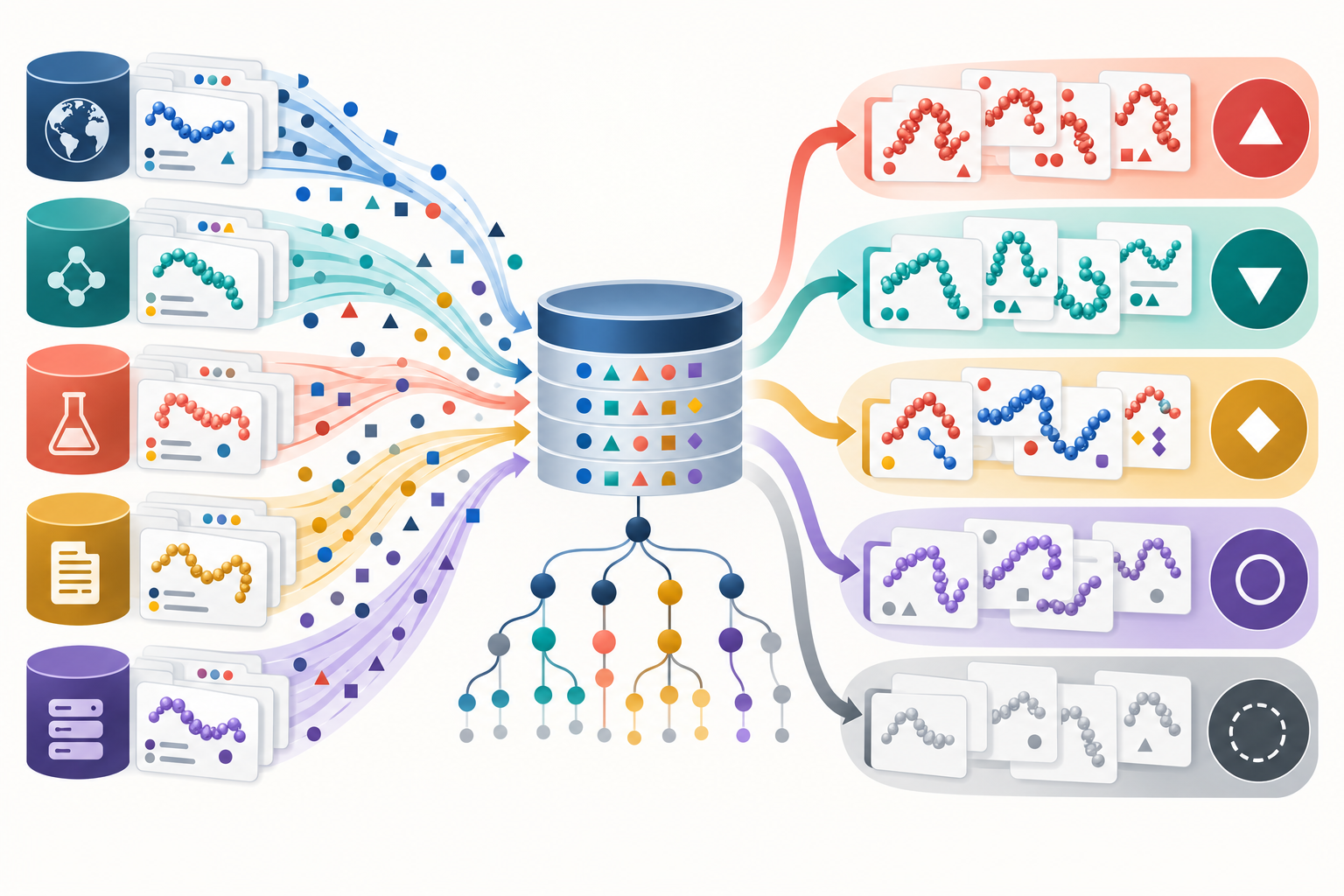
MAOMAO keeps positive, negative, ambiguous, unlabeled, and no-information records separate. The distinction is not cosmetic: each state supports a different conclusion.
Quick answer: Soto-Garcia and colleagues published MAOMAO as a Frontiers in Pharmacology Data Report on October 16, 2026. It is an ontology-guided, FAIR-oriented data resource for harmonizing peptide-toxicity annotations—not a toxicology experiment, clinical safety database, prediction service, regulatory clearance system, or certificate that a peptide is safe.[^frontiers]
Why can a peptide toxicity database give a false sense of safety?
The core error is treating absence of a toxicity label as evidence that toxicity was absent. Those are not the same observation.
Suppose five databases contain the same peptide sequence:
- one reports toxicity in a cell assay;
- one explicitly reports no toxicity at the tested endpoint and conditions;
- one includes the sequence but gives it no class label;
- one has no record for that endpoint;
- one assigns the sequence to a randomly assembled “negative” set.
A conventional binary dataset may force those records into “toxic” and “non-toxic.” That makes the table easier to model but harder to interpret. The apparent negative class can mix an experimentally supported non-toxic observation with silence, missing labels, unresolved conflict, or a weak modeling convention.
MAOMAO’s useful contribution is to refuse that collapse. It organizes each peptide–endpoint pair into one of five mutually exclusive states:
| Evidence state | What it means | What it does not mean | |---|---|---| | Positive | Direct positive evidence, or positive support propagated from a more specific child endpoint | Every possible toxicity was tested | | Negative | Direct endpoint-specific negative evidence | The peptide is safe overall | | Ambiguous | Positive and negative evidence conflict, or the evidence cannot be resolved responsibly | A majority vote settled the issue | | Unlabeled | The sequence appeared in an endpoint-associated source without an explicit positive or negative assignment | The source found no toxicity | | No information | No usable annotation exists for that sequence–endpoint pair | The endpoint was tested and found negative |
The code 999 in MAOMAO means no information. It is not a high safety score. It is a missing-evidence marker.[^supplement]
What does MAOMAO do in practical terms?
MAOMAO standardizes sequences and toxicity concepts while preserving the evidence trail needed to question the final label. Its workflow is more useful than a single yes/no column because it records how each state was constructed.
1. It validates and normalizes peptide sequences
The published v1.1.0 resource keeps sequences made from the 20 canonical amino acids and between 5 and 70 residues long. It removes exact duplicates within a source but retains the same sequence across different sources so that independent or conflicting provenance is not erased.
Each normalized uppercase, whitespace-free sequence receives a deterministic SHA-256 identifier. That identifier links the sequence across the Core, Descriptor, Embedding, Benchmark, and sequence-profile resources.[^frontiers]
These rules improve consistency, but they also define the dataset’s scope. A modified peptide containing non-canonical residues, or a sequence outside the length window, may be excluded even if it matters biologically.
2. It harmonizes toxicity endpoints
MAOMAO maps varying source language into a controlled hierarchy:
- Toxic
- Cytotoxic
- Hemolytic
- Cytolysis
- Anti-mammalian cells
- Neurotoxic
- Embryotoxic
- Ichthyotoxic
- Cytotoxic
This matters because “hemolytic,” “cytolytic,” and “cytotoxic” are related but not interchangeable. A red-blood-cell lysis result is not automatically a complete organism-level safety assessment.
3. It distinguishes strong from weak negative evidence
Not all negative records deserve equal confidence. MAOMAO calls a negative strong when the absence of the endpoint is explicitly supported by experimental or curated evidence. A weak negative may come from a randomly selected negative set or a record lacking explicit confirmation that the effect was absent.
Strong versus weak is retained in provenance rather than becoming a sixth pivot state. Users therefore need to inspect the supporting records before treating two “0” labels as equivalent.[^supplement]
4. It preserves conflicts and source links
When a peptide–endpoint pair has both positive and negative qualitative evidence, MAOMAO marks it ambiguous rather than choosing the convenient label. Its ambiguity-support table, hierarchy audit, source metadata, retrieval details, and sequence cards help trace the final state back to contributing records.
That does not make every upstream source equally reliable. It makes the disagreement visible enough to investigate.
5. It supplies computational representations and repeatable partitions
The resource includes 41 sequence-derived descriptors, 10 protein-language-model embedding sets, one one-hot representation, and fixed benchmark partitions. Those assets can support reproducible comparisons because different users can start with the same sequence identifiers and split assignments.
“Reproducible,” however, does not mean “clinically validated” or even “leakage-controlled.” The released partitions are random or label-stratified five-fold splits. The paper explicitly says they do not control for sequence homology or similarity and should not be interpreted as leakage-controlled evaluation datasets.[^frontiers]
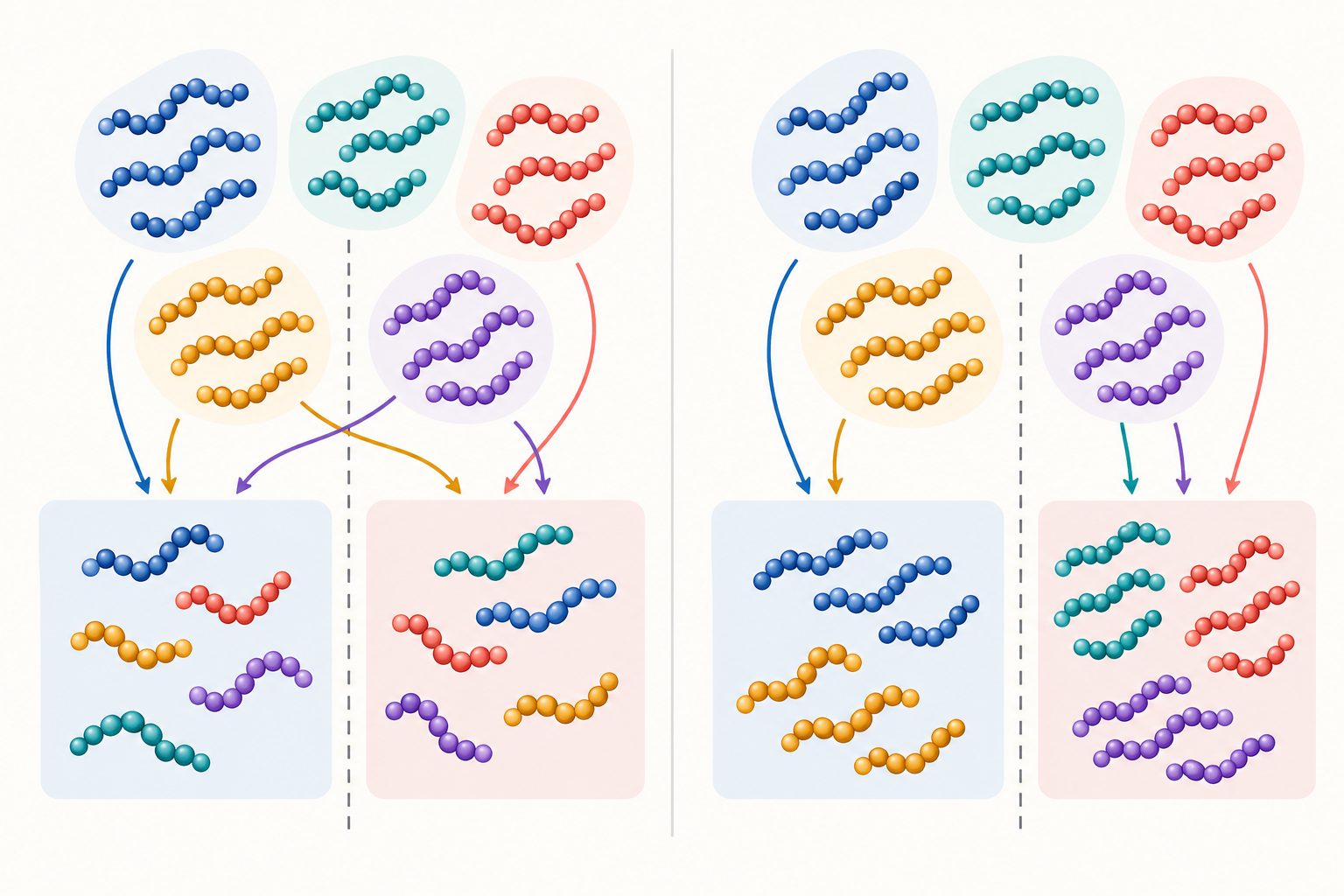
Random or label-stratified splits can place closely related sequences on both sides of an evaluation boundary. MAOMAO’s current partitions are repeatable, but they are not similarity-controlled.
Why do the MAOMAO totals differ across records?
MAOMAO is versioned, and a current landing page can still contain stale prose. Counts must be tied to a specific record and date. Blending them produces a dataset that never existed.
| Versioned record | Sources | Unique sequences | Endpoints | Representation-specific benchmark configurations | |---|---:|---:|---:|---:| | Zenodo v0.1.0, published July 26, 2026 | 54 | 71,701 | 7 | 2,640 | | Zenodo v1.0.0, published September 2, 2026 | 54 | 71,701 | 7 | 2,640 | | Zenodo v1.1.0 attached README, published September 4, 2026 | 56 | 71,857 | 8 | 3,300 | | Frontiers paper and supplement, published October 16, 2026, describing v1.1.0 | 56 | 71,857 | 8 | 3,300 |
The v1.1.0 release added the anti-mammalian-cells endpoint, quantitative toxicity records, and sequence cards. Its attached README reports five binary benchmark endpoints, 300 stored partition configurations, 1,500 stored fold instances, 3,300 representation-specific configurations, and 16,500 representation-specific fold instances.[^zenodo110]
As checked on October 25, 2026, the Zenodo v1.1.0 landing-page description still says four benchmark endpoints, 2,640 configurations, and 13,200 fold instances—figures inherited from the earlier seven-endpoint release. The attached v1.1.0 README, changelog, paper, and supplement carry the updated five-endpoint totals. The responsible reading is to cite the exact artifact, version, and access date rather than silently choosing whichever number looks newest.[^zenodo110]
What did MAOMAO include—and exclude?
The published curation screened retrievable, sequence-level sources; it was not a complete census of every peptide toxicity observation ever produced.
The supplement reports 77 candidate sources evaluated for eligibility. Fifty-six were integrated and 21 were excluded. Seventeen excluded sources had no retrievable dataset through the reported routes; four lacked usable primary peptide sequences. Included sources could still lose individual records for missing sequences, uninterpretable annotations, irrecoverable formatting, non-canonical residues, or sequence length outside 5–70 residues.[^supplement]
The v1.1.0 paper reports:
- 1,372,190 non-deduplicated source-level records initially collected;
- 898,637 retained after source-specific preprocessing;
- 71,857 unique peptide sequences;
- eight endpoint columns, creating 574,856 sequence–endpoint combinations;
- 143,420 combinations with positive, negative, ambiguous, or unlabeled evidence;
- 431,436 combinations coded as no information.[^frontiers]
That final number is the point of the article: most cells in the full sequence-by-endpoint matrix carry no usable information. The database makes that emptiness explicit. It does not convert emptiness into safety.
Licensing is similarly layered. The Frontiers article is CC BY 4.0. MAOMAO-derived data products and documentation in Zenodo v1.1.0 are CC BY 4.0, while the repository’s source code and workflows use the MIT License. Original third-party source material remains governed by its original provider’s terms. In the paper’s audit, explicit licensing information was available for only 15 of 56 sources, so redistribution rights should not be inferred merely because a source participated in the pipeline.[^frontiers][^supplement]
How does the ontology hierarchy change labels?
MAOMAO propagates only positive evidence upward, and direct ambiguity can block that propagation. A positive hemolytic record can support cytotoxic and then toxic. A negative hemolytic record does not propagate upward because “not hemolytic” does not establish “not cytotoxic.”
Likewise, ambiguous, unlabeled, and no-information states do not propagate. If a parent endpoint already has direct conflicting evidence, child positivity does not overwrite that ambiguity.
The v1.1.0 supplement records 17,166 sequence–parent-endpoint rows with positive child support. Of those, 11,937 parent assignments were inferred through the hierarchy, 2,461 were already positive, and 2,768 were blocked by parent ambiguity.[^supplement]
This is a defensible ontology rule, not a biological law. It organizes reported evidence. It does not establish that every child assay predicts organism-level toxicity or that unmeasured contexts are harmless.
What can MAOMAO not prove?
MAOMAO cannot prove that a peptide is safe, unsafe in every context, suitable for a person, or ready for clinical use. It curates other sources; it does not generate a new toxicology program.
MAOMAO is not:
- a toxicology experiment;
- a clinical adverse-event or pharmacovigilance database;
- a complete record of dose, route, formulation, exposure duration, metabolism, interactions, or vulnerable populations;
- a regulatory clearance or approval system;
- a validated clinical prediction tool;
- proof that a peptide with no record is non-toxic;
- proof that one negative endpoint generalizes to every tissue, species, dose, or exposure condition.
Coverage is also uneven. The paper identifies limited class representation for cytolysis, embryotoxicity, and ichthyotoxicity. Only five endpoints had enough positive and negative records for the predefined binary five-fold benchmark. Quantitative toxicity data were small: v1.1.0 contains 169 measurements across HC50, LC50, LD50, and MHC, with units preserved rather than silently pooled.[^supplement]
The authors’ disclosures deserve the same visibility as the methods. The paper reports public and institutional funding from FONDECYT, CeBiB/ANID, postgraduate funds, and an EU/Région Réunion-supported PEACCEL research program. One author was employed by PEACCEL; the remaining authors declared no commercial or financial relationships that could be construed as conflicts. The manuscript also discloses use of ChatGPT for English editing, with authors retaining responsibility for the final text.[^frontiers]
How should readers use a peptide toxicity database responsibly?
Use MAOMAO to ask better evidence questions, not to skip them. For any sequence and endpoint, check:
- Which state is present? Positive, negative, ambiguous, unlabeled, or no information?
- Is a negative strong or weak? Was absence measured, curated, or merely assumed for modeling?
- What endpoint was tested? Hemolysis is not the same as neurotoxicity, developmental toxicity, or whole-organism safety.
- What was propagated? Is the label direct or hierarchy-derived?
- What is the provenance? Which source, assay, organism, version, and processing decision support it?
- Which records were excluded? Is the peptide outside MAOMAO’s sequence rules or simply missing from retrievable sources?
- Which release are you using? Do its README, inventory, and benchmark totals agree?
- Could the benchmark leak similarity? Random reproducibility does not substitute for homology-aware evaluation.
For broader evidence-reading tools, see how to evaluate peptide claims online, what preclinical evidence actually means, and peptide side effects: known, unknown, and overstated.
The bottom line
MAOMAO’s value is not that it declares peptides safe or toxic. Its value is that it makes different kinds of evidence—and different kinds of ignorance—harder to confuse.
Positive, negative, ambiguous, unlabeled, and no information are separate states because they answer separate questions. Strong and weak negatives remain distinguishable. Provenance and hierarchy audits expose how labels were built. Versioned releases make changing scope visible.
That is meaningful data infrastructure. It is still only infrastructure. A blank toxicity record is not a clean bill of health; it is a blank record.
Frequently asked questions
Is MAOMAO a peptide toxicity predictor?
No. MAOMAO is a harmonized, provenance-aware data resource and benchmarking framework. It can support prediction research, but it is not itself evidence that a prediction is clinically valid.
Does a negative MAOMAO label mean a peptide is safe?
No. A negative is endpoint-specific, and its support may be strong or weak. It does not cover every dose, formulation, route, tissue, species, interaction, or clinical population.
What does 999 mean in MAOMAO?
It means no usable information was available for that sequence–endpoint pair. It does not mean non-toxic.
Are MAOMAO’s benchmark splits leakage-controlled?
No. They are reproducible random and label-stratified splits, but the authors state that they do not apply homology- or similarity-based controls.
Which MAOMAO counts should I cite?
Cite a specific version and artifact. For v1.1.0, the attached Zenodo README and October 16, 2026 paper report 56 sources, 71,857 sequences, eight endpoints, and five binary benchmark endpoints. Do not blend those totals with v0.1.0 or v1.0.0.
This article is for general education and evidence literacy. It is not medical advice, a safety assessment of any specific peptide, or guidance for peptide design, synthesis, dosing, sourcing, purchasing, or self-experimentation.
[^frontiers]: Soto-Garcia N, García-Vinuesa J, Uribe-Paredes R, et al. “MAOMAO: an ontology-guided FAIR resource for harmonized peptide toxicity data.” Frontiers in Pharmacology. Published October 16, 2026. https://doi.org/10.3389/fphar.2026.1952924 [^supplement]: Soto-Garcia N, et al. Supplementary Information for the MAOMAO Data Report, including source screening, evidence-state rules, hierarchy audits, licensing review, resource inventory, and benchmark construction. https://public-pages-files-2025.frontiersin.org/articles/1952924/file/Data_Sheet_1.pdf/1952924_data-sheet_1/1 [^zenodo110]: Soto-Garcia N, et al. MAOMAO: An Ontology-Guided FAIR Resource for Harmonized Peptide Toxicity Data, version 1.1.0. Zenodo. Published September 4, 2026. https://doi.org/10.5281/zenodo.22312156