Can an Oral Cyclic Peptide Block RAS? What LUNA18 (Paluratide) Actually Shows
Short answer: LUNA18, also called paluratide, is an experimental oral cyclic peptide designed to inhibit multiple GDP-bound RAS proteins. A July 30, 2026 paper reports activity in cancer-cell models and selected mouse xenografts, including models with several RAS alterations. Those are preclinical findings. They do not show that LUNA18 benefits patients.
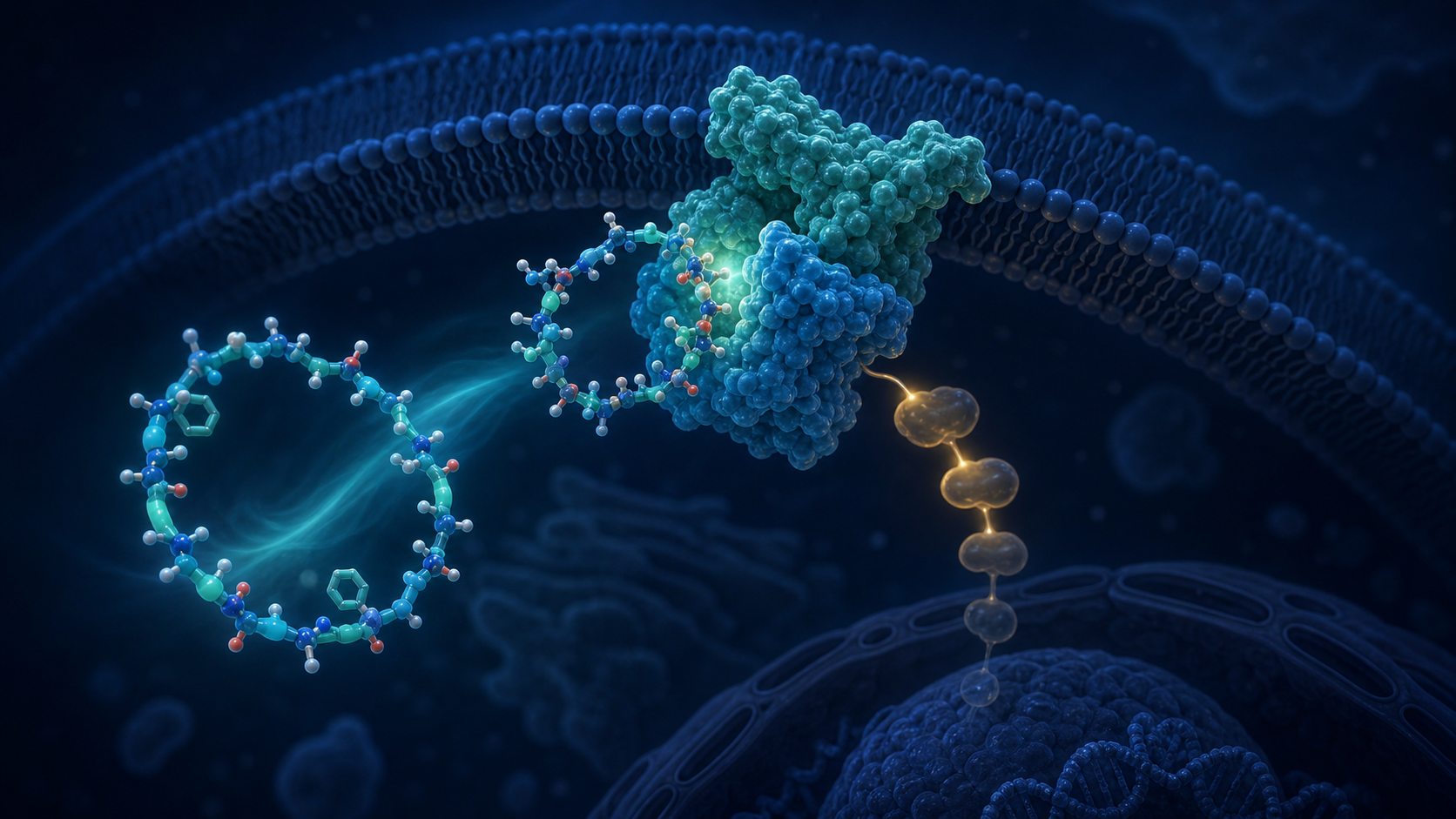
LUNA18 is designed to bind the inactive, GDP-bound form of RAS and limit downstream signaling. This is a conceptual illustration, not a molecular structure or clinical result.
LUNA18 paluratide: quick facts
- What it is: An investigational macrocyclic peptide developed by Chugai Pharmaceutical
- How it is taken in research: Designed for oral availability, an unusual achievement for a peptide-sized molecule
- Proposed target: GDP-bound RAS proteins across more than one RAS variant, described by the authors as pan-RAS inhibition
- Published evidence discussed here: Cancer-cell experiments and animal xenograft models
- Alterations represented in the paper: G12 and G13 mutations and KRAS amplification, among other RAS-altered models
- Human study record: NCT05012618, an industry-sponsored phase 1 study with 128 actual participants, is listed as terminated and has no posted results
- What remains unknown publicly: Whether the compound produced meaningful patient benefit, why the development program ended, and whether its human exposure, selectivity, and safety supported further development
This article is educational only. It does not provide diagnosis, prognosis, treatment selection, dosing, sourcing, purchasing, or clinical recommendations.
What did the July 2026 LUNA18 paper report?
The paper reports broad preclinical activity, sustained pathway suppression, and stronger effects in some combination experiments—but every efficacy statement belongs to a laboratory model.
Sase and colleagues published the study in Molecular Cancer Therapeutics on July 30, 2026. The authors, who were affiliated with Chugai Pharmaceutical, described LUNA18 as a first-in-class, orally available cyclic peptide pan-RAS-GDP inhibitor.
The abstract reports four main findings:
- Activity across diverse RAS alterations. LUNA18 showed antitumor effects in cancer-cell models with RAS changes including G12 and G13 mutations and KRAS amplification.
- Sustained MAPK-pathway suppression. Under long-term treatment and growth-factor stimulation, the investigators reported more potent and sustained signal inhibition than with KRAS G12C inhibitors in the tested systems.
- Combination activity. The paper reports synergy when LUNA18 was combined with agents targeting receptor tyrosine kinases, or RTKs, and the MAPK pathway.
- More durable effects in selected xenografts. In some mouse tumor models where KRAS G12C inhibitor activity was limited, combinations containing LUNA18 produced more durable antitumor effects than either monotherapy.
These results make a coherent preclinical case for studying the compound. They do not establish response rates, survival, quality of life, or an acceptable benefit-risk balance in people.
Quick answer: Did LUNA18 shrink tumors in patients? The July 2026 paper does not answer that question. Its efficacy experiments were performed in cancer cells and xenograft models, not a reported patient cohort.
How is pan-RAS inhibition supposed to work?
Pan-RAS inhibition aims at a shared state of several RAS proteins rather than one mutation-specific pocket. That could broaden biological coverage, but it may also narrow the margin between blocking tumor signaling and disturbing normal signaling.
RAS proteins act like molecular switches. In simplified terms, GDP-bound RAS is the quieter or “off” state, while GTP-bound RAS is the active state that can drive signaling through the RAF-MEK-ERK branch of the MAPK pathway. Cancer-associated RAS alterations can bias that switch toward persistent growth signaling.
LUNA18 was designed to bind RAS in its GDP-bound state. The “pan” label reflects intended activity across multiple RAS forms rather than exclusive recognition of one mutant protein.
The paper’s sustained-suppression argument involves wild-type RAS as well as mutant RAS. In the authors’ models, normal RAS proteins could help restore MAPK signaling after upstream stimulation. Inhibiting that wild-type contribution was proposed as one reason LUNA18 maintained pathway suppression longer than the mutation-specific comparator in those experiments.
That same feature raises an obvious translational question. Wild-type RAS participates in normal cellular signaling. A drug that blocks it broadly may have useful anticancer activity, but exposure and toxicity have to separate a workable medicine from a mechanism that is simply powerful in a model.
How is this different from a KRAS G12C inhibitor?
A KRAS G12C inhibitor is mutation-specific; LUNA18 is intended to cover a broader set of GDP-bound RAS proteins. The difference is target breadth, not proof that one approach is clinically superior.
| Feature | Mutation-specific KRAS G12C inhibition | LUNA18 pan-RAS-GDP concept | |---|---|---| | Primary target logic | A druggable pocket associated with KRAS G12C | A shared GDP-bound state across multiple RAS proteins | | Genetic scope | Tumors carrying KRAS G12C | Intended to extend across several RAS alterations | | Wild-type RAS | Usually not the central target | Wild-type RAS inhibition is part of the proposed sustained effect | | Clinical evidence | Some G12C inhibitors have established human efficacy in defined settings | The public LUNA18 record cited here does not establish favorable human efficacy | | Core tradeoff | Narrower mutation coverage | Potentially broader coverage with added selectivity and toxicity questions |
Mutation-specific drugs can be defeated by pathway reactivation, alternate RAS signaling, or additional resistance changes. A broader inhibitor might suppress more escape routes. It might also affect more normal biology. Only transparent human pharmacology, safety, and efficacy results can show where that tradeoff lands.
Why were the combinations interesting?
The combinations were scientifically interesting because they attacked both RAS signaling and routes that can reactivate the pathway. They were not validated treatment strategies for patients.
Receptor tyrosine kinases sit upstream of RAS, while the MAPK cascade runs downstream. Combining agents at different points can sometimes deepen pathway suppression or delay rebound in experimental systems. The paper reports synergy with both RTK-targeting and MAPK-pathway agents.
It also describes selected xenograft combinations as more durable than monotherapy where KRAS G12C inhibition alone had limited efficacy. “Durable” here means the model’s tumor-control effect lasted longer under the reported experimental conditions. It does not mean durable clinical response in people.
Combination results can be especially difficult to translate. Two compounds may look complementary in a model yet produce overlapping toxicity, incompatible exposure, or little added benefit in patients. The number of possible combinations also creates a selection problem: favorable model results need independent testing against realistic controls, doses, schedules, and tumor diversity.
Why is an oral cyclic peptide scientifically notable?
Oral availability is notable because most conventional peptides are poor oral drugs. Cyclic design can improve stability and membrane behavior, but “oral” does not automatically mean adequately absorbed, selective, safe, or effective.
Linear peptides are commonly broken down by digestive enzymes and often cross cell membranes poorly. Closing a peptide into a ring can reduce conformational flexibility, protect vulnerable bonds, and present chemical features in ways that may improve permeability and target binding.
LUNA18 belongs to the “beyond rule of five” area of drug design: molecules larger and more structurally complex than traditional small-molecule guidelines would predict, yet engineered to achieve useful oral exposure and intracellular access.
That is a genuine drug-design achievement. It answers a formulation and delivery challenge, not the clinical question. An oral compound can still fail if too little reaches tumors, too much reaches healthy tissue, metabolism varies, or the required exposure causes unacceptable effects. A separate TREM2 cyclic-peptide study shows the same boundary from another angle: target binding and cell effects did not establish brain exposure or organism-level efficacy.
Quick answer: Does oral availability make LUNA18 clinically proven? No. Oral availability describes a delivery property. Clinical value requires human evidence of exposure, safety, and meaningful outcomes.
What does the terminated phase 1 record tell us?
The registry shows that LUNA18 reached human testing, but it currently does not provide a favorable human efficacy result or a detailed explanation for the program’s end.
ClinicalTrials.gov lists NCT05012618 as a sponsor-run phase 1 study of LUNA18 alone and with cetuximab in locally advanced or metastatic solid tumors. The study was open-label, non-randomized, and enrolled 128 participants. Its objectives included safety, pharmacokinetics, pharmacodynamics, and preliminary activity.
The record lists an actual completion date of November 13, 2025 and an overall status of Terminated. The reason given is: “Sponsor decided to discontinue this study upon having LPLV.” LPLV generally means last patient, last visit.
That statement tells us the sponsor made a discontinuation decision after the last participant’s last visit. It does not say whether the decision reflected efficacy, safety, exposure, commercial priorities, portfolio strategy, or another factor. The registry currently shows no posted results.
The honest reading is therefore narrow:
- The program entered a 128-person phase 1 study.
- The study is listed as terminated after its completion date.
- The sponsor’s public reason is terse and non-specific.
- The registry does not currently establish why development stopped.
- The registry does not currently provide a favorable human efficacy finding.
Calling the terminated status proof that LUNA18 “failed” would go beyond the public record. Calling the preclinical paper evidence that it works in patients would go much further beyond it.

Cell and xenograft findings can support a research hypothesis. They do not cross the evidence gap to patient benefit by themselves.
Why can a promising preclinical mechanism fail in people?
Translation can fail because human tumors and human bodies impose constraints that simplified models cannot reproduce. Six issues matter especially here.
Drug exposure
The compound must reach the right tissues at a sufficient concentration for long enough. Oral absorption, metabolism, protein binding, tumor penetration, and dosing variability can all change the effective exposure.
Selectivity
Broad target coverage may help across multiple RAS alterations, but inhibition of wild-type RAS could affect healthy cells. The therapeutic window must be wide enough to suppress tumors without unacceptable disruption of normal signaling.
Toxicity
Cell cultures and mouse xenografts cannot predict every human adverse effect. Combination regimens add another layer because toxicity can overlap even when the mechanisms look complementary.
Resistance
Tumors can adapt through altered RAS cycling, pathway rewiring, parallel survival signals, target changes, or selection of resistant subclones. Sustained suppression in one model does not guarantee control across diverse human tumors.
Tumor biology
“RAS-altered cancer” is not one disease. Tissue of origin, co-mutations, immune context, stromal biology, prior treatments, and intratumor heterogeneity can all change drug response.
Transparent human results
Mechanistic elegance cannot substitute for reported clinical data. Interpreting a program responsibly requires participant disposition, exposure, dose-limiting toxicities, adverse events, pharmacodynamic effects, response assessments, duration, and the reasons development continued or stopped.
For a broader framework, see What Preclinical Actually Means, When a Peptide Enters Phase 1, and How to Evaluate Peptide Claims Online.
What should readers conclude from LUNA18?
LUNA18 is a notable example of cyclic-peptide engineering and a credible preclinical pan-RAS strategy, but its clinical value remains unresolved in the public evidence reviewed here.
The July 2026 paper supports the claim that paluratide affected RAS-driven signaling and tumor growth in specific cell and xenograft models. It also gives a mechanistic explanation for sustained MAPK suppression and reports promising combinations.
The public clinical record supplies a necessary counterweight. A phase 1 study enrolled 128 participants, ended, is listed as terminated, and currently has no posted results. The registry’s one-line reason does not explain the development decision or demonstrate patient benefit.
That tension is not a contradiction. Preclinical science can be strong on its own terms while the clinical question remains unanswered. The mistake is treating those terms as interchangeable.
Frequently asked questions
What is LUNA18 paluratide?
LUNA18, or paluratide, is an investigational orally available macrocyclic peptide designed to inhibit GDP-bound RAS proteins across multiple RAS forms.
Is LUNA18 a pan-RAS inhibitor?
The developers and July 2026 paper describe it as a pan-RAS-GDP inhibitor. That label describes its intended target breadth and reported model activity; it does not establish broad clinical effectiveness.
Did the paper include people with cancer?
The efficacy paper discussed here reports cell and animal experiments. A separate phase 1 study enrolled people with solid tumors, but ClinicalTrials.gov currently shows no posted results.
Why was the LUNA18 trial terminated?
The registry says the sponsor decided to discontinue the study after the last patient’s last visit. It does not provide a more specific public explanation, so the reason cannot be determined from the registry alone.
Is LUNA18 the same as a KRAS G12C inhibitor?
No. KRAS G12C inhibitors target a particular mutant form. LUNA18 was designed around a GDP-bound state shared by multiple RAS proteins, including wild-type RAS in the proposed mechanism.
Sources
- Sase H, et al. “Anti-tumor activity of orally available cyclic peptide LUNA18 through direct pan-RAS inhibition across diverse RAS genetic alterations.” Molecular Cancer Therapeutics. Published July 30, 2026. PubMed · DOI
- ClinicalTrials.gov. “A Dose-escalation Study of LUNA18 in Patients With Locally Advanced or Metastatic Solid Tumors (With Expansion).” NCT05012618. Registry record