Icotrokinra for Ulcerative Colitis: What the Phase 2 Oral-Peptide Trial Shows
The ANTHEM-UC phase 2b trial found a clear 12-week clinical-response signal for icotrokinra in adults with moderately to severely active ulcerative colitis. It did not establish long-term benefit, superiority to existing therapies, or broad safety.
Published in the New England Journal of Medicine in October 2026, the randomized trial assigned 252 adults to one of three icotrokinra groups or placebo. All three icotrokinra groups had higher rates of clinical response at week 12 than placebo. Some higher-bar outcomes also favored the highest tested group, but a prespecified multiplicity sequence stopped when one middle-group comparison missed its statistical threshold.
That distinction matters. “The trial was positive” is accurate for its primary endpoint. “Every reported outcome was statistically proven” is not.
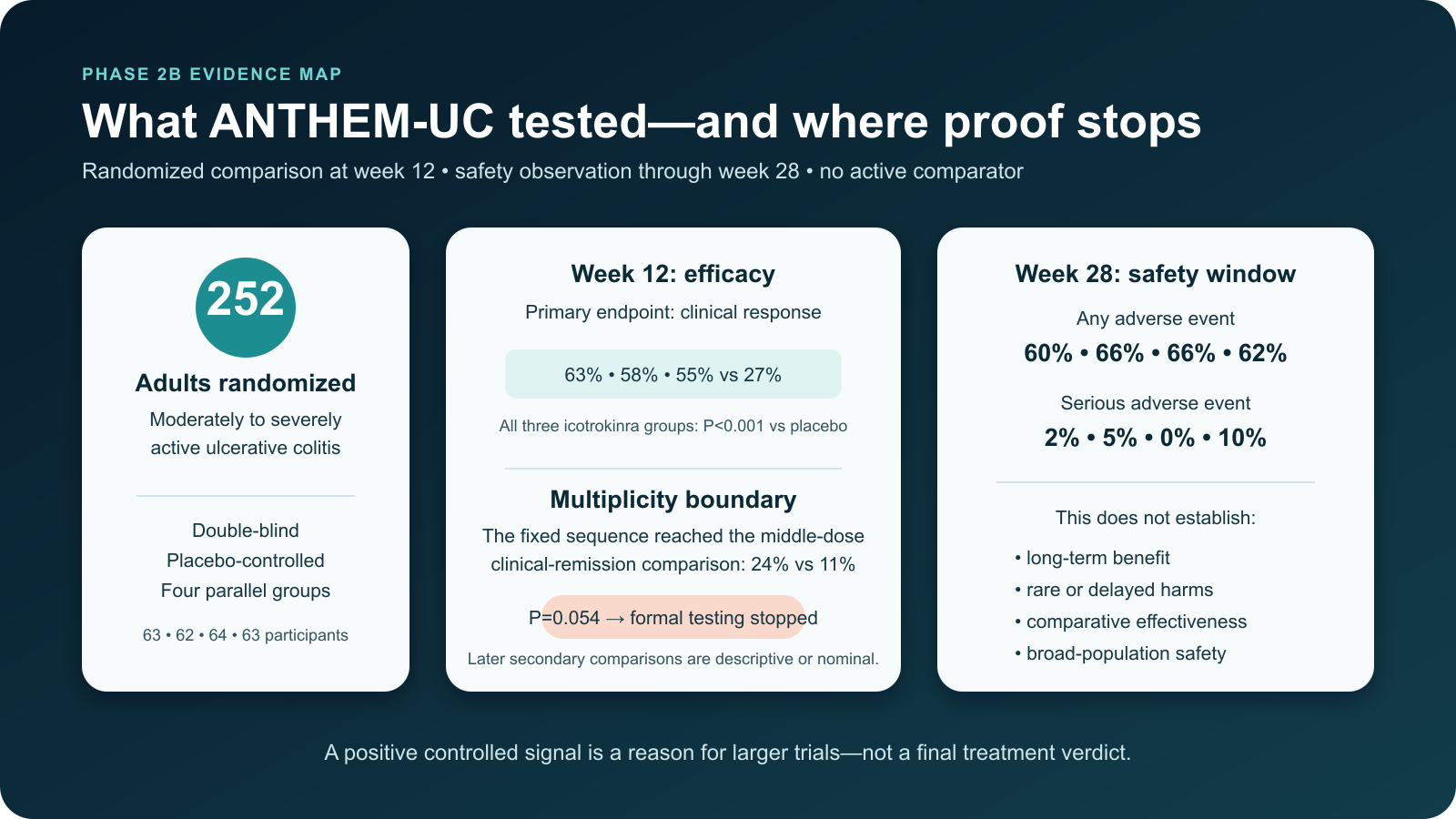
ANTHEM-UC produced a controlled 12-week efficacy signal and 28 weeks of safety observation. Those time horizons do not answer every long-term or comparative question.
What is icotrokinra?
Icotrokinra is an oral peptide designed to block the interleukin-23 receptor, or IL-23R. IL-23 is part of an immune-signaling pathway involved in chronic inflammatory diseases, including inflammatory bowel disease.
The key word is targeted. Icotrokinra is not being developed as a generic nutritional peptide or as a vaguely defined “gut-healing” product. It is a named molecule with a specified receptor target, manufacturing controls, a registered clinical-development program, and prespecified outcome measures.
It is also important not to confuse route of administration with evidence. “Oral peptide” tells you that a peptide-based molecule can be delivered by mouth. It does not, by itself, tell you whether a product works, is safe, survives digestion, reaches its target, or has been studied in people.
How was the ANTHEM-UC trial designed?
ANTHEM-UC was a phase 2b, multicenter, randomized, double-blind, placebo-controlled, dose-ranging trial. The 252 participants had moderately to severely active ulcerative colitis and a history of inadequate response or intolerance to conventional or advanced therapy.
Randomization created four groups:
- 63 participants in the highest icotrokinra group;
- 62 in the middle group;
- 64 in the lowest group; and
- 63 in the placebo group.
Participants and investigators were masked to assignment. The primary endpoint was clinical response at week 12. Secondary outcomes included clinical remission, symptomatic remission, and endoscopic improvement at week 12. Safety was reported through week 28 in the paper.
This design is stronger than an uncontrolled case series because randomization and placebo comparison help separate treatment effects from natural fluctuation, expectation, regression to the mean, and other sources of bias. But phase 2b remains a development stage: it is meant to identify a credible efficacy signal, explore dose response, and characterize common short-term adverse events before larger confirmatory testing.
What did the trial show at week 12?
Clinical response occurred in 63%, 58%, and 55% of the three icotrokinra groups, compared with 27% of the placebo group. Each active-versus-placebo comparison had a reported P value below 0.001.
That was the primary result, and it is the strongest conclusion supported by the trial: in this selected study population, icotrokinra increased the probability of meeting the trial's prespecified clinical-response definition over 12 weeks.
The highest tested group also had better week-12 results than placebo for several secondary outcomes:
| Outcome | Highest icotrokinra group | Placebo | Reported P value |
|---|---|---|---|
| Clinical remission | 30% | 11% | 0.006 |
| Symptomatic remission | 46% | 19% | <0.001 |
| Endoscopic improvement | 37% | 14% | 0.002 |
These outcomes are related, but they are not interchangeable. A study can show a broad response without showing that the same proportion of people reached remission or had visibly improved bowel lining.
Clinical response, remission, symptomatic remission, and endoscopic improvement are different
The endpoints form different evidence layers: improvement, low disease activity, symptom control, and visible mucosal change. Their definitions in ANTHEM-UC were based on components of the modified Mayo score.
Clinical response
Clinical response meant a decrease in the modified Mayo score of at least 30% and at least 2 points, plus improvement in rectal bleeding or a low rectal-bleeding score. It captures meaningful improvement from baseline. It does not mean the disease disappeared.
Clinical remission
Clinical remission required a stool-frequency score of 0 or 1 without worsening from baseline, no rectal bleeding, and an endoscopy score of 0 or 1. This is a more demanding composite than response because it combines symptom control with an endoscopic component.
Symptomatic remission
Symptomatic remission required a stool-frequency score of 0 or 1 without worsening and no rectal bleeding. It focuses on what the participant experiences and reports. It does not require the endoscopic component used in clinical remission.
Endoscopic improvement
Endoscopic improvement meant an endoscopy score of 0 or 1. It reflects what clinicians could see in the bowel lining, not just symptom reports. “Improvement” still is not synonymous with complete healing, cure, or durable remission.
| Endpoint | Main question answered | What it does not prove |
|---|---|---|
| Clinical response | Did disease activity improve meaningfully from baseline? | Remission or cure |
| Clinical remission | Did symptoms and the endoscopic component reach a low-activity threshold? | Permanent disease control |
| Symptomatic remission | Were stool frequency and rectal bleeding controlled? | Endoscopic improvement |
| Endoscopic improvement | Did the bowel lining look less active on endoscopy? | Symptom relief, durability, or long-term outcomes |
Where did the fixed-sequence testing stop?
The multiplicity-controlled sequence stopped at the middle icotrokinra group's clinical-remission comparison, which was 24% versus 11% with placebo and had P=0.054. Because that comparison did not cross the prespecified boundary, no further formal testing of later secondary endpoints was conducted.
Multiplicity control exists because testing many outcomes and groups creates more chances to obtain a small P value by chance. A fixed-sequence procedure protects the overall false-positive rate by specifying the order in which hypotheses may be formally tested. The testing “budget” advances only while each required step succeeds.
The paper reports the highest-group comparisons above as statistically significant and identifies the middle-group clinical-remission result as the stopping point. Once that comparison missed, outcomes later in the hierarchy could still be shown as observed percentages or nominal P values. They could not be promoted to multiplicity-controlled statistical conclusions.
That is not statistical pedantry. It is the line between an observation worth following and a claim the study was designed to confirm while controlling its overall error rate.
What does the safety follow-up show?
Through week 28, overall adverse-event rates were similar across groups, but the study was too small and too short to establish broad safety. Any adverse event was reported in 60%, 66%, and 66% of the icotrokinra groups and 62% of the placebo group. Serious adverse events occurred in 2%, 5%, and 0% of the icotrokinra groups and 10% of the placebo group.
Those percentages are descriptive signals, not proof that icotrokinra prevents serious events or is safer than placebo. With roughly 60 participants per group, a few events can change a percentage substantially. The trial also cannot reliably detect rare harms, harms that emerge after longer exposure, or risks concentrated in populations that were excluded or underrepresented.
The appropriate conclusion is narrow: no broad short-term imbalance is obvious in these reported categories, and larger, longer studies are needed to characterize safety more precisely.
What ANTHEM-UC does not establish
A 12-week efficacy comparison plus safety observation through week 28 leaves several major questions open.
- Long-term benefit: The primary controlled result was at week 12. It does not prove durable remission, fewer hospitalizations or surgeries, steroid-free disease control over years, or maintained benefit after stopping treatment.
- Comparative effectiveness: Placebo was the comparator. The trial does not show whether icotrokinra is better, worse, or easier to sustain than biologics, small-molecule medicines, or other IL-23-pathway therapies.
- Broad safety: A 252-person phase 2b study cannot settle uncommon, delayed, or population-specific risks.
- Universal effectiveness: Trial eligibility selected a particular population. Results should not be silently generalized to every person with ulcerative colitis.
- A complete dose decision: Dose-ranging data help later development, but this article does not provide dosing guidance and the trial does not substitute for a regulated label or individualized clinical judgment.
The study was funded by Johnson & Johnson, and several authors were affiliated with the company. Industry funding does not invalidate a randomized trial, but it is relevant context. Independent replication, larger phase 3 programs, full regulatory review, and post-authorization evidence answer different questions than a sponsor-funded phase 2 study.
Why this is different from vague “oral peptide” marketing
The meaningful difference is not that one product uses the word peptide more convincingly; it is that ANTHEM-UC exposes a testable development chain. Readers can identify the molecule, target, population, comparator, masking, endpoint definitions, time points, statistical hierarchy, trial registration, funding, and peer-reviewed results.
Consumer marketing often supplies none of that. It may use “oral peptide” as if the phrase itself proves absorption, target engagement, effectiveness, or safety. It does not. A product claim becomes assessable only when the claimed molecule and formulation are tied to transparent evidence at the relevant level: analytical testing, pharmacology, controlled human trials, and regulatory oversight.
For a broader example of why route-of-administration language can mislead, see Is an oral GLP-1 pill necessarily a peptide?. To understand why a research label is not a safety or effectiveness standard, read What “research use only” means. The phase 1 evidence guide also explains why each clinical-development stage answers only part of the larger question.
Bottom line
ANTHEM-UC provides credible phase 2 evidence that icotrokinra can improve short-term ulcerative-colitis outcomes compared with placebo, with the clearest proof attached to the prespecified week-12 clinical-response endpoint. The endpoint distinctions and fixed-sequence boundary prevent the results from being flattened into “everything worked.”
The study advances icotrokinra's clinical-development case. It does not establish long-term benefit, comparative superiority, broad safety, or a treatment recommendation. That is the useful way to read a positive phase 2 trial: as meaningful evidence with an equally meaningful perimeter.
Frequently asked questions
Did icotrokinra work in the ANTHEM-UC trial?
Yes for the primary week-12 endpoint: all three icotrokinra groups had higher clinical-response rates than placebo. That does not mean every secondary endpoint at every tested level was formally positive.
Is clinical response the same as remission?
No. Clinical response means meaningful improvement from baseline. Remission uses stricter thresholds, and symptomatic remission and endoscopic improvement measure different aspects of disease activity.
Why did formal secondary testing stop?
The prespecified fixed sequence reached a middle-group clinical-remission comparison with P=0.054. Because it missed the required threshold, later secondary comparisons were no longer eligible for multiplicity-controlled significance claims.
Does the trial prove icotrokinra is safe long term?
No. The paper reported safety through week 28 in 252 randomized participants. That can identify common short-term patterns but cannot settle rare, delayed, or long-term risks.
Does “oral peptide” mean a consumer peptide product works the same way?
No. “Oral peptide” describes a molecular class and route, not evidence quality. Icotrokinra's claim is tied to a specific molecule, receptor target, formulation, and regulated clinical program.
Sources
- Abreu MT, Siegmund B, Surace L, et al. Phase 2 Trial of Icotrokinra for Patients with Ulcerative Colitis. New England Journal of Medicine. 2026;395:1495–1504. doi:10.1056/NEJMoa2604435.
- ANTHEM-UC trial registry: NCT06049017. ClinicalTrials.gov.
- Johnson & Johnson Medical Connect. Icotrokinra: Treatment of Ulcerative Colitis (ANTHEM-UC). Updated October 16, 2026.
This article is for general education and evidence literacy. It does not provide medical advice, treatment selection, dosing instructions, or purchasing guidance.