GLP-1 Drugs and Gastroparesis: What 13 Published Cases Can—and Cannot—Show
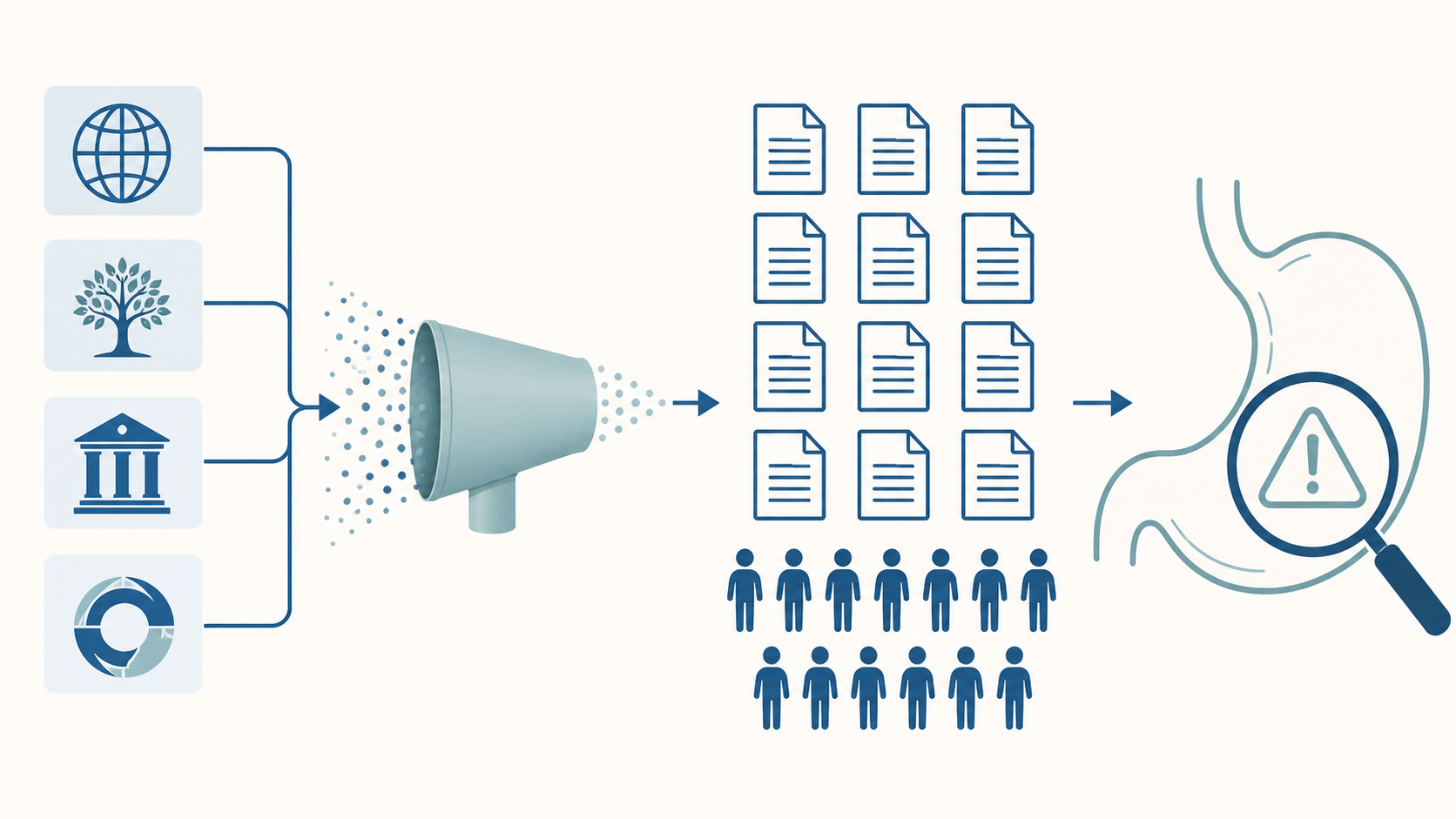
A systematic search can be rigorous even when the evidence it finds is sparse. Here, four databases ultimately yielded 12 case reports describing 13 patients.
The best reading of the GLP-1 gastroparesis evidence is cautious but not dismissive: published case reports describe a clinically plausible safety signal and show what reported presentations can look like, but they cannot tell us how often gastroparesis occurs, prove that a GLP-1 drug caused every case, or establish that one drug is riskier than another.
That distinction matters because the phrase “systematic review” can sound more conclusive than the underlying evidence. The August 13, 2026 PLOS One review used a systematic method to search PubMed, Embase, Scopus, and Web of Science from inception through October 14, 2025. Yet after screening, the included evidence consisted of only 12 case reports describing 13 patients.
Quick answer: The review is useful for identifying a possible safety signal and summarizing reported symptoms, timing, diagnostic approaches, and outcomes. It is not designed to estimate incidence, compare risks among GLP-1 drugs, or prove population-level causality.
What does the GLP-1 gastroparesis evidence actually show?
The review found a small, selected collection of patients who developed or experienced worsening gastroparesis-like illness while using a GLP-1 receptor agonist. Most reported patients were women, and many had type 2 diabetes. Cases also appeared in people without diabetes.
The reports involved semaglutide most often, followed by liraglutide, dulaglutide, and exenatide. Reported presentations included nausea, vomiting, abdominal pain, bloating, early satiety, and difficulty tolerating food or fluids. Onset ranged from hours to months after treatment began or changed.
Diagnostic evaluation was not identical across cases. Some reports described gastric distension or retained stomach contents on imaging or endoscopy after mechanical obstruction had been excluded. Gastric-emptying scintigraphy was used in selected cases rather than consistently across the full group.
The review also summarized what happened after clinicians managed these individual cases. That history helps describe the reports, but it should not be converted into individualized instructions. A systematic review of case reports is not a treatment guideline, and this article does not provide advice about stopping, switching, titrating, diagnosing, or treating GLP-1-related symptoms.
Why is this still a meaningful safety signal?
The signal is clinically plausible because GLP-1 receptor activation is already known to affect gastric emptying, and the reports describe a temporal relationship between drug exposure and symptoms in individual patients. Some cases also documented improvement after the suspected drug was withdrawn, while selected cases included objective testing.
Those features make the reports worth investigating. They are more informative than an unsupported online anecdote because they appeared in clinical publications and often included medical evaluation. By placing the cases side by side, the review makes recurring features easier to see.
But “plausible” is not the same as “proven,” and “reported repeatedly” is not the same as “common.” A safety signal is a reason for better study, not a numerical risk estimate hiding in a lab coat.
Signal versus proof: Case reports can show that an event occurred after an exposure and can reveal patterns worth testing. They generally cannot show how much more often the event occurs among exposed people than among comparable unexposed people.
Why 13 cases cannot estimate incidence or frequency
Incidence requires a denominator: the number of new events in a defined population over a defined period. These case reports supply a numerator-like count of published patients, but no denominator representing everyone who used GLP-1 receptor agonists during the same period.
Without that denominator, 13 reports cannot be translated into “one in X users,” a percentage, or a population frequency. The review itself states that the true incidence and risk magnitude cannot be determined from the available literature.
The published count is also not a complete census of events. Some suspected cases may never be recognized, written up, accepted, or indexed. Conversely, unusual, severe, or apparently drug-related cases are more likely to become case reports than routine experiences. Both underreporting and selective reporting can distort the visible pattern.
This is the denominator problem: a pile of case reports may grow while still telling us nothing reliable about the rate of the event among all users.
Five limits that shape the GLP-1 gastroparesis evidence
The main limitations are not technical footnotes; they determine what conclusions are defensible.
1. Selection bias
Published cases are selected, not sampled. Clinicians may be more likely to report severe, surprising, or diagnostically interesting presentations. The resulting group does not necessarily resemble the broader population using these medicines.
2. Reporting and publication bias
Case reports depend on what authors noticed and chose to document. The review noted incomplete and inconsistent information across reports, and many source items were conference abstracts with limited clinical detail. Cases with clear timelines or dramatic outcomes may be more publishable than ambiguous cases.
3. No denominator or comparison group
The included reports did not provide a defined population of GLP-1 users or a matched group of non-users. That prevents calculation of incidence, relative risk, or excess risk attributable to exposure.
4. Confounding and competing explanations
Many patients had type 2 diabetes, which can itself affect gastric emptying through diabetic autonomic neuropathy and other mechanisms. Three of the 13 cases had evidence of pre-existing or subclinical gastroparesis, according to the review. In such cases, a GLP-1 drug might have contributed, worsened an existing problem, coincided with it, or played a different role than the report initially suggests.
Other medications, metabolic conditions, prior symptoms, and differences in diabetes duration or control can also complicate causal interpretation. A temporal sequence alone does not eliminate those alternatives.
5. Diagnostic inconsistency
The reports did not all use the same diagnostic pathway. Symptoms such as nausea, vomiting, fullness, and abdominal pain are not specific to gastroparesis. Imaging, endoscopy, exclusion of obstruction, and gastric-emptying testing were applied unevenly, making it difficult to know whether every report represented the same clinical entity.
Bottom line: Systematic methods reduce arbitrariness in finding and reviewing studies. They do not upgrade 12 case reports into a cohort study or randomized trial.
Does semaglutide appearing most often mean it is uniquely riskier?
No. Semaglutide was involved in seven of the 13 reported patients, but that count cannot establish comparative drug risk.
To compare semaglutide with liraglutide, dulaglutide, exenatide, or another agent, researchers would need exposure denominators and reasonably comparable populations. The case-report set has neither. A drug used more widely, discussed more often, or scrutinized more intensely can generate more reports even if its individual-user risk is similar to—or lower than—that of another drug.
Reporting can also differ by time period, market uptake, media attention, clinician familiarity, and the availability of newer products. The review’s authors explicitly cautioned that the pattern may reflect wider contemporary use of long-acting GLP-1 receptor agonists.
The correct statement is narrow: semaglutide appeared most frequently in this published case set. “Semaglutide is the riskiest GLP-1 drug for gastroparesis” would be an unsupported leap.
Can the cases prove that GLP-1 drugs caused gastroparesis?
The cases support suspicion, not universal proof of causality. Timing, biological plausibility, improvement after withdrawal in reported cases, and objective findings in some patients strengthen a causal hypothesis. They do not fully exclude diabetic gastroparesis, other illnesses, other medications, measurement differences, or selective reporting.
Rechallenge—the event recurring after deliberate re-exposure—can sometimes add causal information, but deliberately testing a potentially harmful exposure is often inappropriate. Even without rechallenge, stronger causal inference can come from well-designed observational studies that establish exposure before outcome, use consistent definitions, measure confounders, and compare against relevant controls.
The review therefore does something valuable but bounded: it organizes clinical observations and identifies questions that larger studies should answer.
What evidence would answer the questions these cases cannot?
Different questions require different study designs.
| Question | Evidence needed | |---|---| | How often does gastroparesis occur among GLP-1 users? | A large defined cohort with consistent outcome ascertainment and person-time denominators | | Is risk higher than in comparable non-users? | A controlled cohort or other comparative design with confounding addressed | | Is one GLP-1 drug riskier than another? | Head-to-head comparative data with drug-specific exposure denominators | | Does risk vary by diabetes status or prior gastric-motility problems? | Prespecified subgroup analyses with baseline clinical information | | Are reported cases consistently the same diagnosis? | Standardized diagnostic definitions and testing across participants | | Is there a dose-response relationship? | Exposure data analyzed across defined dose and duration categories, without turning the result into personal dosing advice |
Prospective studies would be especially helpful because researchers could define symptoms and testing in advance rather than reconstructing them from incomplete reports. Large observational databases can add scale, but they still require careful outcome definitions and confounding control. For comparison, a nationwide GLP-1 bowel-obstruction study used an active comparator and defined serious intestinal outcomes, but it addressed a different condition and still could not prove zero risk.
How should readers interpret this review?
Readers should hold two ideas at once: the reported cases deserve attention, and the review does not establish population-level risk.
That is not fence-sitting. It is what the evidence tier supports. Dismissing the reports because there are only 13 patients would ignore a plausible signal. Treating them as proof that gastroparesis is common—or that semaglutide is uniquely dangerous—would overstate what was studied.
For a broader guide to how different sources answer different safety questions, see GLP-1 Side Effects: What Trials, Labels, and Online Communities Can Each Tell Us. For context on regulated GLP-1 medicines and vague “research peptide” marketing, see GLP-1 Peptides vs Research Peptides. Our Peptide Research Status Explained guide covers the larger evidence ladder.
Frequently asked questions
Did the review include 13 studies?
No. It included 12 case reports describing 13 patients. One report contributed two patients.
Did it search only one database?
No. The authors searched PubMed, Embase, Scopus, and Web of Science from inception through October 14, 2025.
Does a systematic review automatically provide strong causal evidence?
No. “Systematic” describes how evidence was searched for, selected, and synthesized. The strength of the conclusion still depends heavily on the designs and quality of the included studies.
Can this review show how common GLP-1-associated gastroparesis is?
No. The case reports do not provide a population denominator or comparison group, so they cannot estimate incidence or relative risk.
Does semaglutide being reported most often prove it has the highest risk?
No. Report counts can reflect usage volume, awareness, reporting behavior, and other factors. Comparative risk requires drug-specific denominators and comparable groups.
Is this article medical advice?
No. It explains how to interpret a published evidence base. It does not provide diagnosis, treatment, dosing, titration, stopping, or switching instructions. Questions about symptoms or prescribed medicines require individualized clinical evaluation.
Sources
- Olubodun T, Osundina MA, Soyoye DO, et al. “Gastroparesis induced by glucagon-like peptide-1 receptor agonists: A systematic review of clinical features, diagnosis, management, and outcomes.” PLOS One. Published August 13, 2026. doi:10.1371/journal.pone.0354497
- American College of Gastroenterology. “ACG Clinical Guideline: Gastroparesis.” American Journal of Gastroenterology. 2022. doi:10.14309/ajg.0000000000001874
This article is educational and does not provide medical advice or individualized guidance about GLP-1 medicines.