Can a Seaweed Peptide Lower Blood Sugar? What the EVYR DPP-4 Study Actually Shows
Not yet—not on the evidence available. Researchers identified EVYR, a four-amino-acid peptide, after simulated digestion of dulse and found that it inhibited dipeptidyl peptidase-4, usually shortened to DPP-4 or DPP-IV, in a laboratory assay. They did not test whether EVYR survives the human intestine, enters the bloodstream, reaches an effective concentration, changes incretin hormones, lowers glucose, prevents diabetes, or benefits patients.
That makes EVYR an interesting food-peptide lead, not a demonstrated blood-sugar intervention. The distinction matters because “it inhibits the same enzyme as a diabetes drug” sounds much stronger than the experiment actually was.
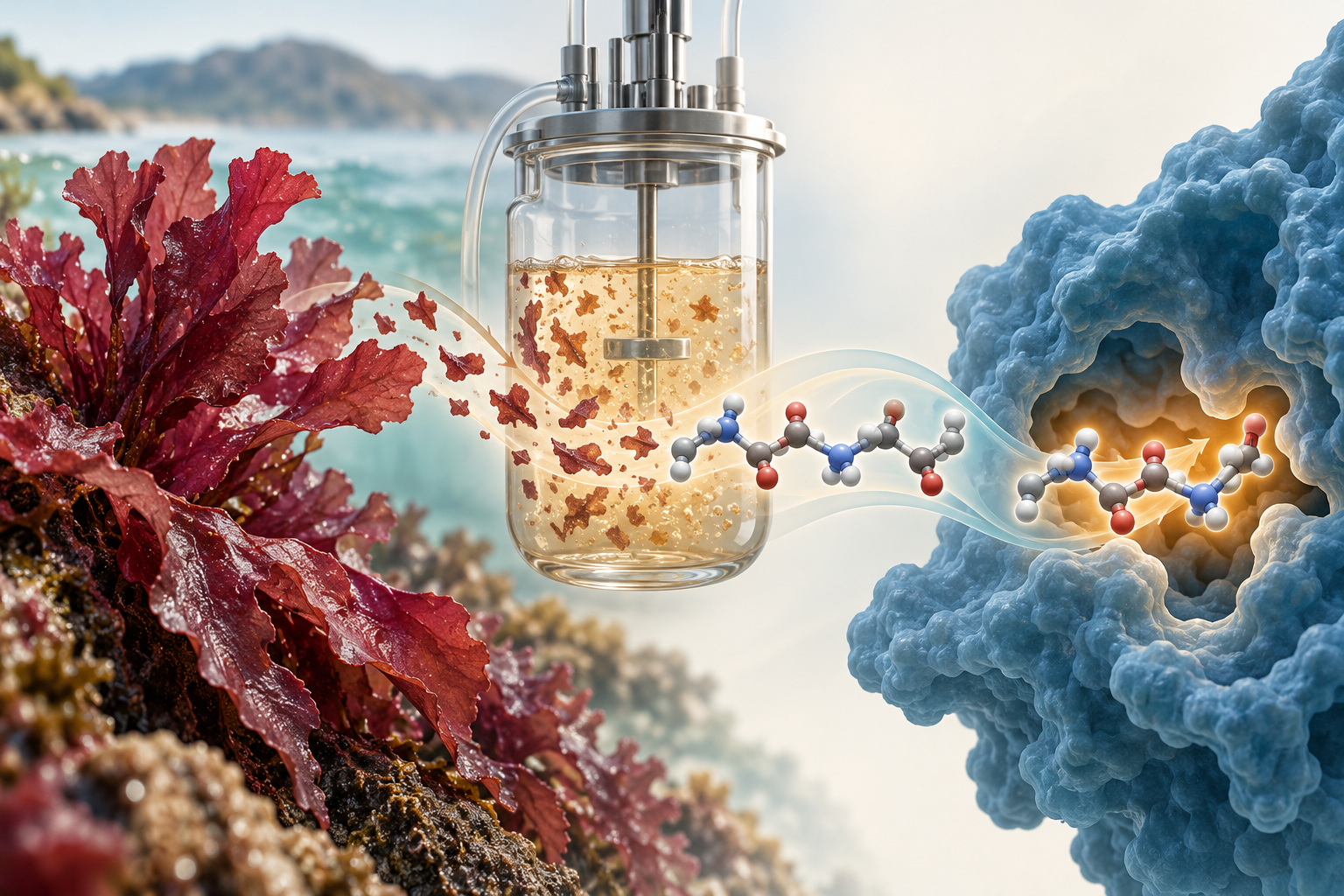
The study connected dulse, simulated digestion, EVYR detection, and DPP-4 inhibition in laboratory systems. This conceptual illustration is not study data and does not depict a human glucose effect.
Quick facts
- Peptide: EVYR, a tetrapeptide represented by the amino-acid sequence Glu-Val-Tyr-Arg
- Source studied: dulse, Devaleraea inkyuleei
- Study type: simulated digestion, analytical peptide identification and quantification, plus biochemical DPP-4 inhibition testing
- Direct result: EVYR was detected and quantified in the in-vitro digest and showed DPP-4 inhibitory activity
- Not tested: intestinal transport, blood exposure, incretin response, insulin response, glucose outcomes, diabetes prevention, safety, or clinical benefit
- Evidence level: laboratory discovery and mechanism signal
In this article
- What the EVYR study measured
- Measured, inferred, and untested claims
- How DPP-4 connects to blood glucose
- Why EVYR is not equivalent to a prescribed DPP-4 inhibitor
- The EVYR evidence ladder
- Simulated digestion versus bioavailability
- What stronger evidence would require
- Frequently asked questions
What did the EVYR study actually measure?
The credible finding is narrow: a particular dulse digestion model produced detectable EVYR, and EVYR inhibited DPP-4 in a laboratory assay.
Yuya Kumagai and colleagues reported the work in Food Bioscience in 2026. The researchers subjected powdered dulse to an artificial digestion process intended to model gastrointestinal digestion. They used liquid chromatography–tandem mass spectrometry to identify and quantify EVYR in the resulting material. They also evaluated DPP-4 inhibitory activity.
Those are useful steps. Simulated digestion is more informative than merely searching an undigested seaweed protein sequence for a peptide that might exist. Quantification is also stronger than reporting detection alone: it asks how much of the target appeared under the chosen laboratory conditions.
But the model remains a model. It shows what was recovered from a controlled digestion procedure, not what necessarily remains intact at the human intestinal surface or reaches circulation after a meal.
Claim-by-claim: measured, inferred, and not tested
The phrase “seaweed peptide blood sugar” crosses several evidence boundaries at once. This table separates them.
| Claim | Evidence status | What the study supports | |---|---|---| | Dulse proteins can release EVYR under the study’s simulated-digestion conditions | Directly measured | EVYR was identified in the in-vitro digest | | The amount of EVYR in that digest can be measured | Directly measured | LC–MS/MS was used to quantify the target peptide | | EVYR can inhibit DPP-4 in a biochemical test | Directly measured | The peptide showed DPP-4 inhibitory activity under assay conditions | | EVYR remains intact throughout human intestinal digestion | Not tested in humans | Recovery from a laboratory digest does not establish survival in a person | | EVYR crosses the intestinal barrier | Not tested | No intestinal transport or human absorption result was reported | | Eating dulse produces an effective EVYR concentration in blood or tissue | Not tested | No pharmacokinetic or exposure measurement was reported | | EVYR preserves active GLP-1 or GIP in people | Mechanistically inferred, not demonstrated | DPP-4 is involved in incretin breakdown, but target engagement in humans was not measured | | EVYR increases insulin secretion in people | Not tested | No human hormone response was measured | | EVYR lowers fasting or post-meal glucose | Not tested | No animal or human glucose outcome was reported in this study | | EVYR prevents diabetes | Not tested | Prevention requires long-term clinical outcome evidence | | EVYR provides clinical benefit or can substitute for medication | Not tested and unsupported | The study was not a treatment trial |
This is the same reading discipline explained in what preclinical actually means: the conclusion should stay at the level of the experiment.
How does DPP-4 connect to blood glucose?
DPP-4 is a biologically relevant enzyme, but inhibiting it in a test tube is not the same as changing glucose regulation in a person.
DPP-4 helps inactivate incretin hormones, including GLP-1 and GIP. These hormones participate in meal-related insulin and glucagon signaling. Prescription DPP-4 inhibitors use this pathway as part of an established drug mechanism.
That background makes EVYR worth investigating. It does not complete the chain of evidence for EVYR. A peptide can inhibit purified enzyme under controlled conditions yet fail to produce a meaningful effect in the body because it is degraded, poorly absorbed, rapidly cleared, nonspecific, or unable to reach sufficient exposure.
The study therefore supports a mechanism hypothesis: if intact EVYR reaches the relevant biological compartment at an adequate concentration, it might influence DPP-4 activity. Every important phrase in that sentence—“intact,” “reaches,” “adequate concentration,” and “might”—still needs evidence.
Why EVYR is not equivalent to a prescribed DPP-4 inhibitor
Sharing a target does not make two substances therapeutically equivalent. A known drug mechanism is a research clue, not a regulatory shortcut.
Prescribed DPP-4 inhibitors are characterized as drug products. Their development includes defined chemical identity, potency and selectivity testing, pharmacokinetics, dose-response work, controlled human trials, safety monitoring, manufacturing specifications, and regulatory review. Their clinical effects depend on reproducible systemic exposure, not merely activity in an isolated enzyme assay.
For a food-released peptide such as EVYR, major questions remain:
- Stability: Does the tetrapeptide avoid further breakdown by intestinal and brush-border peptidases?
- Transport: Can intact EVYR cross the intestinal epithelium?
- Exposure: What concentrations appear in portal or systemic circulation?
- Target engagement: Does that exposure measurably inhibit DPP-4 in vivo?
- Biological response: Are active incretin levels, insulin, glucagon, or post-meal glucose changed?
- Consistency: How much EVYR is released across dulse species, harvests, processing methods, meals, and individual digestive conditions?
- Safety and specificity: Does the peptide affect other enzymes or pathways at achievable concentrations?
- Clinical meaning: Do any changes translate into durable benefit rather than a transient biomarker shift?
Mechanism matching is seductive because it compresses that entire list into one sentence. Biology does not honor the compression.
The EVYR evidence ladder
EVYR currently sits near the bottom of the translational ladder: chemical identification, model-based release, and biochemical activity. Higher steps have not been established.
| Evidence step | Question | EVYR status from this study | |---|---|---| | 1. Sequence identification | Is the peptide present in the analyzed digest? | Reached | | 2. Quantification | How much appears under the model conditions? | Reached | | 3. Biochemical activity | Does isolated EVYR inhibit DPP-4 in an assay? | Reached | | 4. Gastrointestinal stability | Does intact EVYR persist at the intestinal surface? | Not established | | 5. Intestinal absorption | Does intact EVYR cross into the body? | Not established | | 6. Achievable exposure | Are concentrations high enough and sustained long enough? | Not established | | 7. In-vivo target engagement | Is DPP-4 measurably inhibited in an organism? | Not established | | 8. Hormone and glucose effects | Do incretins, insulin, glucagon, or glucose change? | Not established | | 9. Controlled human efficacy | Does EVYR improve a prespecified glucose outcome versus control? | Not established | | 10. Clinical benefit | Does it improve health outcomes with acceptable safety? | Not established |
The ladder is not a prediction that EVYR will climb. It is a map of what would have to be demonstrated before a clinical claim becomes defensible.
Does simulated digestion prove EVYR is bioavailable?
No. Simulated digestion shows compatibility with one laboratory digestion model; bioavailability requires evidence that intact peptide becomes available at a biological site of action.
An in-vitro digestive system can model factors such as enzymes, pH changes, and incubation time. It cannot fully reproduce gastric emptying, food-matrix effects, microbial metabolism, intestinal membrane transport, first-pass metabolism, or variation among people.
Short peptides sometimes have better chances of intestinal transport than larger proteins, but size alone does not prove absorption. Sequence, charge, transporter interactions, local degradation, and concentration all matter. EVYR’s four-residue length makes absorption a reasonable research question—not an answered one.
This is why detecting a peptide after digestion and detecting it in human plasma are fundamentally different results. The first establishes model output. The second begins to establish exposure.
What would stronger evidence look like?
The next useful studies would connect the assay result to intact-peptide exposure and then to biological outcomes. A logical progression would include:
- testing EVYR stability with intestinal and brush-border enzymes;
- measuring transport across validated intestinal models;
- confirming identity in biological samples with targeted mass spectrometry;
- establishing concentration-time profiles and in-vivo DPP-4 target engagement;
- measuring GLP-1, GIP, insulin, glucagon, and glucose responses in controlled models;
- replicating key findings independently; and
- if the earlier steps remain credible, conducting controlled human studies with prespecified outcomes and safety monitoring.
Each step can fail even when the previous one worked. That is not pessimism; it is the reason evidence ladders exist.
What the Hokkaido report gets right—and where readers should be careful
Hokkaido University accurately highlighted the peptide’s discovery and the need for further study, but some press-release language moves faster than the experiment.
The report correctly described EVYR as a four-amino-acid peptide released during simulated digestion, identified LC–MS/MS as the analytical method, and noted the need to determine whether the released amount can influence blood glucose in the human body.
However, statements that EVYR “helps maintain” incretin activity or has potential for “diabetes prevention” describe a proposed downstream implication, not a directly measured human result. The paper did not establish that EVYR reaches circulating DPP-4, preserves incretins, changes insulin release, lowers glucose, or prevents disease.
This does not make the study unimportant. It makes the correct headline smaller: researchers found and quantified a digestion-released dulse peptide with laboratory DPP-4 inhibitory activity. That is a real result. It simply is not a blood-sugar outcome.
For a broader checklist, see how to evaluate peptide claims online and why biological binding or pathway activity is not clinical proof.
Frequently asked questions
What is EVYR?
EVYR is a tetrapeptide—a chain of four amino acids—identified after simulated digestion of dulse in the Kumagai study. Its one-letter sequence corresponds to glutamic acid, valine, tyrosine, and arginine.
Did EVYR lower blood sugar in the study?
No. The researchers measured peptide release, quantity, and DPP-4 inhibitory activity. They did not report a glucose-lowering experiment in animals or humans.
Was EVYR tested in people with diabetes?
No. The study did not administer EVYR or dulse to people and did not test diabetes treatment or prevention.
Does DPP-4 inhibition guarantee an incretin effect?
No. A biochemical inhibition result does not establish that intact EVYR is absorbed, reaches DPP-4 at an effective concentration, or changes GLP-1, GIP, insulin, or glucose in vivo.
Is EVYR the same as a DPP-4 inhibitor drug?
No. It shares a laboratory target, but equivalence would require evidence for potency, selectivity, exposure, dose-response, safety, manufacturing consistency, and controlled human benefit. Those questions were not answered for EVYR.
What is the strongest conclusion from the study?
The strongest conclusion is that simulated digestion of the studied dulse powder generated quantifiable EVYR and that EVYR showed DPP-4 inhibitory activity in laboratory testing.
Bottom line
EVYR is a credible laboratory lead, not evidence that a seaweed peptide lowers blood sugar in people. The 2026 study directly supports three claims: EVYR appeared after simulated dulse digestion, researchers quantified it, and it inhibited DPP-4 in a biochemical assay.
The study did not establish intestinal survival, absorption, achievable human exposure, incretin preservation, insulin effects, glucose reduction, diabetes prevention, or clinical benefit. Until those rungs are climbed, the honest interpretation is simple: a relevant mechanism was observed at the laboratory starting line.
This article is for general education and evidence literacy. It is not medical advice and does not provide dietary, supplement, dosing, purchasing, sourcing, substitution, or treatment instructions.
Sources
- Kumagai Y, Mune Mune MA, Shinohara Y, Hatanaka T. “Identification of dipeptidyl peptidase-IV inhibitory peptides from red alga dulse (Devaleraea inkyuleei) and quantification of the target peptide from in vitro digested dulse powder.” Food Bioscience. 2026;81:109201. https://doi.org/10.1016/j.fbio.2026.109201
- Hokkaido University. “Scientists discover a promising blood sugar-regulating compound in red alga.” October 20, 2026. https://www.global.hokudai.ac.jp/news/28166/
- Liu R, Cheng J, Wu H. “Discovery of Food-Derived Dipeptidyl Peptidase IV Inhibitory Peptides: A Review.” International Journal of Molecular Sciences. 2019;20(3):463. https://doi.org/10.3390/ijms20030463
- Mentlein R, Gallwitz B, Schmidt WE. “Dipeptidyl-peptidase IV hydrolyses gastric inhibitory polypeptide, glucagon-like peptide-1(7–36)amide, peptide histidine methionine and is responsible for their degradation in human serum.” European Journal of Biochemistry. 1993;214:829–835. https://doi.org/10.1111/j.1432-1033.1993.tb17986.x
- Drucker DJ, Nauck MA. “The incretin system: glucagon-like peptide-1 receptor agonists and dipeptidyl peptidase-4 inhibitors in type 2 diabetes.” The Lancet. 2006;368:1696–1705. https://doi.org/10.1016/S0140-6736(06)69705-5