Can Bacteria Resist Programmable Antisense Antibiotics? Why the Delivery Peptide Matters
Yes. Bacteria can become less susceptible to programmable antisense antibiotics, but the route of resistance may depend as much on the delivery peptide as on the RNA-targeting sequence. In a 2026 laboratory-evolution study, bacterial populations repeatedly found ways around one carrier peptide, while a different carrier produced much smaller susceptibility changes that were mainly linked to mutations in the chosen RNA target.
That is useful engineering evidence. It is not evidence that these experimental antibiotics work safely or durably in patients.
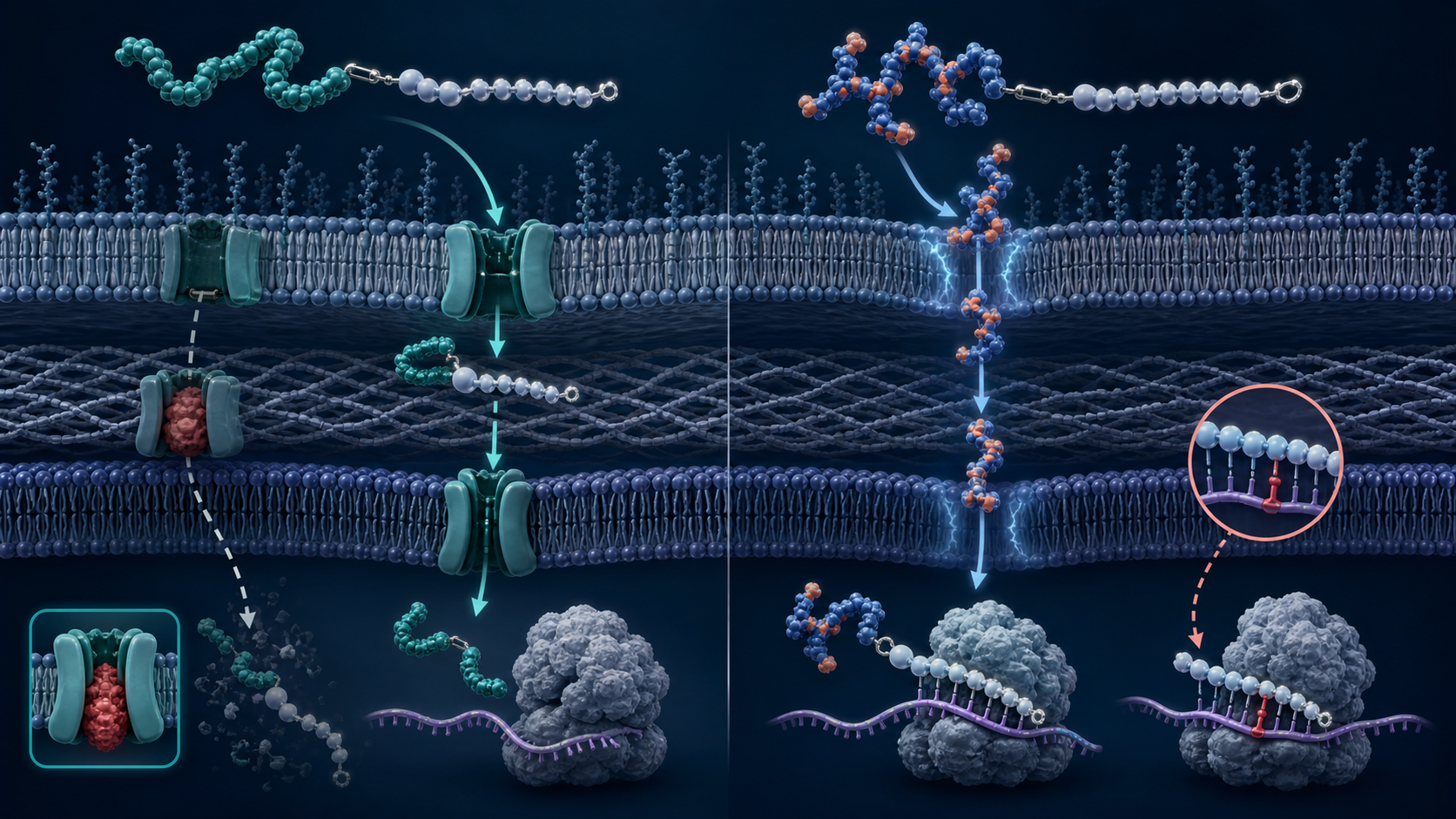
An antisense antibiotic has two functional parts: a programmable PNA payload and a peptide carrier that helps it cross the bacterial envelope. Resistance can interfere with delivery or alter the payload's RNA target. Conceptual illustration created for PeptideBase; not a literal molecular rendering.
Quick answer
- What are antisense antibiotics? Short synthetic oligomers designed to bind a chosen bacterial RNA sequence and block production of an essential protein.
- Why attach a peptide? A peptide nucleic acid (PNA) does not readily cross the multilayered envelope of Gram-negative bacteria on its own, so it is commonly joined to a cell-penetrating peptide.
- What did the study find? Resistance changes were strongly carrier-dependent.
(KFF)3K-conjugated PNAs repeatedly selected uptake-related resistance, including mutations in sbmA.(RXR)4XB-acpPproduced only modest average resistance in the tested E. coli system, associated with rare target-site mutations. - Does this prove a resistance-proof antibiotic? No. The work studied bacterial evolution under controlled laboratory conditions, not infections in animals or treated patients.
What are antisense PNA antibiotics, or asobiotics?
Asobiotics are sequence-programmable antibacterial molecules intended to stop bacteria from making a selected protein. The study focused on peptide nucleic acids, or PNAs: synthetic oligomers with nucleobases arranged on a stable, neutrally charged pseudo-peptide backbone.
The PNA sequence is designed to complement a short region of bacterial messenger RNA, usually near the translation start site of an essential gene. When the PNA binds there, it can sterically obstruct ribosome binding and translation initiation. In plain English, it covers the part of the RNA that the protein-making machinery needs to read.
“Programmable” does not mean universally active. Each PNA must match its intended sequence, and the molecule still has to reach the bacterial cytoplasm. That delivery problem is why the carrier peptide matters.
The 2026 study compared PNAs aimed at two essential genes:
- acpP, which encodes acyl carrier protein and is central to fatty-acid metabolism
- rpsH, which encodes a ribosomal protein
These payloads were coupled to (KFF)3K, its protease-resistant D-form, or (RXR)4XB. The study authors describe different entry behavior for the carriers: (KFF)3K delivery depends on the inner-membrane transporter SbmA after peptide processing, whereas (RXR)4XB is thought to use a membrane-potential-dependent route.
How did researchers test antisense antibiotics peptide resistance?
The researchers used a 16-day “drug selection ramp,” gradually increasing exposure while serially transferring surviving bacterial populations. This design asks which adaptations emerge repeatedly under a defined selection regime; it does not reproduce clinical treatment.
The experiments covered six strains from four Gram-negative species:
- Escherichia coli MG1655
- uropathogenic E. coli 536
- an E. coli ΔsbmA knockout in the BW25113 background
- Klebsiella pneumoniae ICC8001
- Salmonella enterica
- Pseudomonas aeruginosa PAO1
Each strain–construct combination had 10 biological evolution replicates. Cultures were transferred 1:100 every day for 16 passages. Exposure began at one-half of the ancestral minimum inhibitory concentration (MIC), doubled every four passages, and reached four times the MIC. Scrambled-sequence PNA conjugates served as carrier controls.
The construct coverage was not identical across every organism. (KFF)3K-acpP was tested across the susceptible strains other than P. aeruginosa, which lacks an sbmA homolog and instead received its cognate (RXR)4XB-acpP construct. All four principal constructs—KFF-acpP, D-KFF-acpP, KFF-rpsH, and RXR-acpP—were directly compared in E. coli MG1655.
After evolution, the team measured MICs and sequenced bulk populations. Genetic variants below 15% population frequency were filtered out. The analysis removed variants already found in ancestral strains and used scrambled controls to help distinguish treatment-associated changes from adaptations to serial passage. MIC fold changes were assessed with one-sample Wilcoxon signed-rank tests; selected between-construct comparisons used Bonferroni-corrected Mann–Whitney U tests.
What was the central result?
The identity of the delivery peptide strongly influenced both the size and the apparent mechanism of reduced susceptibility. In E. coli MG1655, the mean MIC fold changes were 6 for KFF-acpP and 2.5 for KFF-rpsH, compared with 1.3 for D-KFF-acpP and 1.4 for RXR-acpP.
Across the full experiment, the largest average change was a 17.6-fold MIC increase for S. enterica evolved with KFF-acpP. The smallest was the 1.3-fold average for E. coli MG1655 with D-KFF-acpP. In the RXR-acpP condition, eight of 10 E. coli MG1655 populations showed no MIC increase over the ancestor.
Those numbers should not be treated as a clinical ranking of carriers. MIC is an in-vitro susceptibility measure, the constructs and organisms were not tested in a fully crossed design, and the selection ramp itself shapes which mutations can win.
Delivery resistance and target-sequence resistance are different problems
Delivery resistance blocks the drug from reaching its target; target-sequence resistance changes the molecular address the drug was programmed to recognize. This distinction is the main evidence-literacy lesson from the paper.
Delivery and uptake resistance with (KFF)3K
Likely damaging sbmA variants appeared in at least six replicates for every species exposed to KFF-acpP that carried an sbmA homolog. Nine of 10 E. coli MG1655 populations exposed to KFF-rpsH also acquired sbmA variants. The repeated pattern across E. coli, K. pneumoniae, and S. enterica points to the carrier's uptake dependency rather than one PNA target alone.
Other recurrent changes involved the cell envelope, transport, stress responses, and translation. Examples included yaiW and ykfM in E. coli, rpoS and rfbF in S. enterica, and mdtC in K. pneumoniae. Many remain mechanistic hypotheses rather than proven resistance determinants.
The researchers did causally reconstruct two E. coli variants. A clean ΔsbmA/yaiW mutant had an MIC above 80 µM against KFF-acpP, more than 16 times the 5 µM ancestral value. A reconstructed prfB T246S substitution, affecting a peptide-chain release factor rather than uptake, produced an MIC of 20 µM, a fourfold increase. These experiments strengthen the case for at least two distinct routes to reduced susceptibility, while not validating every mutation found by sequencing.
Target-site resistance with (RXR)4XB-acpP
Only two of 10 RXR-acpP-evolved E. coli MG1655 populations had measurable MIC increases: twofold and fourfold. Each carried a different mutation near the center of the PNA binding site in acpP, present at roughly 30% population frequency.
That pattern is consistent with target-sequence mismatch reducing PNA binding. In principle, a new PNA sequence could be designed around a changed bacterial target. “In principle” matters: the study did not demonstrate a rapid clinical redesign-and-deployment cycle, and changing the payload would require fresh validation.
Did the study test cross-resistance, fitness costs, or uptake directly?
Not comprehensively. Some results support uptake-related resistance, but several clinically important questions remain open.
- Uptake: Repeated sbmA mutations, the established role of SbmA in KFF-PNA transport, and the reconstructed ΔsbmA/yaiW phenotype provide strong indirect and genetic evidence for reduced delivery. This paper did not report direct intracellular PNA concentration measurements across the evolved lines.
- Cross-resistance: The study used multiple PNA–carrier constructs and scrambled controls, but it was not a comprehensive cross-resistance panel against standard antibiotics or every alternate carrier–payload combination. The authors note that envelope and efflux changes could affect other antimicrobials; that remains a question, not a demonstrated general result here.
- Fitness costs: Target-site mutations appeared in only two of 90 evolved treatment lines, leading the authors to hypothesize that changing a highly conserved essential target may carry a fitness cost. They did not establish that with a dedicated competitive-fitness study. Attempts to reconstruct the acpP target mutation ran into technical barriers related to the gene's essentiality.
What this study shows—and what it does not
The study shows that carrier choice is an engineering variable in resistance evolution, not merely a delivery accessory. It offers a systematic way to identify weak links before a candidate reaches more realistic models.
It does not establish:
- efficacy in infected animals or humans
- safe exposure levels or tissue distribution
- toxicity to host cells
- stability in blood, organs, or an infection environment
- durable suppression of resistance during treatment
- activity across the genetic diversity found in clinical isolates
- effects of immune responses, biofilms, mixed infections, or transmission
Real infections add pharmacology, protein binding, metabolism, tissue penetration, host immunity, heterogeneous bacterial populations, and opportunities for resistant strains to spread. A carrier that looks more evolution-resilient in broth can still fail because it does not reach the infection site, is toxic, is cleared too quickly, or behaves differently in vivo. That distinction is central to understanding what preclinical evidence actually means.
The selection design also matters. A gradual rise from one-half to four times MIC favors adaptations that can accumulate under that ramp. Abrupt exposure, fluctuating concentrations, combination treatment, or host-imposed stress could produce a different resistance map.
Why the delivery peptide matters for future design
A programmable payload is only as useful as the route that gets it inside the bacterium. If many species can escape by disabling one shared transporter, changing the RNA sequence alone will not repair the delivery bottleneck. Engineers may need alternate carriers, redundant uptake routes, or delivery strategies with fewer easy loss-of-function escape paths.
Conversely, a rare mutation in one short RNA binding site is conceptually more tractable: the payload sequence may be updateable. But updateability still requires surveillance, manufacturing, susceptibility testing, safety work, regulatory review, and evidence that the revised construct reaches the right bacteria in a living host.
The sensible conclusion is narrower than “resistance-proof antibiotics.” Laboratory evolution can expose predictable failure modes early, and this study suggests that evaluating the carrier and payload as one system is more informative than judging either part alone.
Study transparency and evidence quality
This was a peer-reviewed, open-access primary study with useful replication and public data, but its translational evidence level remains preclinical and in vitro. Raw sequencing reads are available through the European Nucleotide Archive under PRJEB81806, and analysis code is archived through GitHub and Zenodo. The paper reports funding from the German Research Foundation and additional German research and training programs. Authors were affiliated with institutions including TWINCORE, Hannover Medical School, Helmholtz institutes, the universities of Oxford, Würzburg, Toronto, and Columbia University. The authors declared no competing interests, and the paper's declarations do not report patents.
For readers learning to evaluate peptide claims online, the strongest features are the replicated evolution lines, scrambled controls, whole-genome sequencing, and reconstruction of selected variants. The main limitations are the controlled laboratory setting, uneven construct coverage across organisms, population-level sequencing, incomplete causal validation of candidate mutations, and lack of animal or human outcomes. Our guide to peptide research stages explains why these gaps matter.
Frequently asked questions
Are antisense antibiotics the same as antimicrobial peptides?
No. In this system, the PNA is the sequence-specific antisense payload. The attached cell-penetrating peptide is primarily a delivery component. That differs from an antimicrobial peptide whose own sequence directly disrupts or kills bacteria, as illustrated by laboratory studies of reconstructed lactoferricin peptides.
Does changing the PNA sequence solve all resistance?
No. Retargeting may help when resistance changes the RNA binding site. It does not automatically solve resistance caused by failed uptake, altered envelopes, efflux, poor pharmacology, or toxicity.
Was (RXR)4XB proven superior?
No. It produced smaller susceptibility changes than KFF carriers in the direct E. coli MG1655 comparison, but that is not proof of superior safety, delivery, spectrum, or efficacy in living organisms.
Are asobiotics available treatments?
This study does not support treatment decisions or self-use. It evaluated experimental constructs in laboratory bacterial cultures and provides no dosing, sourcing, or clinical-use evidence.
Sources
- Mulkern AJ, et al. “A systematic identification of resistance determinants to antisense antibiotics suggests adaptation strategies dependent on the delivery peptide.” Nature Communications. Published August 12, 2026. https://doi.org/10.1038/s41467-026-76357-y
- Study data: European Nucleotide Archive, PRJEB81806
- Study analysis code: microbial-pangenomes-lab/2024_aso_evolution
This article is for education and evidence literacy. It is not medical advice and does not provide antimicrobial treatment guidance.