Can a Cyclic Peptide Treat Acne? What the New Lab Study Actually Shows
The short answer: A new cyclic peptide acne study found antibacterial activity and several potentially useful signals in laboratory models. It did not establish that the peptide treats acne. The paper also included a seven-day, uncontrolled test-product study in five adults—an important detail missing from the “lab-only” shorthand—but that tiny before-and-after exercise cannot establish patient efficacy, safety, recurrence prevention, or superiority to standard acne care.
Yu and colleagues published the open-access paper in Scientific Reports on October 11, 2026. They called the 28-residue compound an antimicrobial cyclic peptide, or AMCP. Their experiments covered four very different questions: whether AMCP inhibited two bacterial strains, whether it changed selected readouts in cultured skin cells, whether a formulation increased movement through excised pig skin, and whether measurements changed during a five-person product test.
Those evidence layers should not be blended. A low minimum inhibitory concentration is not acne clearance. A change in cultured-cell messenger RNA is not repaired human skin. More permeation is not more benefit. And five people measured before and after using a multi-component product are not a controlled clinical trial.
For the broader distinction between model findings and treatment evidence, see what “preclinical” actually means.
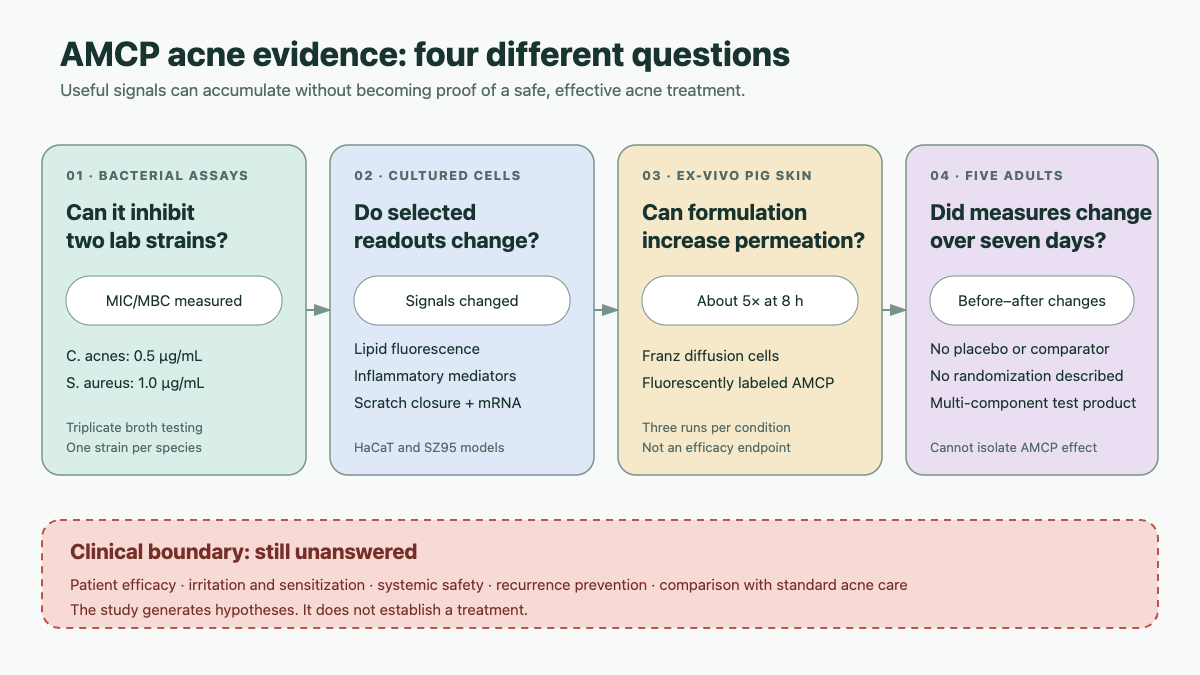
The study moves from controlled laboratory assays toward a very small human observation, but none of its evidence layers establishes a clinically effective or safe acne treatment.
Quick read: what did the cyclic peptide acne study show?
The paper produced several early signals, each confined to its own experimental setting.
- Antibacterial assays: AMCP had matching MIC and MBC values of 0.5 micrograms per milliliter against one Cutibacterium acnes strain and 1.0 microgram per milliliter against one Staphylococcus aureus strain.
- Sebocyte lipid models: At 20 micrograms per milliliter, AMCP reduced dye-based lipid signals induced by dihydrotestosterone by 40.0% and by linoleic acid by 29.1% in cultured SZ95 sebocytes.
- Inflammatory cell models: At 30 micrograms per milliliter, AMCP reduced five measured inflammatory mediators in heat-killed-C. acnes-stimulated HaCaT keratinocytes and SZ95 sebocytes.
- Migration and gene-expression models: AMCP increased scratch closure in cultured keratinocytes and changed messenger-RNA levels for several epidermal differentiation markers.
- Ex-vivo permeation: A propylene-glycol/sodium-surfactin enhancer condition increased cumulative permeation of fluorescently labeled AMCP through excised miniature-pig skin by about five-fold at eight hours versus the no-enhancer control.
- Exploratory human observation: Five adults used a test product for seven days, with no placebo, no untreated comparison group, no randomization, and no blinding described.
The study is therefore more accurately described as mainly laboratory and ex-vivo work with a very small uncontrolled human-product component. That is interesting exploratory research, not proof of treatment.
What exactly was AMCP?
AMCP was a research compound, not an established acne medicine or a fully characterized consumer ingredient. The paper describes a 28-amino-acid peptide with a measured average molecular mass of 3,254.47 daltons. High-performance liquid chromatography placed sample purity at 90.4%.
The structural label also deserves care. The authors interpreted the measured mass as most consistent with three dehydration events and one disulfide bond, but they explicitly called that assignment tentative. Individual crosslinks were not mapped, and the complete covalent topology remained unresolved. “Cyclic peptide” is therefore the study’s working description, not a complete atomic structure determination.
That uncertainty does not erase the assay results. It does matter for reproducibility, manufacturing, purity control, and claims that depend on a precisely defined molecular structure. Our explainer on peptide cyclization, stability, and binding covers why a ring-like design feature does not automatically establish biological or clinical performance.
What did the antibacterial assays show?
AMCP inhibited and killed the two tested laboratory strains at low measured concentrations under broth conditions. The researchers used C. acnes ATCC 6919 and S. aureus ATCC 6538, starting at approximately 500,000 colony-forming units per milliliter. Serial AMCP concentrations ranged from 0.125 to 64 micrograms per milliliter, and testing was performed in triplicate.
The reported results were:
| Laboratory strain | MIC | MBC | |---|---:|---:| | C. acnes ATCC 6919 | 0.5 µg/mL | 0.5 µg/mL | | S. aureus ATCC 6538 | 1.0 µg/mL | 1.0 µg/mL |
MIC is the lowest tested concentration that visibly prevented growth. MBC is the lowest concentration associated with at least 99.9% growth inhibition after subculture. Matching MIC and MBC values support bactericidal activity in this setup.
They do not show that topical AMCP clears acne lesions. The experiment used one strain of each species, a controlled broth environment, and no intact skin, follicle, sebum, immune system, microbiome, biofilm, or repeated-exposure resistance model. S. aureus activity may be relevant to secondary infection biology, but it is not equivalent to treating acne itself.
What happened in the sebocyte lipid experiments?
AMCP reduced a fluorescent lipid readout in stimulated SZ95 sebocytes, not measured sebum production in patients. The researchers exposed cultured sebocytes to either 10 micrograms per milliliter of dihydrotestosterone or 100 micrograms per milliliter of linoleic acid. After 48 hours of co-treatment, Nile red fluorescence was used as the lipid measure.
At 20 micrograms per milliliter of AMCP:
- the dihydrotestosterone-induced lipid signal was inhibited by 40.0% (reported p < 0.001); and
- the linoleic-acid-induced signal was inhibited by 29.1% (reported p < 0.01).
Figure captions describe three independent culture results. The preceding viability work found more than 80% SZ95 viability at AMCP concentrations below 20 micrograms per milliliter and led the authors to use concentrations up to 20 micrograms per milliliter for the lipid series.
This is a useful cellular signal because excess and altered sebum biology contributes to acne. It remains an artificial induction model in an immortalized cell line. Nile red fluorescence does not tell us whether a topical product reduces clinically meaningful oiliness, comedones, inflammatory lesions, or relapse.
Did AMCP reduce inflammation in skin cells?
AMCP lowered selected inflammatory mediators in two cultured-cell models after stimulation with heat-killed bacteria. HaCaT keratinocytes and SZ95 sebocytes were pretreated for two hours with 0, 10, 15, or 30 micrograms per milliliter of AMCP, then exposed for 24 hours to heat-killed C. acnes at 10 million CFU per milliliter. Treatments were performed in triplicate.
At 30 micrograms per milliliter, the paper reported these reductions relative to the stimulated model:
| Marker | HaCaT keratinocytes | SZ95 sebocytes | |---|---:|---:| | IL-6 | 81.0% | 84.8% | | IL-8 | 90.1% | 89.1% | | PGE₂ | 64.6% | 33.4% | | IL-1β | 93.1% | 91.2% | | TNF-α | 96.4% | 92.1% |
These are large assay-level changes, but they answer a narrow question. The model used heat-killed bacteria, immortalized cells, and short exposure. It did not reproduce a living follicle or establish that the same concentration can be delivered safely and maintained in human skin. The inflammatory series also used 30 micrograms per milliliter—above the maximum working concentration selected for the paper’s sebocyte lipid experiments—so concentration-specific viability and context matter when reading across assays.
Transcriptomic enrichment pointed to IL-17, MAPK, NF-κB, and Toll-like-receptor pathways. Enrichment makes those pathways plausible leads; it does not prove that AMCP directly acts through any one of them.
Did migration and barrier-marker changes prove skin repair?
No. The experiments suggest effects on keratinocyte behavior and gene expression, but they do not demonstrate repaired acne-damaged skin. In a scratch assay, 10 micrograms per milliliter of AMCP produced reported closure rates of 35.73% at 12 hours and 60.01% at 24 hours, both higher than the blank control. Figure captions again describe three independent cultures.
At the same concentration, RT-PCR measurements showed:
- FLG messenger RNA up 104%;
- IVL up 37%;
- Claudin-1 up 208%;
- KRT1 up 23%; and
- KLK7 down 27%.
Those genes relate to epidermal differentiation, tight junctions, structural support, and desquamation. But messenger RNA is not the same as functional protein, an intact barrier, or improved healing in a patient. Scratch closure can also reflect more than migration unless proliferation and other contributors are separately controlled.
What did the skin-permeation experiment establish?
The ex-vivo work established a formulation-feasibility signal, not an acne-treatment result. The researchers fluorescently labeled AMCP and tested a 0.08% weight/volume solution in Franz diffusion cells using freshly thawed miniature-pig skin 0.4–0.6 millimeters thick. Each group had three diffusion-cell runs.
Compared with the enhancer-free control, the condition containing 2% propylene glycol plus 0.1% sodium surfactin produced roughly five times greater cumulative permeation at eight hours. Fluorescence imaging also suggested deeper epidermal localization with the combination.
That finding means the tested enhancer condition changed movement of labeled peptide through excised skin under the study’s apparatus conditions. It does not show five-fold greater acne improvement. It also does not establish irritation risk, systemic absorption, stability in a finished product, long-term tolerability, or the behavior of unlabeled AMCP in living human skin.
The formulation percentages are reported here only to identify the experiment. They are not a consumer recipe or treatment protocol. Penetration enhancers can change both delivery and tolerability, and this study did not establish a do-it-yourself use case.
Was AMCP tested in people with acne?
The paper included five adults, but not a controlled efficacy trial. Three women and two men, with a mean age of 35, used a test product for seven days. The researchers measured sebum, porphyrin area, acne volume, transepidermal water loss, erythema, and lesion count at baseline, day 4, and day 7.
The table reports, among other changes, a fall in mean lesion count from 30.4 at baseline to 25.0 at day 7 and a 55.99% reduction in the instrument-defined “acne volume” measure. Those numbers can look clinical. The design cannot tell us that AMCP caused them.
There was no placebo or active comparator, no untreated side of the face, and no randomization or blinding described. The sample was five people, follow-up lasted one week, and the tested product contained a penetration enhancer. The paper does not provide enough separation of AMCP from the full product and enhancer to isolate which component—if any—produced a change. Regression to the mean, natural fluctuation, measurement variability, concurrent behavior, and expectancy effects remain possible.
The paper also does not provide a meaningful adverse-event analysis from five people. Absence of a reported irritation signal is not evidence of low irritation risk. A one-week uncontrolled observation cannot answer systemic safety, sensitization, microbiome effects, longer-term tolerability, or recurrence after stopping use.
This distinction is exactly why a methods-first approach matters when evaluating peptide claims online.
What does the study not establish?
The study does not establish a clinically useful acne treatment. Specifically, it does not show:
- that AMCP improves acne versus placebo;
- that it is better, safer, or less irritating than standard acne care;
- that antibacterial concentrations are achievable and sustained in living follicles;
- that broader skin microbial ecology is preserved;
- that benefits persist or recurrence is prevented;
- that repeated use does not select for reduced susceptibility;
- that the enhancer system is safe for repeated human use;
- that systemic exposure is negligible or safe; or
- that a reproducible, fully characterized AMCP product can be manufactured at clinical quality.
The right next step would not be a larger uncontrolled before-and-after demonstration. It would be a preregistered, randomized, blinded, controlled study of a chemically defined formulation, with adequate sample size, validated acne outcomes, irritation and adverse-event monitoring, adherence tracking, and follow-up long enough to assess durability and recurrence. Laboratory replication across additional strains, biofilm conditions, reconstructed human skin, and independent research groups would strengthen the translational case before or alongside that work.
Who funded the study, and were conflicts disclosed?
The funding and affiliations add relevant commercial context, even though the authors declared no competing interests. DFSIN (Shanghai) Biotechnology Co., Ltd. funded the research. Two authors were affiliated with DFSIN, two with Dermatide Biotec Pte Ltd., and the remaining listed authors with Jiangnan University’s School of Chemical & Material Engineering and its Key Laboratory of Synthetic and Biological Colloids.
The authors declared no competing interests. A commercial funder or company affiliation does not invalidate a result. It does make independent replication, complete formulation disclosure, and careful separation of exploratory findings from product claims especially important.
The supplementary file contained mass-spectrometry and HPLC figures supporting identity and purity checks. It did not add a controlled human protocol, broader safety dataset, or hidden clinical comparator.
Bottom line: can a cyclic peptide treat acne?
This study makes AMCP an interesting research lead, not a demonstrated acne treatment. The cleanest signals are the broth antibacterial values and the internally consistent cultured-cell changes. The permeation work shows that formulation can alter delivery through excised skin. The five-person product test is too small and uncontrolled to bridge those findings into patient efficacy or safety.
The paper is useful precisely because it generates several testable hypotheses. The mistake would be stacking those hypotheses on top of one another until they resemble a clinical conclusion the study never earned.
Frequently asked questions
What were AMCP’s MIC and MBC values?
Against C. acnes ATCC 6919, both were 0.5 micrograms per milliliter. Against S. aureus ATCC 6538, both were 1.0 microgram per milliliter. Each test was performed in triplicate under laboratory broth conditions.
Did the study prove that AMCP reduces sebum?
No. It reduced Nile-red lipid fluorescence in stimulated cultured SZ95 sebocytes. That is a cell-model result, not a measurement of clinical sebum reduction in a controlled patient trial.
Does five-fold permeation mean five-fold better acne results?
No. The five-fold figure compared cumulative movement through excised pig skin at eight hours under one enhancer condition versus no enhancer. Permeation, efficacy, and safety are different endpoints.
Was the study entirely preclinical?
No. Most mechanistic work was in vitro or ex vivo, but the paper also reported an uncontrolled seven-day test-product study in five adults. That human observation was far too small and weakly controlled to establish treatment benefit or safety.
Is AMCP safer than standard acne treatments?
Unknown. The study did not run a controlled safety comparison and did not characterize repeated-use irritation, sensitization, systemic safety, or long-term adverse events.
Primary source
- Yu N, Guo G, Zhang L, et al. An antimicrobial cyclic peptide with multitarget efficacy for acne. Scientific Reports. Published October 11, 2026. The full accepted-manuscript PDF and supplementary mass-spectrometry/HPLC figures were reviewed for this article.
This article is for education and evidence interpretation only. It does not provide medical advice, diagnosis, treatment instructions, dosing, purchasing guidance, sourcing advice, or a consumer formulation.