AI-Designed Peptides Against Zika: What a 214 µM Lab Hit Really Means
An AI-designed Zika peptide inhibitor reached a measurable result in a purified-enzyme assay, but the strongest initial hit had an IC50 of 214 µM—useful as prospective validation of a discovery workflow, not evidence of an antiviral medicine. The study did not test infected cells, animals, human safety, or clinical efficacy.
Published in Scientific Reports on October 15, 2026, the study by Cadillo-Valverde, Sanchez-Castro, and Milon joined two distinct tools: a recombinant fluorescence sensor that measured Zika protease activity, and a computational pipeline that generated and ranked candidate peptide inhibitors. Keeping those jobs separate is essential to understanding what the paper actually showed.
Quick answer: The paper prospectively found weak micromolar inhibitors after computational design and biochemical testing. That is a real laboratory signal. It is also several evidence levels below antiviral activity in cells, animal efficacy, human safety, or clinical usefulness.
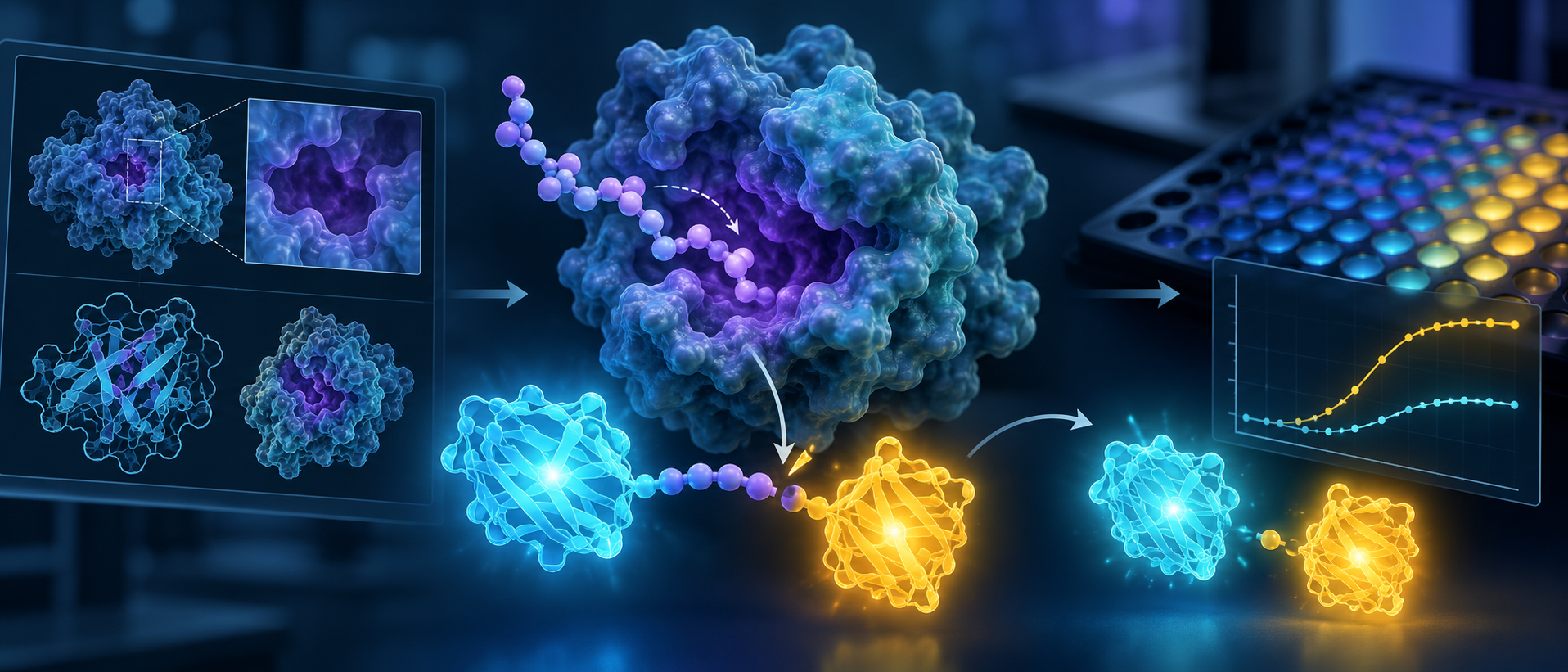
The computational pipeline proposed candidates; PEprotZIKV measured protease activity. Neither tool by itself demonstrated antiviral activity.
What did the AI-designed Zika peptide inhibitor study find?
The study found three short candidates worth dose-response testing, with peptide 715 producing the strongest initial result at IC50 214 ± 16 µM. Peptide 630 measured 570 ± 40 µM, and peptide 701 measured 763 ± 64 µM.
Those numbers describe the concentration associated with 50% inhibition under this purified-enzyme assay. Lower values generally indicate greater potency within a comparable assay, but an IC50 is not a universal property of a molecule. It depends on assay design, substrate concentration, enzyme conditions, and the inhibition mechanism.
The paper's authors explicitly described these candidates as proof-of-concept hits rather than realistic drug leads. They compared the micromolar results with previously reported Zika protease inhibitors in the nanomolar or low-micromolar range. More importantly, potency in an isolated biochemical system says nothing direct about whether a peptide can enter infected cells, survive biological fluids, avoid host proteins, reach useful concentrations, or safely reduce viral replication.
PEprotZIKV and the AI pipeline did different jobs
PEprotZIKV was the measurement tool; RFdiffusion and the downstream computational methods were the candidate-selection tools. Conflating them makes the workflow sound more magical than it was.
PEprotZIKV measured protease activity
PEprotZIKV is a recombinant FRET sensor. It places a Zika NS2B-NS3 protease cleavage site between two fluorescently labeled protein domains. When the protease cuts the linker, the fluorescent relationship changes, creating a quantitative readout.
The sensor was validated against an uncleavable control, reactions without protease, a protease-inhibitor cocktail, and a chemically synthesized substrate carrying the same cleavage motif. The recombinant sensor had a reported Km of 4.3 ± 0.2 nM versus 22.4 ± 1.3 nM for the synthetic comparator, with comparable turnover and about 5.5-fold greater catalytic efficiency. A reference inhibitor also produced similar IC50 values with the two substrates: 57 ± 3 µM with PEprotZIKV and 60 ± 1 µM with the synthetic substrate.
This supports PEprotZIKV as an assay platform. It does not make PEprotZIKV itself an inhibitor or a treatment.
The computational pipeline ranked candidates
The design side began with hotspot mapping across 53 Zika protease crystal structures. Fifteen recurring binding-pocket residues became constraints for RFdiffusion, which generated peptide backbones. ProteinMPNN proposed sequences for those backbones.
The funnel then used:
- two peptide-docking methods to estimate binding poses and scores;
- AlphaFold 3 co-folding to examine placement and structural ordering in the protease pocket;
- 200-nanosecond molecular-dynamics simulations to test modeled stability; and
- MM/PBSA calculations to estimate relative binding energetics.
These methods prioritized experiments; they did not establish inhibition. In fact, the experimental rankings often disagreed with the calculated energies. That mismatch is one of the paper's most useful results and echoes a broader lesson from AI peptide design research: predicted binding is not the same as biological function.
What was the exact experimental funnel?
The funnel narrowed hundreds of generated designs to a small tested set, and only three short candidates advanced to quantitative dose-response analysis. The denominators matter because “AI-designed inhibitor” can otherwise hide how much selection occurred.
- RFdiffusion and ProteinMPNN produced 544 short candidates across five length classes.
- Clustering reduced these to 75 representatives: 15 per length class.
- Docking, pocket-location checks, AlphaFold 3 co-folding, molecular dynamics, and MM/PBSA prioritized 9 short candidates for biochemical screening.
- At 100 µM, the researchers identified 3 prominent inhibitory candidates—630, 701, and 715—and advanced them to dose-response testing.
- All three produced fitted IC50 values, with 715 strongest at 214 ± 16 µM.
- The team then generated 45 elongated variants, 15 around each of the three active cores.
- Computational filtering selected 6 elongated variants—two from each series—for experimental testing.
- Only the 630-derived series improved. The best elongated variant, 630_03, measured 224 ± 10 µM.
The “best elongated” result did not beat the best initial short hit: 224 µM for 630_03 versus 214 µM for 715. Elongation improved the 630 parent, not the overall study record.
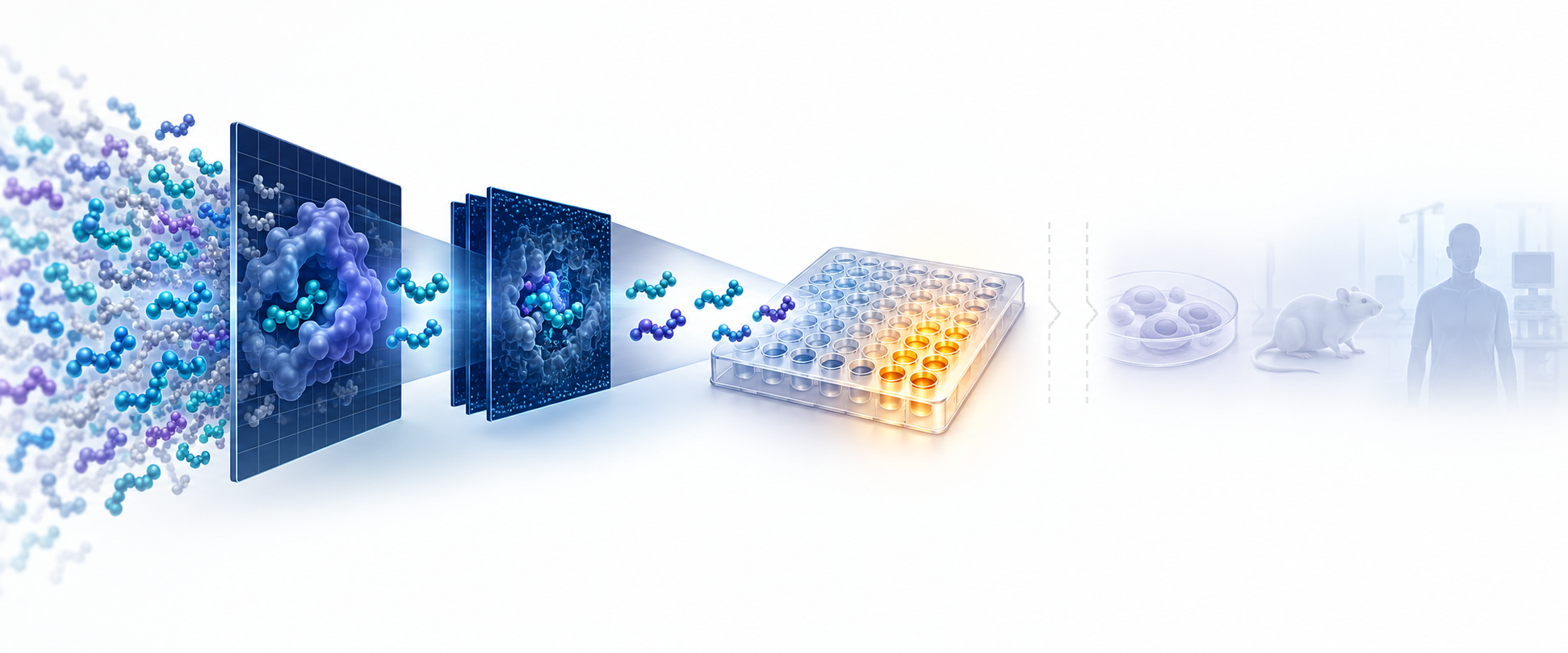
The study reached purified-enzyme inhibition. Infected-cell, animal, and human evidence remained beyond the tested boundary.
What did not work?
Most computationally favored candidates did not become convincing biochemical inhibitors, and elongation often made activity worse. Those negative results are not footnotes; they show why prospective testing matters.
At the short-peptide stage:
- no four- or five-residue candidate met the main docking cutoff;
- one co-folded candidate repeatedly appeared outside the intended pocket and was excluded;
- candidate 616 failed to inhibit despite favorable computational predictions and actually produced a higher fluorescence signal than the DMSO vehicle in the supplementary screening table;
- candidates 702, 714, 718, 724, and 811 produced statistically lower fluorescence than vehicle but were characterized as weak effects and were not advanced to IC50 fitting; and
- MM/PBSA did not predict the experimental potency order of 715, 630, and 701.
At the elongation stage, the split was sharper. The 630-derived variants improved over their parent: 630_03 measured 224 ± 10 µM and 630_13 measured 379 ± 12 µM. But the 701-derived variants weakened to 1,446 ± 112 µM and 2,240 ± 437 µM. The 715-derived variants weakened dramatically to 5,622 ± 1,929 µM and 7,629 ± 2,723 µM.
In other words, more peptide did not automatically mean more inhibition. The models captured some useful structure, but not enough biology to make optimization reliable.
How was the inhibition assay run?
The experiment was a controlled in-vitro protease assay, not an infected-cell antiviral test. Candidate peptides were prepared with 0.5% DMSO and diluted into 20 mM Tris at pH 8.5 with 10% glycerol and 0.01% Triton X-100. The candidate and protease reaction was incubated at 25 °C for 30 minutes; PEprotZIKV was then added to 200 nM, followed by one hour at 25 °C. Fluorescence was read at 490/520 nm.
The inhibition methods subsection does not restate the protease concentration for this step, so it should not be inferred from a separate sensor-validation experiment. Initial candidate screening used 100 µM peptide. Confirmed candidates were evaluated across 0–1 mM and fitted with a variable-slope four-parameter logistic model.
Controls included:
- AYA2 at 100 µM as a positive inhibitor control;
- N40, a randomized linear peptide, at 100 µM as a negative control; and
- a DMSO vehicle control.
For the 100 µM screen, the paper reports Dunnett's multiple-comparison test against DMSO using three biological replicates, with p < 0.05 as the threshold. The main dose-response figure reports standard deviations from five measurements. Elongated candidates were compared with their parents using Bonferroni's multiple-comparison test.
The authors converted IC50 values to approximate Ki and binding free-energy values using the Cheng-Prusoff relationship, assuming competitive inhibition. They also stated that the competitive mechanism was not experimentally verified, so those derived values are approximations.
Were solubility, aggregation, selectivity, or cytotoxicity checked?
The paper reports a DMSO preparation condition but no dedicated solubility, colloidal-aggregation, selectivity, cytotoxicity, or infected-cell antiviral testing. That absence limits how confidently the inhibition can be interpreted.
- Solubility: candidates were prepared using 0.5% DMSO, but no quantitative solubility limit, precipitation assessment, or recovery measurement was reported.
- Aggregation: no detergent-dependence experiment, dynamic light scattering, centrifugation control, or other dedicated colloidal-aggregation check was reported. The assay buffer did contain 0.01% Triton X-100, but that is not equivalent to demonstrating that aggregation did not contribute.
- Selectivity: the study did not test host serine proteases such as trypsin, chymotrypsin, or thrombin, nor related viral proteases.
- Cell testing: there was no infected-cell antiviral assay, cellular-uptake study, or cytotoxicity test.
- Stability and pharmacology: there were no serum or plasma stability, permeability, pharmacokinetic, biodistribution, or animal studies.
This is why the result belongs below even ordinary preclinical cell and animal evidence. It is a biochemical hit in a purified system.
Why does a 214 µM hit still matter?
It matters because the result was prospective and experimental: a computational pipeline nominated candidates, and a purpose-built assay found measurable inhibition in some of them. That is stronger than showing only docking scores or retrospective benchmarks.
The value is methodological. The study showed that the integrated workflow could enrich a large generated pool into a small set containing measurable hits. It also exposed false positives, poor potency prediction, and sequence-dependent failures. That combination of positive and negative results gives researchers information for improving the next design cycle.
But 214 µM is weak relative to many established enzyme-inhibitor starting points, and the authors did not call it a realistic lead. Unlike the Mirror-Peptidizer work, which included orthogonal binding assays and selected cell-based functional tests, this Zika study stopped at enzyme inhibition. The two studies answer different questions and should not be ranked as if every “AI-designed peptide” result carries the same evidence.
What would need to happen next?
The next evidence steps are mechanism confirmation, artifact controls, selectivity, stability, and infected-cell testing—not clinical speculation. A stronger follow-up would need to show that the measured signal reflects direct, reproducible inhibition rather than assay interference or aggregation; confirm how the peptide inhibits the protease; test selectivity against host and related viral enzymes; and determine whether activity survives in infected cells without unacceptable cytotoxicity.
Only after those steps would animal pharmacology and safety become informative. Human testing would be much later. Nothing in this paper establishes superiority to existing Zika antiviral research, and the authors themselves cited substantially more potent prior inhibitor classes.
Funding and patent interests
The study reported public research funding and a sensor-related patent interest. Funding came from Prociencia-Concytec grants PE501080265-2022 and EULAC-2022-058. Open-access funding came from Universidad Peruana de Ciencias Aplicadas grant C-012-2021.
Pohl Milon was listed as an inventor on a patent family covering the PEprotZIKV sensor: Peruvian application 002931-2023 and international PCT publication WO2025089973. The other authors declared no competing interests. The patent covers the measurement platform, which is relevant context when interpreting claims about the sensor's utility.
Bottom line
The paper provides credible proof that an AI-assisted selection pipeline can yield measurable Zika protease inhibitors, but its strongest initial hit—214 µM in a purified-enzyme assay—is not an antiviral therapy. The result supports another design-and-test cycle. It does not demonstrate infected-cell activity, animal efficacy, human safety, clinical usefulness, or superiority to other Zika programs.
That is not a failure. It is what early discovery looks like when the denominators, weak results, and missing evidence are left in the picture.
Frequently asked questions
Is peptide 715 a Zika treatment?
No. It was a laboratory candidate that inhibited purified Zika protease in a biochemical assay. It was not tested as a treatment in infected cells, animals, or people.
Is an IC50 of 214 µM strong?
It is measurable but modest. The paper treated the result as proof of concept and noted that other reported Zika protease inhibitor classes have achieved nanomolar or low-micromolar values.
Did AI discover the inhibitor by itself?
No. AI-assisted generation and computational filters prioritized candidates. Biochemical experiments determined whether those candidates actually reduced protease activity.
Did elongating the peptides improve them?
Only one series improved relative to its parent. The 630-derived variants improved, while analogous changes to the 701 and 715 series made activity substantially worse.
Did the study test antiviral activity in cells?
No. The authors explicitly described the work as biochemical validation and reported no infected-cell antiviral or cytotoxicity testing.
This article is for general education only. It is not medical advice and does not recommend using, obtaining, synthesizing, or experimenting with any research peptide.
Primary source
Cadillo-Valverde A, Sanchez-Castro A, Milon P. “Integrated sensor engineering and AI-assisted peptide design to target the Zika virus NS2B-NS3 protease.” Scientific Reports. Published October 15, 2026. doi: 10.1038/s41598-026-73774-3. Full paper and Supplementary Material 1 were reviewed for this article.