Personalized Ovarian Cancer Peptide Vaccines: What a 10-Patient Phase 1 Trial Can—and Cannot—Show
Short answer: A 2026 phase 1 trial showed that researchers could make and deliver personalized synthetic long-peptide vaccines to ten people with platinum-sensitive high-grade epithelial ovarian cancer, with no unexpected safety signal and measurable immune or tumor-biomarker activity in some participants. It did not show that the vaccine improved progression-free survival or overall survival.
That distinction matters because this was a tiny, nonrandomized study of a treatment sequence, not a controlled test of the vaccine alone. Participants received standard platinum chemotherapy before NeoVax, and the vaccine was followed by delayed nivolumab, an anti-PD-1 antibody. Some also received maintenance treatment or local therapy. The study was built mainly to test feasibility and short-term safety.
Published in Nature Medicine on October 14, 2026, the trial is a useful lesson in reading early cancer-vaccine evidence: manufacturing success, target persistence, immune responses, biomarker movement, and clinical benefit are separate claims. They should not be bundled into “the vaccine worked.”
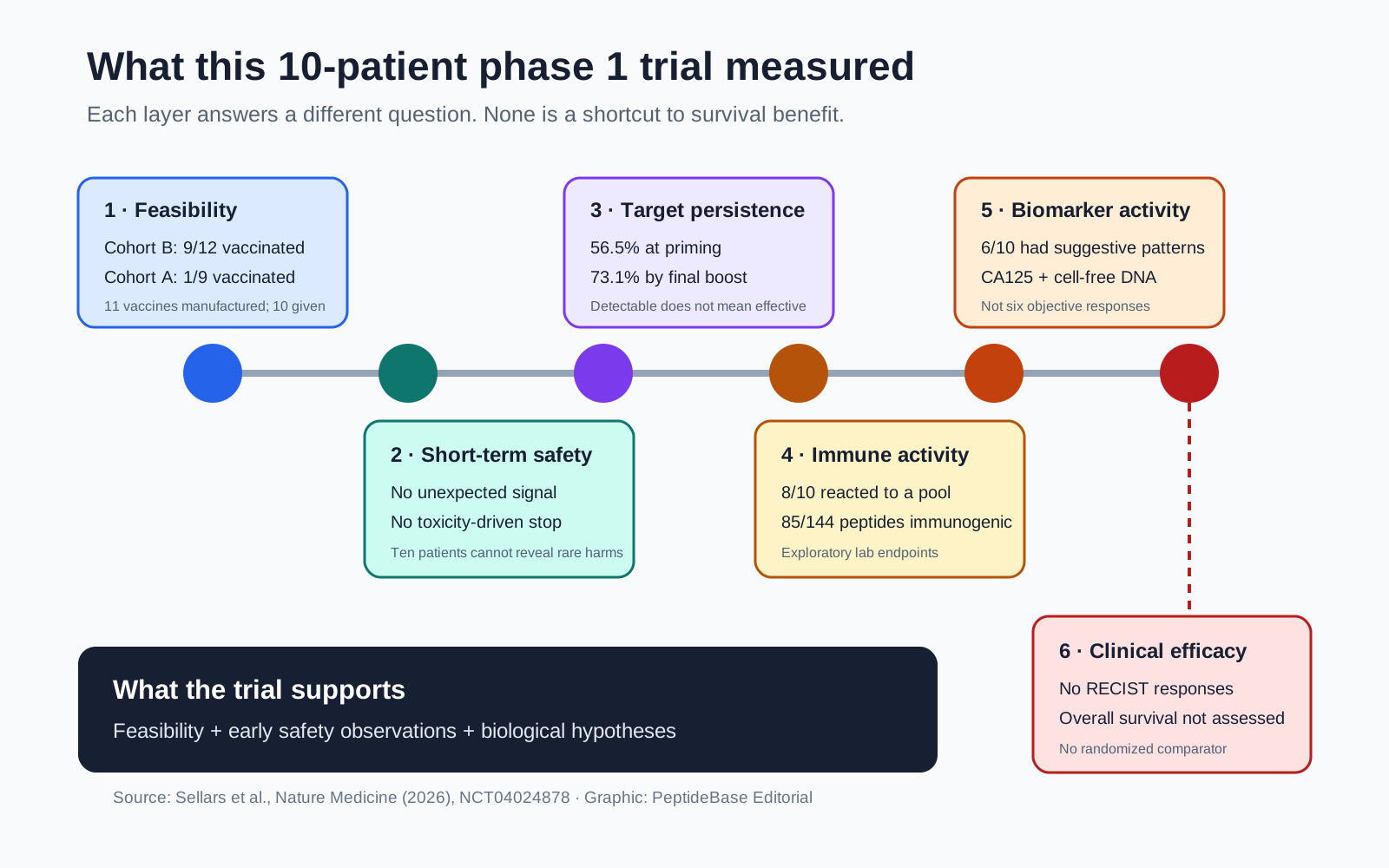
The trial produced several kinds of early evidence, but none can substitute for a randomized comparison of progression-free or overall survival.
What did the ovarian cancer peptide vaccine phase 1 trial test?
The study tested whether a personalized vaccine program could fit around standard ovarian-cancer care and be delivered without unacceptable early toxicity. NeoVax was not one fixed peptide. Each vaccine contained pools of synthetic long peptides selected from mutations found in that participant’s tumor, mixed with the immune stimulant poly-ICLC.
The ten vaccinated participants had platinum-sensitive high-grade epithelial ovarian cancer:
- one had newly diagnosed disease in Cohort A;
- nine had a first platinum-sensitive recurrence in Cohort B;
- all received standard platinum-doublet chemotherapy before vaccination;
- nivolumab began later, after the initial vaccine course;
- several participants also received maintenance therapy, and at least one received palliative radiation during follow-up.
This design can reveal whether a complex personalized workflow is practical and whether biological signals appear. Because everyone received a combination sequence and there was no control group, it cannot isolate the vaccine’s clinical effect.
For the broader development-stage context, see what a peptide entering phase 1 actually means.
How many people were enrolled, evaluable, manufactured for, and vaccinated?
The headline number of ten vaccinated patients sits inside several different denominators, and they should not be collapsed.
Twenty-two people consented to prescreening. One withdrew before the prescreening biopsy, and nine withdrew before treatment consent for reasons including inadequate biopsy tissue, progression during standard therapy, preference, or impaired performance status. Twelve signed treatment consent. Personalized vaccines were designed and successfully synthesized for 11; one person withdrew before manufacture and another after manufacture but before treatment.
The protocol’s feasibility result was reported separately by cohort:
- Recurrent disease, Cohort B: 9 of 12 evaluable prescreened patients were vaccinated — 75%, with a 90% confidence interval of 47% to 93%.
- Newly diagnosed disease, Cohort A: 1 of 9 evaluable prescreened patients was vaccinated — 11%, with a 90% confidence interval of 0.6% to 43%.
The Cohort A result matters. The program did not demonstrate broad feasibility in newly diagnosed patients, largely because core biopsies often produced inadequate tissue and the first-line maintenance landscape changed during the study. Accrual stopped early because of funding, well short of the planned 30 treatment-consented participants.
Quick answer: Was manufacturing feasible? A personalized vaccine was successfully synthesized for 11 treatment-consented patients and given to ten. Delivery feasibility differed sharply by cohort: 9 of 12 evaluable recurrent-disease patients versus 1 of 9 newly diagnosed patients were vaccinated.
What did the safety results show?
The study found no unexpected safety signal, but ten treated patients are far too few to characterize uncommon or long-term risks. Nine of the ten vaccinated participants received every planned vaccine dose. The protocol-defined completion analysis reported no discontinuations attributed primarily to toxicity among evaluable participants: 1 of 1 in Cohort A and 8 of 8 in Cohort B.
The most common events attributed to NeoVax were injection-site reactions in 70%, decreased neutrophil count in 50%, myalgia in 50%, and chills in 50%. Two grade 3 vaccine-associated events were reported, each in one patient: an allergic reaction and neutropenia.
One participant had grade 3 abdominal pain and diarrhea associated with nivolumab while being treated after progression. That participant missed the final vaccine booster, but the investigators classified progression—not toxicity—as the primary reason treatment ended.
“No unexpected safety signal” therefore means no new pattern emerged in this small, closely monitored cohort. It does not mean the combination is proven safe, that rare harms were excluded, or that vaccine and nivolumab effects can always be separated.
Did the selected vaccine targets still exist after chemotherapy?
Many selected tumor mutations remained detectable after chemotherapy, supporting target relevance rather than treatment efficacy. Vaccine design used pretreatment tumor tissue, yet a median of 6.5 months passed before vaccination while participants received standard therapy.
Using personalized cell-free DNA assays, the researchers detected more than half of the vaccine-targeted single-nucleotide variants in seven of ten participants at vaccine priming and in an eighth participant before the last booster. Across participants, 56.5% of targeted variants were detected at priming and 73.1% had been detected by the last boost.
This is an important manufacturing and biological result: the vaccines were not aimed entirely at mutations erased by intervening treatment. It does not show that detecting a target means the immune system can recognize it, that the tumor still presents it through HLA molecules, or that attacking it improves survival.
What immune responses did NeoVax produce?
The vaccines were immunogenic by several exploratory laboratory measures. Ex vivo IFN-gamma ELISpot testing detected reactivity to at least one vaccine pool in eight of ten participants. After laboratory expansion of post-boost blood cells, 85 of 144 tested vaccine peptides met the study’s immunogenicity definition.
The six participants placed in the transient- or prolonged-control biomarker groups developed responses against more targeted mutations on average than the four progressors: 9.3 versus 5.5 mutations. The analysis was exploratory, involved very small groups, and did not establish a validated cutoff or causal link to patient benefit.
Tumor and blood analyses also found vaccine-associated T-cell clonotypes and detailed examples of tumor-reactive T cells. Those data show immune recognition and clonal expansion. They do not show that the response was strong enough, broad enough, or durable enough to improve a clinical outcome.
What does “biomarker activity in six of ten patients” mean?
It means the investigators saw exploratory CA125 and cell-free-DNA patterns that they considered consistent with biological activity—not six objective responses.
The researchers grouped the ten participants after examining longitudinal biomarkers:
- four were classified as progressors;
- three showed transient biomarker control;
- three showed prolonged control.
That produced the often-quoted six-of-ten signal. But the analysis was ad hoc, the groups were tiny, and biomarker timing overlapped with other treatments. In one transient-control case, declines occurred after nivolumab began and while the participant was receiving PARP-inhibitor maintenance. Another participant received palliative radiation early in the vaccine course.
CA125 and cell-free DNA can help track tumor burden, but a rise or fall is not automatically a patient-centered benefit. The study’s own supplement reports no RECIST objective responses. Biomarker movement should therefore be described as hypothesis-generating biological activity, not a response rate.
Quick answer: Did six of ten patients respond? Not by RECIST. Six had exploratory biomarker patterns described as transient or prolonged control. The paper did not establish that NeoVax caused those patterns or that they translated into longer survival.
What did the tumor-evasion findings add?
The tumor analyses suggest immune pressure and several routes of escape, but they do not prove that vaccination alone selected every resistant clone.
The study identified three main patterns:
- Pre-existing HLA loss: Three of ten vaccinated tumors had loss of part of chromosome 6 affecting HLA genes before vaccination, potentially preventing presentation of some selected targets.
- Treatment-emergent signaling loss: In one progressor, a post-treatment tumor carried a JAK1 structural change associated with impaired interferon signaling and HLA class I upregulation. Restoring JAK1 in an organoid restored recognition by a vaccine-target-specific T-cell receptor.
- Loss or reduced expression of selected targets: In two transient-control cases, some vaccine-target mutations were absent from recurrence biopsies, and one tumor showed lower expression of several target genes.
These findings support a plausible immune-editing story: tumors can evade recognition by losing antigens or the machinery needed to display them. Yet chemotherapy and ordinary clonal evolution occurred during the same period, recurrence tissue was available for only a subset, and several analyses were patient-specific. The authors explicitly could not exclude evolution during standard therapy.
Did the trial show better progression-free or overall survival?
No. The trial was not designed or powered to prove a survival advantage. Median progression-free survival from the first vaccine dose was 3.3 months, with a range from one month to not reached at the data cutoff. That descriptive number had no randomized comparator and came from a clinically heterogeneous ten-person cohort.
The full supplement makes the efficacy boundary unusually clear:
- there were no RECIST responses;
- overall survival was not assessed because the cohort was too small;
- duration of response was not reported because there were no RECIST responders;
- the planned comparison of second versus first progression-free survival was not assessed;
- no participant underwent the planned NeoVax retreatment analysis.
The trial was also open-label and nonrandomized. Standard chemotherapy came first, delayed nivolumab came later, and maintenance or local treatments varied. Without a control group, these factors make causal clinical claims impossible.
This is the same evidence boundary seen in personalized pancreatic cancer vaccine research: immune activity can be real and scientifically valuable without proving longer survival.
Who funded the study, and what conflicts were disclosed?
The study was led by Dana-Farber Cancer Institute with academic collaborators and substantial public, nonprofit, and philanthropic support. Affiliations included Dana-Farber, Harvard Medical School, the Broad Institute, Harvard T.H. Chan School of Public Health, the University of Oxford, Massachusetts General Hospital, Boston University, Brigham and Women’s Hospital, and Methodist University.
Funding included National Cancer Institute grants, the Dana-Farber/Harvard Ovarian Cancer SPORE, the Mark Foundation, the Breast Cancer Research Fund, the Ovarian Cancer Research Association, the Wellcome Trust, and several philanthropic funds. Bristol Myers Squibb supplied nivolumab; Almac Sciences manufactured vaccine peptides. The paper states that funders had no role in trial conduct or analysis of clinical or immune endpoints.
The authors disclosed numerous relationships across biotechnology and pharmaceutical companies. Relevant examples include research funding or advisory relationships involving Bristol Myers Squibb, equity and licensed patents involving BioNTech, intellectual-property interests in an MRD assay, and multiple cancer-immunotherapy advisory roles. These disclosures do not invalidate the findings, but they belong in the evidence review because the study combined a proprietary personalized-vaccine workflow, a commercial checkpoint inhibitor, and specialized biomarker platforms.
What can this phase 1 trial honestly support?
The trial supports feasibility, short-term safety observations, immunogenicity, and a detailed biological hypothesis—not clinical efficacy.
What it can show:
- personalized long-peptide vaccines could be manufactured for most treatment-consented participants;
- vaccination was feasible in most evaluable recurrent-disease patients but not in the newly diagnosed cohort;
- no unexpected short-term safety pattern or toxicity-driven discontinuation emerged in the evaluable group;
- many selected mutations remained detectable after chemotherapy;
- vaccine-associated immune responses appeared in blood and tumor;
- biomarker and tumor analyses generated testable hypotheses about activity and immune escape.
What it cannot show:
- that NeoVax improved progression-free survival;
- that NeoVax improved overall survival;
- that biomarker activity in six people equals six clinical responses;
- that the vaccine, rather than nivolumab or other treatment, caused an individual clinical course;
- that uncommon or long-term harms have been characterized;
- that the findings generalize beyond this small, selected population.
The next meaningful test would require a larger prospectively designed study with a credible comparator, predefined clinical endpoints, enough follow-up for survival outcomes, and analyses that can separate vaccine effects from checkpoint blockade and maintenance therapy.
Frequently asked questions
Was NeoVax one standard ovarian cancer peptide vaccine?
No. Each vaccine used a different pool of synthetic long peptides chosen from mutations in that participant’s tumor. “NeoVax” describes the personalized platform and workflow, not one universal peptide sequence.
Did the trial prove that personalized peptide vaccines treat ovarian cancer?
No. It was a ten-person, nonrandomized phase 1 combination study focused on feasibility and safety. It generated immune and biomarker signals but did not prove improved clinical outcomes.
Were the six biomarker-active patients RECIST responders?
No. The supplement reports no RECIST responses. The six-of-ten result came from exploratory longitudinal CA125 and cell-free-DNA patterns.
Does “no treatment discontinuations for toxicity” mean no serious adverse events occurred?
No. Grade 3 events occurred. The statement means investigators did not classify toxicity as the primary reason an evaluable participant discontinued the treatment sequence.
Was overall survival measured?
Overall survival was a planned secondary endpoint, but the authors did not assess it because the cohort was too small.
Primary sources
- Sellars MC, Frank JA, Shim B, et al. Personalized neoantigen-targeting cancer vaccines in ovarian cancer: a phase 1 trial. Nature Medicine. Published October 14, 2026.
- Full supplementary information and study protocol.
- ClinicalTrials.gov record NCT04024878.
- Open-access accepted manuscript, University of Oxford Research Archive.
This article is for education and evidence interpretation only. It does not provide medical advice, treatment selection, dosing, administration, trial-enrollment guidance, purchasing guidance, or sourcing advice.