OPT101 for Type 1 Diabetes: What the Small Phase 1b Trial Actually Shows
Short answer: OPT101 produced short-term immune and metabolic signals in a randomized phase 1b study, and the OPT101 groups had only grade 1 and 2 treatment-emergent adverse events. That supports further research. It does not establish that OPT101 restores beta cells, reduces insulin needs, or modifies type 1 diabetes over the long term.
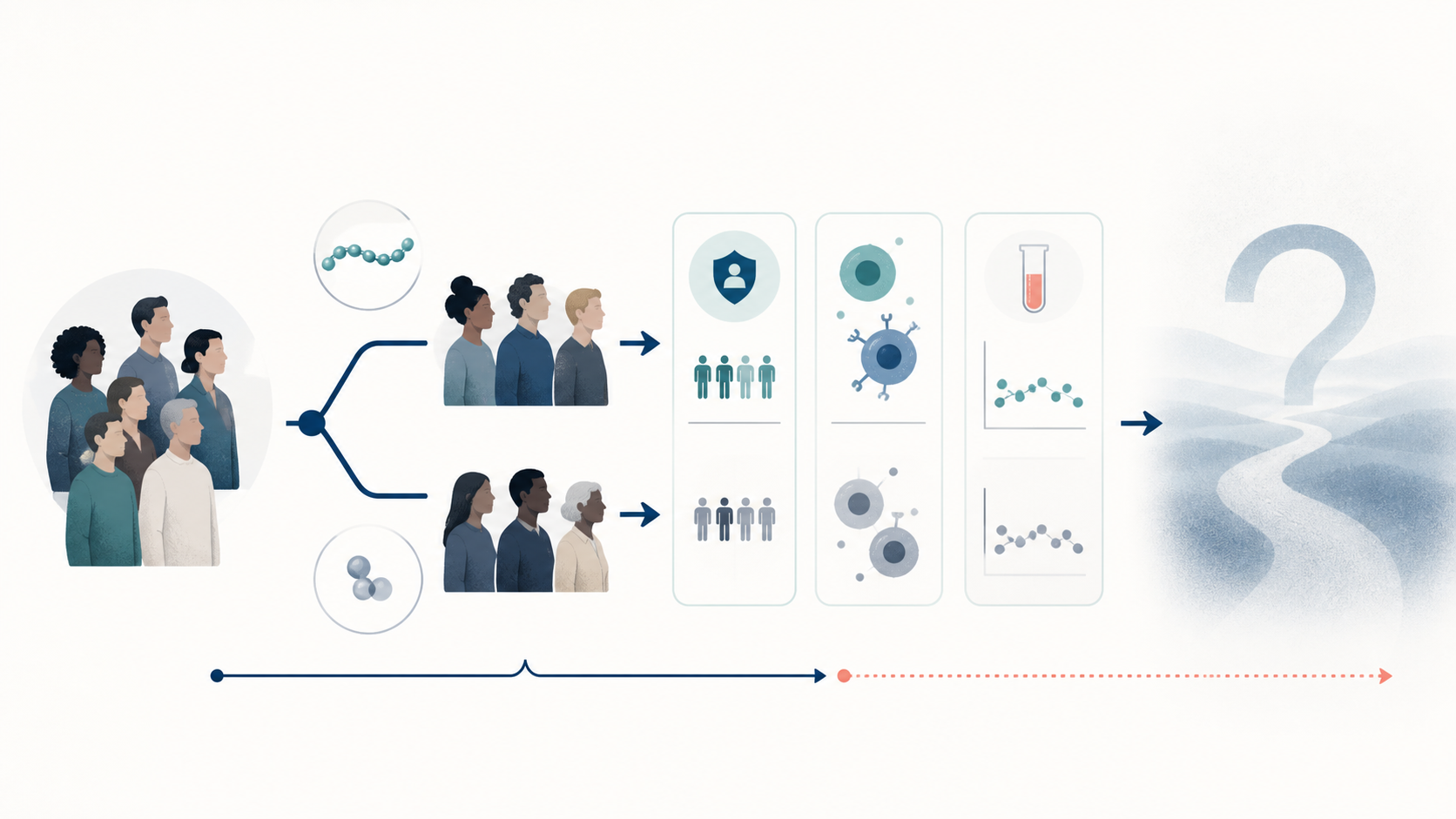
An early trial can measure tolerability and biological signals while leaving durable clinical benefit unresolved. Conceptual illustration; not trial data or a molecular model.
Quick facts about the OPT101 type 1 diabetes peptide study
- Product: OPT101, an experimental 15-amino-acid peptide
- Target idea: A CD40/integrin-associated receptor complex on CD40-positive pathogenic effector T cells called Th40 cells
- Design: Randomized, double-blind, placebo-controlled, multiple-ascending-dose phase 1b study
- Treatment schedule: Eight infusions over six weeks, followed by an end-of-study assessment
- Primary purpose: Safety and tolerability
- OPT101 adverse-event severity: Grade 1 and 2 treatment-emergent events in the two active-treatment cohorts
- Exploratory findings: Changes in Th40 percentages, regulatory T cells, inflammatory cytokines, glucose, HbA1c, and C-peptide
- What remains unproven: Treatment efficacy, durable beta-cell restoration, insulin independence, comparative benefit, and long-term safety
The peer-reviewed paper was published in Diabetology on August 6, 2026. The related registry record is NCT05428943.
What is OPT101, and what is it intended to do?
OPT101 is an investigational peptide designed to alter signaling associated with a particular inflammatory T-cell population—not to replace insulin. The researchers describe it as a 15-amino-acid peptide derived from part of the CD154 sequence.
The proposed target involves Th40 cells, a subset of CD4-positive T cells that also express CD40. The research group argues that these cells contribute to autoimmune inflammation in type 1 diabetes. Their mechanistic work suggests OPT101 interacts with CD40 when CD40 is associated with activated integrins.
That is a biological rationale. It is not evidence by itself that changing Th40 measurements preserves insulin-producing beta cells or improves a person's health. Mechanism, biomarker response, and clinical benefit are separate evidence layers.
Quick answer: Is OPT101 a treatment for type 1 diabetes? No established treatment effect has been demonstrated. OPT101 remains experimental, and this early study was primarily designed to assess safety and tolerability.
How many people were actually in the phase 1b study?
The participant accounting is inconsistent across the paper and the current registry, so describing this as a simple “22-person trial” would be misleading. This is not bookkeeping trivia; it affects how confidently readers can interpret percentages and outcomes.
The August 2026 paper states that 18 participants were enrolled, randomized, and completed the study: six in each active-dose cohort and six receiving placebo. It then says one placebo participant developed pneumonia and was withdrawn, after which an additional placebo participant was enrolled and received five placebo infusions.
The current ClinicalTrials.gov results record reports:
- 24 participants started: eight in each of three groups
- 18 completed: six in each group
- 20 participants in the baseline-characteristics and adverse-event analysis sets: six at the lower active dose, six at the higher active dose, and eight assigned to placebo
Those figures do not resolve cleanly into the paper's narrative. The paper also cites the registration number inconsistently in two places. The safest interpretation is therefore based on the clearly reported analysis groups—not a single headline enrollment number.
Evidence-literacy lesson: When a paper and registry disagree, report the denominators attached to each result. Do not force several analysis populations into one tidy number because tidy numbers look better in a headline.
For a broader explanation of what this development stage can establish, see what it means when a peptide enters phase 1.
What was the study designed to establish?
The primary objective was safety and tolerability, while immune and metabolic measurements were secondary or exploratory. That hierarchy matters more than the enthusiasm of the paper's conclusion.
Participants were randomized in a two-to-one active-to-placebo pattern within two active-dose cohorts. The study was masked, and each participant was assigned to one dose level or placebo. Eight infusions were scheduled across 42 days, with end-of-study testing two weeks after the last dose.
The registry defines the primary outcome as the number of treatment-related adverse events over 42 days. Pharmacokinetic measures and metabolic measures—including HbA1c, glucose, and stimulated C-peptide—appear as secondary outcomes.
Randomization and masking are real strengths because they reduce several forms of bias. But a good design does not make a small, short study large or long. It still has limited power to detect uncommon harms, distinguish signal from chance across many exploratory measurements, or establish durability.
What did the trial show about short-term safety?
The paper supports a narrow short-term tolerability conclusion: the OPT101 groups experienced grade 1 and 2 treatment-emergent adverse events during this small study. It does not support a broad declaration that OPT101 is safe.
Across the two active groups, the paper counted 68 treatment-emergent adverse events. The reported events included infusion-related reactions, feeling hot, paresthesia, infections, and laboratory findings such as reduced ferritin. Events deemed definitely related to treatment occurred mainly in the higher active-dose group; those were mild or moderate.
The placebo group included a grade 3 pneumonia event that led to withdrawal. This is why “only grade 1 and 2 adverse events” should be attached specifically to the OPT101 cohorts, not presented as a description of every event in the study.
No deaths or serious adverse events were reported in the registry results. The paper also reported no anti-drug antibodies at the end of the study and no observed depletion of broad lymphocyte populations. Those are useful observations, but they cover a short period in a small sample.
Quick answer: Was OPT101 proven safe? No. The trial provides encouraging short-term tolerability data. It cannot characterize rare, delayed, cumulative, or population-specific harms.
What immune changes did the researchers report?
The study reported changes consistent with the proposed immune mechanism, but these are biomarker findings rather than proof of disease modification.
The paper reported that OPT101-treated participants had lower percentages of Th40 cells without broad cell ablation. It also reported increases in regulatory T cells and decreases in several inflammatory cytokine measurements.
These results help answer, “Did something measurable happen in the immune system?” They do not answer, “Did the intervention preserve insulin-producing cells for years?” A biomarker can be mechanistically interesting while still failing to predict a durable clinical outcome.
Small exploratory analyses also face multiplicity problems: when many cells, cytokines, time points, and metabolic measures are tested, some statistically significant results may occur by chance. The paper reports multiple comparisons, but a phase 1b trial of this size cannot provide a robust confirmatory test of every exploratory signal.
What happened to glucose and HbA1c?
The paper reported lower serum glucose and HbA1c by the final treatment visit in OPT101-treated participants, but the study was not designed to prove glycemic efficacy.
Glucose and HbA1c are clinically familiar measures, which makes these findings easy to overread. In this study they were secondary measurements collected over weeks, not evidence of durable control over months or years.
The published report does not establish that OPT101 reduced insulin requirements, improved time in range, prevented hypoglycemia, or produced a sustained HbA1c benefit after treatment ended. In a small trial, baseline imbalance, concurrent insulin management, ordinary variation, and selective emphasis can all influence an apparent metabolic signal.
What does detectable C-peptide in two participants mean?
Detectable C-peptide after treatment in two participants is a hypothesis-generating observation—not proof that OPT101 restored beta cells. C-peptide is released when the body produces its own insulin, so its detection can indicate residual beta-cell function.
The paper highlights two OPT101-treated participants who had undetectable C-peptide at screening and detectable C-peptide after treatment. They had been diagnosed 11 and 13 years earlier. That is interesting because long-standing type 1 diabetes can involve very low endogenous insulin production.
But two cases cannot establish causation. A stronger claim would require prespecified analysis, repeated measurements, assay confirmation, an appropriate comparison with placebo, and evidence that the change persists and improves meaningful clinical outcomes. The paper does not establish new beta-cell mass, lasting beta-cell recovery, or insulin independence.
Quick answer: Did OPT101 regenerate beta cells? The trial does not show that. It reports post-treatment C-peptide detectability in two participants, which warrants testing in a larger controlled study.
Why the paper's “safe and effective” conclusion goes too far
The authors conclude that OPT101 “proved safe and effective,” but the study design supports a much narrower interpretation. Readers should separate what investigators believe the findings mean from what the trial was built to establish.
| Evidence layer | What this study contributes | What it cannot establish | |---|---|---| | Short-term safety | Grade 1–2 treatment-emergent events in active groups; no serious adverse events reported | Rare, delayed, or long-term harms | | Target biology | Changes in Th40 percentages, Tregs, and inflammatory cytokines | That those changes preserve beta cells or improve health | | Metabolic signals | Exploratory glucose, HbA1c, and C-peptide observations | Durable glycemic benefit or reduced insulin dependence | | Clinical efficacy | A reason to conduct a larger trial | Effective treatment, comparative benefit, or disease modification |
“Safe” is rarely an all-or-nothing property. It depends on population, exposure, duration, comparator, and the frequency of harms a study is large enough to detect. “Effective” requires an outcome and design capable of establishing benefit. Here, the registry's primary endpoint was treatment-related adverse events; the metabolic measures were secondary.
This is a common early-trial reading error. Our guide to evaluating peptide claims online explains why a paper's strongest sentence should not replace its methods and outcome hierarchy.
The broader peptide research-status framework also shows why early human testing moves a candidate beyond preclinical evidence without making it an established treatment.
What the planned phase 2 study could add
The recruiting phase 2 trial is the next evidence step, not evidence that OPT101 works. NCT06964087 plans to enroll 72 participants and follow them for 48 weeks.
Its primary outcome is change in mixed-meal-stimulated C-peptide. That is more directly aligned with the beta-cell-function hypothesis than the phase 1b primary safety endpoint. The larger sample and longer follow-up may provide a better test of whether the C-peptide signal is reproducible and durable.
Even then, the final strength of evidence will depend on completion, missing data, prespecified analyses, effect size, adverse events, insulin-use data, and whether changes translate into outcomes meaningful to patients. A recruiting trial proves only that a question is being studied.
Bottom line
OPT101 has crossed an important but early threshold: a small randomized phase 1b study found manageable short-term adverse-event severity in the active groups and generated immune and metabolic hypotheses worth testing.
The study does not establish durable beta-cell restoration, insulin independence, long-term safety, comparative advantage, or treatment efficacy. The current mismatch among participant counts in the paper and registry is another reason to interpret precise percentages cautiously.
The honest conclusion is less cinematic than “safe and effective,” but more useful: OPT101 has early human tolerability data and exploratory biological signals. Phase 2 must determine whether those signals survive a larger, longer, prospectively defined test.
Frequently asked questions
Is OPT101 an approved type 1 diabetes treatment?
No. OPT101 is an investigational peptide being studied in clinical trials.
Did participants stop using insulin?
The phase 1b paper does not establish insulin independence or a durable reduction in insulin requirements.
Does lower HbA1c prove OPT101 was effective?
No. HbA1c was a secondary metabolic measure in a small, short study. Confirmatory evidence would require a larger trial designed to test efficacy and durability.
Why does the participant count differ between sources?
The paper, participant-flow record, and registry analysis sets report different totals. The paper describes 18 completed participants and a withdrawn/replaced placebo participant; the registry currently lists 24 started, 18 completed, and 20 in baseline and adverse-event reporting. Results should therefore be read using their specific denominators.
Where can I read the primary sources?
Read the August 2026 Diabetology paper, the phase 1b registry record, and the recruiting phase 2 record.
This article is for general education and evidence literacy. It is not medical advice and does not recommend OPT101, trial participation, or any change to diabetes care.