NPR3 and Kidney Injury: Why One Mouse Model Looked Protective and Another Did Not
Deleting NPR3 only in podocytes did not protect mice in a DOCA–high-salt hypertension model, but it did reduce albumin leakage and podocyte foot-process damage after Adriamycin injury. That split result is the main lesson of the October 2026 study by Khbouz and colleagues: NPR3 may influence how podocytes respond to some injuries, but the effect depended on the experimental context.
This was not a human trial. It did not test an NPR3 drug, establish a treatment for kidney disease, or provide human efficacy or safety evidence. It combined two mouse injury models, a small pooled mouse proteomic experiment, and phosphoproteomics in CRISPR-edited cultured human podocytes.
Quick answer: In the DOCA–high-salt model, both genotypes developed hypertension, albuminuria, kidney enlargement, and glomerular injury, with no significant genotype benefit. In the Adriamycin model, podocyte-specific Npr3 knockout mice had less albuminuria and less foot-process effacement than wild-type mice at day 10. The finding is model-dependent, not proof of a kidney therapy.
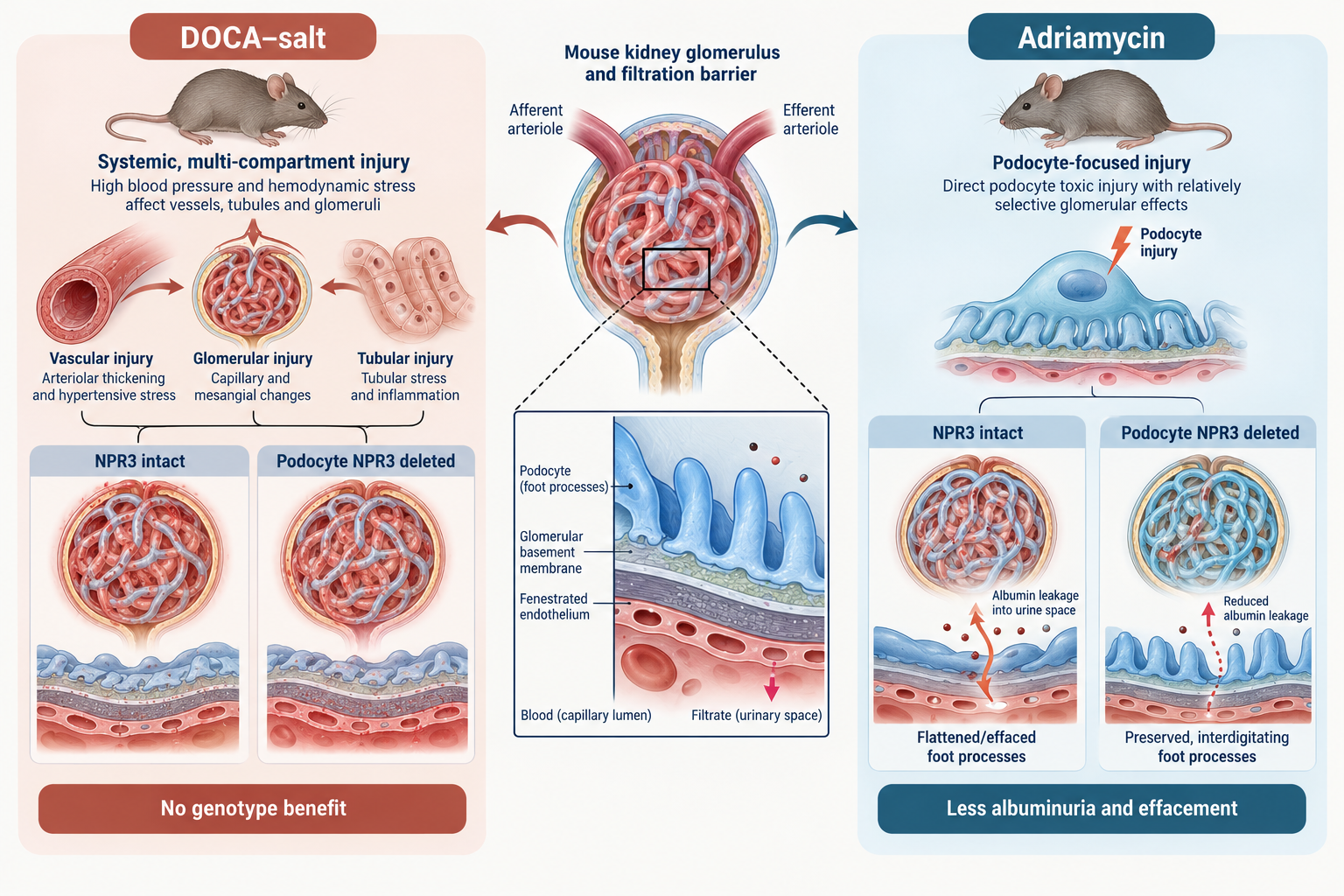
The same genetic change produced different results under two different experimental injuries. This is a conceptual illustration of the study design, not human treatment evidence.
What is the natriuretic peptide system?
The natriuretic peptide system is a hormone-and-receptor network that helps regulate fluid balance, blood pressure, blood-vessel tone, and tissue signaling. Its best-known peptide messengers are:
- ANP, or atrial natriuretic peptide, released mainly from the atria of the heart
- BNP, or B-type natriuretic peptide, released mainly in response to cardiac wall stress
- CNP, or C-type natriuretic peptide, which has important local signaling roles in tissues and blood vessels
These peptides interact with three receptor families. NPR1 and NPR2 are membrane guanylyl cyclases: receptor activation generates cyclic GMP, or cGMP, inside the cell. ANP and BNP signal mainly through NPR1, while CNP signals mainly through NPR2.
NPR3 is different. It lacks the guanylyl-cyclase domain found in NPR1 and NPR2. It can bind natriuretic peptides and remove them from the local environment, which is why it is often called the “clearance receptor.” But that nickname is incomplete.
Why is NPR3 more than a simple clearance receptor in podocytes?
NPR3 may affect podocytes through both peptide clearance and cell signaling. Reducing NPR3 could leave more natriuretic peptide available to interact with NPR1 or NPR2. NPR3 has also been linked to inhibitory G-protein signaling, meaning it may directly influence intracellular pathways rather than functioning only as a molecular drain.
That possibility matters in podocytes—the specialized cells whose interlocking foot processes help form the kidney’s filtration barrier. Their slit diaphragms contain structural and signaling proteins such as nephrin and podocin. When podocyte architecture fails, foot processes can flatten or merge, a change called foot-process effacement, and albumin can leak into urine.
The Khbouz paper also builds on prior work that placed NPR3 in the molecular neighborhood of slit-diaphragm proteins. That does not prove NPR3 controls the filtration barrier by itself. It makes a podocyte-specific role plausible enough to test.
Mechanism is not outcome: More natriuretic-peptide availability, altered Gi signaling, and changed phosphorylation are possible explanations. None establishes that blocking NPR3 will improve kidney disease in people.
What did the researchers actually test?
The study used four distinct evidence streams that should not be blended together.
| Evidence stream | What was tested | What it can show | |---|---|---| | Mouse baseline follow-up | Podocyte-specific Npr3 knockout on a C57BL/6 background | Whether deletion produced an obvious early kidney phenotype | | Two mouse injury models | DOCA–high-salt hypertension and Adriamycin nephropathy | Whether genotype changed selected injury outcomes in each model | | Mouse glomerular proteomics | Slit-diaphragm-associated proteins after Adriamycin injury | Whether major measured structural protein abundance differed | | CRISPR-edited cell-line phosphoproteomics | NPR3-deficient versus control cultured human podocytes at baseline | Which phosphorylation patterns changed in an engineered cell system |
The knockout was restricted to podocytes using an Nphs2-Cre strategy. At baseline, knockout mice were viable and showed no overt renal phenotype; albumin excretion did not differ from controls through six months. That is reassuring only within the measured period and conditions.
What happened in the DOCA–high-salt model?
Podocyte-specific Npr3 deletion did not produce a statistically significant benefit in the DOCA–high-salt hypertension experiment. The model combined unilateral nephrectomy, a deoxycorticosterone acetate pellet, and high-salt drinking water. It creates a strong, systemic injury involving blood pressure, hemodynamics, inflammation, and multiple kidney compartments.
The study included 54 mice: 8 wild-type controls, 8 knockout controls, 20 wild-type DOCA–salt mice, and 18 knockout DOCA–salt mice. After treatment, the hypertensive groups showed higher systolic blood pressure, albuminuria, kidney weight, and glomerular damage than untreated controls.
Knockout mice had numerically lower blood pressure and albuminuria than hypertensive wild-type mice, but the genotype differences were not statistically significant. Heart weight was also comparable between genotypes.
The honest conclusion is not “a trend toward protection.” It is that this experiment did not demonstrate a genotype benefit. The authors argue that the broad and severe injury may have made a modest podocyte-specific effect difficult to detect. That is a hypothesis about the null result, not evidence that a hidden benefit definitely existed.
What happened in the Adriamycin model?
The Adriamycin model produced the study’s protective-looking result. Thirty-five C57BL/6 mice received one injection of doxorubicin: 18 wild-type and 17 podocyte-specific Npr3 knockout animals. The researchers collected samples 10 days later.
At that early time point, gross tissue morphology and blood urea nitrogen did not differ. Wild-type mice developed mild but significant albuminuria, while knockout mice did not show the same rise. Electron microscopy also found less foot-process effacement in knockout mice.
Those are relevant filtration-barrier readouts. They are still narrow, short-term mouse outcomes. C57BL/6 mice are relatively resistant to Adriamycin nephropathy, and the authors intentionally used this milder setting to reveal a potentially subtle podocyte effect. Results in this strain, dose, and 10-day window cannot be assumed to predict other strains, chronic kidney disease, or human disease.
Why the models disagreed: Adriamycin created a relatively podocyte-focused injury in a resistant strain, while DOCA–salt caused a broader systemic and multi-compartment insult. NPR3 deletion may act as a modest context-sensitive modifier rather than a universal protective switch.
What did the proteomic experiment add?
The mouse proteomics did not show major remodeling of the measured slit-diaphragm protein complex. A separate Adriamycin cohort included 4 knockout and 8 wild-type mice, processed into only two biological pools per genotype. Major structural components in membrane fractions were comparable, and nephrin affinity-purification did not reveal major differences in associated protein composition.
That result argues against an obvious wholesale rearrangement of the measured slit-diaphragm machinery. It does not prove the complex was functionally identical. The pooled design leaves very few independent biological units for comparison, and abundance measurements can miss localization, activity, timing, and cell-to-cell variation.
Small pooled cohorts are especially important here: twelve mice did not become twelve independent proteomic samples. Pooling can improve material yield, but it reduces the number of independent observations available for inference.
What did the CRISPR cell experiment add?
The cell-line phosphoproteomics generated mechanism clues, not treatment evidence. Researchers compared 10 NPR3-knockout and 10 control cultures of conditionally immortalized human podocytes under baseline, unstimulated conditions.
NPR3 loss changed phosphorylation at proteins connected to cytoskeletal organization, membrane dynamics, metabolism, calcium handling, and stress responses. Examples included increased phosphorylation involving ARHGAP1, EPPK1, HACE1, filamin A, PFKFB2, AKAP12, and desmoplakin, with decreases involving proteins such as AHNAK and EFHD2.
The authors interpret the pattern as consistent with a more injury-resistant state. “Consistent with” matters. Phosphorylation can alter protein behavior, but a list of changed phosphosites does not prove which pathway caused the mouse phenotype. The cultures were engineered, immortalized, and unstimulated; they were not kidneys, patients, or a clinical intervention.
Why this NPR3 kidney disease mouse study is not treatment proof
The study supports a biological question, not a clinical recommendation. Its strongest conclusion is that podocyte NPR3 can matter differently depending on the injury context.
Key limits include:
- No human efficacy evidence. No patient received an NPR3 inhibitor or gene intervention.
- No human safety evidence. The study cannot define adverse effects, therapeutic windows, or long-term risk in people.
- Model dependence. Protection appeared in Adriamycin injury but not DOCA–salt hypertension; the paper also notes null or combination-dependent findings in other experimental settings.
- Strain and timing limits. The Adriamycin result came from relatively resistant C57BL/6 mice assessed after 10 days.
- Genetic deletion is not drug inhibition. Lifelong cell-specific deletion can differ substantially from partial, temporary, or systemic pharmacological blockade.
- Small pooled proteomic cohorts. Two biological pools per genotype limit inference about variability.
- Mechanistic uncertainty. Clearance, NPR1/NPR2 availability, Gi signaling, and downstream pathways remain incompletely separated.
The authors also warn that chronic NPR3 absence may carry a late filtration-barrier risk, even if deletion looks helpful during some acute or moderate injuries. Their paper calls for longitudinal physiology, morphometry, and multi-omics to determine whether later changes are adaptive or harmful. That warning is another reason not to turn an acute mouse signal into a chronic-treatment story.
For a broader explanation of why animal and cell findings do not equal human benefit, see What Preclinical Actually Means in Peptide Research and How to Evaluate Peptide Claims Online.
The bottom line
NPR3 deletion looked protective in one mouse kidney-injury model and ineffective in another. In DOCA–high-salt hypertension, there was no significant genotype benefit. In Adriamycin nephropathy, knockout mice had less albuminuria and foot-process effacement at an early time point.
That is useful evidence that NPR3 participates in podocyte biology and that experimental context matters. It is not evidence that NPR3 inhibition treats kidney disease, is safe in humans, or should be pursued outside research. The boring conclusion is also the accurate one: one receptor, two models, two different answers. Biology refuses to read the marketing deck.
Frequently asked questions
Did NPR3 deletion protect the kidneys in this study?
Only in one of the two injury models. It reduced albuminuria and foot-process effacement after Adriamycin injury, but it produced no significant genotype benefit in the DOCA–high-salt hypertension model.
Is NPR3 only a clearance receptor?
No. NPR3 clears natriuretic peptides, but evidence also links it to Gi-coupled signaling and to podocyte signaling complexes. Its exact podocyte functions remain under study.
Were human kidney-disease patients studied?
No. The in vivo work used mice. The human component used an engineered, conditionally immortalized podocyte cell line for phosphoproteomics.
Does this support using an NPR3 inhibitor for kidney disease?
No. The study did not test human efficacy or safety, and genetic deletion is not equivalent to a drug. The model-dependent results and possible late filtration-barrier risk argue for more research, not treatment use.
Why did the two mouse models give different answers?
The injuries were biologically different. DOCA–salt causes strong systemic, hemodynamic, inflammatory, and multi-compartment damage. Adriamycin in the chosen strain produced a milder, more podocyte-focused injury. A modest podocyte-specific effect may be visible in one context and overwhelmed or irrelevant in another.
Sources
- Khbouz B, Dumoulin B, Kocylowski MK, et al. A functional investigation of the natriuretic peptide receptor 3 (NPR3) in glomerular stability and disease progression. Scientific Reports. Published October 8, 2026. Open access under CC BY 4.0.
- Dabaghie D, et al. Unraveling the role of natriuretic peptide clearance receptor (NPR3) in kidney function. Scientific Reports. 2024.
This article is for educational purposes only and is not medical advice. It does not recommend an NPR3-targeted treatment or any change in kidney-disease care.